
- Buy Crypto
- Markets
- Futures
- Spot
- Copy Trade
 Earn
Earn- More
Wintermute: The four-year cycle is dead, Crypto Breakthrough 2026, where to next?

Original Title: The four-year cycle is dead. What will drive crypto in 2026?
Original Source: Wintermute
Original Translation: DeepTech TechFlow
Abstract:
What was once considered the "iron rule" of the crypto market, the four-year halving cycle, is facing an unprecedented challenge. Top market maker Wintermute pointed out in its latest 2025 annual report that the traditional cycle narrative has collapsed, and the market logic has shifted from "seasonal rotation" to "liquidity locking."
2025 did not see the expected widespread frenzy; instead, it showed extreme emotional polarization: on one hand, BTC and ETH entered the institutional hall under the blessing of ETFs, while on the other hand, altcoins experienced a sudden loss of momentum and shortened lifecycle.
Looking into 2026, can the crypto market break free from the current stockpile deadlock? Wintermute has outlined three core variables that could disrupt the status quo.
Body:
2025 did not bring the anticipated bull market, but this may be seen by future generations as the beginning of the cryptocurrency's transition from a speculative tool to a mature asset class.
The traditional four-year cycle is becoming obsolete. Market performance is no longer dominated by self-fulfilling timed narratives but rather depends on the flow of liquidity and the concentration of investor attention.
What changed in 2025?
Historically, native crypto wealth has acted as a fungible fund. Bitcoin's gains would spill over to Ethereum (ETH), then to blue-chip stocks, and finally reach altcoins.
Wintermute's over-the-counter (OTC) trading flow data indicates that this transmission mechanism significantly weakened in 2025.
Spot exchange traded funds (ETFs) and digital asset trust companies (DATs) have evolved into a "walled garden." They provide sustained demand for large-cap assets but do not naturally rotate funds into the broader market.
As retail interest shifted to the stock market, 2025 became a year of extreme polarization.
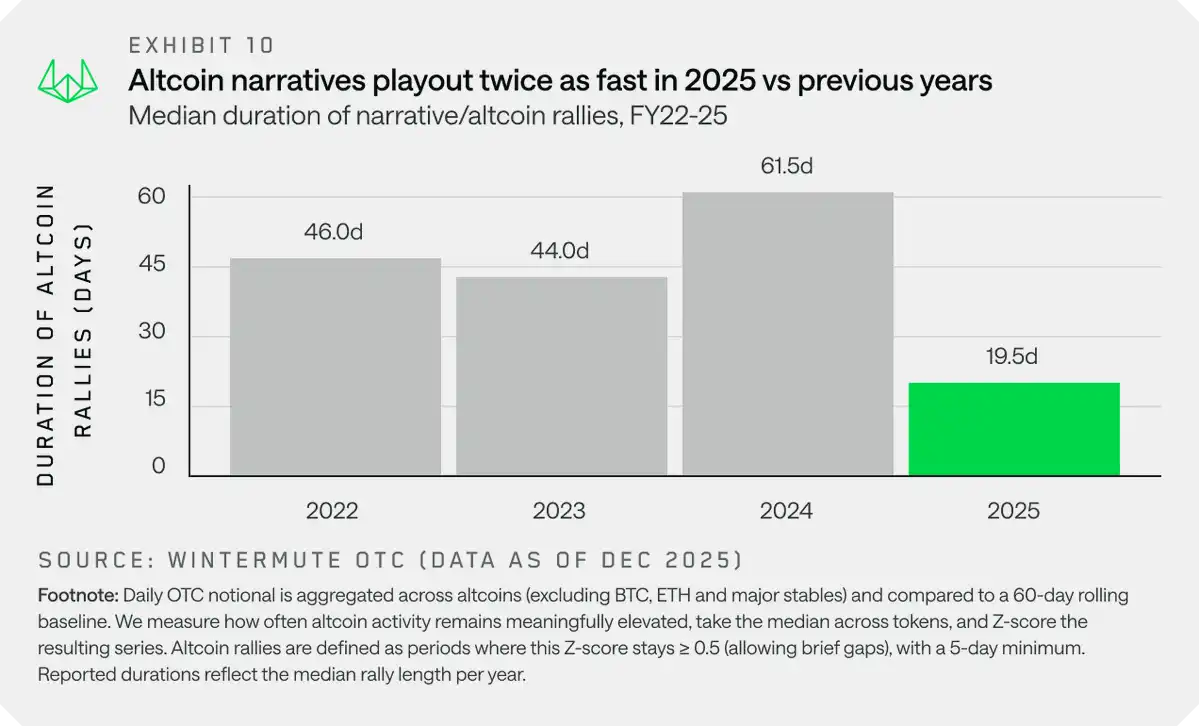
In 2025, the average rebound duration of altcoins was 20 days, much lower than 60 days in 2024.
A few mainstream assets absorbed the majority of the new inflows, while the broader market struggled.
Three Paths for 2026
If market participation beyond mainstream assets is to grow further, at least one of the following three things needs to happen:
1. Expanding Institutional Mandates
Currently, most of the new liquidity remains within institutional channels. A full market recovery requires institutional investors to expand the range of assets they can invest in.
Early signs are evident through Solana (SOL) and XRP's ETF applications.
2. The Wealth Effect from Mainstream Assets
A strong rebound in Bitcoin or Ethereum could trigger the wealth effect, spilling over to the broader market, similar to what happened in 2024.
The level of funds eventually flowing back into digital assets remains uncertain.
3. Rotation from Equities
Retail investors' focus may rotate back from the stock market (into areas like artificial intelligence AI, rare earths, quantum computing, etc.) to cryptocurrency, bringing in new inflows and stablecoin minting.
While this is the least probable scenario, it would significantly increase market participation.
The future outcome will depend on whether the above catalysts can effectively diffuse liquidity beyond a few large-cap assets, or if the trend of centralization will persist.
Understanding fund flows and the necessary structural changes will determine which strategies will succeed in 2026.
You may also like

IOSG Investment Insider: In 2026, How Should We Bet on Mainstream Assets?

「Money Printer」 PUMP.FUN Establishes Investment Arm, Can $3 Million Keep a Good Project?

After reviewing the recommendation algorithm of Platform X, this is the type of content you need to post to generate high traffic.

Trump's First Year in Office: Big Wins and Major Setbacks

If I were the founder of Kaito, how would InfoFi 2.0 survive?

Wintermute: The four-year cycle is dead, Crypto Breakthrough 2026, where to next?

How AI Trading Systems Perform in Live Markets: Inside the WEEX AI Hackathon Beta Test
WEEX launched a Beta Test to provide participants with a proving ground that closely mirrors real trading conditions, allowing strategy stability, execution capability, and risk control to be tested by the market in advance, while refining an AI trading infrastructure that can truly be deployed in live markets.

Paradex Rollback Roasted, HIP-3 Competition Heats Up, What's New in the Mainstream Ecosystem?
Why Can Coinbase Halt a CLARITY Act Vote with Just One Sentence?

31 Investments, 4 IPOs: Veteran VC Pantera's 2025 Report Card and 2026 Outlook

Here’s What Happened in Crypto Today
Key Takeaways Bitcoin experienced a significant price dip as Europe considered retaliatory trade measures against the U.S. The…

Key Market Intelligence on January 16th, how much did you miss?

Trump’s Tariff Policies Impact Cryptocurrency Market Dynamics
Key Takeaways Trump’s tariff policies lead to significant volatility in cryptocurrency markets, notably affecting Bitcoin prices. Bitcoin experienced…
Market Decline Impacts Meme Coins with WhiteWhale Dropping 75%
Key Takeaways The meme coin market has experienced a severe correction, notably impacting $WhiteWhale, which has decreased by…

Market Correction Causes Significant Drop in Meme Coin Values
Key Takeaways WhiteWhale’s value has decreased by 32.3% in the past 24 hours. The coin is currently trading…
Memecoins Fall While BlackWhale Rises in Cryptocurrency Market Shakeup
Key Takeaways The cryptocurrency market is experiencing a correction that has severely impacted memecoins. WhiteWhale’s value has declined…

Hyperliquid Introduces Direct ETH Deposits and Withdrawals for Enhanced Spot Trading
Key Takeaways Hyperliquid has officially rolled out direct Ethereum deposits and withdrawals, streamlining its spot trading capabilities. The…
Solana Whale Sells $1M WhiteWhale, Leading to Steep Price Drop
Key Takeaways The White Whale cryptocurrency has recently experienced a significant decline with a drop of -11.1% within…


 App
App