
- Buy Crypto
- Markets
- Futures
- Spot
- Copy Trade
 Earn
Earn- More
6 Years Ago, $220,000 Worth of Blood Money from Dongguan Flowed into a US Stock That Surged 38-Fold

Original Article Title: "Six Years Ago, the Blood Money of 220,000 People in Dongguan Flowed into a Stock That Soared 38 Times"
Original Article Author: Lin Wanwan, Beetling from Deepchain
On January 19, 2026, Martin Luther King Jr. Day, the U.S. stock market was closed.
A 35-page short-selling report quietly went online. The title was alarming enough: "The NASDAQ 'Laundromat' of a Southeast Asian Money Laundering Group."
The core conclusion of the report was only one sentence: "AppLovin is the ultimate milestone of 21st-century transnational financial crime."
The publisher, Capitalwatch, is an investigation firm focused on U.S.-listed Chinese stocks. Considering their previous financial fraud allegations against Nova Healthcare that ultimately led to delisting in 2025, investors had reason to take this report seriously.
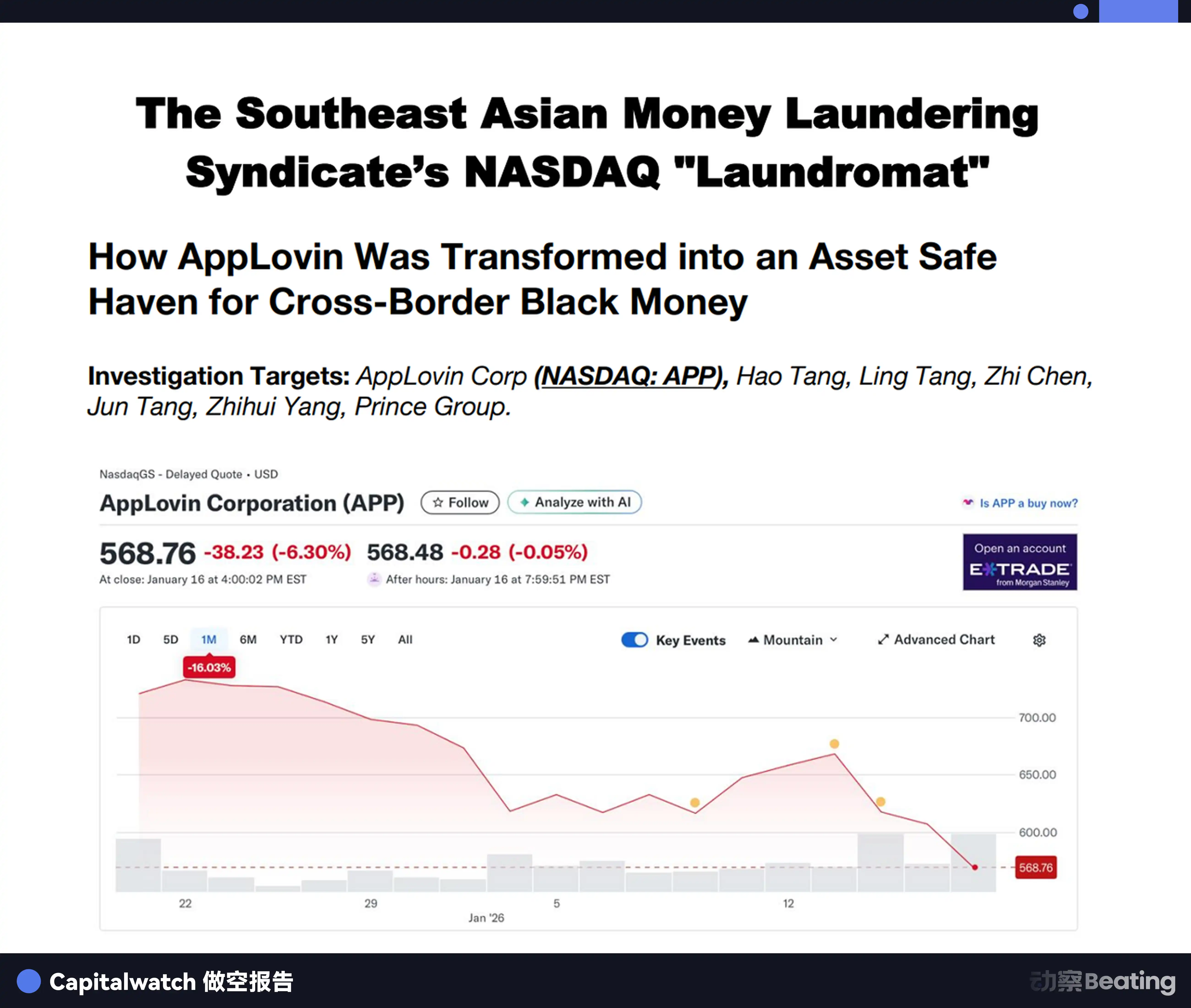
The next day at the opening, AppLovin's stock price fell by 4.8% in pre-market trading. In the previous three trading days, the stock had already cumulatively dropped by 15%.
Interestingly, three days later, the buying volume of AppLovin continued to increase, indicating that the bullish sentiment was still high.
This constituted a typical Gordian Knot: the short-selling institution said this was a "false empire," while retail investors said this was "another case of being set up."
Who is telling the truth?
Section One: Allegation: Advertising Equals Money Laundering
Capitalwatch's report focused on three key figures.
The first is Hao Tang, a major shareholder of AppLovin.
The report alleges that his wealth includes approximately $957 million in illicit proceeds related to the collapse of the Chinese P2P platform Ezubao and about $2.15 billion in funds related to gambling. Capitalwatch describes him as a "fugitive under judicial pursuit" and claims that "every dollar of his equity is steeped in the tears and blood of victims of illegal fundraising."
The second is Ling Tang, who holds about 20.49 million shares of AppLovin through Angel Pride Holdings, accounting for 7.7% of the company, making her one of the largest individual shareholders. The report alleges that she is the sister of Hao Tang and that her shareholding is "a key part of the Tang family's money laundering network."
The third key figure is Chen Zhi, the founder of the Cambodian Prince Group. In October 2025, the U.S. Department of Justice indicted him for operating forced labor camps and conducting "rug pull" cryptocurrency scams. On the same day, the DOJ announced the confiscation of around 15 billion US dollars' worth of Bitcoin, marking the largest asset seizure in U.S. history. On January 7, 2026, just 12 days before the report was released, Chen Zhi was arrested in Cambodia and extradited.
The report attempts to demonstrate that these three individuals constitute a money laundering network spanning China, Cambodia, and the United States. And it is AppLovin that serves as the ultimate "whitewashing" export for the illicit funds.
The core accusation revolves around a system called the "Mobius Loop": the criminal group pays advertising fees to AppLovin through intermediaries, converting dirty money into legitimate income.
The specific operation is as follows: the Prince Group sets up an advertiser account through a shell company, spending billions to purchase traffic. AppLovin recognizes this revenue as legitimate income in its financial reports, then settles it to overseas accounts controlled by the Prince Group in the form of "developer revenue share." At this point, the fraudulent funds have been transformed into legitimate remittances from a Nasdaq-listed company.
The report also accuses AppLovin's technology of being a criminal tool. The "silent install" mechanism is alleged to allow apps to be implanted on devices without user consent. The AXON algorithm is accused of aiding in the distribution of gambling and scam apps, pinpointing vulnerable users.
If these accusations are true, it would mean that a significant portion of AppLovin's astounding revenue growth in recent years is derived from an "unsustainable criminal group money laundering budget."
But the question remains: how remarkable is this company's performance really?
II. Myth: The AI Darling that Soared 700% in a Year
To understand the devastating impact of this short report, one must first grasp the capital market myth that AppLovin has created over the past three years.
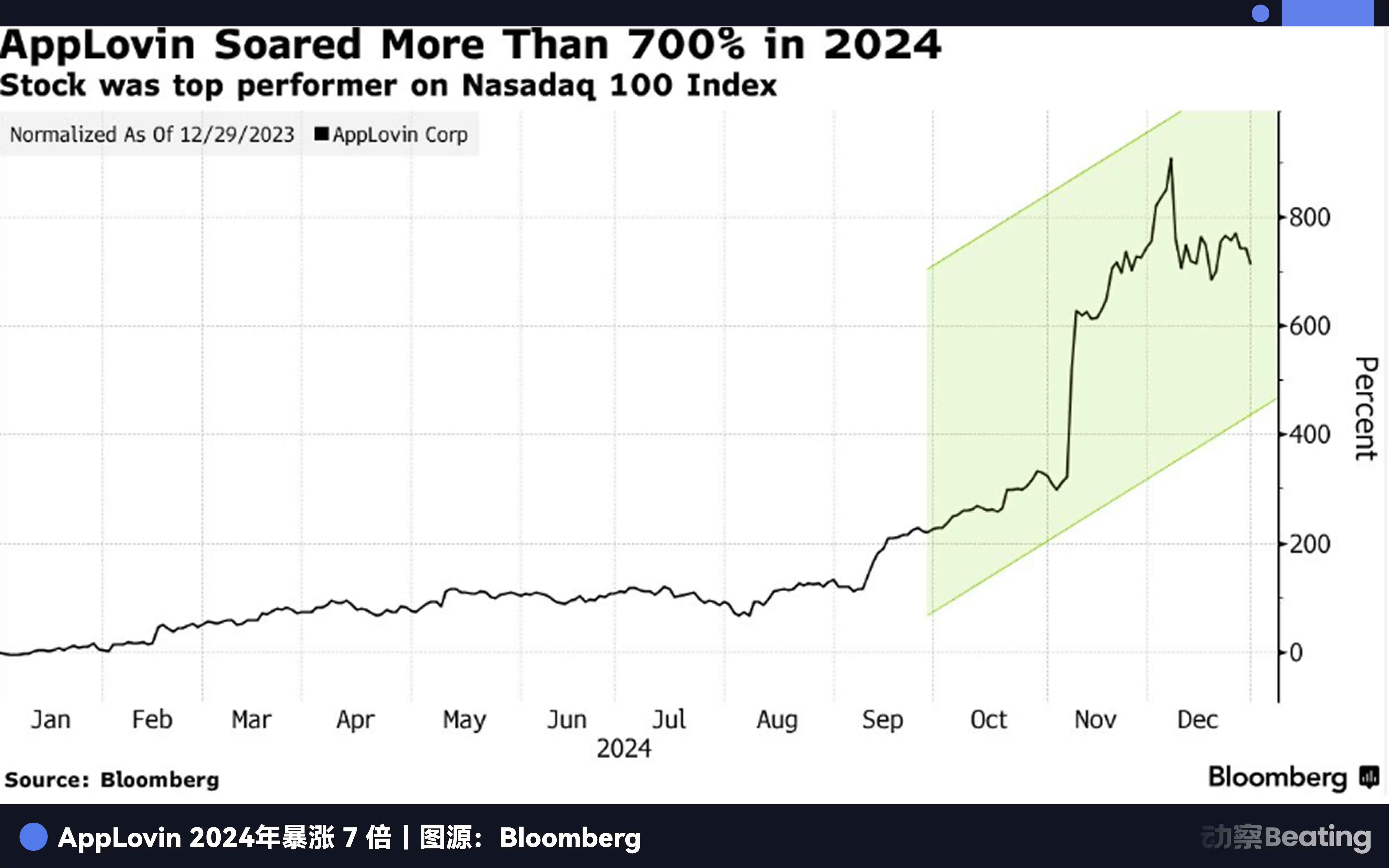
Throughout the whole year of 2025, AppLovin's stock price rose by 108%. In 2024, this figure was even more exaggerated, exceeding 700%, with a market capitalization surpassing $140 billion at one point.
From the lowest point in 2022, AppLovin has surged 38 times. During the same period, Nvidia increased by 10 times, Bitcoin by 6 times, and gold by less than 1 time.
This company was founded in Silicon Valley in 2011, originally a platform to help mobile developers acquire users and monetize. In 2018, it acquired the ad mediation platform MAX, and in 2020, it launched the AI-driven ad optimization engine AXON. It went public on the Nasdaq in 2021, but its performance in the first two years was mediocre.
The turning point came in 2023. After AXON was upgraded to version 2.0, its effectiveness skyrocketed. Just as Apple's iOS 14 privacy changes devastated the entire mobile ad industry, causing Meta to lose hundreds of billions in market value, AppLovin instead rose against the trend. Wall Street began to rediscover this company, labeling it as an "AI beneficiary."
By the third quarter of 2025, the company's revenue had increased by 68% year-on-year to $1.4 billion, marking the second-highest quarterly growth rate in the past four years; net profit grew by 92% to $836 million.
In July 2024, the company sold the game studio Tripledot Studios for $800 million, completing its transformation into a pure ad tech company. A month later, it increased its stock buyback plan by $3.2 billion and joined the S&P 500 Index.
From an unknown mobile ad company to an S&P 500 component and a darling of AI concepts, AppLovin achieved all this in less than two years.
However, doubts have never ceased. In February 2025, both Fuzzy Panda and Culper Research announced short positions, accusing AppLovin of "systematic abuse of app permissions." In March 2025, Muddy Waters joined the battle, claiming that 52% of e-commerce conversions came from redirected users, with an incremental value of only 25%-35%.
With each short attack, the stock price briefly dipped, only to continue rising.
Until this report from Capitalwatch. It no longer dwelled on technical details or financial metrics but instead pointed directly to a more deadly question: where does this company's money come from?
To answer this question, we need to turn the clock back seven years, back to Dongguan, China.
III. Source: The Collapse of Tuan Dai and the "Elder Sister's" 5.3 Million
March 27, 2019, Dongguan, China.
Tuan Dai's founder Tang Jun and co-founder Zhang Lin surrendered to the police. This company, once a top P2P platform in China, collapsed overnight.
Tuandai Network was established in 2012 and, at its peak, facilitated over 130.7 billion RMB in online lending business. Tang Jun himself is a star entrepreneur, serving as a mentor at a startup incubator in Dongguan, often lecturing young people on how to start and fund a company. A company under his control, Derivative Technology, went public on the Shenzhen Stock Exchange, with a market value that once exceeded 20 billion RMB.

Then, in the summer of 2018, the Chinese P2P industry experienced a "massive thunderstorm" event. Tightened regulations, dried-up liquidity, and widespread panic withdrawals led to the collapse of hundreds of platforms within a few months.
Law enforcement swiftly took action, arresting 41 suspects, freezing 3.1 billion RMB in bank accounts, 35 properties, an airplane, and 40 cars. Investigations revealed that before the crackdown, Tang Jun and Zhang Lin attempted to transfer and conceal assets, and later recovered over 880 million RMB of hidden funds.
At the time of the collapse, Tuandai Network had around 220,000 active lenders, involving a total loan amount of 14.5 billion RMB. Most of these individuals were ordinary families lured by high-interest rates, seeing their life savings disappear overnight.
In 2022, the court ruled: Tang Jun was sentenced to 20 years in prison and fined 51.5 million RMB.
The case was closed, but where did the money go? There remains a significant gap between the recovered assets and investor losses.
A report by Capitalwatch claims that part of the answer lies in a extradition hearing held in Bordeaux, France, in 2021.
In that year, a man named Hao Tang flew into France from Iceland on a private jet and was arrested at the airport. An extradition request was subsequently made. However, the Bordeaux Court of Appeal ultimately rejected the extradition under the "political exception" clause, deeming that although the extradition request ostensibly based on money laundering charges, it actually served a political purpose, with Hao Tang's defense team arguing that he was involved in a high-level political case.
Hao Tang regained his freedom. However, the court ruling unexpectedly revealed the money laundering evidence chain.
The judgment showed that during the critical window between the collapse of Tuandai Network, from February 2018 to March 2019, Hao Tang used a network of shell companies to help Tang Jun transfer 632.89 million RMB of illicit funds. Money laundering techniques included fund placements disguised as "aircraft hosting fees," 27 labyrinthine cross-border transfers, and using underground banks for "bidirectional trading" to evade foreign exchange controls.
The court did not deny the facts of these fund transfers.
The judgment also revealed a key detail: a judicial audit found approximately 5.3 million RMB transferred to a company account controlled by Hao Tang's "sister."
This clue later led Capitalwatch to the list of shareholders of AppLovin.
The report, through cross-referencing SEC filings, found that Ling Tang holds a 7.7% stake in AppLovin through Angel Pride Holdings. SEC filings show her contact address on Wing Hong Street, Cheung Sha Wan, Kowloon, Hong Kong, which is in the same neighborhood as the address declared by Hao Tang. In early business registrations, the office addresses of the two individuals had a physical overlap.
The report's conclusion is: "There is sufficient reason to conclude that Ling Tang is the sister of Hao Tang, and the multi-billion-dollar stake held by Angel Pride Holdings is a key part of the Tang family's money laundering network."
However, Ezubao was only the "original accumulation" of funds. To complete the entire money laundering cycle, another key node is needed.
This node is in Phnom Penh, Cambodia.
IV. Undercurrent: The Industrialization of Ponzi Schemes and a $15 Billion Seizure
Chen Zhi, a mysterious tycoon born in Fujian and later naturalized in Cambodia. Over the past decade, he has turned Prince Group into Cambodia's largest business empire, with operations spanning banking, aviation, and real estate.
However, according to the U.S. Department of Justice's court documents, beneath this shining business landscape lies another world. Since 2015, Chen Zhi and his executive team "secretly developed Prince Group into one of Asia's largest transnational criminal organizations."
The indictment paints a chilling picture: Prince Group operated multiple forced labor scam sites in Cambodia, with "large dormitories enclosed by high walls and barbed wire, operating like violent forced labor camps."
The labor force inside the camps was mostly foreign nationals lured in by high-paying jobs; once inside, their passports were confiscated, and under armed guard surveillance, they were forced to work over a dozen hours a day engaging in Ponzi scheme scams. Chen Zhi himself directly participated in violence against camp residents and possessed photos depicting beatings and other torture methods.
By 2018, Prince Group was making over $30 million a day from such fraudulent activities.
In October 2025, the U.S. Department of Justice announced the seizure of approximately $15 billion in Bitcoin, the largest asset seizure action in U.S. history. On the same day, the Treasury Department classified Prince Group as a transnational criminal organization and imposed sanctions on Chen Zhi and over 100 related individuals and entities.
On January 7, 2026, Chen Zhi was arrested in Cambodia and later deported for investigation. The Cambodian Ministry of Interior confirmed that his Cambodian citizenship had been revoked.
A report by Capitalwatch attempts to establish the connection between Hao Tang and Chen Zhi. The report notes that at the end of 2018, on the eve of the Ezubao crisis, a change in control occurred at the Hong Kong-listed company Geotech Holdings, where the sole shareholder of the acquiring BVI company was Chen Zhi. The report suggests that the overlap in operations during this timeframe demonstrates the collaborative relationship between the two in a money laundering network.
The key link connecting the two individuals with AppLovin is the Cambodian super-app WOWNOW.
In May 2022, Prince Bank entered into a payment partnership with WOWNOW, fully integrating the underlying payment system. WOWNOW claims to serve over 800,000 users and is connected to over 13,000 merchants.
However, in a country with a population of only 16 million, why would such a local lifestyle app need to allocate a massive budget on a U.S. advertising platform?
The report's answer is: these advertising expenditures are essentially a money laundering conduit.
Section Five: Rashomon: Who Is Telling the Truth?
The accusations are serious, but AppLovin is not without a defense.
CEO Adam Foroughi has initiated an independent investigation into the activities of the short-selling institutions, insisting that these accusations are "false and misleading" and are driven by "individual economic interests for short-selling gains."
There is also another rational question: "Anything is possible. But if I were to assume that I wanted to launder a large sum of money, I probably wouldn't attempt to do so through a U.S.-registered, Nasdaq-listed entity that is subject to more regulatory scrutiny than a typical global company."
This is a thought-provoking counterpoint. Laundering significant sums of money on a Nasdaq-listed company, subject to SEC oversight, Big Four audits, institutional investor due diligence, and short-selling institution targeting, in such a transparent environment, requires not only courage but also an extremely sophisticated system.
Regarding the ruling of the French court, there are different interpretations. The court's refusal to extradite Hao Tang was based on a "political exception" clause, rather than a denial of money laundering facts. Does this truly prove his innocence, or does it merely indicate that he successfully exploited a legal loophole?
As of January 21, 2026, several key questions remain unanswered.
What is WOWNOW's advertising spending on AppLovin? This is the core verifiable point of the entire "advertising laundering" allegation. The SEC has been investigating AppLovin's data collection practices since October 2025. Does this investigation intersect with Capitalwatch's allegations? If Chen Zhi, after being repatriated, confesses to financial transactions with Hao Tang, will it trigger further scrutiny of AppLovin's shareholder structure by U.S. regulatory agencies?
Currently, AppLovin's short interest is around 5%, indicating that investors remain cautious. The company will announce its fourth-quarter performance in February.
Capitalwatch's ultimate conclusion in the report is: this is an "empire built on quicksand," with its foundation "burying the tears of victims of Ezubao and the sweat of Southeast Asian factory workers."
Time will provide the answer to whether this assessment is correct. However, the questions raised in the report about shareholder background, funding sources, and compliance review are indeed worthy of serious attention from the market and regulatory agencies.
The capital market is never short of myths. Every few years, a company always rises at an astonishing speed, with its stock price skyrocketing, valuation surpassing imagination, and analysts vying to endorse it with the most magnificent terms. In this process, skeptics are often seen as laggards who "do not understand the new paradigm" until one day the tide recedes.
Will AppLovin be the next myth to be debunked, or will it be another occasion where the short-selling institutions retreat in defeat? No one knows. But one thing is certain: in a market where everyone is shouting "AI revolution," there are still those willing to ask, "Where does the money come from?" This, in itself, is a rare form of sobriety.
And for every investor, perhaps the most important lesson is not to take sides but to learn to remain vigilant amidst the frenzy. When a stock rises 700% in a year, when everyone is talking about how advanced its technology is and how miraculous its algorithms are, maybe a few more of the most basic questions should be asked: Who are the major shareholders of this company? Where is their money coming from? Is this money clean?
After all, in the world of capital, the most expensive cost has never been missing out on a ten-bagger but forgetting that across the table in the frenzy, the dealer always sits.
You may also like

Bitcoin 30-Day Realized Losses and Gold Reaching Record Highs
Key Takeaways Bitcoin holders have experienced a rare stretch of 30-day realized losses for the first time since…

Central banks vs Bitcoin: Who truly earns the public’s trust?
Key Takeaways The debate over trust between central banks and Bitcoin continues, receiving global attention at the World…

Kaspa is Expected to Decline to $0.032939 by January 26, 2026
Key Takeaways Kaspa’s price is projected to drop 23.07% within the next five days. Current market sentiment for…

Bitcoin Fills New Year CME Gap with Sub-$88K BTC Price Drop
Key Takeaways Bitcoin’s price has closed a significant CME gap that appeared at the beginning of the year,…

Bitcoin Exhibits Resilience at $92K Amidst Economic Fluctuations: Is the Downturn Over?
Key Takeaways: Bitcoin remains robust at $92,000, though ETF outflows and geopolitical concerns loom. BTC futures premium close…

Crypto Mortgages in the US Tackle Valuation Risks and Regulatory Challenges
Key Takeaways The adoption of crypto mortgages is facing challenges around valuation risks and regulatory uncertainties in the…

Can Bitcoin Regain $90K? Bulls at Risk as Long-Term Holders Increase Selling
Key Takeaways: Bitcoin has declined below the $90,000 mark amid increased selling pressure from whales and long-term holders.…

Michael Saylor’s Strategy Surpasses 700,000 Bitcoin with a New $2.1B Acquisition
Key Takeaways: Michael Saylor’s Strategy has significantly increased its Bitcoin holdings to an impressive 709,715 BTC after purchasing…
Bitcoin Pursues $90K: Trump to Fast-Track Crypto Legislation
Key Takeaways Bitcoin is gaining momentum as President Trump indicates imminent crypto-friendly legislation. Trump’s World Economic Forum speech…

What Happened in Crypto Today: Key Updates and Insights
Key Takeaways A crucial crypto bill’s progress is delayed as the Senate pivots its focus to broader affordability…

Crypto’s Decentralization Dream Falters at Interoperability
Key Takeaways The promise of decentralization in the crypto industry is hindered by centralized intermediaries managing interoperability between…

Midnight Price Prediction – NIGHT Price Anticipated to Decline to $ 0.047821 By January 25, 2026
Key Takeaways Midnight’s price is anticipated to decrease by 23.24% in the following five days, with a prediction…

Arbitrage Era Ends as Wall Street Exits Bitcoin Basis Trading
Vanguard Group's $700 Million Entry, MSTR Bottom Reached?
6 Years Ago, $220,000 Worth of Blood Money from Dongguan Flowed into a US Stock That Surged 38-Fold

AI News Today: Can AI Make Blockchain Systems More Reliable in Live Crypto Markets?
Learn how AI is used in blockchain systems to detect risks, improve reliability, and support secure crypto trading in live crypto market environments.

Demystifying the NYSE Tokenized Securities Platform: Why Enable 24/7 Trading

After opting for a refund following a 122x oversubscription, what new trick is FIGHT playing?
Bitcoin 30-Day Realized Losses and Gold Reaching Record Highs
Key Takeaways Bitcoin holders have experienced a rare stretch of 30-day realized losses for the first time since…
Central banks vs Bitcoin: Who truly earns the public’s trust?
Key Takeaways The debate over trust between central banks and Bitcoin continues, receiving global attention at the World…
Kaspa is Expected to Decline to $0.032939 by January 26, 2026
Key Takeaways Kaspa’s price is projected to drop 23.07% within the next five days. Current market sentiment for…
Bitcoin Fills New Year CME Gap with Sub-$88K BTC Price Drop
Key Takeaways Bitcoin’s price has closed a significant CME gap that appeared at the beginning of the year,…
Bitcoin Exhibits Resilience at $92K Amidst Economic Fluctuations: Is the Downturn Over?
Key Takeaways: Bitcoin remains robust at $92,000, though ETF outflows and geopolitical concerns loom. BTC futures premium close…
Crypto Mortgages in the US Tackle Valuation Risks and Regulatory Challenges
Key Takeaways The adoption of crypto mortgages is facing challenges around valuation risks and regulatory uncertainties in the…


 App
App