
- Buy Crypto
- Markets
- Futures
- Spot
- Copy Trade
 Earn
Earn- More
$2 Billion "Prediction Game": Is the Forecasting Market Approaching a "Turning Point" Moment?

Original Article Title: "Bitget Wallet Research: The $20 Billion "Probability Game": Is the Prediction Market Welcoming a "Singularity" Moment?"
Original Source: Bitget Wallet Research
Introduction
From the whimsical chatter of "Will Zelensky Wear a Suit" to the global focus on the U.S. election and Nobel Prize winners, the prediction market always seems to periodically "catch fire." However, since 2025Q3, a true storm seems to be brewing:
In early September, industry giant Polymarket received regulatory approval from the U.S. CFTC to re-enter the U.S. market after three years;
In early October, NYSE parent company ICE proposed to invest up to $20 billion in Polymarket;
In mid-October, the weekly trading volume of the prediction market hit a historic high of $20 billion.
With a wave of capital, regulatory opening, and market frenzy coinciding, there are rumors of the listing of the Polymarket token—where did this surge come from? Is it just another short-lived hype, or is it a "value singularity" in a brand-new financial track? Bitget Wallet Research will take you deep into this article to analyze the underlying logic and core value of the prediction market and make an initial judgment on its core dilemmas and development direction.
I. From "Dispersed Knowledge" to "Duopoly": The Evolutionary Path of the Prediction Market
The prediction market is not unique to the crypto world; its theoretical foundation can even be traced back to 1945. Economist Hayek proposed in his classic discourse:
Dispersed, local "dispersed knowledge" can be effectively aggregated by the market through the price mechanism. This idea is considered to have laid the theoretical foundation of the prediction market.
In 1988, the University of Iowa in the U.S. initiated the first academic prediction platform—the Iowa Electronic Markets (IEM), which allowed users to trade futures contracts on real-world events (such as presidential elections). In the following decades, extensive research generally confirmed that a well-designed prediction market often outperforms traditional opinion polls in accuracy.
However, with the emergence of blockchain technology, this niche tool found a new scalable landing ground. The transparency, decentralization, and global access characteristics of blockchain have provided the prediction market with nearly perfect infrastructure: through smart contracts for automatic settlement, it can break through the access barriers of traditional finance, allowing anyone globally to participate, thereby greatly expanding the breadth and depth of "aggregated information." The prediction market has gradually transformed from a niche gambling tool to a powerful on-chain financial sector, beginning to integrate deeply with the "crypto market."
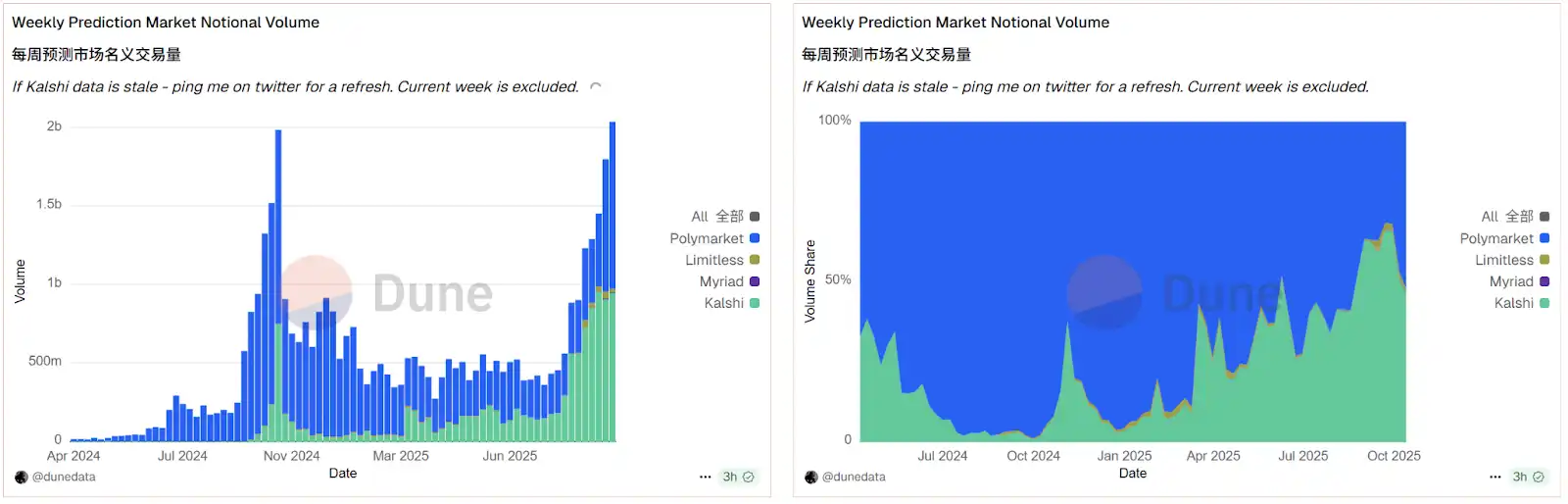
Data Source: Dune
Data from the Dune platform vividly confirms this trend. On-chain data shows that the current crypto prediction market has exhibited a highly monopolistic "duopoly" pattern: Polymarket and Kalshi, the two giants, have captured over 95% of the market share. Stimulated by both capital and regulatory tailwinds, this track is being activated as a whole. In mid-October, the weekly trading volume of the prediction market surpassed $2 billion, surpassing the previous pre-2024 U.S. election historical peak. In this round of explosive growth, Polymarket, with its key regulatory breakthroughs and potential token expectations, temporarily holds a slight advantage in the fierce competition with Kalshi, further solidifying its leading position.
II. "Event Derivatives": Beyond Gambling, Why Is Wall Street Betting?
To understand why ICE made a heavy investment in Polymarket, one must strip away the "gambling" facade of the prediction market and see the core of its "financial instrument." The essence of the prediction market is an alternative type of trading contract, belonging to a category of "Event Derivatives."
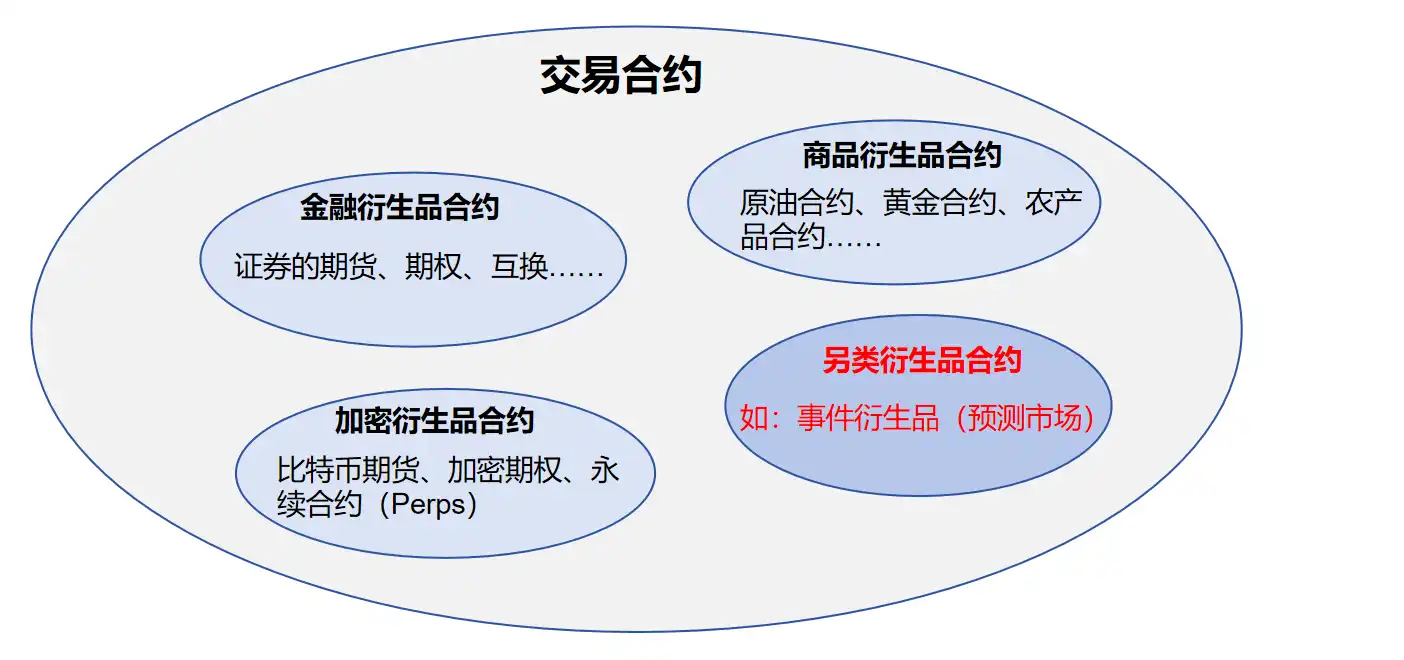
This is different from the familiar "price derivatives" such as futures and options. The underlying asset of the latter is the future price of assets (such as oil or stocks), while the former's underlying asset is the future outcome of a specific "event" (such as an election or climate). Therefore, the price of its contract represents the market's collective consensus on the "probability of event occurrence," not the asset's value.
Under the blessing of Web3, this difference is further amplified. Traditional derivatives rely on complex mathematical models like Black-Scholes for pricing and clear through brokers and centralized exchanges; whereas on-chain prediction markets execute automatically through smart contracts, rely on oracles for settlement, and have pricing (such as AMM algorithms) and pools completely transparent on-chain. This significantly lowers the entry barrier but also brings new risks (like oracle manipulation and contract vulnerabilities), contrasting sharply with traditional finance's counterparty and leverage risks.
Prediction Market vs Traditional Financial Derivatives Comparison Table

This unique mechanism is at the core of its attraction to mainstream financial institutions. It provides a triple-core value that traditional markets cannot reach, which is also the key focus of giants like ICE:
Firstly, it is an advanced "information aggregator" that reshapes the landscape of information equity. In today's world where AI-generated content, fake news, and information silos abound, the "truth" has become expensive and hard to discern. The prediction market provides a radical solution to this: truth is not defined by authorities or media but is "auctioned" by a decentralized, economically incentivized market. It responds to the growing distrust in traditional sources of information, especially among the younger generation, providing an alternative source of information that implements a "money-voting" system and is more honest. More importantly, this mechanism goes beyond traditional "information aggregation" itself, achieving real-time pricing of "truth," creating a highly valuable "real-time sentiment indicator," and ultimately achieving information equity across all dimensions.
Secondly, it commodifies the "information gap" itself, opening up a whole new investment track. In traditional finance, investment targets are ownership certificates such as stocks and bonds. The prediction market has created a new tradable asset—"event contracts." This essentially allows investors to directly transform their beliefs about the future or their information advantage into tradable financial instruments. For professional information analysts, quantitative funds, or even AI models, this represents an unprecedented dimension of profit. They no longer need to indirectly express their views through complex secondary market operations (such as longing/shorting related company stocks) but can directly "invest" in the event itself. The significant trading potential of this new asset class is a key interest point for exchange operators like ICE.
Lastly, it has created a "hedge everything" risk management market, greatly expanding the boundaries of finance. Traditional financial tools struggle to hedge the uncertainty of an "event" itself. For example, how can a shipping company hedge the geopolitical risk of "whether the canal will be closed"? How can a farmer hedge the climate risk of "whether the rainfall will be less than X millimeters in the next 90 days"? The prediction market provides a perfect solution for this. It allows participants from these real-world entities to transform abstract "event risks" into standardized tradable contracts for precise risk hedging. This is akin to opening up a brand-new "insurance" market for the real economy, providing a new entry point for finance to empower the real economy, with potential far beyond imagination.
errorBut in any case, a new era combining information, finance, and technology has begun. As top-tier traditional capital intensifies its focus on this racetrack, the leverage it will exert will far exceed a weekly trading volume of 20 billion US dollars. This may well be a true "singularity" moment — it heralds a new asset class (the pricing power of "belief" and "future") being embraced by the mainstream financial system.
This article is contributed content and does not represent the views of BlockBeats.
You may also like

By seizing the first five seconds of Gold Dog, "Dry Sitting P Junior" earns $430,000 in 30 days.

DAU of 8? The Data Truth in the Solana vs. Starknet Public Opinion Battle

ThunderChain Resumes Legal Battle as Former CEO Chen Lei Accused of Embezzlement for Cryptocurrency Speculation - What Happened Back Then?

Key Market Intelligence for January 15th, how much did you miss out on?

BNB Chain 2025 Year-End Review: Self-Traversal, Trade Everything

$200K Annual Salary Hiring, Predicting Market Will See Wall Street Players

Matrixdock releases latest semi-annual physical gold audit report, strengthening physical gold transparency practices

Former Star Public Blockchain Berachain in Crisis: Price Collapse, Layoffs, Developer Exodus

Senate Committee Delays Crypto Bill Due to Coinbase’s Objections
Key Takeaways The Senate Banking Committee has postponed its planned markup of a major crypto market structure bill…

Eric Adams Denies “Rug Pull” Allegations Linked to NYC Token Despite Significant Losses
Key Takeaways: Eric Adams firmly denies allegations implying that money was moved out of the NYC Token. Market…

XRP Price Action: Crypto Bill Could Grant XRP the Same Legal Designation as Bitcoin
Key Takeaways A new legislative draft in the United States might classify XRP alongside Bitcoin (BTC) and Ethereum…
Coinbase CEO Raises Red Flags Regarding US Crypto Bill
Key Takeaways Coinbase CEO Brian Armstrong voices opposition to the proposed Senate crypto bill, citing significant concerns. The…

Asia Market Open: Bitcoin Nears $96K Amid Mixed Asian Stocks and Wall Street Slump
Key Takeaways Bitcoin’s price edges closer to $96,000 amid mixed signals from Asian stock markets and a recent…
Ethereum Price Prediction: SharpLink Activates Multi-Billion ETH Strategy – How Soon Might ETH Achieve a New All-Time High?
Key Takeaways SharpLink has strategically deployed $170 million in Ethereum on the Linea network, showcasing a productive use…

Transforming the Cryptocurrency Landscape: A 2026 Outlook
Key Takeaways Cryptocurrency systems have seen expansive growth and technological innovation. The introduction of new regulations has reshaped…
Pi Coin Price Prediction: Mainnet Tokens Just Unlocked – What Does This Mean for Holders?
Key Takeaways Daily token unlocks are increasing the supply of Pi Coin, affecting its short-term price stability. Pi…

Best Crypto to Buy Now January 14 – XRP, PEPE, Internet Computer
Key Takeaways The current crypto landscape is at a pivotal junction with potential changes in U.S. regulations offering…
New ChatGPT Forecasts for XRP, Ethereum, and Solana by 2026
Key Takeaways ChatGPT predicts a potential bull market for XRP, Ethereum, and Solana by 2026, supported by the…


 App
App