
- Buy Crypto
- Markets
- Futures
- Spot
- Copy Trade
 Earn
Earn- More
ThunderChain Resumes Legal Battle as Former CEO Chen Lei Accused of Embezzlement for Cryptocurrency Speculation - What Happened Back Then?

Editor's Note: This article was first published on October 10, 2020. At that time, Xunlei was in a public dispute with its former CEO, Chen Lei, accusing him of embezzling millions of RMB from the company to speculate on cryptocurrency and fleeing overseas.
Several years have passed, and the aftermath of this internal conflict has resurfaced. Today, Xunlei announced the restart of lawsuits against Chen Lei and his core team, accusing them of harming the company's interests, with the claim amount now increased to 200 million RMB. Looking back at the melodramatic events surrounding "contract fabrication, improper benefits transfer, and elopement with a lover" in 2020, there are still many details worth revisiting. The following is the original content:
On the last day of the National Day holiday, the U.S.-listed company Xunlei released a statement accusing its former CEO, Chen Lei, of embezzling millions of RMB from the company for cryptocurrency speculation, arranging for relatives to fabricate contracts internally to embezzle company funds. The Shenzhen Public Security Bureau has launched a criminal investigation against Chen Lei and others suspected of embezzlement.
Meanwhile, Chen Lei, who claimed his innocence, had left the country with his lover when the "Xunlei power struggle" began in April this year.
The rapid development of online streaming layered over the internet has almost pushed Xunlei, a company, out of the view of internet users. Still, it cannot be denied that Xunlei is indeed a product of its time.
From a downloading software used by 100 million people daily to a CEO who was ousted to make the company soar, from a U.S.-listed company to being involved in illegal blockchain fundraising, what has Xunlei been through in these 20 years?
First in the Download Business Field
At the end of the last century, few households had computers connected to the internet. It was the era of dial-up internet, and the computer's download function was very limited. Downloads would often be interrupted by a phone call or network fluctuation, causing the downloaded files to be lost.
There was a strong need for a technology that could resume downloading files from where it was interrupted, known as a download manager with the feature of resuming broken downloads. This led to the creation of NetAnts in 1998, FlashGet in 2001, and Xunlei founded by Zou Shenglong in 2003.
Interestingly, these three download software were all developed by Chinese developers. FlashGet, based on NetAnts, added multi-threading and a Chinese interface, making it more popular among Chinese users.
However, just as FlashGet was gaining momentum in the Chinese market and Xunlei was still a small player, Blizzard's "World of Warcraft" started its public beta testing.
Speaking of "World of Warcraft," this game has truly influenced many people. Ethereum's founder, Vitalik Buterin, was inspired by "World of Warcraft" to focus on decentralization. Xunlei also benefited greatly from this game: because "World of Warcraft" was so fun, Hou Yantang, the developer of FlashGet, stopped updating the software for more than a year just to play the game.
For Thunder, founded in 2002, this was truly a heaven-sent opportunity.

Thunder brought all the functions of Internet Express, added a large number of new features, allowing even niche resources to be downloaded at high speed. In an instant, Thunder was installed on the computers of Chinese netizens. Next, Thunder further upgraded the anti-deadlink function to P2SP, incorporating all the resources on Thunder users' computers and resources not belonging to Thunder on servers into Thunder's download network, accelerating downloads through resources from multiple sources.
Although this strategy is debatable, product experience is key, and at that time, Thunder's download speed was unrivaled.
Thus, relying on the "skillful use" of Chinese users' computer resources and network bandwidth, Thunder successfully became China's top download software. In Thunder's initial public offering prospectus, Thunder had a 73% market share in 2008. Everyone knew Thunder, and no one could live without it. Thunder was also favored in the capital market, receiving support of over $30 million.
In theory, Thunder should have been able to become a company like Tencent, earning money effortlessly with traffic support. However, the fact is that this company, apart from doing well in the download business, performed miserably in all other businesses.
Disastrous Business Ventures
Starting in 2007, Thunder ventured into online video streaming with Thunder KanKan, even doing less than Youku, becoming just a section player. In 2008, it acquired Shiny Stone Magic Hand to enter photo processing, and the same year, Meitu Xiuxiu was launched. Today, the already publicly listed Meitu Xiuxiu is well known, while Shiny Stone Magic Hand was quietly closed in 2014.
According to Nan Qidao's description in "The Power Game Behind Thunder's Palace Drama," during the period when Zou Shenglong was in charge of Thunder, whatever this company did, it failed, resulting in the death of dozens of products. All functions were launched at the best time but died due to various institutional and management constraints of this company.
After raising funds for so many years, almost ready to go public, Thunder faced a "short-selling wave." At the end of 2010, capital institutions began short-selling Chinese concept stocks, and many Chinese companies with financial fraud saw their stocks become worthless, with 42 Chinese concept stocks being suspended and delisted within a year. The US capital market began to question Chinese companies listed in the US.
Against this backdrop, in June 2011, Thunder submitted its application for a US stock market listing.
Not only was the IPO timing unfavorable, but the prospectus also revealed that the company was carrying a $21.8 million copyright lawsuit. This was the fatal issue Thunder could not evade, as the Motion Picture Association previously publicly stated that Thunder was helping netizens download pirated movies, causing harm to movie copyrights.
With external challenges exacerbating internal issues, Thunder's IPO journey in 2011 failed. Despite Thunder lowering the offering price multiple times, reducing the financing scale, it still did not attract the attention of the capital markets, leading Thunder to halt its IPO.
Looking back at that time, it was also when the mobile internet began to develop, China's internet started to shift from home computers to smartphones, and Thunder, which started with PC downloads, found it increasingly difficult.
Xiaomi's Rescue
In 2014, the mobile internet rising star Lei Jun invested $310 million in Thunder (with Xiaomi contributing $200 million and Kingsoft $90 million), becoming Thunder's largest shareholder. Xiaomi held 27.95% of the shares, Kingsoft held 11.19%, Lei Jun held a total of 39% of Thunder's shares, and founder Zhou Shenglong's shares fell to only 9.5%, losing control of the company.
In Xiaomi's view, Thunder was a cloud service provider to improve Xiaomi's ecosystem's video playback, download, and other functions, perhaps to squeeze out the last bit of value from desktop computers. With Lei Jun's help, in June 2014, Thunder finally went public on the NASDAQ in the United States. Everyone thought that Thunder might have emerged from its low point and started to turn the corner, but Thunder took action that defied everyone's expectations.
During the years from 2014 to 2017, Thunder remained silent like a dead chicken. Storm Video was making VR glasses next door, LeTV was doing mobile phones, TVs, and cars, Baidu was doing artificial intelligence, Didi had already dominated the market, but Thunder did not chase any hot trends.
However, after three years of silence, in October 2017, Thunder's stock experienced an unprecedented large-scale surge, becoming a star company in the entire internet world. Did their business make a qualitative leap? Not really. The reason was simple. While Bitcoin was surging towards its all-time high, Thunder followed the trend and directly issued its own cryptocurrency.
Thunder Issues Cryptocurrency
As early as the beginning of 2014, Zhou Shenglong personally led a new business called the "Crystal Plan," which sold Thunder users' idle bandwidth and storage space to internet companies in need, such as video websites, music websites, download websites, etc., forming a CDN network with users' computers. The prices were very cheap and highly competitive. They even launched the Thunder Router product as hardware support.
However, during Zhou Shenglong's leadership at Thunder, the product experience was not ideal and was gradually shelved, to the extent that it did not even appear in Thunder's own introductions.
At the end of 2014, Tencent's cloud business leader, Chen Lei, was persuaded by Lei Jun to join Xunlei and became Xunlei's CTO, taking over the cloud service business and Xunlei's subsidiary, Xunlei Technologies, established in September 2013.

Chen Lei Image Source: Internet
From then on, Xunlei's main focus shifted to Xunlei Technologies, and Xunlei Group's download business no longer had much new content.
After taking over Xunlei Technologies, Chen Lei began to revitalize the Crystal Plan by creating the "Earning Treasure," which focused on earning money using idle bandwidth and hard drive space. Starting in April 2015, they began selling the Earning Treasure boxes and actually started selling this CDN service. A year later, they began providing cheap CDN services to live streaming websites. Many live platforms are still using it, such as Bilibili Live. By August 2016, the Earning Treasure users exceeded 4 million.
4 million may seem small today, but imagine this: 4 million households chose to connect their home network cables to the Earning Treasure, using their own hard drive and bandwidth to accelerate the national video websites. This was equivalent to adding 4 million servers nationwide, which was definitely a pioneering move at that time.
However, greatness comes with sacrifices. Initially, to encourage users to buy the Earning Treasure and participate in this network, Xunlei adopted a cash repurchase model of users' bandwidth and storage. The more Earning Treasure sold, the more Xunlei lost, which was not something a company hoped to see.
In 2017, there was a trend of hype around virtual currencies in China. The price of Bitcoin doubled crazily from $1,000, giving Chen Lei a new idea. In June of the same year, Chen Lei was appointed as the CEO of Xunlei Group. One month later, the Earning Treasure was rebranded as "Kuaike Cloud" and issued the Kuaike Coin virtual currency.
Once the coin was issued, things took a different turn.
Xunlei transformed the cash subsidy model into a model where users received virtual currency based on the amount of shared resources. Then, the 4 million Earning Treasure players became Kuaike Cloud miners, with some mining dozens to hundreds of Kuaike Coins a day, while others earned a few coins. The price of Kuaike Coin on exchanges also surged from 1 cent to over ten yuan, allowing some to break even in a day.
Driven by profit, there was a frenzy for Kuaik Cloud machines across the network. The original price of 399 yuan for Kuaik Cloud was resold for over 2,000 or 3,000 yuan on the second-hand market, turning buyers into winners. That year, Xunlei's revenue from selling Kuaik Cloud alone reached 100 million yuan a day, marking one of Xunlei's rare moments of glory.
When Chinese speculators were crazily hyping the cloud and coin of QvodPlayer, Thunder's stock also soared to an unprecedented $27, a 900% surge.
With a 9x increase, even in the current era of limitless quantitative easing, not many US stocks have seen a 9x surge from their lows. Thunder's stock became a "diamond" in the eyes of all US stock traders.
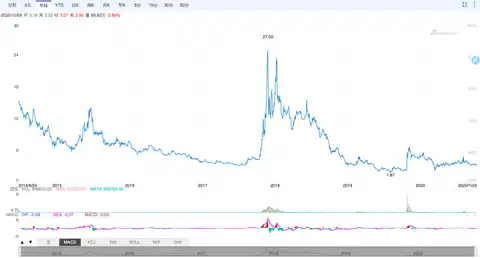
Thunder Stock Price
By November 2017, Chen Lei was probably blinded by success, starting to axe those old businesses of Thunder that were not profitable. At the end of November 2017, Thunder announced the revocation of brands and trademark authorizations such as Thunder Big Data, Thunder Financial, and Thunder Mini Games.
However, this move disrupted the interests of Thunder's old guards, triggering internal strife within Thunder's management. The biggest chaos was with Thunder Big Data, whose actual controller, Yu Fei, was the former senior vice president of Thunder. She came out to accuse QvodPlayer of being a scam, illegal fundraising, and even started reporting Netease Technology.
It's the same company reporting on itself.
The good times ended in a few days. In January 2018, the virtual currency market experienced a major crash, national regulators continued to intervene, QvodPlayer collapsed, and Thunder's stock also collapsed; in 2019, Thunder Group's losses continued to widen, and Thunder's proud CDN business began to face challenges from companies like Alibaba Cloud, Tencent Cloud, and Wangsu Technology. The once-vaunted blockchain business did not show much promise.
All of this was a prelude to this "palace struggle."
Clearing the Gates
In January 2014, Thunder's CTO Li Jinbo resigned and in July of the same year founded the ZuiRight APP, which has been doing very well. In April 2019, Xiaomi invested $80 million in ZuiRight. ZuiRight and several investors reached an agreement to exchange their shares in Thunder for shares in ZuiRight. Through this process, ZuiRight transformed into Thunder's largest shareholder, holding a 39.8% stake. The old guard of Thunder, represented by Li Jinbo, is about to come back to take over Thunder.
The first thing upon return is: clearing the gates.
In early April 2020, Thunder announced a personnel adjustment, with Chen Lei no longer serving as CEO of Thunder and its affiliates. Li Jinbo took over, followed by the occupation of Netease Technology by security guards, physically taking over the company.
Faced with the sudden fall from grace, Chen Lei said he regretted joining Xunlei in 2014 at the invitation of Lei Jun. I made many big mistakes as a professional manager: first, I offended some people, and second, I was too naive.
But the Xunlei elders don't see it that way.
In the investigation details released by Xunlei, a Xunlei broadband supplier named Xingronghe was found. This was a company personally controlled by Chen Lei, and he illicitly transferred a huge amount of funds to this company.
During Chen Lei's tenure, there had been constant external questioning about his relationship with Xunlei's Senior Vice President and Vice President of Netac Technology, Dong Xue. There were rumors that the two were in a romantic relationship. During a board meeting, the Xunlei board directly questioned Chen Lei, who, based on his Christian reputation, assured them that the two had no relationship beyond being colleagues.
However, after his resignation, Xunlei discovered that the two had a child during their tenure. Chen Lei also used Dong Xue to place a group of fellow natives and close friends from Hegang, Heilongjiang, in key positions within the company. He misappropriated company funds through fictitious trade links, devalued fake contracts, and was even found to have embezzled tens of millions of dollars for cryptocurrency speculation.
Xunlei had had enough. On October 8, Xunlei announced that former CEO Chen Lei and others were suspected of embezzlement. The Shenzhen Public Security Bureau has initiated an investigation into Chen Lei's alleged embezzlement and called on him to return to China to cooperate with the investigation as soon as possible.
Although Chen Lei expressed a different opinion in an interview with the "National Business Daily," since a case has been filed, everything will be determined by the public security judgment. This "Xunlei Court Battle," which began in April this year, has also come to an end. Regardless of whether Chen Lei truly regrets coming to Xunlei, the six years of relationship have also ended in this power struggle.
Compared to the power struggle, Xunlei's core business itself is more worthy of our attention. When the core download function is no longer a high-frequency application for people, how will Xunlei, whose stock price has dropped nearly 90% from its peak, regain its past glory?
Original Article Link
You may also like

Key Market Intelligence for January 15th, how much did you miss out on?

$200K Annual Salary Hiring, Predicting Market Will See Wall Street Players

Senate Committee Delays Crypto Bill Due to Coinbase’s Objections
Key Takeaways The Senate Banking Committee has postponed its planned markup of a major crypto market structure bill…

Eric Adams Denies “Rug Pull” Allegations Linked to NYC Token Despite Significant Losses
Key Takeaways: Eric Adams firmly denies allegations implying that money was moved out of the NYC Token. Market…

XRP Price Action: Crypto Bill Could Grant XRP the Same Legal Designation as Bitcoin
Key Takeaways A new legislative draft in the United States might classify XRP alongside Bitcoin (BTC) and Ethereum…
Coinbase CEO Raises Red Flags Regarding US Crypto Bill
Key Takeaways Coinbase CEO Brian Armstrong voices opposition to the proposed Senate crypto bill, citing significant concerns. The…

Asia Market Open: Bitcoin Nears $96K Amid Mixed Asian Stocks and Wall Street Slump
Key Takeaways Bitcoin’s price edges closer to $96,000 amid mixed signals from Asian stock markets and a recent…
Ethereum Price Prediction: SharpLink Activates Multi-Billion ETH Strategy – How Soon Might ETH Achieve a New All-Time High?
Key Takeaways SharpLink has strategically deployed $170 million in Ethereum on the Linea network, showcasing a productive use…

Transforming the Cryptocurrency Landscape: A 2026 Outlook
Key Takeaways Cryptocurrency systems have seen expansive growth and technological innovation. The introduction of new regulations has reshaped…
Pi Coin Price Prediction: Mainnet Tokens Just Unlocked – What Does This Mean for Holders?
Key Takeaways Daily token unlocks are increasing the supply of Pi Coin, affecting its short-term price stability. Pi…

Best Crypto to Buy Now January 14 – XRP, PEPE, Internet Computer
Key Takeaways The current crypto landscape is at a pivotal junction with potential changes in U.S. regulations offering…
New ChatGPT Forecasts for XRP, Ethereum, and Solana by 2026
Key Takeaways ChatGPT predicts a potential bull market for XRP, Ethereum, and Solana by 2026, supported by the…
Mantra Slashes Staff and Restructures Following ‘Brutal’ OM Token Collapse
Key Takeaways The OM token experienced a dramatic price collapse, prompting a significant restructure within Mantra, including job…

Crypto Price Prediction Today 14 January: XRP, PEPE, Maxi Doge
Key Takeaways Amidst a blossoming crypto market, altcoins such as XRP, PEPE, and Maxi Doge are showing promising…

Bitnomial Debuts the First U.S.-Regulated Aptos Futures
Key Takeaways: Bitnomial has launched the first U.S.-regulated futures contracts for Aptos, extending a new avenue for institutional…

Why Is Crypto Up Today? – January 14, 2026
Key Takeaways Cryptocurrency market capitalization has risen by 3.6% to $3.33 trillion, with 95 of the top 100…

Current Landscape of Cryptocurrency Exchanges in 2026
Key Takeaways The cryptocurrency exchange market is notably competitive, with each platform offering unique strengths to attract users.…

Senate Crypto Bill Markup Rescheduled to January 27 Amid Legislative Momentum
Key Takeaways The Senate Agriculture Committee has rescheduled the release of the legislative text for crypto market structure…
Key Market Intelligence for January 15th, how much did you miss out on?
$200K Annual Salary Hiring, Predicting Market Will See Wall Street Players
Senate Committee Delays Crypto Bill Due to Coinbase’s Objections
Key Takeaways The Senate Banking Committee has postponed its planned markup of a major crypto market structure bill…
Eric Adams Denies “Rug Pull” Allegations Linked to NYC Token Despite Significant Losses
Key Takeaways: Eric Adams firmly denies allegations implying that money was moved out of the NYC Token. Market…
XRP Price Action: Crypto Bill Could Grant XRP the Same Legal Designation as Bitcoin
Key Takeaways A new legislative draft in the United States might classify XRP alongside Bitcoin (BTC) and Ethereum…
Coinbase CEO Raises Red Flags Regarding US Crypto Bill
Key Takeaways Coinbase CEO Brian Armstrong voices opposition to the proposed Senate crypto bill, citing significant concerns. The…


 App
App