
 Buy Crypto
- Markets
 Futures
- Spot
- Copy Trade
- Earn
- More
Trump Speech Sparks Market: "Major Strike on Iran" in the Next Two to Three Weeks, Oil Price Surges, Gold Plunges


Original Title: "Trump's Speech Sparks Market: 'Heavy Strike on Iran' in the Next Two to Three Weeks, Oil Price Skyrockets, Gold Plunges"
Original Source: Golden Ten Data
At 9 a.m. Beijing time on Thursday morning, U.S. President Trump delivered a national address, issuing a "significant update" on the Iran issue.
Trump's speech stated that the U.S. military has achieved a rapid and decisive victory. Trump emphasized that the core strategic objective is close to being achieved, "We want to complete the mission, and we want to complete it quickly. We are very close."
He mentioned that most of Iran's leadership is already dead. The Iranian navy no longer exists, the air force has also been reduced to rubble, and the command and control capabilities of the Islamic Revolutionary Guard Corps are being destroyed.
He stated that Iran had sought to produce as many missiles as possible, and military action significantly hindered Iran's ability to acquire nuclear weapons. The Iran nuclear deal was a flawed agreement that should never have been reached. "Iran having nuclear weapons is an intolerable threat."
He said that without withdrawing from the Iran nuclear deal, Israel would not exist. Moreover, Iran had been stockpiling conventional ballistic missiles, which could have soon "reached the U.S. mainland, Europe, and nearly anywhere else on Earth." "We will never allow Iran to have nuclear weapons. As long as Iran remains a state that supports terrorism, we will never do so. Iran had some weapons that nobody believed they had, and we destroyed those weapons."
Trump revised the death toll of Iran's protest activities to 45,000 people, having previously announced a death toll of 32,000 people.
Trump said, "Partly thanks to Venezuela's oil and gas, the United States is now completely no longer dependent on the Middle East. "We do not need oil from the Middle East. We are helping them."
Regarding concerns about oil prices, Trump stated that the recent increase in gasoline prices is a "short-term" phenomenon due to Iran's attacks on oil tankers. Oil production will quickly increase significantly. The U.S. has never been more prepared economically. "We didn't need the Strait of Hormuz in the past, and we don't need it now. Once the conflict is over, the strait will naturally open."
Trump mentioned the timeframe once again, saying, "In the next two to three weeks, we will deal a heavy blow to them. We are resolving all of America's military concerns as quickly as possible, very quickly according to plan. Regime change is not our plan, but it has happened." He threatened to send Iran back to the Stone Age. "If no agreement is reached, power plants in Iran will be targeted."
Trump emphasized in his final remarks that the objective is very clear, to destroy Iran's ability to threaten the United States and to dismantle its defense industrial base. The U.S. has various options to target Iran's oil, including seizing key energy facilities. Trump thanked Middle Eastern allies, stating that the U.S. will not allow them to be harmed.
It is worth noting that Trump did not announce a withdrawal from NATO. Some had anticipated that Trump might use this opportunity to criticize NATO allies for not joining the fight against Iran.
During Trump's address on the Iran war, U.S. stock index futures fell. S&P 500 index futures briefly fell by 0.5%. Asia-Pacific stocks turned lower, with the MSCI Asia-Pacific index widening its decline to 0.5%. The Nikkei 225 index gave up its early gains and is now down by 0.4%.
U.S. Treasuries and Japanese government bonds fell. The yield on the U.S. 10-year Treasury rose by 3 basis points to 4.35%. The yield on the 30-year Japanese government bond rose by 2.5 basis points to 3.640%.
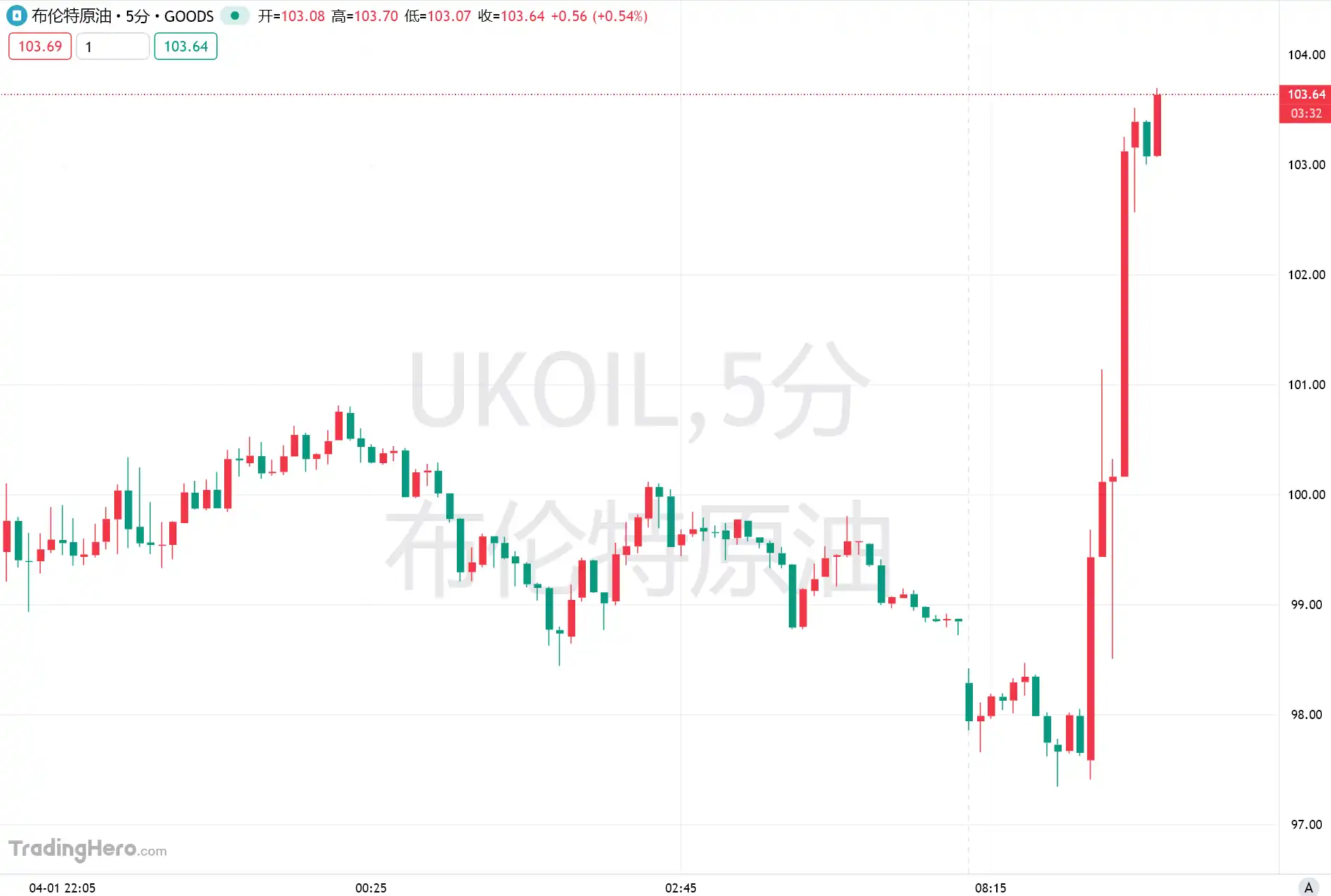
Due to Trump's threat to target Iran's energy facilities if no agreement is reached, oil prices continued to rise, with WTI crude oil surpassing $103 per barrel, up over 4% intraday. Brent crude oil surged by $4 intraday to $102.86 per barrel, a 4.06% increase.
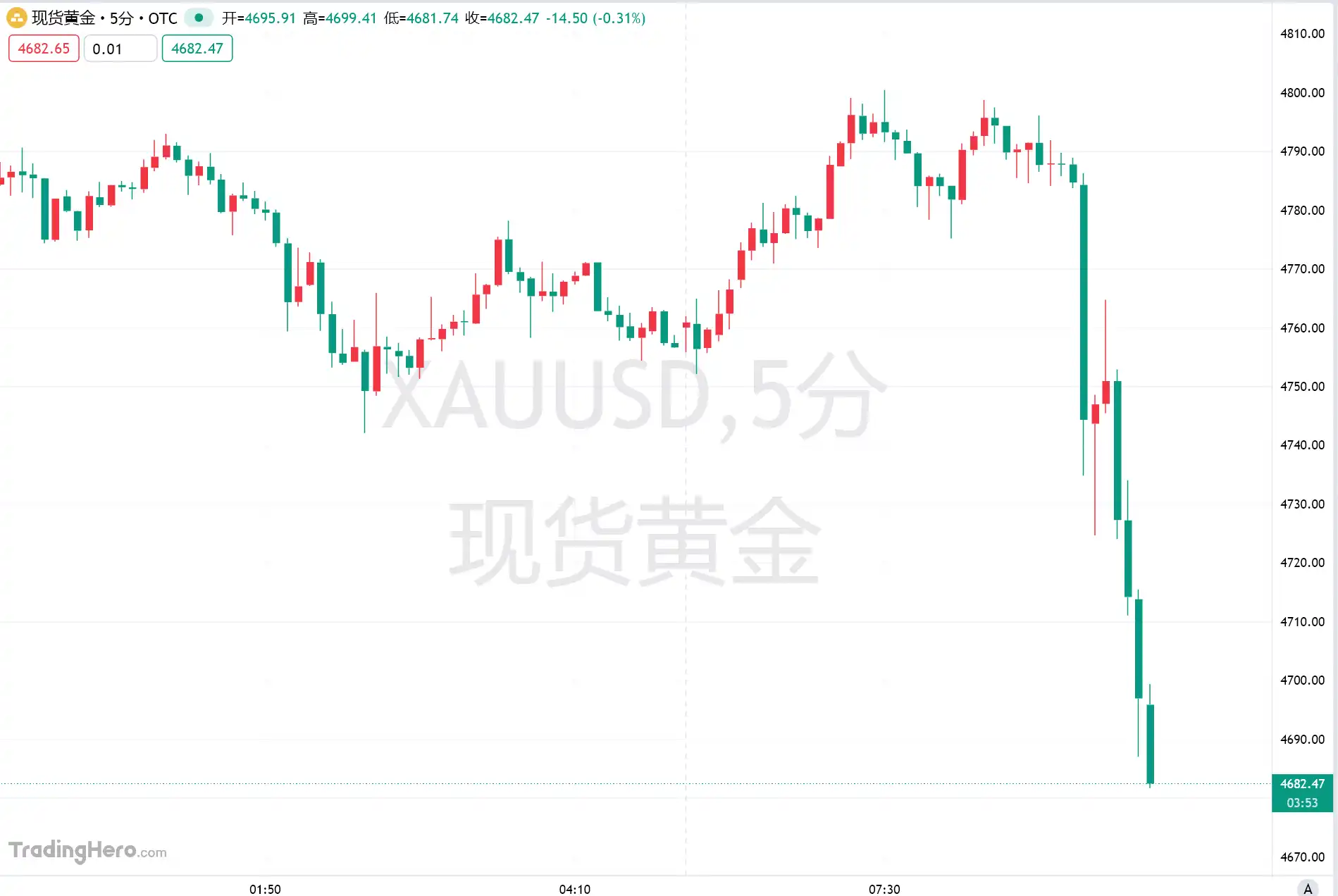
With Trump hinting that military action could escalate in the short term, international spot gold and silver prices plummeted, with spot gold falling below $4700 per ounce, a decrease of over 2% intraday. Spot silver fell by over 3% intraday, now trading at $72.54 per ounce. COMEX silver dropped below $73 per ounce, down 4.13% intraday.
This speech highlighted the immense pressure Trump is facing to clearly define the objectives of the war to the public and to find an "exit ramp" for this conflict, which has now entered its fifth week and is increasingly difficult to control. It is worth noting that this speech, in some ways, appeared more like mobilization at the beginning of a war rather than a summary one month into the war. Currently, the Strait of Hormuz, which accounts for one-fifth of global seaborne oil, has been essentially blockaded since the outbreak of hostilities, becoming a major economic pain point. Although Trump still insists that the energy shock will ease after the war, the government has not clearly outlined how it will persuade Iran to reopen the strait for navigation.
Derek Wallbank, Senior Editor of "U.S. Economy and Government," pointed out, "If you've been listening to the president's speeches for the past week or so, you didn't hear too much new content tonight."
He outlined the rationale for the U.S. taking military action against Iran, vowing a swift end to the war while indicating the U.S. would continue to strike Iran. The timeline remains unchanged: two to three weeks. He once again urged nations reliant on the Strait of Hormuz for energy to act to reopen the strait.
Reporter Abhishek Vishnoi noted that Trump stated that nations depending on the Strait of Hormuz must address this issue, increasing the likelihood of the oil risk premium persisting, even amid ceasefires, prolonged global inflation, and cautious prospects for non-U.S. assets, especially in emerging markets and oil-importing nations.
Trump did not provide any new details on the Strait of Hormuz or signs of a lasting solution, which could disrupt the oil market. Instead, he reiterated past remarks, urging countries relying on this waterway for oil flow to summon the "courage that came too late" to address the issue.
Bloomberg's Clara Ferreira Marques stated: "In the hope of conquering experience, some oil traders have been seeking clarity from Trump's speech. He offered no direction, repeated past remarks, and mingled bluster and threats with the prospect of an imminent end. This lifted Brent and WTI crude prices. While the president made comments today, there's little sign the Strait of Hormuz is naturally reopening. Indeed, Iran is pushing ahead with plans to introduce tolls—formalizing a structure that could reinforce its control of the narrow waterway."
For oil traders, producers, and users, the key takeaway from Trump's remarks is that the global oil supply squeeze triggered by Iran closing the Strait of Hormuz may last until April. According to earlier Bloomberg data, each day the strait is shut results in about 11 million barrels lost.
AT Global Markets Chief Market Analyst Nick Twidale said, "Investors are clearly not impressed by this, and there could be more downside in global markets today. Overall, I think while he said the war would end soon, the significant downside impact on the market of this key update of continuing strikes against Iran in the next few weeks is considerable."
You may also like

Atkins Marks One-Year Anniversary at SEC: Crypto Regulation Shifts from ‘Enforcement Heavy’ to ‘Rulemaking Mode’

Under Political Pressure, Is the Federal Reserve Still Independent?

Yellen's Past Remarks: How Will This Incoming "Fed Chair" Disrupt the Federal Reserve? Janet Yellen, who is expected to become the next Chair of the Federal Reserve, has made several significant statements in the past regarding monetary policy, financ...

ZachXBT vs. RAVE: Is a “Clean” Market Really What Speculators Want?

Arbitrum Poses as Hacker, 'Steals' Back Money Lost by KelpDAO

Without Cook's Apple, Can it Still Grow in the AI Era?

Saylor's Bitcoin Holdings Surpass BlackRock, How Does This "Bitcoin Financing Machine" STRC Work?

What Is RWA? What Is RWA in Crypto (Complete 2026 Guide)
Wondering what is RWA in crypto? We explain what RWA is, break down RWA tokenization in simple no-jargon terms, and cover why it's 2026's hottest crypto narrative.

What Is the KelpDAO Attack? What It Means for Aave Users in 2026
KelpDAO suffered a $292M rsETH exploit on April 18, 2026, triggering Aave market freezes and $13B DeFi outflows. Here’s what happened, whether Aave is safe now, and what users should do next.
Is your gold really "within reach"? The geographical blind spots of custodial services behind tokenized gold
Cook Passes the Baton, Anthropic Gears Up | Rewire News Morning Brief

Will the Fed Cut Interest Rates Again? Tonight's Data Is Key

The person taking over Apple has to do something he has never done before

Why Are You Always Losing Money on Polymarket? Because You're Betting on News, While The Rulebook Favors Insiders
Not a Price Hike, but a Supply Shortage? Oil Price Has Crossed the Threshold

a16z: 5 Ways Blockchain Helps AI Agent Infrastructure

Morning News | The Hong Kong Securities and Futures Commission announced the regulatory framework for secondary market trading of tokenized investment products; Strategy increased its holdings by 34,164 bitcoins last week; KAIO completed a strategic fi...
What Is an XRP Wallet? The Best Wallets to Store XRP (2026 Updated)
An XRP wallet lets you safely store, send, and receive XRP on the XRP Ledger. Learn what wallets support XRP and discover the best XRP wallets for beginners and long-term holders in 2026.


 App
App