
Atkins Marks One-Year Anniversary at SEC: Crypto Regulation Shifts from ‘Enforcement Heavy’ to ‘Rulemaking Mode’

Original Title: One year under Paul Atkins, SEC's crypto stance shows break with past
Original Author: Turner Wright, Cointelegraph
Original Translation: TechFlow
TechFlow Summary: On April 21, 2025, Paul Atkins was sworn in as SEC Chairman, marking exactly one year today. During this year, the SEC dismissed multiple lawsuits against crypto companies, approved multiple crypto ETFs, and signed a digital asset regulatory coordination Memorandum of Understanding with the CFTC. However, the SEC is still awaiting Congress to pass the Market Structure Bill to clarify its jurisdiction over crypto assets.
On April 21, 2025, Paul Atkins was sworn in as the Chairman of the U.S. Securities and Exchange Commission (SEC). Today marks exactly one year since then.
During this year, the SEC has undergone a fundamental shift in its regulatory and enforcement stance on digital assets, contrasting sharply with the approach during the tenure of former Chairman Gary Gensler.
During the 2024 election, Trump made several promises to the crypto industry: replacing Gensler, establishing a national Bitcoin (BTC) reserve, and opposing the issuance of a U.S. central bank digital currency. After winning the election in November 2024, Gensler resigned in January 2025, and SEC Commissioner Mark Uyeda temporarily served as Acting Chairman until Atkins' nomination was confirmed by the Senate.
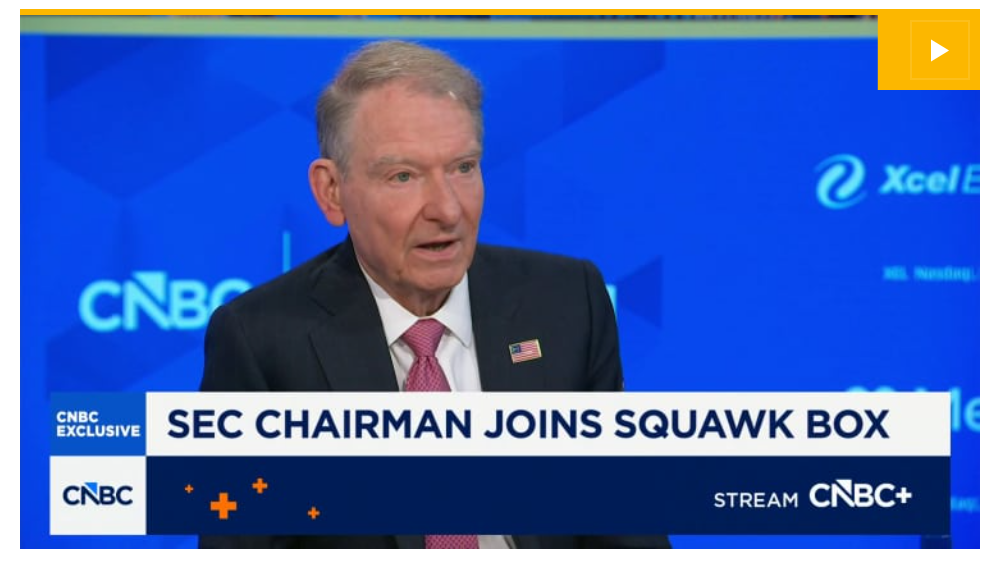
Caption: SEC Chairman Paul Atkins being interviewed on CNBC Squawk Box on April 20, 2026
SEC's Shift Began Before Atkins Took Office
Prior to Atkins' official appointment, during Uyeda's acting tenure, the SEC established a crypto working group led by Commissioner Hester Peirce and began gradually dismissing civil enforcement actions and investigations against crypto companies starting from February 2025, with Coinbase being the first.
During Atkins' first 12 months in office, the SEC rolled out a series of policies widely seen as favorable by the industry:
· Concluded multiple enforcement actions against crypto companies
· Approved several exchange-traded funds (ETFs) linked to various types of crypto assets
· Signed a memorandum of understanding on digital asset regulation with the Commodity Futures Trading Commission (CFTC)
· Issued interpretive guidance clarifying that most cryptocurrencies do not constitute securities under federal law
Speaking to CNBC on April 21, Atkins himself said, "The year went by quickly, but I feel like we've made a lot of progress. I promised a new day at the SEC when I took office, and I believe we've delivered on that. We've moved away from the past approach of regulating through enforcement and operating in a non-transparent manner, and the crypto space is the best example of that."

Source: CFTC Chairman Michael Selig
Democratic Lawmakers Focus on Conflict of Interest
While the crypto industry has mostly welcomed Atkins' approach, criticism from congressional Democrats is escalating. The focus is on investigations and enforcement actions revoked by the SEC that involved companies associated with Trump and his family, raising concerns about potential conflicts of interest.
Last week, Senator Elizabeth Warren of Massachusetts accused Atkins of misleading lawmakers during congressional testimony. In a letter dated April 15, Warren pointed out that SEC's own data for the 2025 fiscal year showed a decrease in the number of enforcement actions to the lowest level in a decade.
Despite the clear direction of dismissals and regulatory loosening, the SEC is still awaiting Congress to pass a market structure bill to formally clarify its regulatory boundaries over crypto assets. Until the bill is enacted, the SEC's crypto regulatory framework remains in a transitional phase of "administrative guidance + case-by-case approach."
Original Article Link
You may also like

Paul Graham: How to Make a Billion Dollars

If the AI bubble has already burst, who will truly remain?

Morning Report | Prediction market platforms like Kalshi and Polymarket jointly sue Kentucky over 14.25% trading tax; Bridgewater founder discusses decision-making in the AI era: principled thinking should run parallel to AI, human insight remains irre...

What is the connection between Huang Zheng of Pinduoduo and blockchain?

The other side of Musk's trillion-dollar fortune: 85% cannot be sold

The U.S. government prohibits foreigners from using Fable 5, Anthropic issues a rebuttal

Citibank releases "2030 Asset Tokenization Market Outlook": 6 major trends may create a $8.2 trillion market
The trillion-dollar valuation test: Are the three major super IPOs a celebration for tech stocks or a nightmare for the crypto market?

Morning Report | Digital Asset completes $355 million financing led by a16z Crypto; Meta completes operational separation from Manus

a16z Crypto Partner: Cash flow is the moat

Cryptocurrency market makers collectively seek change as it becomes increasingly difficult to make money

How TradeXYZ, xStocks, and Alpaca break down the SpaceX IPO into three different strategies
$75 billion in risk asset redistribution: How will SpaceX's IPO affect U.S. stocks and Bitcoin?
Why Is BlackRock Investing $5 Billion in the SpaceX IPO?
Morning News | CME Group launches Nasdaq Cryptocurrency Index futures; Asset management giant Janus Henderson strategically invests in Ethena

Bitcoin Layer 2 Network Botanix: Why Did We Choose to Dissolve?

Why did Oracle deliver the strongest financial report in history, yet its stock price fell?
When the P2P illicit funds from ten years ago turned into 60,000 bitcoins
Paul Graham: How to Make a Billion Dollars
If the AI bubble has already burst, who will truly remain?
Morning Report | Prediction market platforms like Kalshi and Polymarket jointly sue Kentucky over 14.25% trading tax; Bridgewater founder discusses decision-making in the AI era: principled thinking should run parallel to AI, human insight remains irre...
What is the connection between Huang Zheng of Pinduoduo and blockchain?
The other side of Musk's trillion-dollar fortune: 85% cannot be sold
The U.S. government prohibits foreigners from using Fable 5, Anthropic issues a rebuttal

Popular coins
Latest Crypto News


