
The founder personally intervened, why did the two popular L1s, Sonic and Monad, engage in a war of words?



Original Title: "Two Major Layer1 Networks Exchange Insults, How Did Sonic and Monad Start Quarreling?"
Original Author: Azuma, Odaily Planet Daily
The market remains quiet, but the cryptocurrency industry never lacks excitement.
This morning, two major Layer 1 networks, Sonic (formerly Fantom) and Monad, suddenly engaged in a war of words, even involving the founders of both projects.
As the two most anticipated Layer 1 networks in the future market, Sonic, born from the once-popular Layer 1 network Fantom and now revamped by the well-known DeFi guru Andre Cronje, and Monad, born from the market-making giant Jump Trading and received a $2.25 billion investment led by Paradigm at a $30 billion valuation in April last year. From a competitive standpoint, the two Layer 1 networks indeed have a natural rivalry, but it seems they don't need to be so direct in their confrontation. So, what exactly happened last night?
Here is the background of the event.
First, on January 12, the Sonic team officially released a celebratory video announcing that the network's Total Value Locked (TVL) had surpassed $100 million on the mainnet. This was a standard marketing move by the project team and did not seem problematic.

However, shortly after, a core member of the growth team at Monad, known as tunez, suddenly made a provocative comment: "This is almost as much as they lost in the cross-chain bridge incident."

tunez also shared a Forbes article about the cross-chain bridge Multichain being hacked in a previous year.
In July 2023, the cross-chain bridge project Multichain fell victim to a hacker attack, with initial estimates of losses around $126 million. Although Multichain's services spanned multiple networks, Fantom, as the primary cross-chain bridge, suffered the most severe consequences. Subsequently, the stablecoin on Fantom experienced long periods of significant de-pegging, multiple ecosystem projects announced shutdowns due to fund losses, ultimately leading to Fantom's exit from the intense competition among the previous generation of emerging Layer 1 networks.
Sonic was originally celebrating the newborn happily, but the good day was directly hit by tunez, which naturally could not be tolerated.
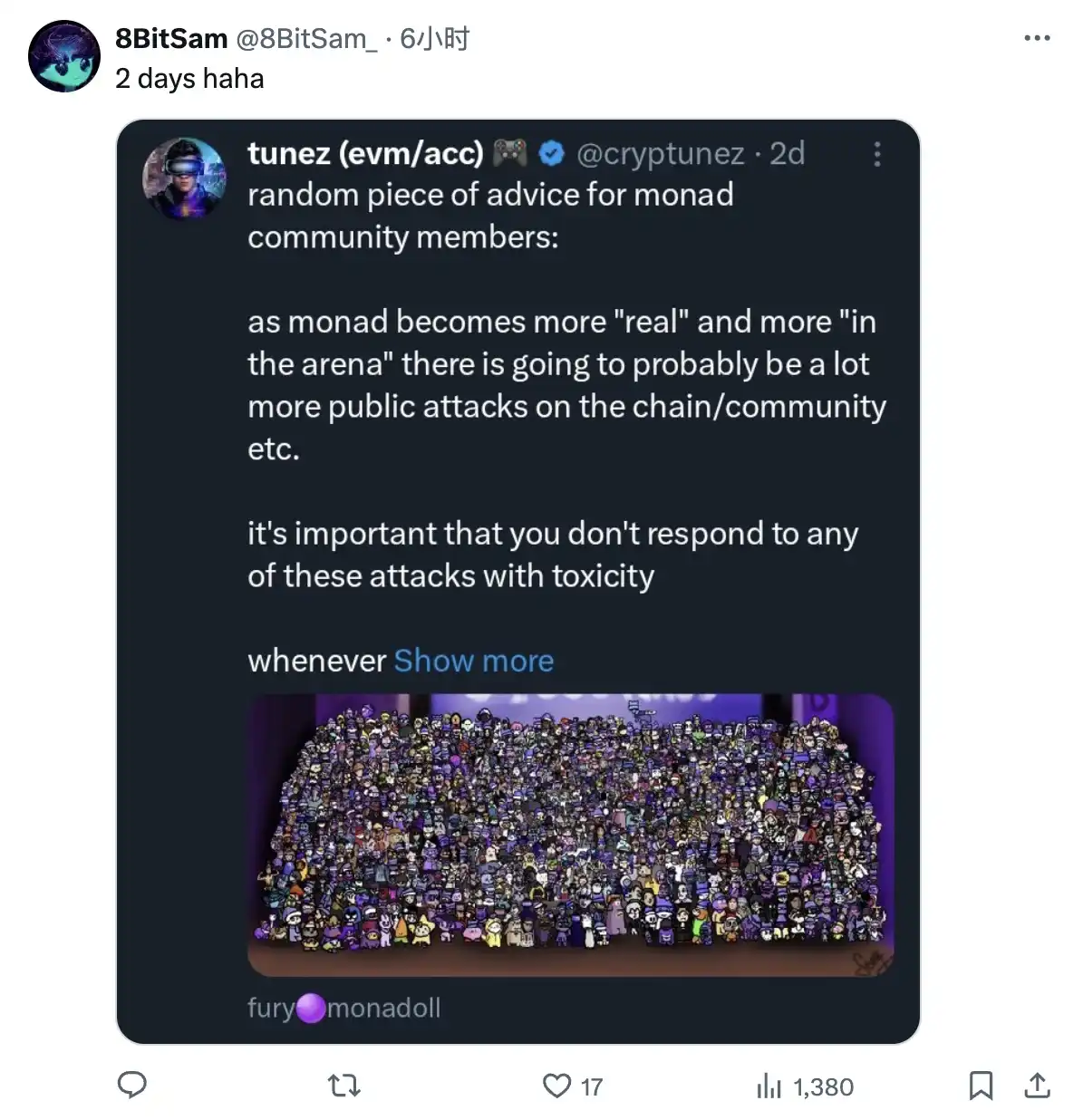
Many Sonic community members immediately began to retaliate against tunez, with some even bringing up tunez's words from two days ago, "As Monad becomes more popular, it will also face more and more attacks," directly pointing out that tunez's actions were provoked by Sonic's popularity.
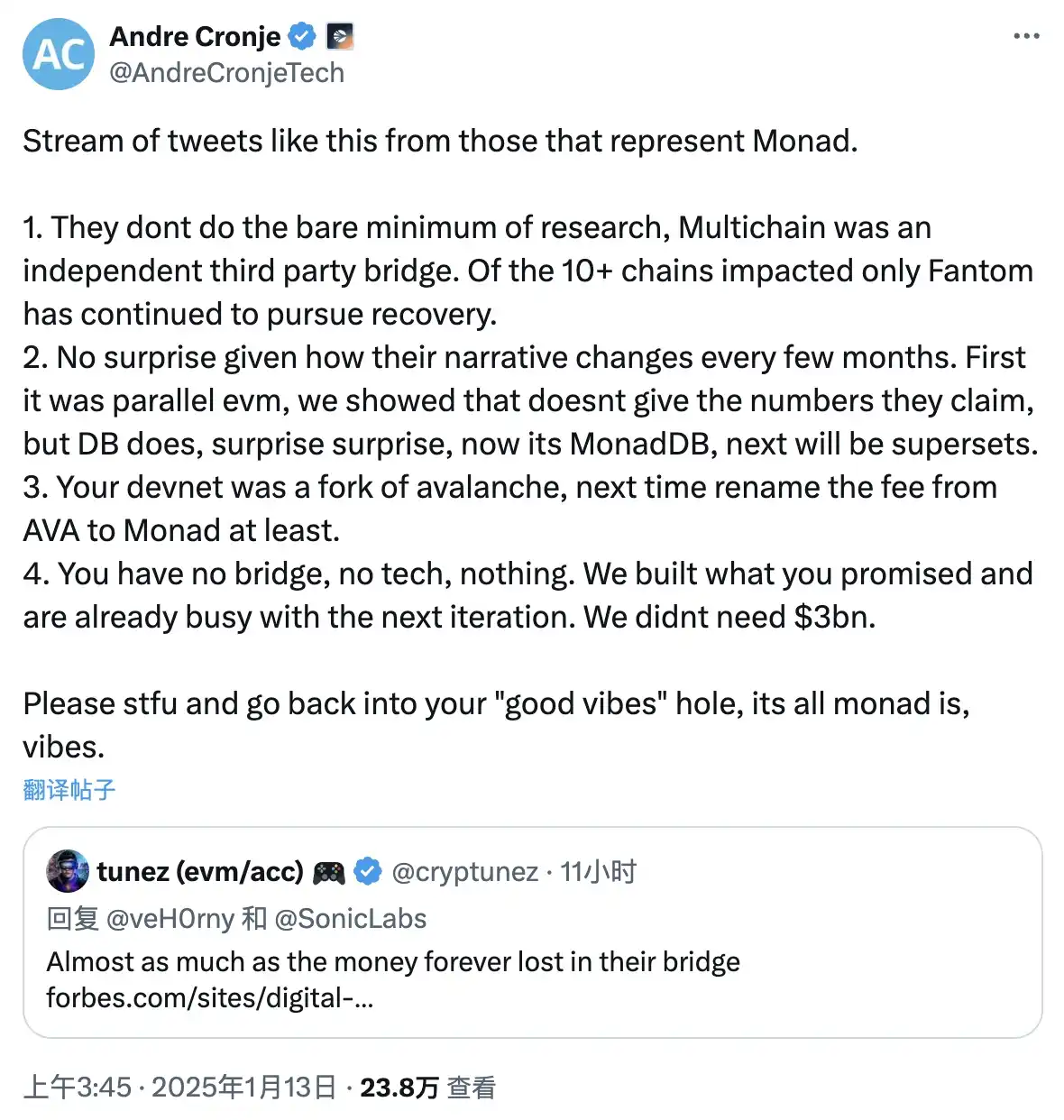
Subsequently, Sonic (formerly Fantom) co-founder AC personally responded to tunez, with the following content:
· Monad did not do the most basic investigation; Multichain is an independent third-party cross-chain bridge. Among the more than 10 affected chains, only Fantom is still seeking fund recovery.
· Monad's narrative changes every few months. Monad initially said they would do parallel EVM, but we found that they could not deliver the promised performance numbers, and reminded them that unless they do another database (DB), and then Monad announced they would launch MonadDB, and next they will probably do supersets.
· Moand's Devnet is just a fork network of Avalanche, and they even forgot to rename the gas fee token from AVA to Monad.
· Monad has no cross-chain bridge, no technology, nothing. Sonic developed what Monad promised, and is busy with the next iteration. Sonic also does not need $3 billion.
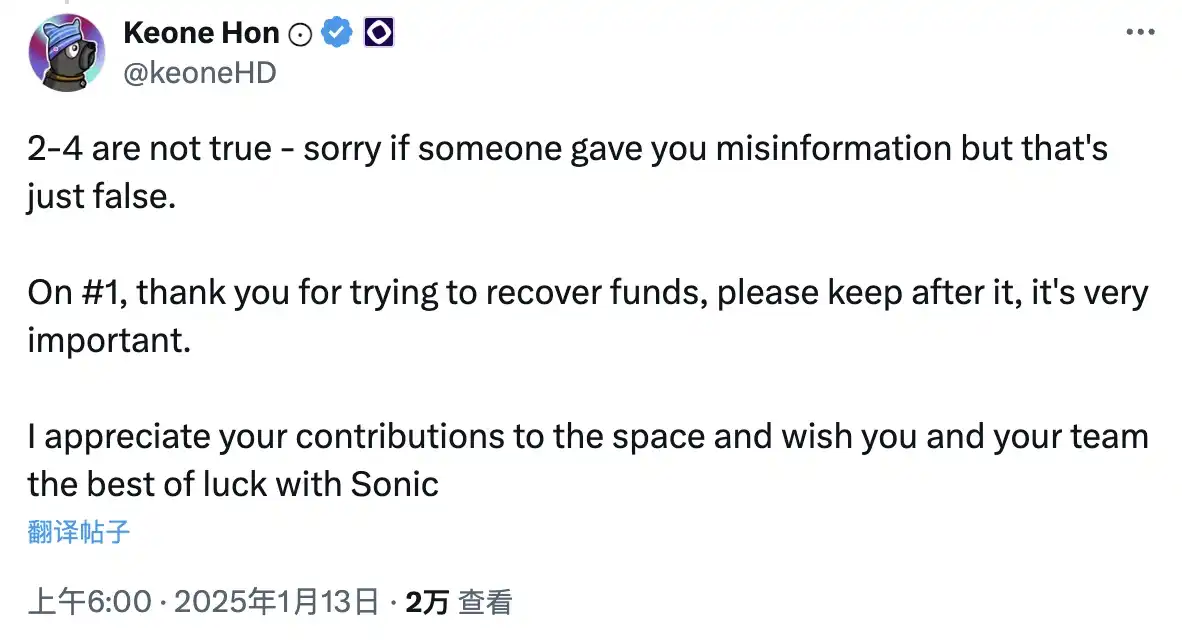
After AC's response, Monad's two co-founders, Keone Hon and James Hunsaker, also responded successively. However, perhaps feeling that tunez's provocation was unjust, the language of the two co-founders seemed to be much milder and did not further escalate the conflict.
Keone Hon first denied AC's criticisms of Monad points 2-4 and emphasized that such rumors are all incorrect. At the same time, Keone Hon praised Sonic's continued efforts to trace the funds and AC's contributions to the industry, and finally wished AC and Sonic the best for their future development.
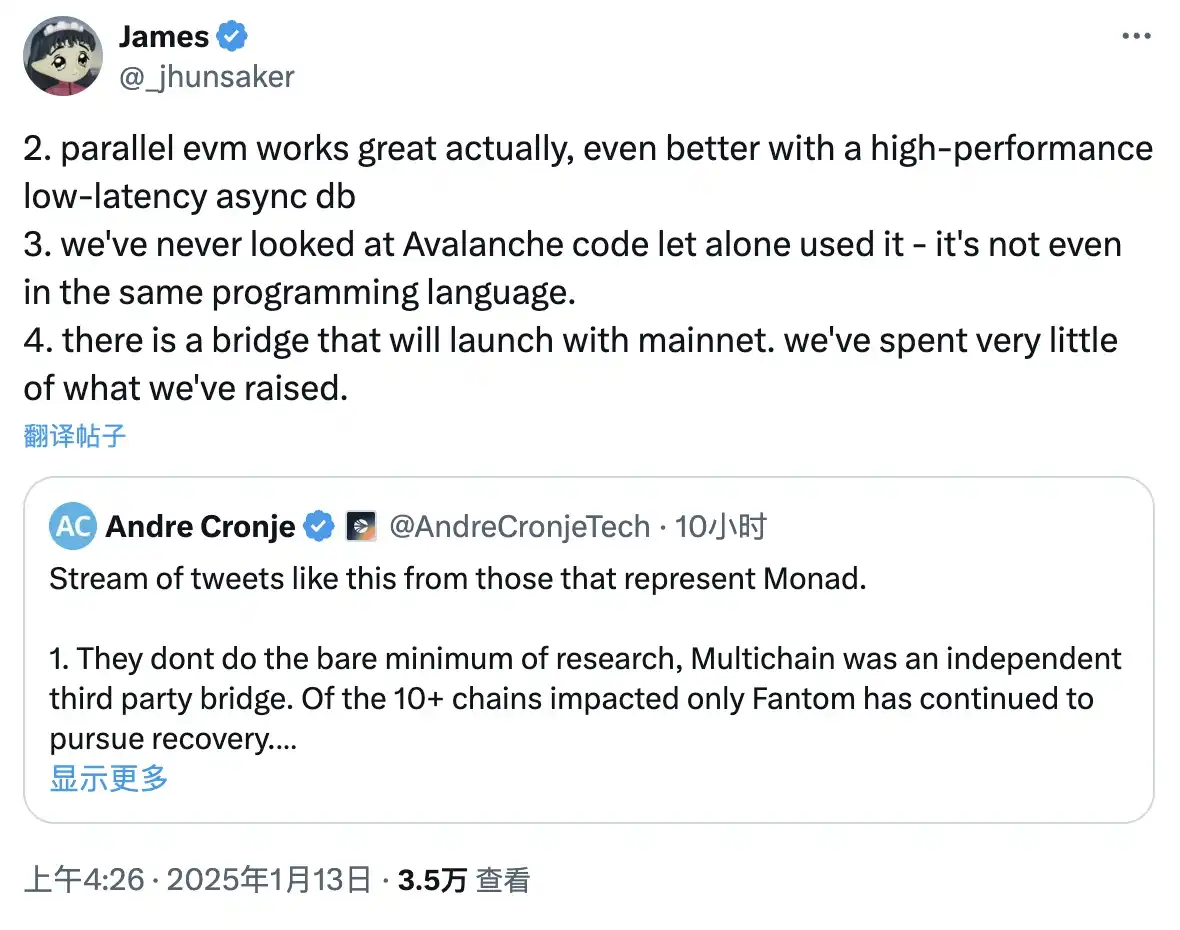
James Hunsaker's response was more detailed:
· The parallel EVM is actually running well, but introducing a high-performance, low-latency asynchronous database would yield better results;
· Monad has never seen Avalanche's code, let alone forked it—Monad and Avalanche are not even written in the same programming language;
· Monad will launch a cross-chain bridge when its mainnet goes live;
· Only a small portion of the funds raised by Monad has been temporarily utilized.
In conclusion, after Monad took a more moderate approach to mitigate the conflict, the verbal battle between the two parties has temporarily ceased.
The market is bleak, and market information is hindered. We are eager to see new projects compete in terms of technical paths, application types, adoption patterns, and more, but clearly not in this manner. As the two most highly anticipated Layer 1 representative projects in the current community, Sonic and Monad should seemingly set an example.
You may also like

Morning Report | OpenAI has submitted an S-1 registration statement draft to the U.S. SEC; Morpho completes $175 million financing

Galaxy Deep Research Report: How Hyperliquid's HIP-4 Upgrade Changes the Landscape of Prediction Markets?

Latest research from 13 top universities including Cornell University: The current state, challenges, and misconceptions of the fusion of Crypto and AI

Deconstructing Anthropic: The Best AI Company, Possibly Also a Type of Organizational Invention

Every exchange is a "Universal Exchange."

The counterattack of traditional finance: Alliance chains are quietly reviving
Pantera Capital Partner: How Tokenization is Restructuring the Private Equity and Early Investment Ecosystem?

Mastercard Launches Agent Pay for AI, Plans to Record AI Agent Payment Authorizations on Polygon
Mastercard launched Agent Pay for AI, a new payment protocol designed to help AI agents make small payments such as pay-per-use access to data and APIs. The system plans to record human-granted AI agent permissions on Polygon, focusing on verifiable authorization, identity, and payment controls.

Curve Deploys Llamalend v2 on Optimism With 250,000 OP Incentives
Curve launched Llamalend v2 on Optimism with 250,000 OP incentives from the Optimism Foundation. The upgrade expands Llamalend beyond its earlier crvUSD-focused model, adding broader collateral support, LlamaRisk market reviews, and the ability to use Curve LP tokens as collateral.

Raydium Old Liquidity Pool Reportedly Exploited, With $1.34 Million Moved to Ethereum and Tornado Cash
An old Raydium liquidity pool was reportedly exploited for around $1.34 million in USDC, RAY, and wSOL, with the stolen funds bridged to Ethereum and deposited into Tornado Cash. The incident highlights the tail risks of legacy DeFi pools, old contracts, and cross-chain fund laundering paths.
Kalshi Executive Challenges “SBF Backed AI Unicorns” Narrative, Says Leopold Aschenbrenner Was Key Figure
Kalshi executive John Wang questioned the “SBF backed AI unicorns” narrative, saying Leopold Aschenbrenner was the key figure behind major AI investment decisions.

New York Proposes Stricter Stablecoin Issuer Rules Aligned With Federal GENIUS Act
NYDFS proposed stricter stablecoin issuer rules aligned with the GENIUS Act, covering reserves, custody, redemption timelines, audits, and capital buffers.

CryptoQuant Says Bitcoin Profitable Supply Is Near 45% Pressure Zone as On-Chain Data Points to Market Repricing
CryptoQuant said Bitcoin’s profitable supply is nearing the 45% pressure zone, signaling rising market stress, unrealized losses, and a possible on-chain repricing phase.

Bitcoin Falls Below 200-Week Moving Average as On-Chain Data Shows Over Half of Supply in Loss
Bitcoin dropped below its 200-week moving average as on-chain data showed over 50% of circulating supply is now in loss, signaling rising market stress.

CFTC Reportedly Plans New Prediction Market Rules Focused on Manipulation Risk and Public Interest Review
The CFTC is reportedly preparing new prediction market rules focused on manipulation risk, public interest review, and retail trader protections.

Meet the new WEEX trial fund—your gateway to greater profits

WEEX Labs Lands at Dutch Blockchain Week: A Disruptive Crypto × AI Conversation Sets Sail in Amsterdam
SK Hynix Reportedly Plans U.S. ADR Listing as Early as August, With SEC Approval Possible in Late June
SK Hynix may pursue a U.S. ADR listing as early as August, with SEC approval reportedly possible in late June amid strong AI chip supply chain demand.
Morning Report | OpenAI has submitted an S-1 registration statement draft to the U.S. SEC; Morpho completes $175 million financing
Galaxy Deep Research Report: How Hyperliquid's HIP-4 Upgrade Changes the Landscape of Prediction Markets?
Latest research from 13 top universities including Cornell University: The current state, challenges, and misconceptions of the fusion of Crypto and AI
Deconstructing Anthropic: The Best AI Company, Possibly Also a Type of Organizational Invention
Every exchange is a "Universal Exchange."
The counterattack of traditional finance: Alliance chains are quietly reviving


