
North Korean Hacker Group's Attack on Top Coin Circle Infrastructure Safe: How Important Is Security in Crypto? In this translation, I aimed to maintain the original meaning while ensuring the terminology related to finance and blockchain was accurately
The next hacker-themed movie may be inspired by the recent $1.5 billion Bybit and Safe hack. The hacker's technique was near-perfect, and so far, no traces have been found.
After a week of multi-party investigations, updates have been provided by Safe's team, Bybit's team, and the security company. Blockbeats has summarized the investigation results in the most concise language, revealing the first-hand situation:
1. Code is fine: Safe's front-end code is open source, with no issues at the code level. It was Safe's server security that was compromised.
2. Inside job: Specifically, the code deployed in the production environment was not consistent with what was shown in the open-source repository. This means that at some point, someone replaced or inserted malicious code during the deployment process.
3. Unknown insider: Not all developers have the permission to deploy production code. The individual capable of conducting such a deep operation must have a high level of trust. This insider could be a long-trusted developer or a team member with sufficient permissions. The attacker concealed their tracks for a considerable period. Safe has examined the transaction history, found no anomalies, and has not identified the insider. The community and users are requested to assist in the investigation.
In addition, Safe has not mentioned any plans for compensation but has discussed some follow-up upgrade plans. They also remind everyone to stay rational and to not trust those who are marketing so-called "advanced multisig," "semi-custodial," "MPC," and similar products leveraging this hack event, as these products may instead expand the attack surface.
Indeed, this is not the first theft involving Safe's multisig. The technique used this time is very similar to the October incident involving Radiant Capital. During the Radiant Capital hack, the hacker infected the core developer's device and implanted malicious software, causing the developer to mistakenly believe they were signing a legitimate transaction when, in reality, a malicious transaction was being executed in the background.
Safe's Impact on the Crypto Space
Why is this event so attention-grabbing? The reason is that Safe is the most popular multisig wallet in the Ethereum ecosystem.
When Safe was launched last year, the top 100 airdrop addresses were mainly project teams, institutions, and large holders. This means that Safe's security can impact a significant part of the crypto space.
As shown in the image, well-known names include Metamask, PleasrDao, AAVE, 1inch, Lido, and more.
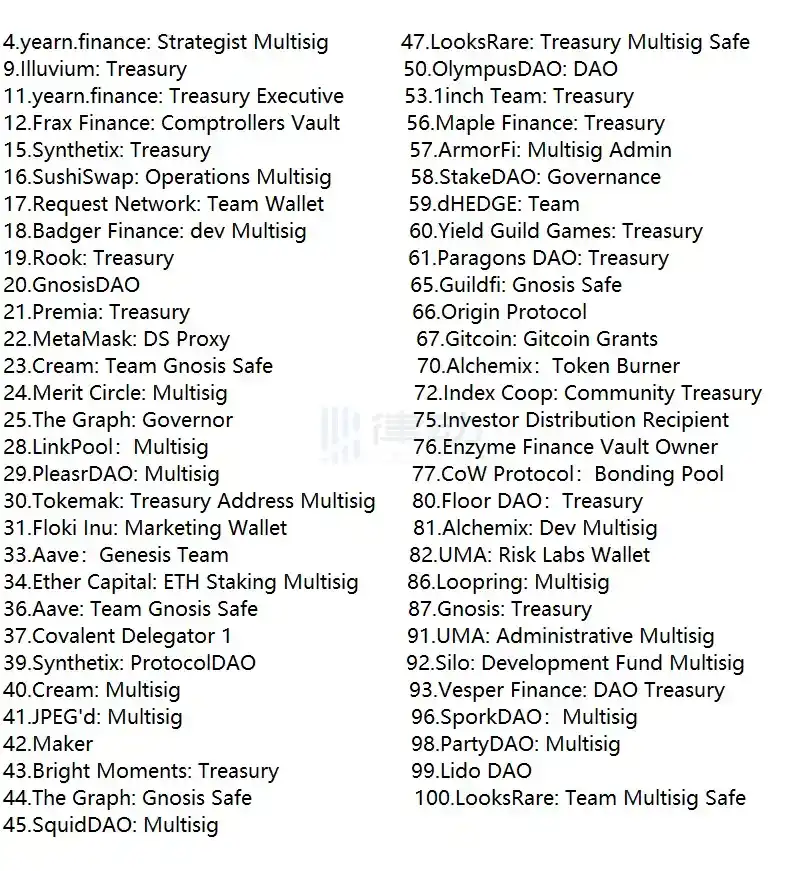
During this cycle, traditional finance, traditional institutions, family funds, and old money have accelerated their entry. However, due to the high entry barrier of crypto, many people have chosen a relatively safer way to protect their funds while engaging in on-chain activities, which is through a multi-signature wallet like Safe.
For example, the most representative is former President Trump's DeFi team.
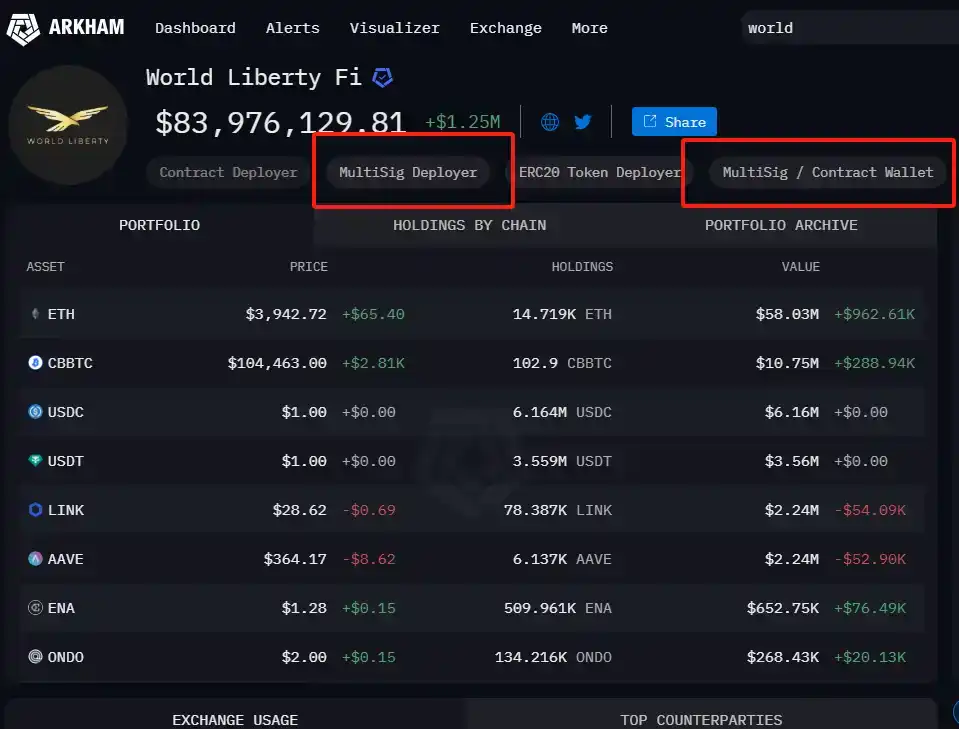
According to Safe's guardians speaking to Doozer BlockBeats, the simplest way to determine if an on-chain address is a Safe wallet address is through two methods: first is the "MultiSig" displayed on ARKHAM, and second is the "MultiSig: Safe" directly displayed below the address on the debank page. As seen in the image above, former President Trump's DeFi project World Liberity Fi indeed uses a multi-signature wallet.
This means that any security vulnerability within Safe could potentially trigger a huge chain reaction and butterfly effect.
Even Top Coin Security Infrastructure Can Encounter Issues
The Safe project is basically a blue-chip project in the Ethereum ecosystem, with its incubation team being Gnosis.
Gnosis Chain, which was a well-known Ethereum sidechain in the previous cycle, focuses on efficient and secure decentralized application development. According to DefiLlama data, as of the time of writing this article, Gnosis Chain's total value locked (TVL) is $200 million, with a peak of $350 million.
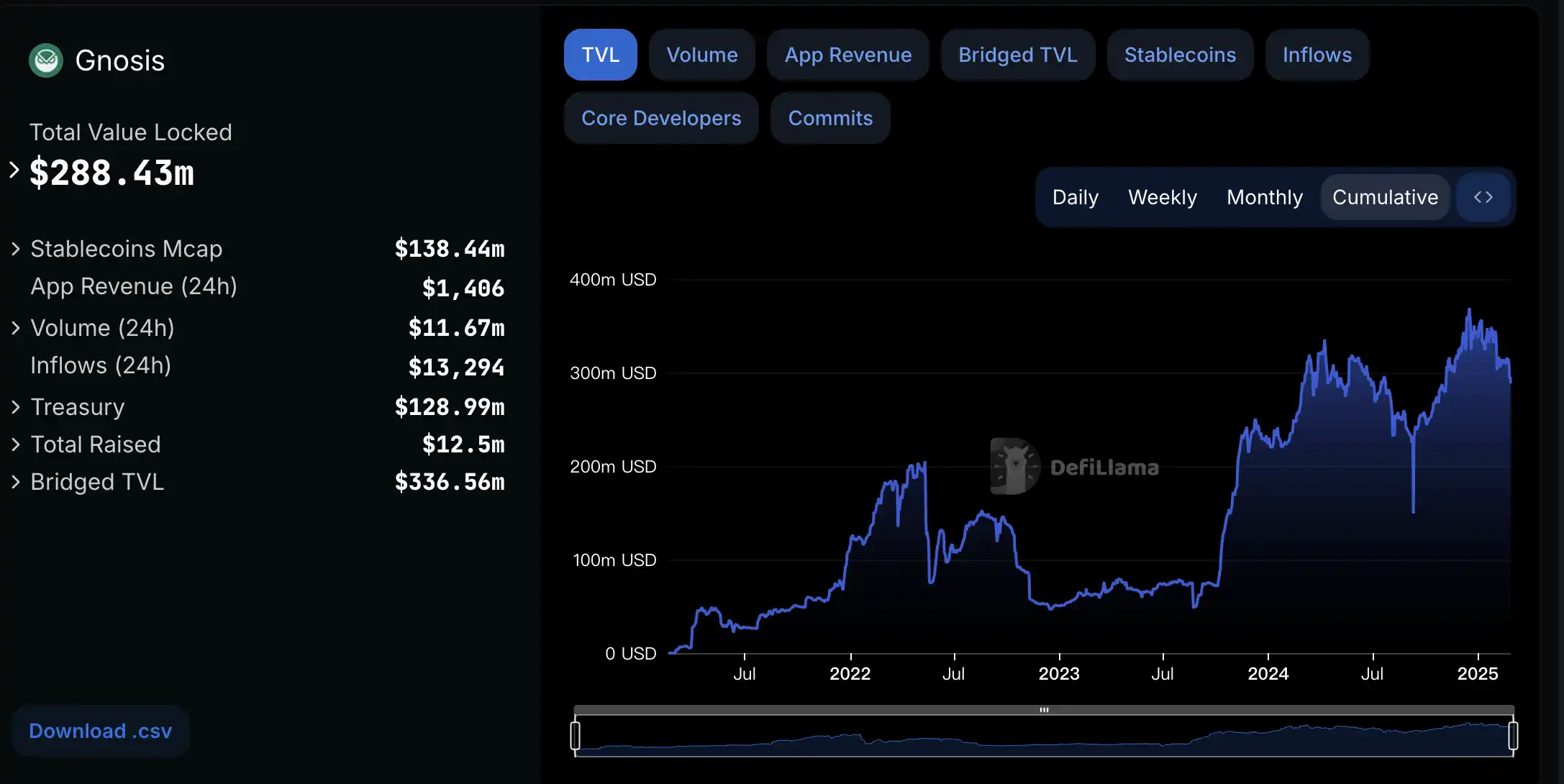
In fact, the story of the Gnosis ecosystem and incubator can be traced back to 2015.
Compared to the now well-known Polymarket, Gnosis co-founder Martin Koeppelmann began researching decentralized prediction markets much earlier. In 2015, he posted his thoughts on the combination of MarketMaker and OrderBook on his forum, which was one of the earliest concepts of a decentralized prediction market in the industry.
Martin Koeppelmann is also one of the earliest Ethereum developers, having joined before TheDAO era and being based in Berlin, he had close interactions with Vitalik, who had an office in Berlin at the time.
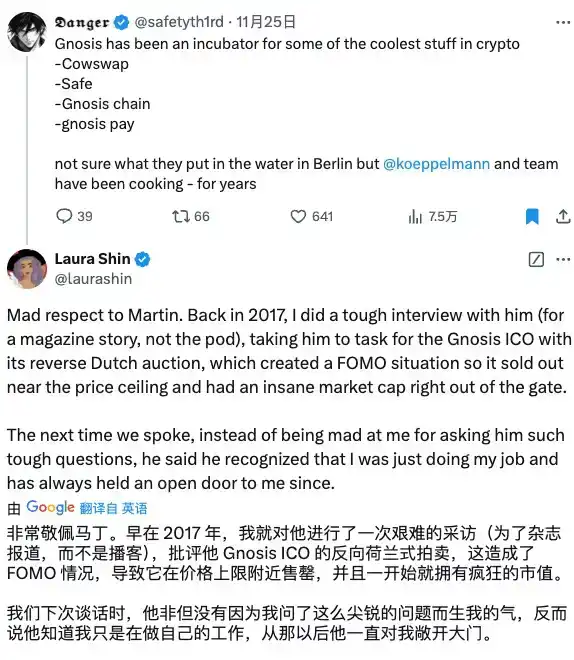
Over the years, he has been actively involved in many discussions in the Ethereum development community, often engaging with Vitalik on topics such as L2, ZK, and the Ethereum roadmap. Martin's integration into the community can also be seen from his social media presence.
Based on this technical expertise, Gnosis has gradually developed a complete ecosystem. Evolving from Gnosis Protocol to CowSwap, Martin and his team have further expanded to create products such as Gnosis Chain, Safe, and Gnosis Pay.
Has the Bear Market Signal Been Triggered?
The extensive impact of this Safe security incident has indeed caused a significant amount of panic and pessimism in the crypto community. According to Alternative.me data, today's cryptocurrency fear and greed index has dropped to 10, hitting a new low since July 2022, with the market remaining in extreme fear.
Many community members are now questioning whether multi-signature is merely a "fig leaf" decoration.?
Simultaneously, many industry practitioners are expressing reflection and concerns about the industry: "If multi-signature wallets are not secure, then who will take this industry seriously and trust it? Has the crypto industry turned into a hacker haven?"
A historical perspective shows that the end of each crypto bull market is often accompanied by major security and trust crises.
For example, the early Mt.Gox event led to a large amount of crypto assets being stolen, becoming one of the most famous hacking incidents in crypto industry history; the end of the last bull market started with a trust crisis stemming from FTX's run on the bank and Terra's collapse, severely affecting investor confidence in the entire industry.
So, what will mark the end of this bull market? Pessimistically, the Safe security incident is very likely to be one of the "signals" marking the end of this bull run.
You may also like

Deconstructing Binance Alpha2.0's New "Asia-Led Liquidity Mining" Model
After CEX and Wallet, OKX enters the payment game
Science Equity Movement: DeSci's Trillion-Dollar Knowledge Economy Reconstruction Revolution
Sentient In-Depth Research Report: Secures $85 Million in Funding to Build a Decentralized AGI New Paradigm
a16z Leads $25M Investment, 0xMiden to Run a Privacy Chain on Your Phone
Ethereum Foundation's "Three Pillars" Manifesto: From Core Vision to Decentralization Reform, Vitalik Reaffirms Mission
This is the Winter of VC, yet the Spring of KOL Agency.
Vitalik's Talk: Exploring the Ethereum 2025 Vision, Fusion Innovation of POS, L2, Cryptography, and AI
This Week in Review | Trump to Host Dinner for TRUMP Holders; Musk and US Treasury Secretary Engage in Heated Argument at the White House
Bitcoin Surges Back to $90,000: Which Altcoins Are Worth Watching?
MCP In-Depth Research Report: Protocol New Infrastructure in the AI+Crypto Mega Trend
Bull Market Returns, Can Ethereum's Pectra Upgrade Turn the Tide?
Vitalik's Long-Term L1 Execution Layer Proposal Full Text: Replacing EVM with RISC-V
Without Interest Rate Perpetuals, Will DeFi Ever be Whole?
Weekly Recap | MANTRA (OM) Plunges Sparking Controversy; Powell Emphasizes No Immediate Market Intervention
Bitcoin Eco Goes 10x Again, What Is the New Asset Protocol Alkanes?
「Methane」 is the most popular term in the recent Bitcoin ecosystem, serving as the first fairly minted token of the new Alkanes protocol in the Bitcoin ecosystem. 「Methane」
The market value of METHANE has exceeded 6 million USD, which means each METHANE is worth over 60 USD. The author inquired with some Bitcoin ecosystem players who participated in the minting process, and there is a significant difference in minting costs. If we take 5 USD per token as the minting cost benchmark, then the profit from minting METHANE has already exceeded 10 times.
In the long stagnant situation of the Bitcoin ecosystem, how did this new asset protocol Alkanes emerge?
The predecessor of the Alkanes protocol was called Protorunes, which means 「programmable runes,」 and it has the same founder. This thing also briefly caught the attention of the Bitcoin ecosystem last year, and runes were quite popular at that time.
The protocol's founder @judoflexchop is the Chief Technology Officer of the Bitcoin wallet Oyl Wallet. Although the number of users of this wallet in the Bitcoin ecosystem may not be very high, it is still well-known. Just look at its funding situation to understand why:
On March 8, 2024, the Bitcoin infrastructure company Oyl completed a 3 million USD Pre-Seed round of financing, led by Arca, with participation from Foresight Ventures, Arthur Hayes's family office Maelstrom, Domo, UTXO Management, Taproot Wizards CEO Udi Werthheimer, Kanosei, and FlamingoDAO, among others.
With Arthur Hayes's involvement, this wallet quickly gained prominence in the Bitcoin ecosystem. In the middle of last year, Oyl launched a Bitcoin NFT project called 「Airheads,」 which sparked controversy due to the relatively high minting price. In terms of the NFT's price performance, it was considered a 「failure」 project, but recently it has surged nearly three times in value due to the popularity of the Alkanes protocol.
Although they are all wallets, in the Bitcoin ecosystem, most major wallets are not just wallets. For example, OKX, UniSat, Magic Eden, and the main character of this article, Oyl, have various other Bitcoin ecosystem businesses outside of their wallets, with only Xverse having a more "focused" business scope. Returning to Oyl, in addition to the wallet, they have also developed a Bitcoin RPC called "Sandshrew" and the Alkanes protocol.
Currently, Oyl is fully focused on promoting this protocol, and the official promotion has also adopted the name Alkanes:
Alkanes is a new Bitcoin asset protocol. Overall, it draws on the "Runestone" structure of the Rune protocol, but with greater scalability and support for smart contracts. As mentioned earlier, the predecessor of this protocol was Protorunes. At first glance, Protorunes may seem like a "customized version of Rune," but it is not. In simple terms, the Rune protocol and the "Runestone" structure are like a closed iOS system, while Protorunes and Alkanes are like open-source Android.
Protorunes corresponds to the "Runestone" of the Rune protocol. Here, "Runestone" is not the highly valuable early NFT of the Rune system but rather a "transaction data encapsulation," in short, a piece of information embedded in a Bitcoin transaction that serves as an index to determine if there is any Rune operation in the transaction.
If the indexer discovers the "RUNES" identifier while scanning the OP_RETURN of each transaction, it interprets the data following the identifier, such as etching, minting, transferring, and so on. The "Runestone" acts as an operational guide, and the indexer derives indexing results based on this guide.
The "Runestone" is exclusively for the Rune protocol's operational guide, directly corresponding to the Rune protocol, unlike Protorunes. Simply put, we cannot instruct the indexer of the Rune protocol to perform such actions directly, saying, "I am a sub-asset protocol based on Runestone; please index me together." However, Protorunes can. Everyone can customize their new asset protocol based on the Protorunes data format, and these protocols will be assigned a "Protocol ID." The indexer will read the "Protocol ID" to determine which protocol's specifications to parse.
There are some modular blockchain launch frameworks like Ethereum's, which make things simpler. For developers, they can just use the tools provided by Oyl instead of having to build their own indexer.
On the smart contract implementation front, before OP_CAT's revival, it was basically limited to storing contract data in transactions and executing off-chain indexes, not deviating too much from that approach.
On a technical level, apart from technology, there are two main reasons why this protocol could gain momentum. Firstly, it has received strong support from the Chinese inscription player community. Undoubtedly, the most financially capable group in the Bitcoin ecosystem currently is the Chinese inscription player community. This group is quite unique, as the PvP aspect of Solana meme coins is redundant in the Bitcoin ecosystem, but gaining approval from the Chinese inscription player community is also quite challenging. Once the inscription gains momentum, the spread speed within WeChat groups will be rapid and influential.
Searching for the keyword "Alkanes" on Twitter, one will find that most of the content comes from Chinese users, and the protocol's founder has also posted Chinese tweets thanking the Chinese community for their support. The early Bitcoin ecosystem minting tool, iDclub, created a transaction market for the Alkanes protocol, also coming from Chinese hands.
The second reason is that the project team behind this protocol has a background, and according to their disclosed plans, they don't just intend to launch an asset protocol to "funnel" into their own wallet. They also plan to develop AMM, BTC staking, stablecoins, MEV tools, and a trustless ZK bridge, essentially creating a BTCFi ecosystem around this protocol.
The entire narrative logic is coherent—a smart contract-supported asset protocol used to build applications around it. Without the backing of the project team to explain this narrative, it's hard to convince people. After all, in the Bitcoin ecosystem, players still feel some pain from Atomicals' decline, and there is too much uncertainty when big things are not done by a mature team.
- METHANE, the first fairly minted token of the Alkanes protocol, currently with a market cap of about $6 million. The Chinese meaning of Alkanes is "alkanes," while the Chinese meaning of METHANE is indeed "methane," so players also mention BUTANE "butane" and HEXANE "hexane," but these two tokens currently have market capitalizations of only around $250,000 each.
- DIESEL, from the official team and also the first token deployed by the Alkanes protocol, currently valued at around $12.6 million. This coin has a unique mechanism, with a total supply of only 1,562,500 tokens, 28% reserved for the team, and 72% being produced block by block along with each Bitcoin block, with production halving following Bitcoin's halving schedule. In each block, the miner who submits the highest fee for a DIESEL minting transaction will ultimately receive the block's DIESEL output. In summary, a DIESEL is minted per block, and only one person (the miner whose fee for the minting transaction was the highest) can mine DIESEL in each block. Ordinary players can hardly mint anymore, and scientists will automatically monitor and increase the miner fee continuously.
Since METHANE is fairly launched, the holder base/chip distribution is definitely healthier compared to DIESEL, and it is fully circulating. Therefore, currently on social media platforms, the volume of METHANE is much higher than that of DIESEL. Purely based on volume rather than market value, it would feel like METHANE is leading the pack. There is no information available from the official sources about DIESEL's future empowerment. Thus, in terms of community engagement, METHANE is far superior, while DIESEL excels in official background and potential future empowerment expectations.
This protocol is still in its very early stages. Various wallets have not caught up with support for assets of this protocol yet, so it is best to use Oyl Wallet for interacting with assets of this protocol to ensure asset security.
Essentially, the success of this protocol has ticked off all the key success factors of a new asset protocol in the Bitcoin ecosystem — "Mainnet Asset," "Fair Launch," and "Community Support." Additionally, it has "Smart Contracts" and a narrative on the ecosystem layer. In the long-standing quietness of the Bitcoin ecosystem, it has still managed to stand out. Hopefully, the ecosystem can be further developed and progress even further in the future.
ArkStream Capital: The Power Play of WLFI's CEX-DEX Convergence
How to Mine on HyperEVM and Earn Rewards?
Editor's Note: The HyperEVM ecosystem has attracted miners due to the HYPE token's solid tokenomics and value accrual. Surrounding protocols such as @upshift_fi, @stakedhype, @HyperSwapX, @hyperlendx, @HypurrFi, and @felixprotocol, the article explores strategies such as staking, LP, and lending, with rewards including APY, points, and potential airdrops. However, the ecosystem is still in its early stages, so caution is advised to avoid risks associated with unverified protocols.
The following is the original content (slightly restructured for readability):
Why Choose HyperEVM?
Intuition tells me it will be very profitable, and HYPE is one of the few meme coins with value accrual, product-market fit (PMF), and a solid tokenomics.
A premium DeFi ecosystem is forming around high-quality collateral.
This is the easiest "set-it-and-forget-it" mining strategy.
The hbHYPE treasury dynamically allocates deposits to DeFi protocols in the HyperEVM. It utilizes delta neutral strategies, capital arbitrage, and various other methods to maximize returns.
By depositing WHYPE, you can receive a 6.0% Annual Percentage Yield (APY) + ecosystem points (5x Upshift, Hyperbeat, @hyperlendx, @hyperpurrfi, @HyperSwapX, @TimeswapLabs, and @silhouette_ex).
Upshift is backed by @dragonfly_xyz, with $235 million in deposited assets on the platform.
HYPE's primary liquidity staking token (LST) can be used in DeFi to earn additional rewards.
This is built by @thunderheadxyz; I am not sure if there will be a protocol token, but stHYPE holders can be quite confident they will be rewarded through Jeff's HYPE airdrop in the future.
Wrap your stHYPE with HyperSwapX and provide liquidity on different pairs (e.g., HYPE/stHYPE).
Earn rewards + HyperSwapX points.
Deposit HYPE, wstHYPE, or UBTC (using @hyperunit) to earn rewards + HyperLend points.
The current pool is full, so please check for availability or a potential limit increase.
HyperLend has been officially recognized by AAVE DAO as a friendly fork, and will share revenue and tokens with AAVE.
Borrow USDXL by collateralizing wstHYPE.
You can also use @hyperunit to supply BTC and ETH as collateral and borrow USDXL. Earn HypurrFi points.
Swap USDXL for feUSD and deposit into the Felix protocol.
The returns in the current HYPE pool are higher than the borrowing cost of USDXL + you can earn Felix points.
Felix currently has a considerable TVL and borrowing volume.
There are more applications to explore, but this is my current summary (not an expert, still figuring it out).
I focus on audited protocols with a higher TVL (of course, there is still risk). There will certainly be more high-risk, high-reward opportunities.
We know Hyperliquid will allocate incentives for HyperEVM users, so I believe earnings will be boosted through retroactive HYPE.
However, please note that the HyperEVM ecosystem is still in its very early stages. I wouldn't risk more than I'm willing to lose. Don't do stupid things and invest too much in protocols that haven't been battle-tested for a long time.
「Original Article Link」