
Without Interest Rate Perpetuals, Will DeFi Ever be Whole?


Original Article Title: Interest Rate Perpetuals: DeFi's missing piece
Original Article Author: @defiance_cr
Original Article Translation: zhouzhou, BlockBeats
Editor's Note: DeFi lacks a rate perpetual contract tool similar to CME, leading to significant interest rate fluctuations and an inability to hedge risks. Introducing rate perps can help both lenders and borrowers lock in rates, achieve arbitrage and risk management, and promote the integration of DeFi and TradFi, enhancing market efficiency and stability.
The following is the original content (slightly reorganized for readability):
At the Chicago Mercantile Exchange (CME), the daily trading volume of interest rate futures exceeds one trillion dollars. This massive volume is primarily driven by banks and asset managers who operate by hedging the risk between floating-rate and fixed-rate loans already issued.
In DeFi, we have already established a thriving floating-rate lending market, with a total locked value exceeding 300 billion dollars. Pendle's incentivized order book has liquidity exceeding 200 million dollars in a single market, demonstrating a strong market demand for spot interest rates.
However, we still lack a DeFi-native tool like CME interest rate futures to hedge interest rate risk for both lenders and borrowers (excluding IPOR swaps, as they are too complex).
To understand why we need this tool, we first need to understand how interest rates operate in DeFi.
Take AAVE as an example, where its interest rates are dynamically adjusted based on supply and demand. However, AAVE's supply and demand are not isolated but nested within the broader context of the global economy.
Comparing AAVE's smoothed USDC floating rate with CME's 10-year Treasury futures price on a chart, we can see this macroeconomic correlation:
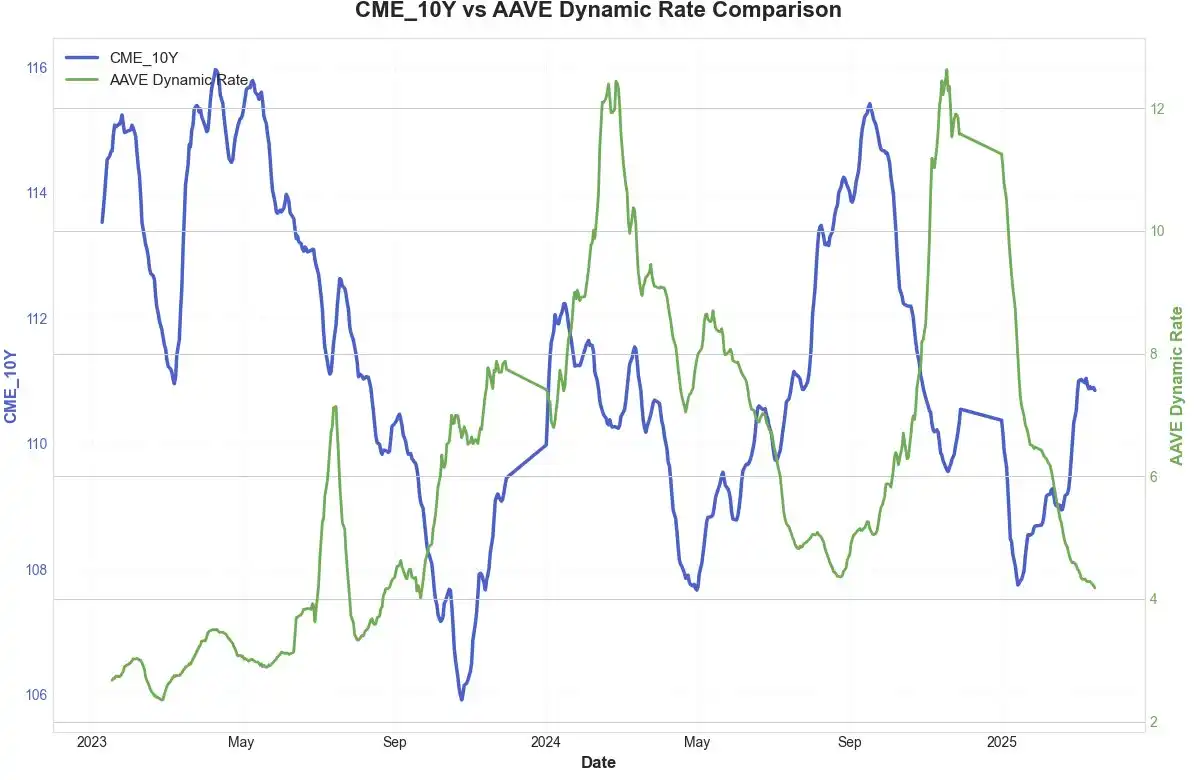
AAVE's USDC rate trend aligns with global rates but with some lag. The primary reason for this lag is the lack of an immediate linkage mechanism between global rates and AAVE rates.
It is precisely this discontinuity that allows the supply and demand dynamics of the crypto market to play a stronger role in interest rate formation. When we eliminate the smoothing process and directly compare AAVE's rate with the global 10-year Treasury rate on a chart, this phenomenon becomes more pronounced:
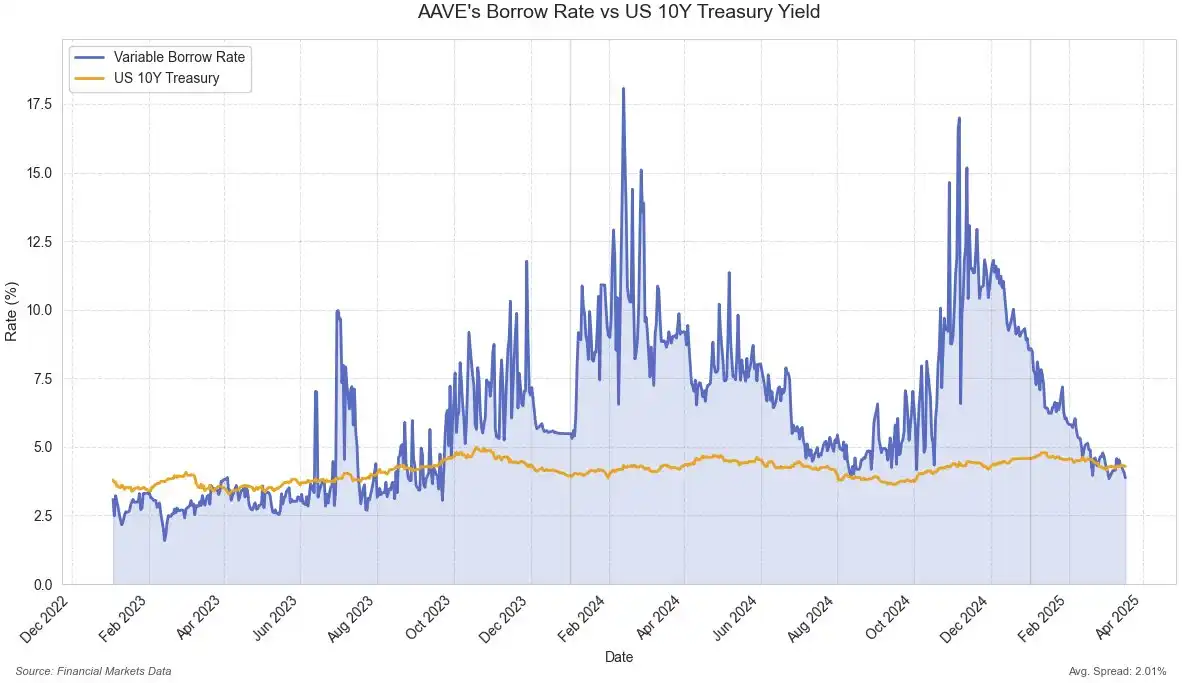
The interest rate of AAVE is highly volatile, and most of the time, it carries a significant premium compared to the U.S. 10-year Treasury bond rate.
The fundamental reason for this premium is still the lack of a direct link between these two markets. If there were a simple, two-way connection mechanism between DeFi and TradFi interest rates for hedging or arbitrage, it would better integrate the two ecosystems.
And the **Interest Rate Perpetual Swap** is precisely the best way to achieve this. Perp has already been validated by the market as a fit product-market fit (PMF). If a perpetual market covering AAVE rates and U.S. Treasury rates could be established, it would bring about significant change.
For example:
- For borrowers, they can long a perpetual swap tied to the AAVE borrowing rate. If the borrowing annual rate surges from 5% to 10%, the price of this perpetual swap will rise, thus hedging against the risk of increased costs.
Conversely, if the rate decreases, borrowing becomes cheaper, but the perpetual position incurs losses, akin to paying an "insurance premium." In this way, borrowers effectively lock in a fixed rate by borrowing + longing the perpetual swap.
- For stablecoin lenders, they can short a perpetual swap based on the stablecoin lending rate. If lending returns decline, the short position in the perpetual swap profits, offsetting the loss from reduced loan income; if returns increase, the short incurs losses, but interest income rises, creating a hedge.
Moreover, these contracts can also utilize high leverage. In the interest rate markets on CME, 10x leverage is a common setup.
Having a liquid interest rate market can also reduce cascading liquidations during market stress. If market participants hedge in advance, they will not be forced to make large withdrawals or close positions due to interest rate fluctuations.
More importantly, this also opens the door to truly long-term fixed-rate loans—if this interest rate perpetual swap is entirely DeFi-native, it can be used by various protocols for long-term rate hedging, thus providing users with fixed-rate loans.
In traditional finance, hedging interest rate risk is a routine operation, and most long-term loans have interest rate hedging tools behind them.
Introducing this mechanism into DeFi can not only improve efficiency but also attract more TradFi players into this market, truly bridging the gap between DeFi and TradFi.
We can make the market more efficient, and all it takes is the emergence of a perpetual interest rate swap.
You may also like

Perp DEX: The Next Generation Exchange "War"

The AI gamble of mining companies: Valuations enter a phase of differentiation, and it's hard to turn the tide

A letter from Alliance to entrepreneurs: Written on the occasion of Cursor selling for 60 billion dollars

Stablecoins Finally Find Real Returns: On-Chain Reinsurance Re Explained | Interview with Re Founder Karan Saroya

The impossible triangle is simply a pseudo problem

Will MicroStrategy fall into a death spiral? What will the macro trend be in the second half of the year?

Blockchain Capital Partner: The Core Secret of Arbitrage
STRC unanchored by 11%, can the perpetual motion machine of Strategy still operate?

Bitcoin Market Analysis 2026: Can BTC Reach $150K by Year-End?
Bitcoin ETF Outflows Hit a Record $4.4 Billion: What Are Traders Doing With Their Cash?
WEEX App Just Got Smarter – New Tabs for Faster Trades & Easy Asset Management

WEEX All-New Search Features: Find, Trade & Earn Faster Than Ever

Morning Report | Illinois signs the strictest digital asset tax law in the U.S.; RWA tokenization market size surpasses $43 billion, institutions accelerate the migration of on-chain assets
Full version of the debut Q&A! Federal Reserve Chairman Waller: Sticking to the 2% inflation target, establishing five special working groups, individual did not submit the dot plot

From Disruptor to Shadow Market: The Crypto Market is Becoming a Colony of Traditional Finance
Dalio's important long article: How to position in the current market environment?
OKX Star analyzes Binance's competitive advantages: when regulation levels the playing field, competition has just begun
New gameplay for participating in initial offerings on cryptocurrency exchanges
Perp DEX: The Next Generation Exchange "War"
The AI gamble of mining companies: Valuations enter a phase of differentiation, and it's hard to turn the tide
A letter from Alliance to entrepreneurs: Written on the occasion of Cursor selling for 60 billion dollars
Stablecoins Finally Find Real Returns: On-Chain Reinsurance Re Explained | Interview with Re Founder Karan Saroya
The impossible triangle is simply a pseudo problem
Will MicroStrategy fall into a death spiral? What will the macro trend be in the second half of the year?


