
- Buy Crypto
- Markets
- Futures
- Spot
- Copy Trade
 Earn
Earn- More
Strategy: Buy 10,000 BTC in a Single Week, How Much More Can Be Bought on the Market?

Original Article Title: "Strategy Buys 10,000 BTC in a Single Week, How Much More Can Still Be Bought in the Market?"
Original Article Author: Ding Dang, Odaily Planet Daily
Over the past two weeks, Strategy once again significantly increased its Bitcoin holdings: acquiring over 10,000 BTC in a single week, worth over 9 billion USD.
As a well-known long-term holder in the market, amidst a continuous downtrend in Bitcoin's price and Strategy's own mNAV falling below 1, Strategy not only did not sell as the market feared, but instead provided a completely opposite response—steadfast buying. As of now, Strategy holds approximately 671,000 BTC, with a total value exceeding 50 billion USD, solidifying its position as one of the world's largest Bitcoin holding institutions.
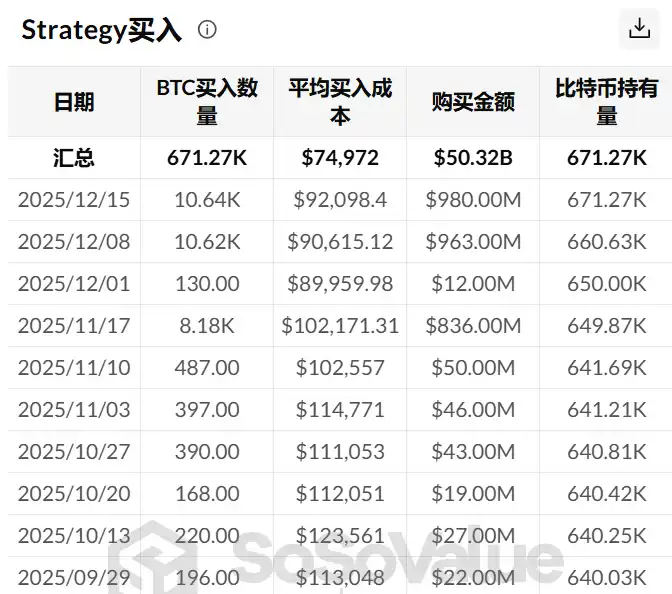
This move has also sparked deeper market contemplation: with such massive and sustained purchases, how much Bitcoin truly available for trading is left in the market?
While Bitcoin's theoretical limit is indeed 21 million coins, the actual circulating supply is much smaller. Approximately 19.96 million coins have already been mined, accounting for 95% of the total, with only about 1.04 million coins yet to be produced. The current block reward is 3.125 BTC, with a daily addition of around 450 coins, and will halve again in 2028. At this rate, the last Bitcoin is expected to be mined around 2140.
However, what truly determines market supply is not the yet-to-be-mined new coins, but the liquid portion within the existing supply.
According to statistics, over 30% of Bitcoin has not moved long-term, labeled as "dormant holdings"; another approximately 20% is presumed permanently lost. Additionally, institutional and public holdings, including those of listed companies, ETFs, and national funds, continue to rise, and most of these BTC are not actively circulating. Furthermore, Bitcoin balances on exchanges have reached multi-year lows, indicating that the "available for immediate sale" liquidity is rapidly shrinking. Against the backdrop of whales quietly accumulating, and long-term holders reluctant to sell, the market liquidity is facing structural tightening.
In response to the issue of Bitcoin's actual circulating supply, crypto analyst Murphy conducted a comprehensive analysis. Odaily Planet Daily further integrated data and perspectives based on their work, attempting to present the full picture of the scarcity narrative—when buying pressure persists while sellable supply diminishes, the market landscape may be quietly shifting.
Institutional HODLers Engaging in "Structural HODLing," Taking Over Circulating Chips
Long-term HODLers have become the most important structural force in the Bitcoin market. According to Glassnode statistics, this group collectively holds about 14.35 million BTC, representing over 70% of the circulating supply.
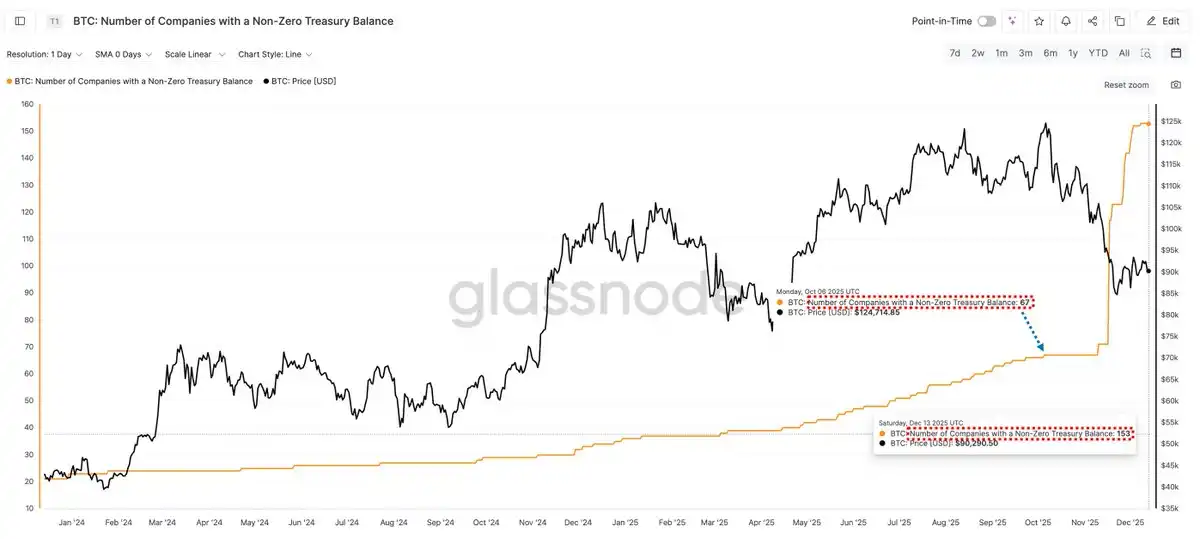
Further breakdown. There are currently 153 companies holding a non-zero balance of BTC, with the most prominent being 29 publicly traded companies holding a total of 1.082 million BTC (where Other holds 54,331 BTC). Among these 29 publicly traded companies, one company, Strategy, holds 671,000 BTC, accounting for a high 62% of the total.
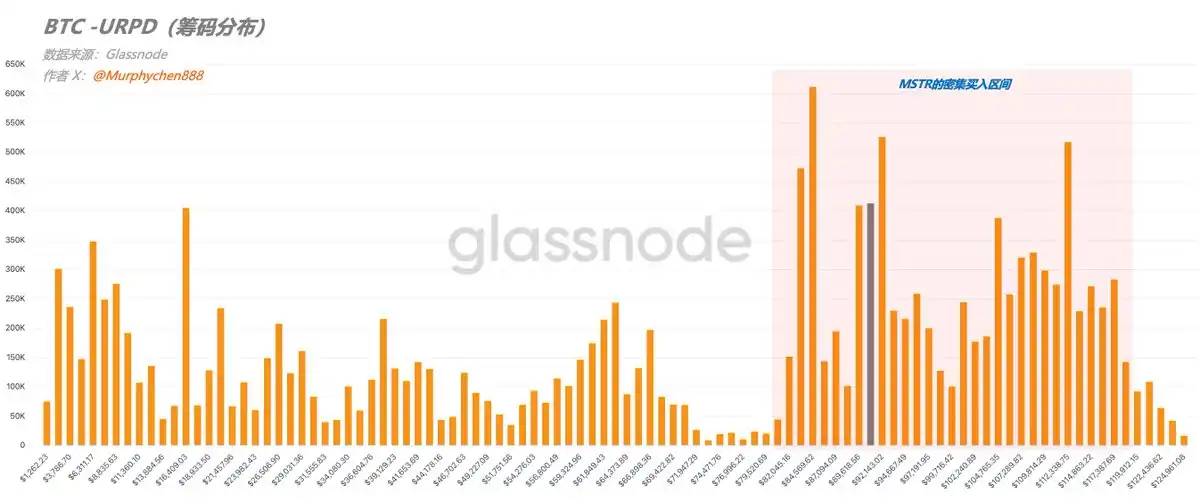
When considering URPD (UTXO Realized Price Distribution) data, Strategy's intensive buying range happens to be the most densely stacked area in the BTC chip structure, mainly concentrated between $80,000 and $118,000. This indicates that Strategy has indeed played a significant role in the high-chip range turnover. This is also why MSTR and ETF are considered the driving forces of this bull market cycle.
It is worth noting that on October 6th, there were only 67 companies holding "non-zero balance BTC," and with BTC's deep retracement, this number suddenly surged to 153. Does this mean that new enterprise players are quietly entering during the price decline?
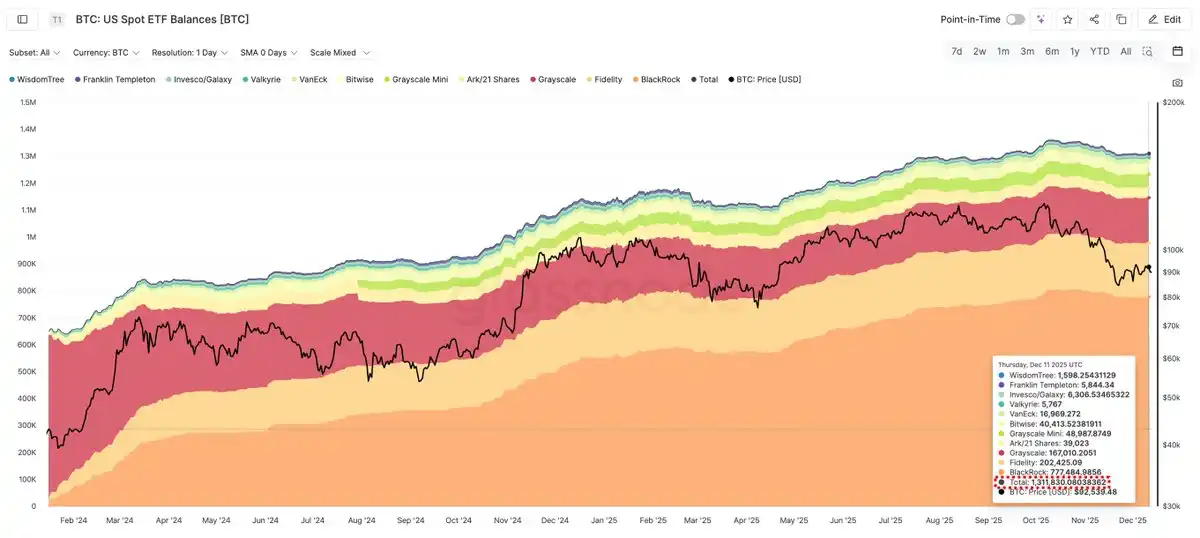
In addition to the BTC held by physical enterprise reserves, as of now, physical Bitcoin ETFs collectively hold about 1.311 million BTC. Among them, the top three are: BlackRock with about 777,000 BTC, Fidelity with about 202,000 BTC, and Grayscale with about 167,000 BTC.
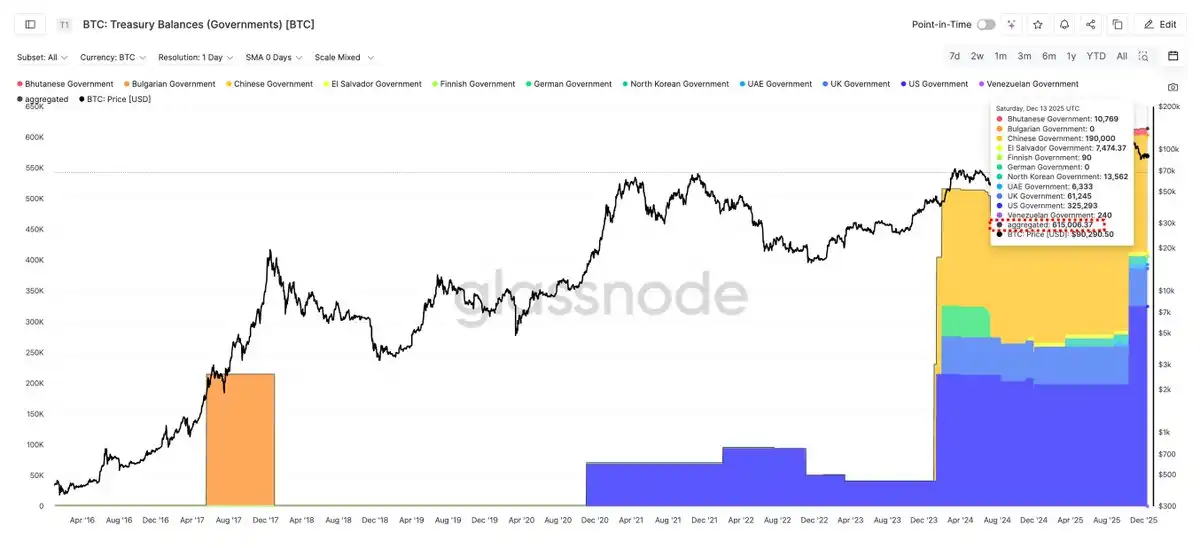
Furthermore, the total amount of Bitcoin held by governments around the world is about 615,000 BTC. Among them, the U.S. government holds the top spot with 325,000 BTC; and the second-ranking is the Chinese government with approximately 190,000 BTC. It is important to note that the Chinese government has never officially disclosed its holdings, and this data is mainly from Glassnode, with some uncertainty in its statistical methodology compared to the actual situation.
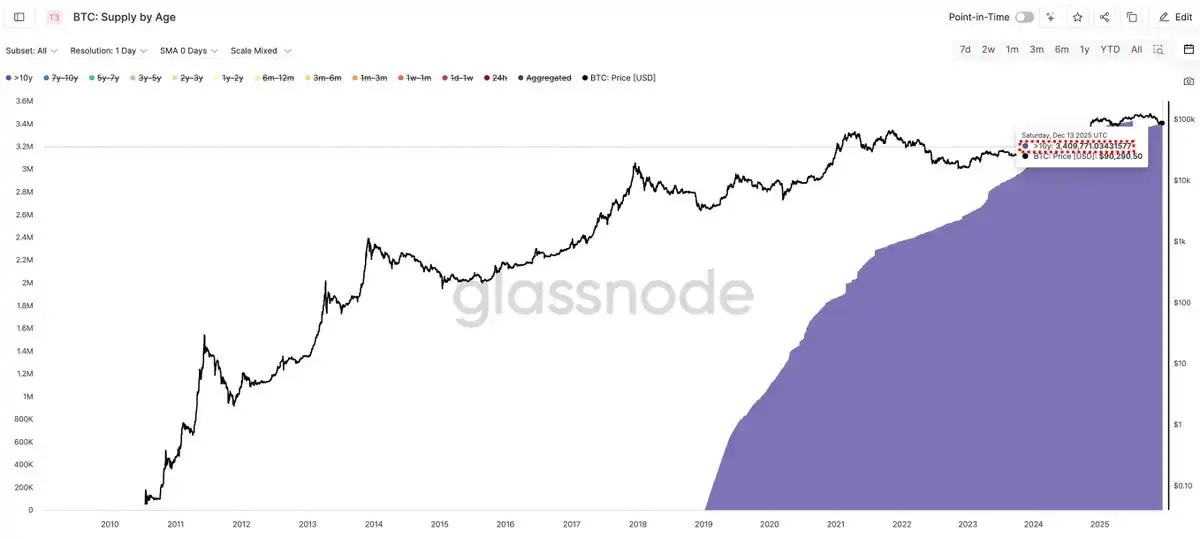
Furthermore, the number of bitcoins that have been held without movement for over 10 years is approximately 3.409 million coins. This portion of the assets includes cold wallets from early exchanges as well as true "believer-type OGs." However, it is equally important to note that a significant portion of these coins has likely exited the circulating supply due to reasons such as lost private keys or the passing of the holders, including approximately 1 million BTC widely believed to belong to Satoshi Nakamoto.
How Much of the Mined BTC Is Actually "Unspendable"?
Murphy later provided a more detailed analysis of this data. Because Bitcoin does not have a "forgot password, reset" feature like traditional bank accounts and relies entirely on private keys to prove ownership. Once a private key is lost or inaccessible, the corresponding bitcoins can never be moved or spent, even though they are still recorded on the blockchain, they are effectively considered permanently destroyed in economic terms.
If we divide the circulating supply by date range, each date range refers to the creation date of a UTXO. Then, we can see that the peak of Bitcoin aged between 2010-2014 appeared in December 2014, rapidly declined (spent); and there has been almost no significant change since January 2019.
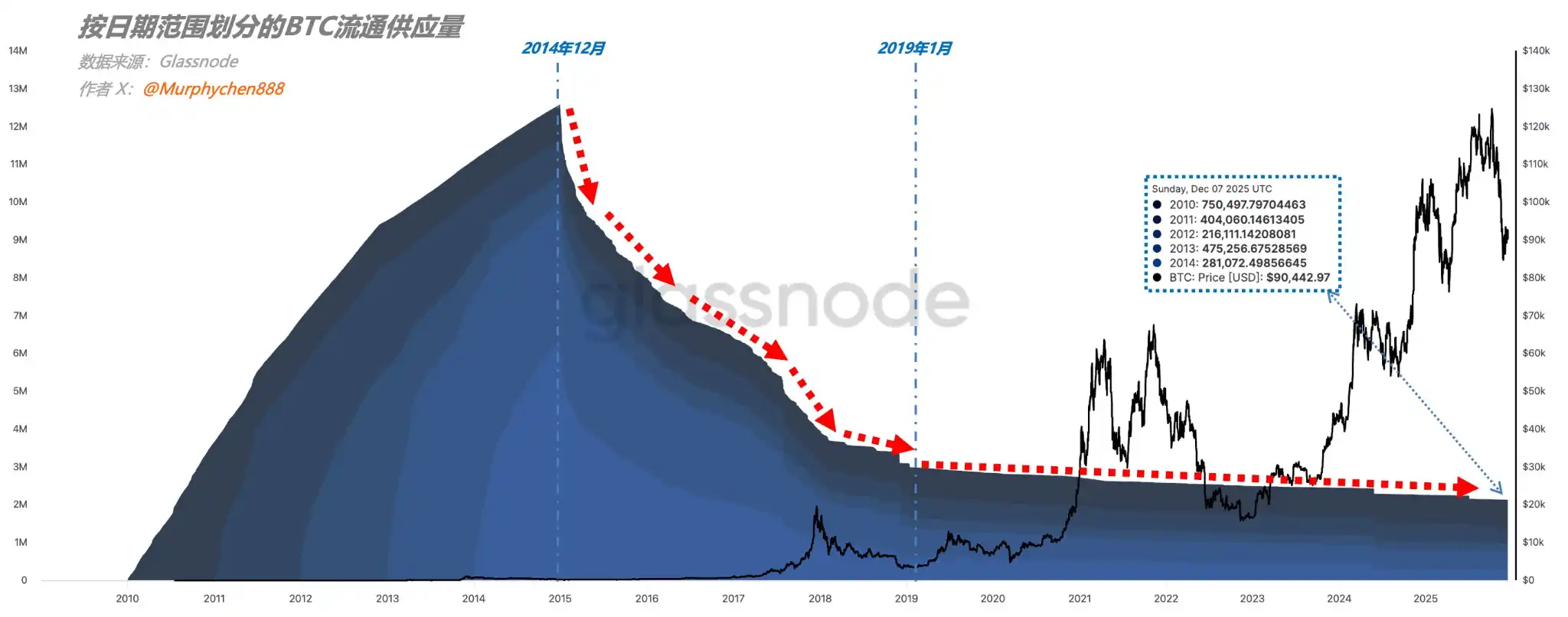
These ancient bitcoins that have been held until today, apart from the holders with unwavering faith, have mostly been lost. According to Murphy's estimation, this proportion is at least 50% or more, meaning at least 1.06 million coins or more.
There is also a set of "Satoshi-era" coins, with a UTXO creation date in 2009. They have hardly moved since December 2011 and to this day, this group of addresses holds 1.08 million BTC.
In other words, at least about 2.14 million BTC may effectively be permanently unspendable.
Truly Circulating Supply
If we look at the most direct indicator, the exchange platform balances, the current amount of Bitcoin held in exchange wallets is approximately 2.49 million coins, and this trend is continuously declining, reaching a new low since 2023.
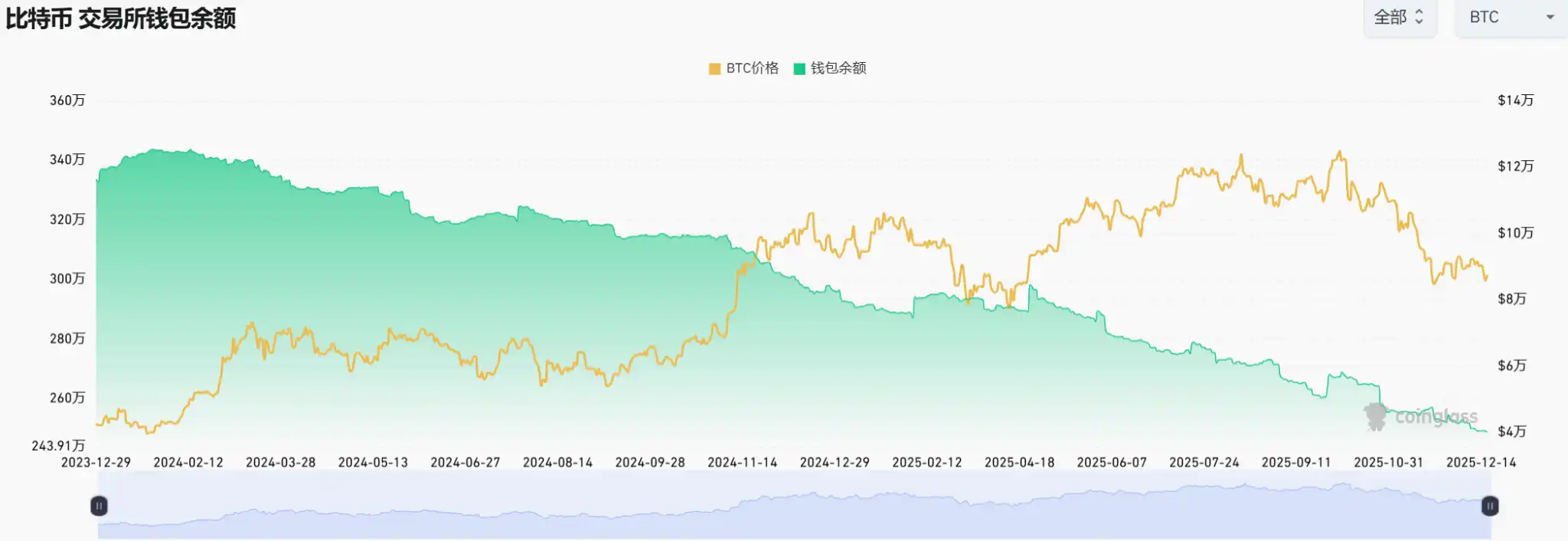
That is to say, as the demand side continues to 'institutionalize,' the supply side is shrinking, and the current pool of available Bitcoin for trading is also becoming smaller and smaller.
You may also like

AI in the Crypto Market: How Artificial Intelligence is Changing Trading Strategies
This article explores how AI contributes to these movements and share practical strategies to help you navigate an AI-powered crypto market.

Cross-chain Collaboration: Tom Lee Invests $200 Million, Joins Forces with Global Top Streamer Mr. Beast

Trump Waves Hand, Stirs Venezuela's Game Hurricane

VanEck Q1 Market Outlook: Long-Term Bullish on Cryptocurrency, Strong Gold Demand

ThunderChain Resumes Legal Battle as Former CEO Chen Lei Accused of Embezzlement for Cryptocurrency Speculation - What Happened Back Then?

Key Market Intelligence for January 15th, how much did you miss out on?

XRP Price Action: Crypto Bill Could Grant XRP the Same Legal Designation as Bitcoin
Key Takeaways A new legislative draft in the United States might classify XRP alongside Bitcoin (BTC) and Ethereum…

Asia Market Open: Bitcoin Nears $96K Amid Mixed Asian Stocks and Wall Street Slump
Key Takeaways Bitcoin’s price edges closer to $96,000 amid mixed signals from Asian stock markets and a recent…
Transforming the Cryptocurrency Landscape: A 2026 Outlook
Key Takeaways Cryptocurrency systems have seen expansive growth and technological innovation. The introduction of new regulations has reshaped…
Pi Coin Price Prediction: Mainnet Tokens Just Unlocked – What Does This Mean for Holders?
Key Takeaways Daily token unlocks are increasing the supply of Pi Coin, affecting its short-term price stability. Pi…

Best Crypto to Buy Now January 14 – XRP, PEPE, Internet Computer
Key Takeaways The current crypto landscape is at a pivotal junction with potential changes in U.S. regulations offering…

Crypto Price Prediction Today 14 January: XRP, PEPE, Maxi Doge
Key Takeaways Amidst a blossoming crypto market, altcoins such as XRP, PEPE, and Maxi Doge are showing promising…

Bitnomial Debuts the First U.S.-Regulated Aptos Futures
Key Takeaways: Bitnomial has launched the first U.S.-regulated futures contracts for Aptos, extending a new avenue for institutional…

Why Is Crypto Up Today? – January 14, 2026
Key Takeaways Cryptocurrency market capitalization has risen by 3.6% to $3.33 trillion, with 95 of the top 100…

Current Landscape of Cryptocurrency Exchanges in 2026
Key Takeaways The cryptocurrency exchange market is notably competitive, with each platform offering unique strengths to attract users.…

Senate Crypto Bill Markup Rescheduled to January 27 Amid Legislative Momentum
Key Takeaways The Senate Agriculture Committee has rescheduled the release of the legislative text for crypto market structure…

Bitcoin Registers Movement Amidst Market Volatility
Key Takeaways Bitcoin briefly dipped below 96,000 USDT, now trading at approximately 95,986.1875 USDT. Despite fluctuations, Bitcoin experienced…
Bitcoin Climbs Over $97,000, Signalling Investor Optimism
Key Takeaways Bitcoin’s price briefly surged past $97,000, reflecting a market shift towards optimism. The cryptocurrency’s market capitalization…
AI in the Crypto Market: How Artificial Intelligence is Changing Trading Strategies
This article explores how AI contributes to these movements and share practical strategies to help you navigate an AI-powered crypto market.


 App
App