
- Buy Crypto
- Markets
- Futures
- Spot
- Copy Trade
 Earn
Earn- More
Crypto ETF Fund Outflows: Is BlackRock and Other Issuers Still Making Money?

Original Article Title: When Wrappers Run Red
Original Article Author: Prathik Desai, Token Dispatch
Original Article Translation: Luffy, Foresight News
During the first two weeks of October 2025, Bitcoin spot ETFs saw inflows of $32 billion and $27 billion, setting records for the highest and fifth-highest weekly net inflows in 2025.
Prior to this, Bitcoin ETFs were on track to achieve a "no consecutive outflow week" milestone in the second half of 2025.
However, the most severe cryptocurrency liquidation event in history occurred unexpectedly. This event, which resulted in the evaporation of assets worth $190 billion, continues to haunt the crypto market.
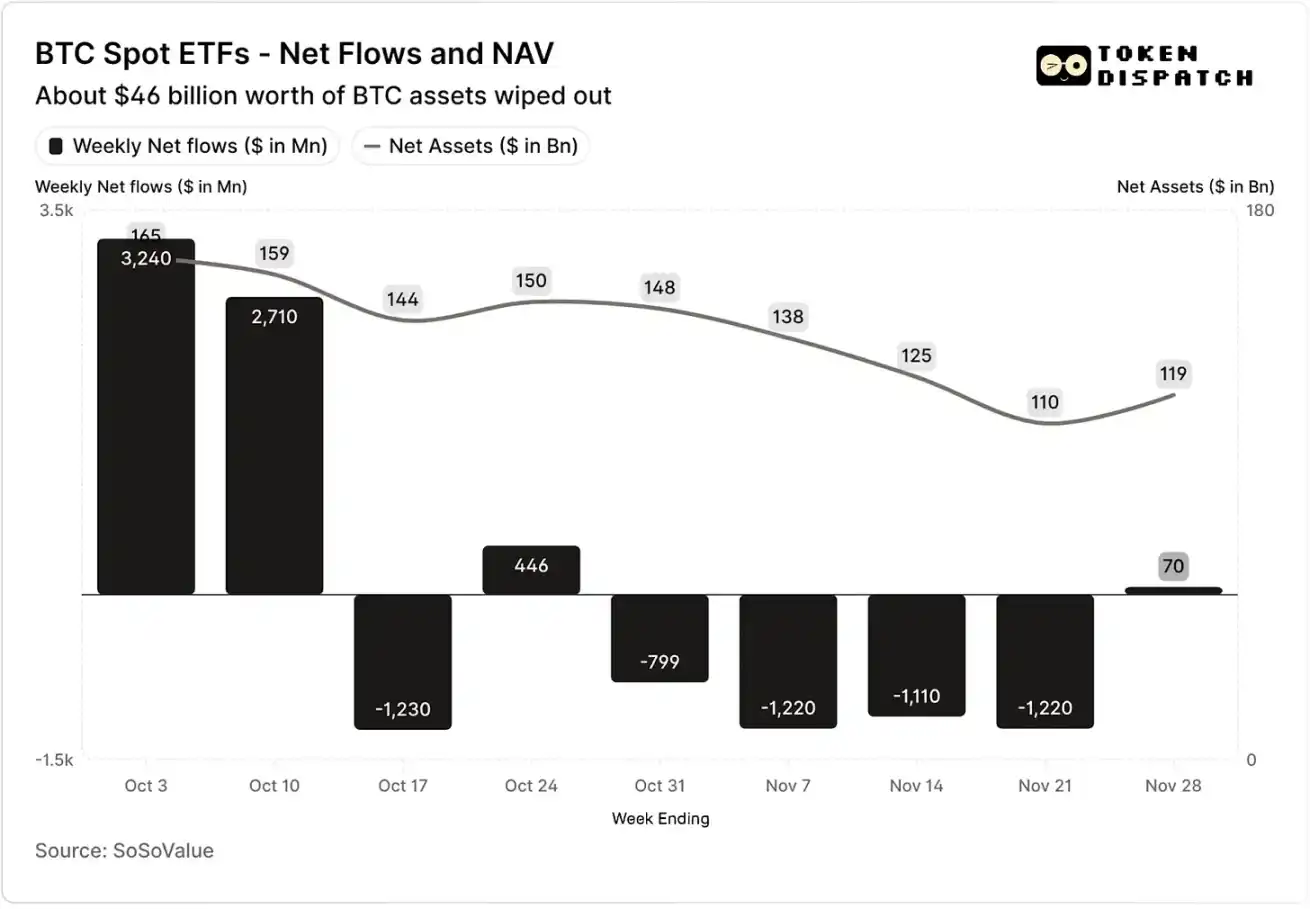
Net Fund Flows and Asset Net Value of Bitcoin Spot ETFs in October and November
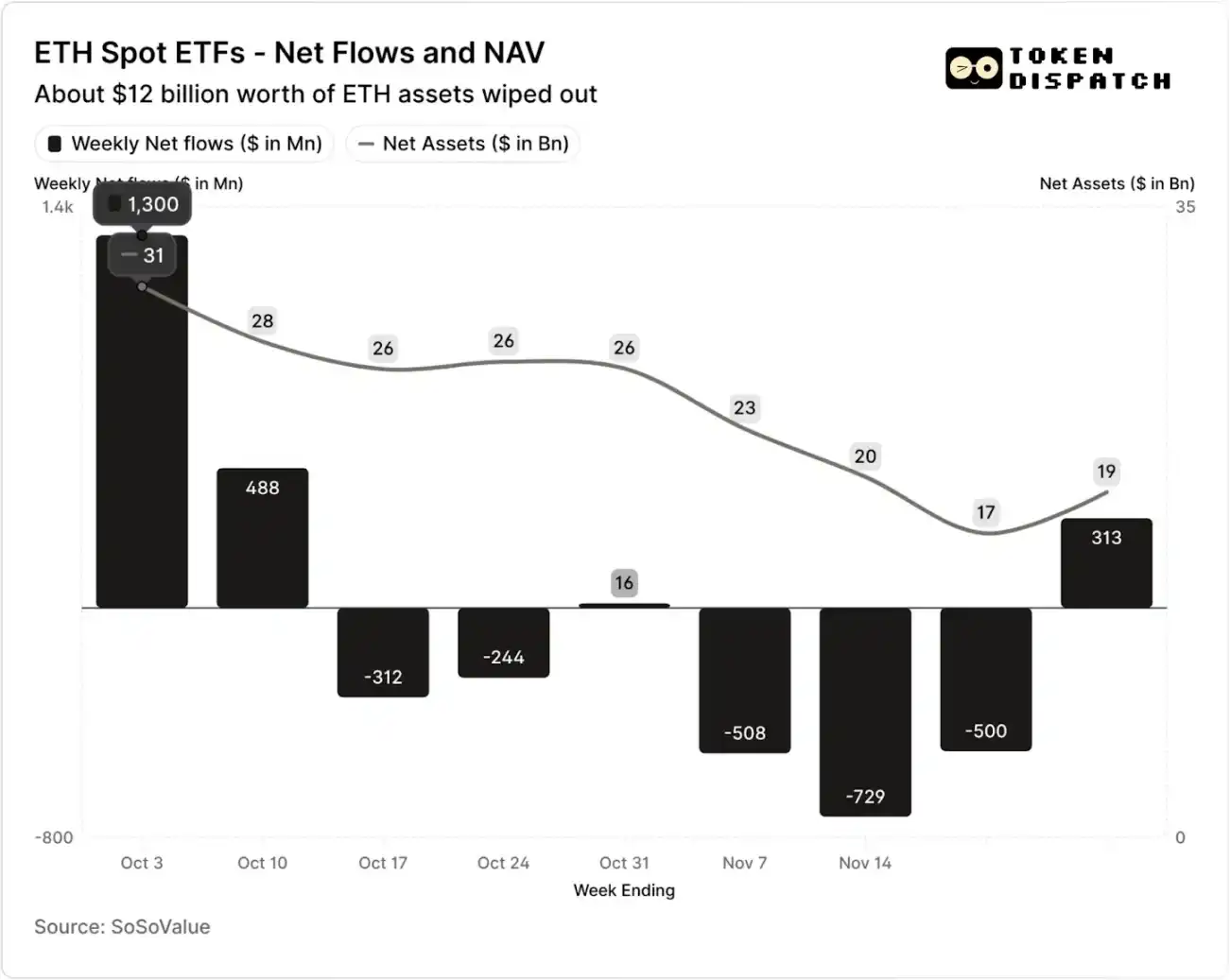
Net Fund Flows and Asset Net Value of Ethereum Spot ETFs in October and November
However, in the seven weeks following the liquidation event, Bitcoin and Ethereum ETFs experienced outflows in five weeks, totaling over $50 billion and $20 billion, respectively.
By the week ending November 21, the Net Asset Value (NAV) managed by the Bitcoin ETF issuer had shrunk from approximately $1.645 trillion to $1.101 trillion, while the Ethereum ETF's asset net value was nearly halved, dropping from $306 billion to $169 billion. This decline was partly due to the price decline of Bitcoin and Ethereum themselves, as well as some tokens being redeemed. In less than two months, the combined net asset value of Bitcoin and Ethereum ETFs evaporated by about one-third.
The retreat in fund flows reflects not only investor sentiment but also directly impacts the fee income of ETF issuers.
Bitcoin and Ethereum spot ETFs are the "money printers" of institutions like BlackRock, Fidelity, Grayscale, Bitwise, etc. Each fund charges fees based on the assets under management, typically expressed as an annual fee rate but actually accrued based on daily net asset value.
Every day, the trust funds holding Bitcoin or Ethereum shares will sell a portion of their holdings to cover transaction fees and other operational expenses. For the issuer, this means that their annual revenue is approximately equal to the Assets Under Management (AUM) multiplied by the fee rate; for the holders, this results in a gradual dilution of the amount of tokens held over time.
The fee rate range for ETF issuers is between 0.15% and 2.50%.
Redemption or outflows of funds themselves do not directly result in profit or loss for the issuer, but outflows cause a reduction in the issuer's ultimately managed asset size, thereby decreasing the asset base on which fees can be collected.
On October 3, the total assets under management by Bitcoin and Ethereum ETF issuers reached $195 billion, considering the aforementioned fee levels, their fee pool size was considerable. However, by November 21, the remaining asset size of these products was only about $127 billion.
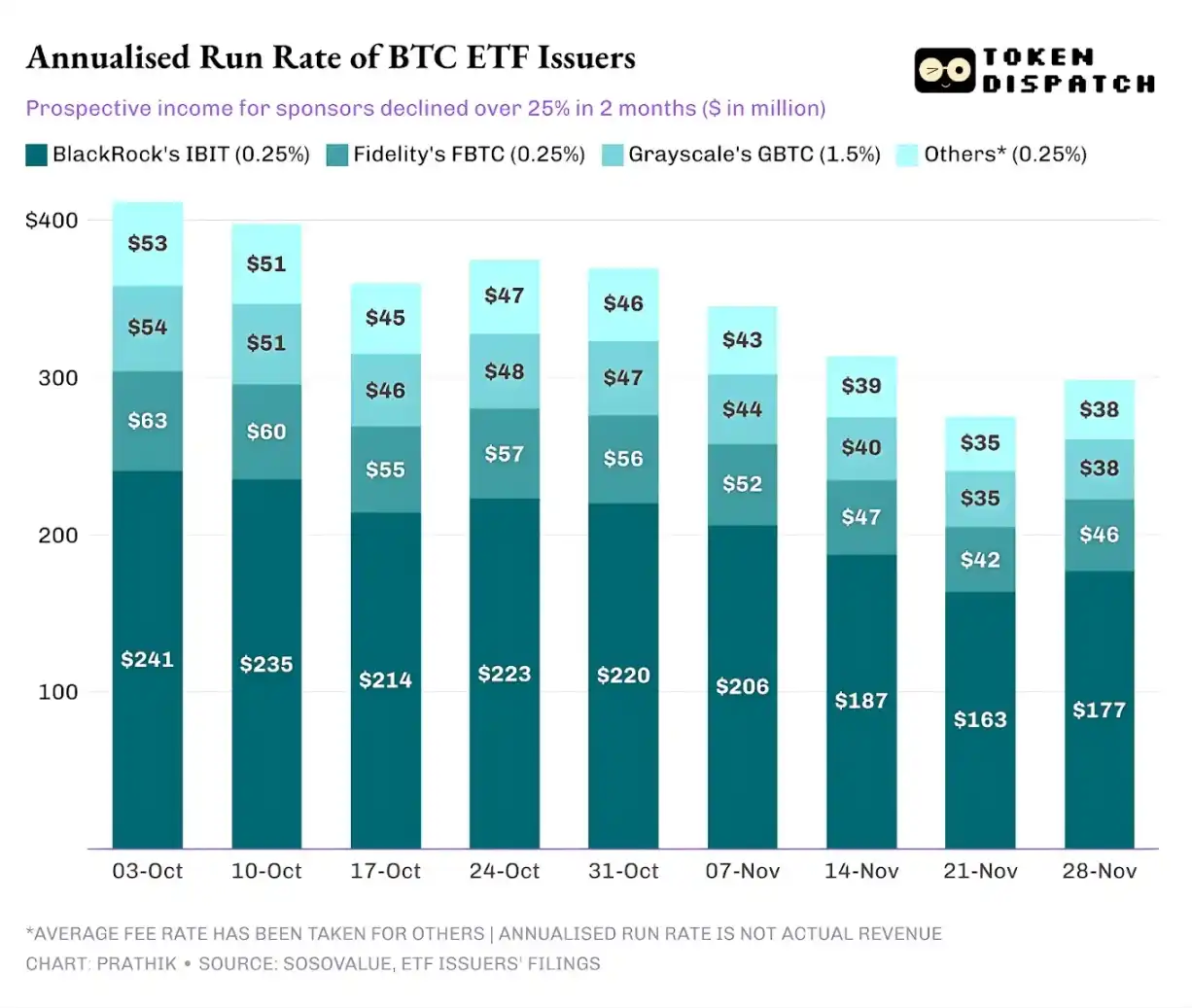
If we calculate the annualized fee income based on the weekend's assets under management, over the past two months, the potential revenue for Bitcoin ETFs has declined by over 25%; Ethereum ETF issuers have been more significantly affected, with a 35% decline in annualized revenue over the past nine weeks.
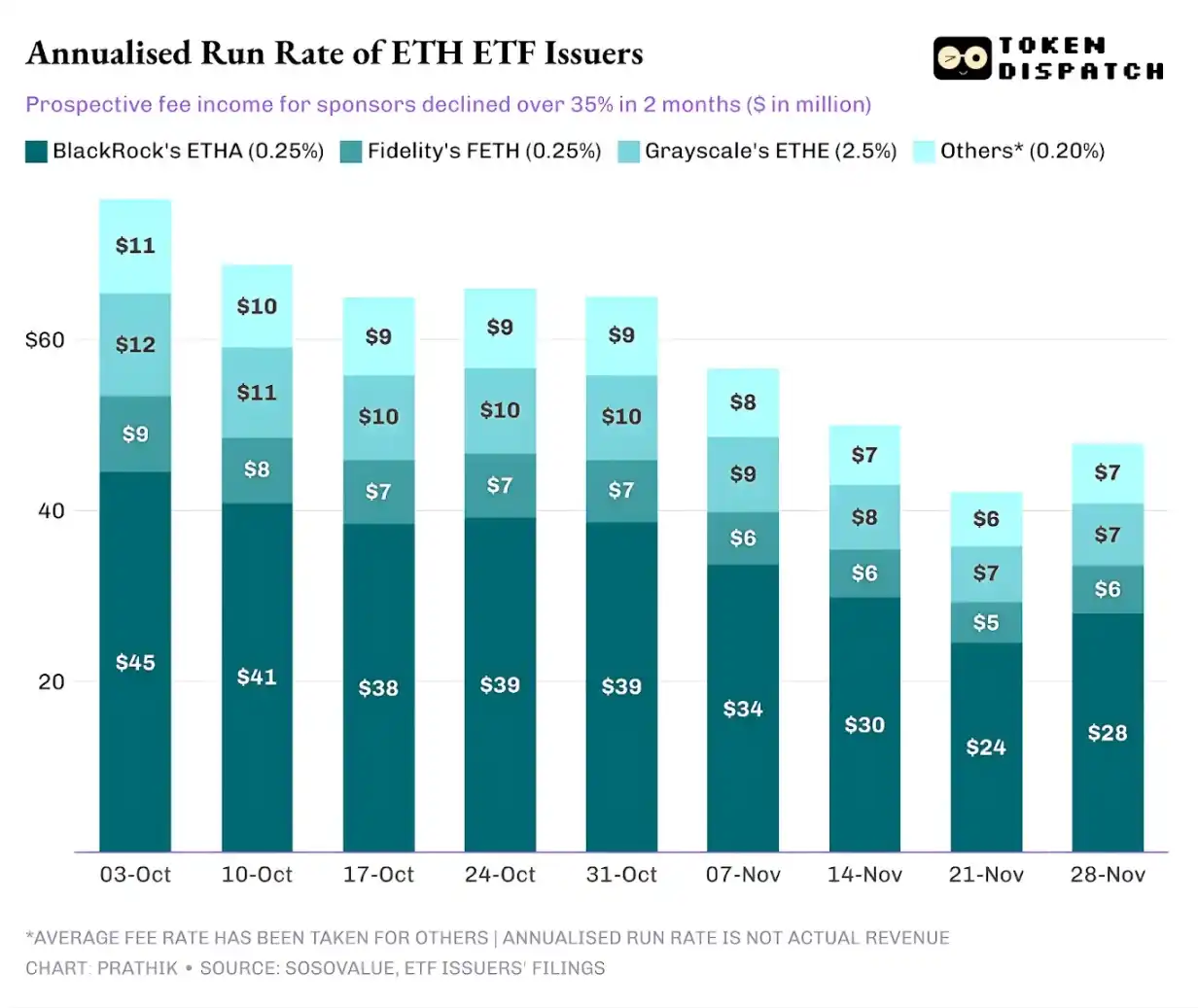
The Larger the Issuance Scale, the Harder the Fall
From the perspective of a single issuer, there are three slightly different trends behind the flow of funds.
For BlackRock, its business characteristics involve a combination of "economies of scale" and "cyclical fluctuations." Its IBIT and ETHA have become the default choices for mainstream investors to allocate Bitcoin and Ethereum through an ETF channel. This has allowed the world's largest asset management institution to charge a 0.25% fee based on its large asset base, especially when the asset size hit a record in early October, the gains were substantial. However, this also means that when large holders decided to reduce risk in November, IBIT and ETHA became the most direct selling targets.
The data is sufficient to support this: BlackRock's Bitcoin and Ethereum ETFs saw annualized fee income declines of 28% and 38%, exceeding the industry average declines of 25% and 35%.
Vanguard's situation is similar to that of BlackRock, but on a relatively smaller scale. Its FBTC and FETH funds also followed the rhythm of "inflow first, outflow later," where the market enthusiasm in October was eventually replaced by outflows in November.
Grayscale's story is more about "historical legacy issues." Once upon a time, GBTC and ETHE were the only scaled channels for numerous U.S. investors to allocate Bitcoin and Ethereum through brokerage accounts. However, with institutions like BlackRock and Vanguard leading the market, Grayscale's monopoly position no longer exists. To make matters worse, the high fee structure of its early products has led to continued outflow pressure over the past two years.
The market performance in October and November also confirmed this investor tendency: when the market is bullish, funds will shift to lower-fee products; when the market weakens, positions will be significantly reduced.
The early Grayscale cryptocurrency products had a fee rate 6-10 times lower than low-cost ETFs. Although a high fee rate can boost revenue figures, the elevated cost will continuously drive investors away, diminishing the asset under management that generates fee income. The retained funds are often constrained by frictional costs such as taxation, investment mandates, operational processes, rather than stemming from active investor choices; and each outflow reminds the market: once a superior option arises, more holders will abandon high-fee products.
These ETF data unveil several key features of the current cryptocurrency institutionalization process.
The spot ETF market in October and November demonstrates that the cryptocurrency ETF management business is as cyclical as the underlying asset market. When asset prices rise and market sentiment is positive, inflows will drive up fee revenue; however, once the macro environment changes, funds will swiftly exit.
Although large issuance institutions have established efficient "fee channels" on Bitcoin and Ethereum assets, the volatility in October and November proves that these channels are also susceptible to market cycle impacts. For issuers, the core issue is how to retain assets in the face of a new market shock, avoiding significant fluctuations in fee revenue following macro trend changes.
While issuers cannot prevent investors from redeeming shares in a sell-off, income-generating products can to some extent mitigate downside risks.
Covered call option ETFs can provide investors with premium income (Note: A covered call option is an options trading strategy where an investor holds the underlying asset while simultaneously selling an equal number of call option contracts. Through collecting the premium, this strategy aims to enhance portfolio returns or hedge some risks.), offsetting some of the underlying asset price declines; collateralized products are also a viable direction. However, such products need to undergo regulatory review before being formally introduced to the market.
You may also like

AI in the Crypto Market: How Artificial Intelligence is Changing Trading Strategies
This article explores how AI contributes to these movements and share practical strategies to help you navigate an AI-powered crypto market.

Cross-chain Collaboration: Tom Lee Invests $200 Million, Joins Forces with Global Top Streamer Mr. Beast

Interactive Brokers Integrates USDC, US Bank Questions Stablecoin, What's the Overseas Buzz?

Trump Waves Hand, Stirs Venezuela's Game Hurricane

VanEck Q1 Market Outlook: Long-Term Bullish on Cryptocurrency, Strong Gold Demand

ThunderChain Resumes Legal Battle as Former CEO Chen Lei Accused of Embezzlement for Cryptocurrency Speculation - What Happened Back Then?

Key Market Intelligence for January 15th, how much did you miss out on?

XRP Price Action: Crypto Bill Could Grant XRP the Same Legal Designation as Bitcoin
Key Takeaways A new legislative draft in the United States might classify XRP alongside Bitcoin (BTC) and Ethereum…

Coinbase CEO Raises Red Flags Regarding US Crypto Bill
Key Takeaways Coinbase CEO Brian Armstrong voices opposition to the proposed Senate crypto bill, citing significant concerns. The…

Asia Market Open: Bitcoin Nears $96K Amid Mixed Asian Stocks and Wall Street Slump
Key Takeaways Bitcoin’s price edges closer to $96,000 amid mixed signals from Asian stock markets and a recent…
Ethereum Price Prediction: SharpLink Activates Multi-Billion ETH Strategy – How Soon Might ETH Achieve a New All-Time High?
Key Takeaways SharpLink has strategically deployed $170 million in Ethereum on the Linea network, showcasing a productive use…
Transforming the Cryptocurrency Landscape: A 2026 Outlook
Key Takeaways Cryptocurrency systems have seen expansive growth and technological innovation. The introduction of new regulations has reshaped…
Pi Coin Price Prediction: Mainnet Tokens Just Unlocked – What Does This Mean for Holders?
Key Takeaways Daily token unlocks are increasing the supply of Pi Coin, affecting its short-term price stability. Pi…

Best Crypto to Buy Now January 14 – XRP, PEPE, Internet Computer
Key Takeaways The current crypto landscape is at a pivotal junction with potential changes in U.S. regulations offering…
New ChatGPT Forecasts for XRP, Ethereum, and Solana by 2026
Key Takeaways ChatGPT predicts a potential bull market for XRP, Ethereum, and Solana by 2026, supported by the…

Crypto Price Prediction Today 14 January: XRP, PEPE, Maxi Doge
Key Takeaways Amidst a blossoming crypto market, altcoins such as XRP, PEPE, and Maxi Doge are showing promising…

Bitnomial Debuts the First U.S.-Regulated Aptos Futures
Key Takeaways: Bitnomial has launched the first U.S.-regulated futures contracts for Aptos, extending a new avenue for institutional…

Why Is Crypto Up Today? – January 14, 2026
Key Takeaways Cryptocurrency market capitalization has risen by 3.6% to $3.33 trillion, with 95 of the top 100…
AI in the Crypto Market: How Artificial Intelligence is Changing Trading Strategies
This article explores how AI contributes to these movements and share practical strategies to help you navigate an AI-powered crypto market.


 App
App