
- Buy Crypto
- Markets
- Futures
- Spot
- Copy Trade
 Earn
Earn- More
Next year's biggest IPO, how will SpaceX, valued at $1.5 trillion, participate?

On-chain stock trading has rapidly evolved in the US market. Apart from stocks that are already listed and can be directly traded on the secondary market, many high-quality companies now receive significant funding through private placements without the need for an IPO, such as OpenAI and SpaceX.
For these private placement equity holdings, retail investors often find it difficult to participate. Investment opportunities usually only arise after an IPO, with a few institutional investors monopolizing pre-IPO investment opportunities. Although in the traditional finance field, platforms like Ustockplus under Korea's Dunamu, as well as Forge and EquityZen in the US, allow retail investors to purchase private placement equity within existing regulatory frameworks, these traditional financial platforms operate on a peer-to-peer matching basis. If no one is willing to sell, buyers still have limited access, leading to poor liquidity due to unpredictable transaction volumes.
So, would the situation improve with pre-IPO private equity + blockchain? Currently, there are three platforms on-chain—Ventuals, PreStocks, and Jarsy—that provide pre-IPO private equity trading. Let's take a look at their respective characteristics.
Ventuals
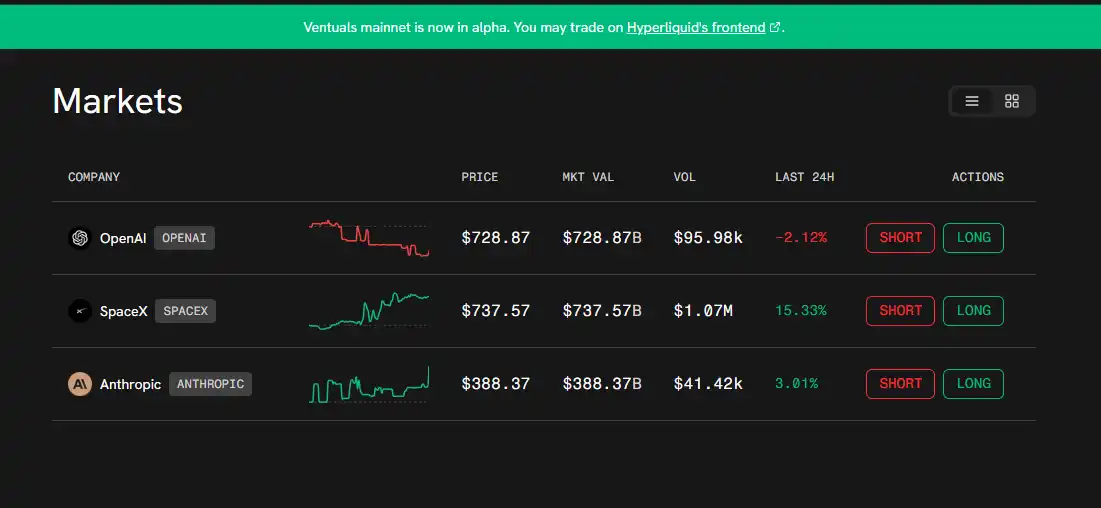
Ventuals is an IPO pre-equity perpetual contract platform built on HIP-3. On Ventuals, traders do not trade based on stock prices but on their expectations of the company's total valuation fluctuations. Holding a position on a pre-IPO company on Ventuals does not imply actual ownership of the company—only speculation on its valuation changes.
As it is not tied to actual equity, Ventuals is essentially a platform for speculating on company valuations. The advantage of this model is that Ventuals can quickly list a large number of pre-IPO company targets and respond to market trends. Moreover, having no underlying assets to a certain extent can help avoid traditional regulations.
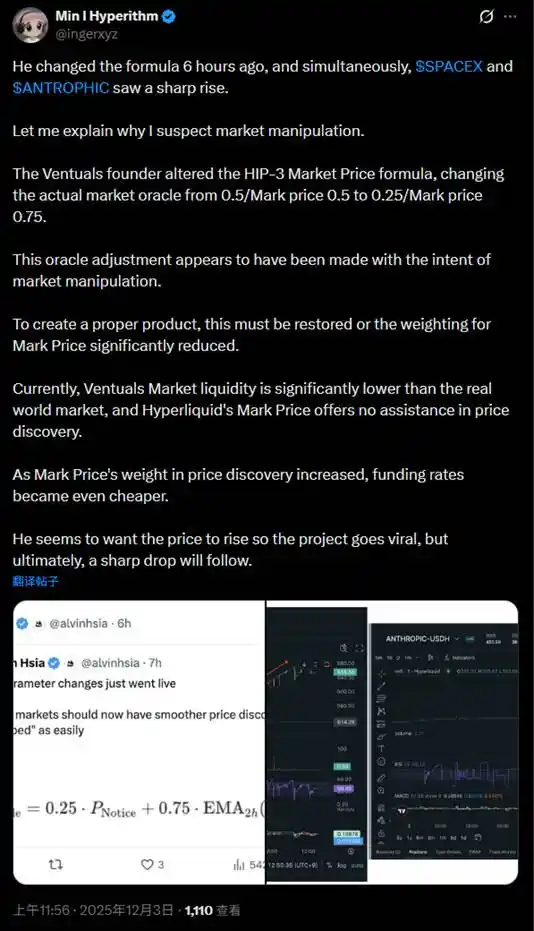
However, Ventuals' drawback is that price manipulation is easily facilitated due to reliance on oracle feeds. Private company valuation data is inherently opaque, with low update frequencies. Additionally, Ventuals recently reduced the weight of external oracle feeds to 0.25 and increased the marking price weight to 0.75, raising concerns among some players about potential market manipulation.
PreStocks
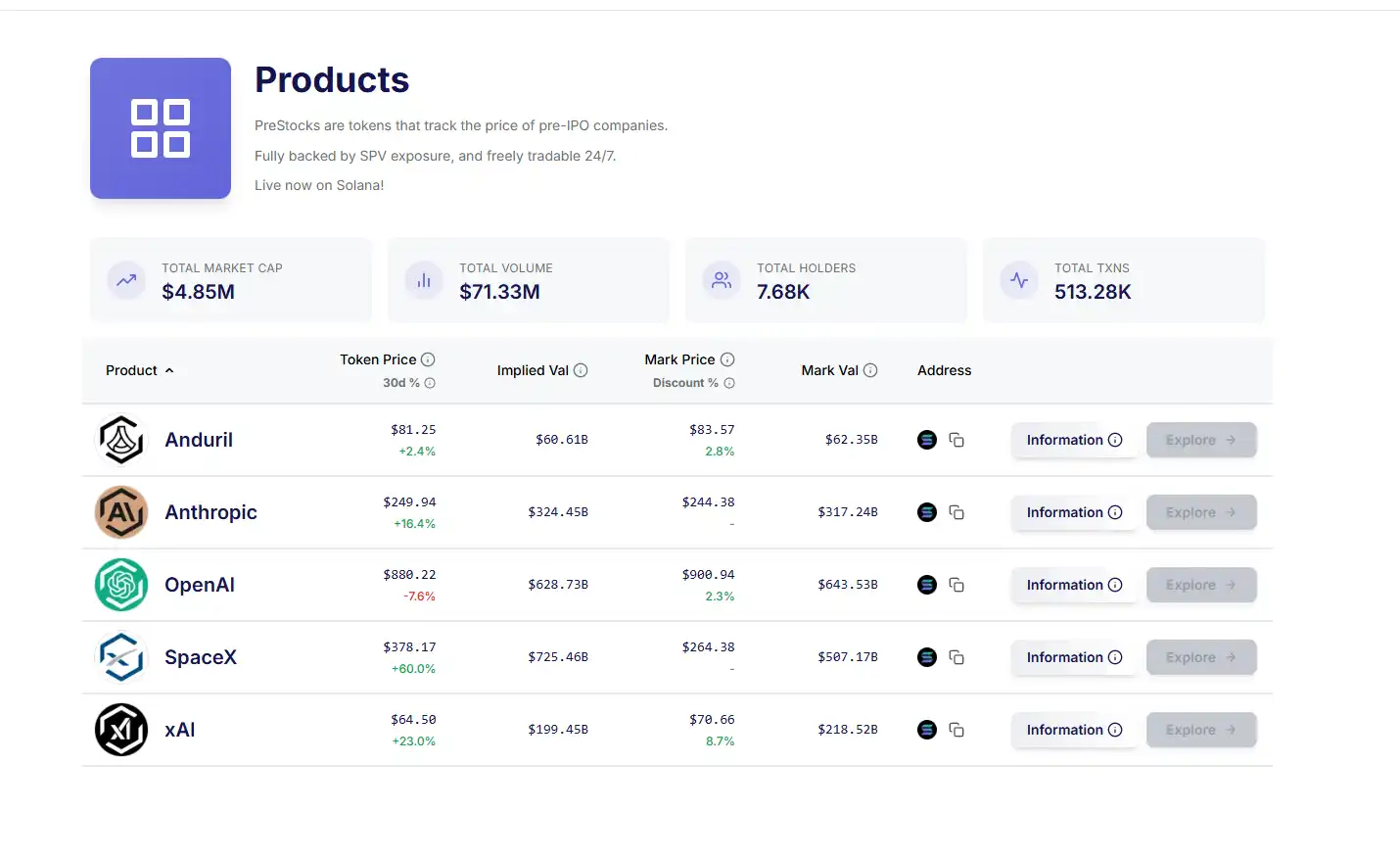
PreStocks is built on the Solana network. Unlike Ventuals, PreStocks truly tokenizes pre-IPO equity held directly or indirectly by entities investing in the underlying company. The team mentioned on their website that they will regularly release third-party verification reports to ensure that the token supply corresponds to the actual equity held and will also publish them upon active requests that can cover audit fees.
Due to the involvement of actual equity, users from countries such as China, the United States, Canada, etc., cannot practically use the platform's minting and redemption services. While it is still possible to buy and sell these equity tokens on-chain without KYC, if one wants to buy and wait for listing before redeeming these tokens for USDC, KYC is required. Additionally, despite having actual equity backing, holding equity tokens does not imply ownership, voting rights, dividend rights, or similar privileges.
PreStocks' main advantage lies in its good integration with the DeFi ecosystem, allowing direct trading in wallets such as Jupiter, OKX, and participation in low-cost lending or leverage trading within some dApps in the Solana ecosystem.
Jarsy
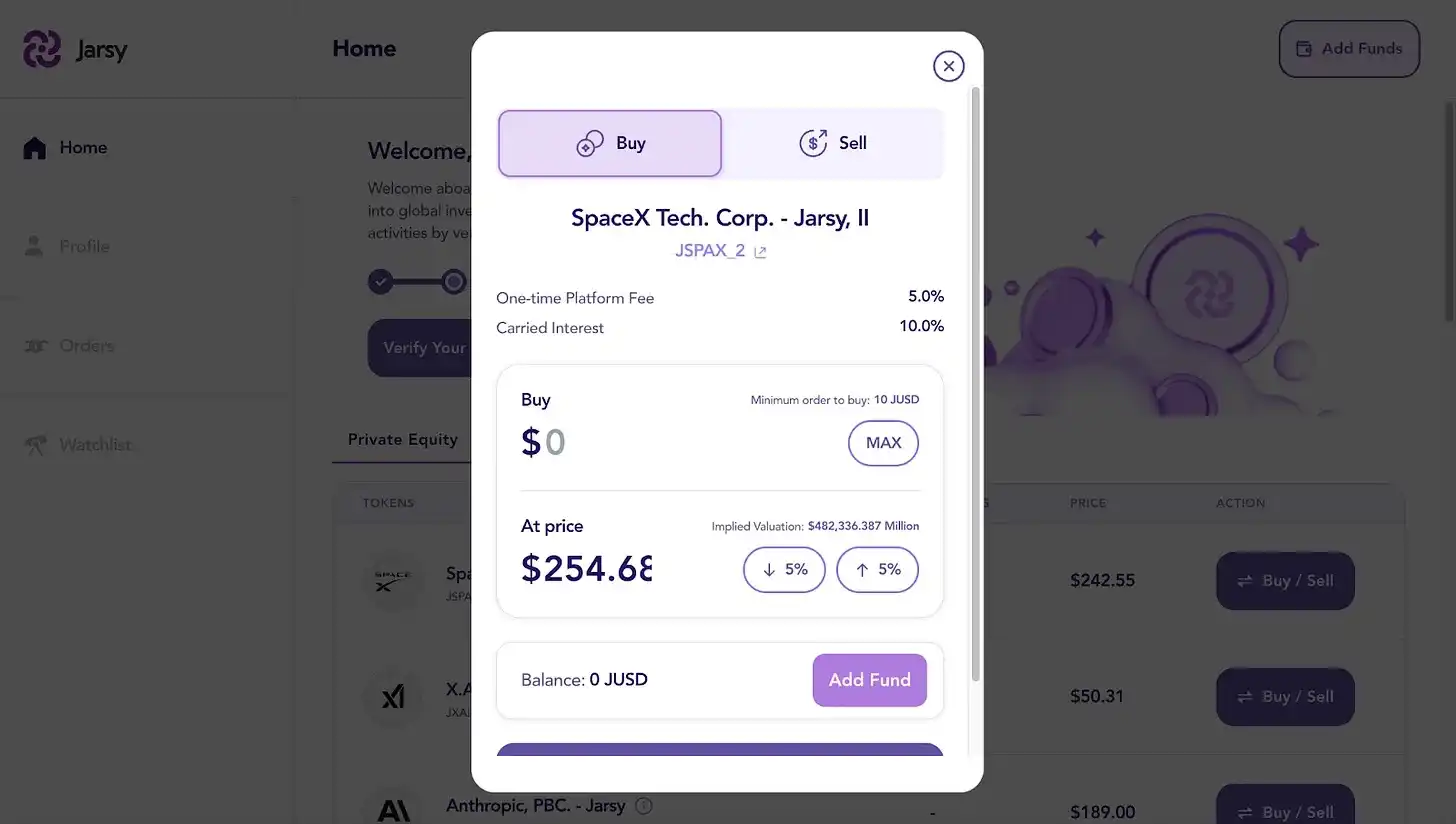
Similar to PreStocks, Jarsy also has actual equity support. However, compared to PreStocks, Jarsy is more like a blockchain-technology-based pre-IPO equity investment platform rather than a trading platform. This is because equity tokens on Jarsy are non-transferable and cannot be used in DeFi; they have their own built-in trading system and trading can only occur on the platform.
Nevertheless, Jarsy currently provides better transparency and disclosure compared to PreStocks.
Jarsy and PreStocks share some similarities and differences. Firstly, the minimum investment amounts for both platforms are very low, with Jarsy at $10 and PreStocks having none, which is beneficial for users worldwide as it lowers the barrier to entry for pre-IPO equity investments. However, a downside is that the amount of equity they can hold is relatively low; for example, xAI's equity token TVL on Jarsy is only about $1.1 million, whereas SpaceX's is approximately $1.7 million. The limited scale of actual pre-IPO equity holdings can directly lead to liquidity issues, where even seemingly small orders can cause significant price fluctuations.
Conclusion
Looking at the three companies above, liquidity remains a challenging issue for pre-IPO equity tokenization, making it difficult for large on-chain funds to enter this space.
However, the benefits are also obvious. Retail investors previously had almost no way to invest in companies like SpaceX and OpenAI before their IPOs. Now, through blockchain technology, a door that has always been closed is opened.
In fact, Echo, the on-chain funding platform created by Cobie and acquired by Coinbase for $375 million, is doing something similar. They have previously conducted a $10 million 1X Technologies Series C round of financing in a private group, although they did not tokenize equity.
It's all still early days.
You may also like

Predicting the market does not predict the truth; it simply rewards those who guess right

Delphi Digital's Top 10 Predictions for 2026: Perp DEX Eats Wall Street, AI Agents Usher in Era of Autonomous Trading

Layoffs of 30%, But Spending $250 Million to Buy a Company - What Is Polygon Thinking?

Cross-chain Collaboration: Tom Lee Invests $200 Million, Joins Forces with Global Top Streamer Mr. Beast

Interactive Brokers Integrates USDC, US Bank Questions Stablecoin, What's the Overseas Buzz?

Trump Waves Hand, Stirs Venezuela's Game Hurricane

The Genius Stopping Law: Why Did Coinbase Backpedal at the Eleventh Hour?

Fact Check: How Much Money Did the University of Chicago Lose in its Crypto Investment?

Rumor has it that Coinbase is set to acquire Farcaster, still an Acquihire.

By seizing the first five seconds of Gold Dog, "Dry Sitting P Junior" earns $430,000 in 30 days.

DAU of 8? The Data Truth in the Solana vs. Starknet Public Opinion Battle

Key Market Intelligence for January 15th, how much did you miss out on?

$200K Annual Salary Hiring, Predicting Market Will See Wall Street Players

Former Star Public Blockchain Berachain in Crisis: Price Collapse, Layoffs, Developer Exodus

Eric Adams Denies “Rug Pull” Allegations Linked to NYC Token Despite Significant Losses
Key Takeaways: Eric Adams firmly denies allegations implying that money was moved out of the NYC Token. Market…

XRP Price Action: Crypto Bill Could Grant XRP the Same Legal Designation as Bitcoin
Key Takeaways A new legislative draft in the United States might classify XRP alongside Bitcoin (BTC) and Ethereum…
Coinbase CEO Raises Red Flags Regarding US Crypto Bill
Key Takeaways Coinbase CEO Brian Armstrong voices opposition to the proposed Senate crypto bill, citing significant concerns. The…

Transforming the Cryptocurrency Landscape: A 2026 Outlook
Key Takeaways Cryptocurrency systems have seen expansive growth and technological innovation. The introduction of new regulations has reshaped…


 App
App