
You Have Been Training Google's AI for Free for 15 Years, and You Didn't Even Know

Original Title: You've been training Google's AI for 15 years. You had no idea.
Original Author: Sharbel, Co-founder of Unfungible
Original Translator: Lila, BlockBeats
Editor's Note: CAPTCHA, the numbers or images you need to click on every time you log into a website, is familiar to every Internet user. But when you click "I'm not a robot" time after time, you may think you're just verifying your identity, when in fact you're participating in the world's largest and most secretive data production. Luis von Ahn's reCAPTCHA has aggregated scattered human behavior into a data cornerstone supporting Google and its subsidiary, the self-driving company Waymo.
Beneath the facade of "free" and "secure," the Internet has quietly reshaped a new form of labor relationship: you spend time proving you're human, but you're actually contributing to AI training, and once AI learns, this labor is completely replaced. This article has received over 9.5 million views on Twitter in less than 20 hours. The following is the original content:
Approximately 500,000 hours of human labor are freely exploited by Google every day. And the people contributing to this just want to log into online banking.
reCAPTCHA is the most successful invisible data operation in Internet history. At its peak, 200 million people completed the verification process every day. But almost no one realized what each click meant behind the scenes.
Google's self-driving car company, Waymo, is now valued at $45 billion. And most of its core training data is freely provided by you as you access various websites.
Here is the full story:
Origin: A Clever Idea
In 2000, spam bots were wreaking havoc on the Internet. Forums were flooded, inboxes were overflowing, and websites needed a way to distinguish between humans and machines.
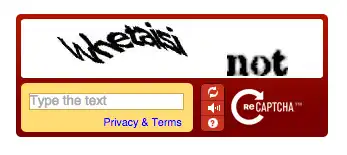
Carnegie Mellon University professor Luis von Ahn solved this problem. He invented CAPTCHA: distorted text that only humans could read, not bots.
But von Ahn saw more than that. Millions of people had devoted their energy to these challenges. What if that energy could do two things at once?
In 2007, he introduced reCAPTCHA. Its brilliance: no longer showing random garbled text, but two words. One word was known to the system, the other a real scanned book word that computers couldn't recognize yet. And your answer helped in the digitization of these books.
These books came from The New York Times archives and Google Books, totaling up to 130 million.
You thought you were just logging into a regular website, but you were actually performing OCR (Optical Character Recognition) for the world's largest digital library.
In 2009, Google officially acquired reCAPTCHA.
Later, Google changed the game
The era of "twisted text" ended around 2012.
Google faced a new challenge: Street View cars had photographed every road globally, but the pictures were just raw data. For AI to work its magic, it needed to understand what it saw: road signs, crosswalks, traffic lights, storefronts.
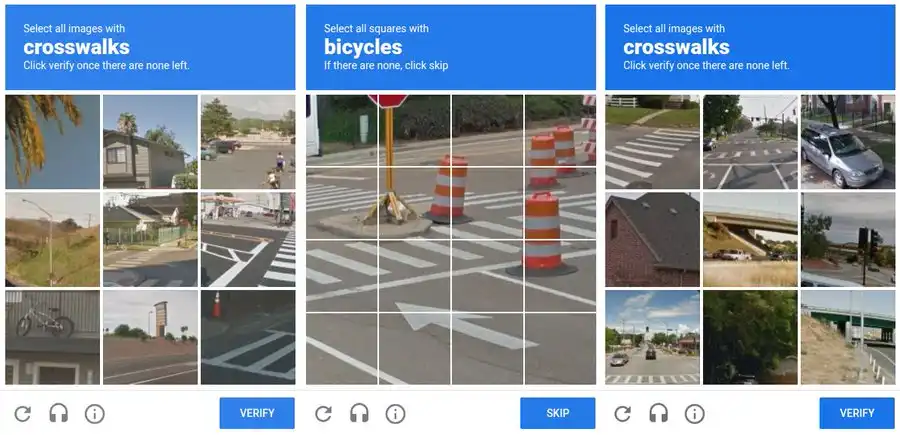
So Google redesigned reCAPTCHA v2. Instead of distorted text, there were photo grids. "Click on all squares with traffic lights." "Select every crosswalk." "Identify storefronts."
These images came directly from Google Street View. Your clicks served as tags.
Every selection was informing Google's computer vision model: these pixels form a traffic light, that shape is a crosswalk. You weren't taking a test; you were building a dataset.
An Unimaginable Scale
At its peak, 200 million reCAPTCHAs were solved daily. Each challenge took 10 seconds, meaning 2 billion seconds of human labor per day. That's 500,000 hours every day.
The cost of paid data labeling is about $10 to $50 per hour. Calculated at the lowest rate: the daily value of freely extracted labor reached up to $5 million.
Moreover, reCAPTCHA doesn't just exist in a particular app. It's present across every bank, every government portal, every e-commerce website. You have no choice: Want to log in to your account? First, help annotate the dataset. Google has never asked for your opinion, paid you a cent in salary, or even told you about this.
What has all this led to?
This data directly feeds into two products:
-Google Maps: The most widely used navigation tool globally. Its ability to recognize road signs, shops, and city geography is partially credited to the billions of human annotations made while logging into websites.
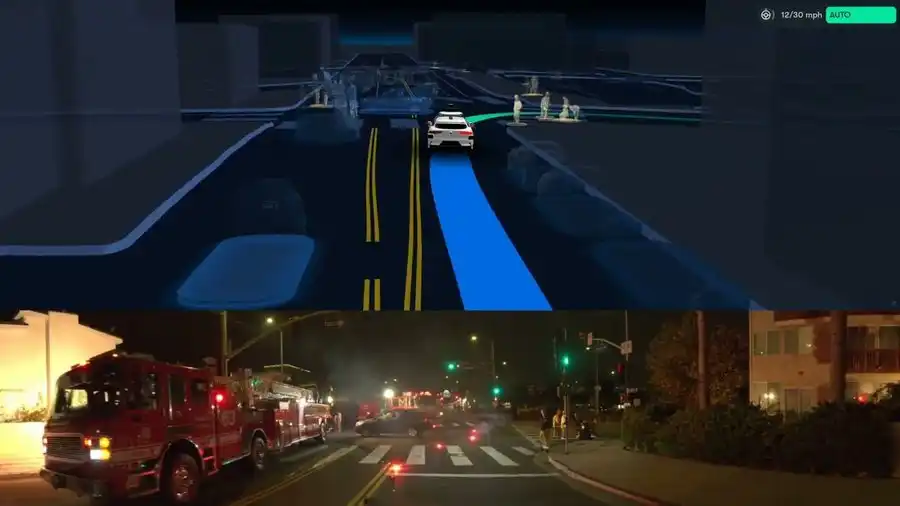
-Waymo: Google's self-driving project. For safe navigation, autonomous vehicles need to almost perfectly identify thousands of visual patterns.
The ground truth training data for that identification work is precisely what millions of people unknowingly annotated through reCAPTCHA. Waymo completed over 4 million paid trips in 2024, valued at $45 billion. Its cornerstone, laid by those "unpaid internet users" who just wanted to check their email.
Why can't anyone replicate this model?
Data annotation is extremely costly. Companies like Scale AI, Appen, and Labelbox exist to solve this problem; they hire hundreds of thousands of workers, sometimes paying less than $1 per hour.
Google took a different approach to the problem: they turned annotation into a requirement. No payment required, no consent needed, but as a "ticket" to enter every corner of the internet. The result: billions of labeled images, global coverage, all-weather, every city in the world. No annotation company can achieve this. The internet itself is a factory, and every netizen is an undocumented employee.
You're Still Participating
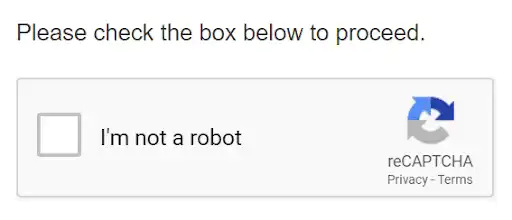
reCAPTCHA v3, launched in 2018, no longer even displays challenges. It observes how you move the mouse, scroll speed, dwell time. Your behavioral fingerprint informs it whether you're human. This behavioral data also feeds back into Google's AI systems.
You never actively chose to join, never had a checkbox to tick. Yet right now, on most websites you visit, you're still doing this.
Disturbing Irony
Luis von Ahn's original intent was brilliant: to transform the energy humans were already wasting into useful output. However, what Google did with this vision is a different story altogether. They took a security mechanism users had to use, deployed it across the web, and harvested the output to build a business product worth hundreds of billions of dollars. Users got nothing in return, not even awareness.
The deepest irony is: you spent years proving you are human by completing visual recognition tasks that AI couldn't do at the time. But once AI learned to do these tasks, human visual annotations were no longer needed.
You proved you are human, only to end up making yourself replaceable.
You may also like

Will MicroStrategy fall into a death spiral? What will the macro trend be in the second half of the year?

Blockchain Capital Partner: The Core Secret of Arbitrage

STRC unanchored by 11%, can the perpetual motion machine of Strategy still operate?

Bitcoin Market Analysis 2026: Can BTC Reach $150K by Year-End?

Bitcoin ETF Outflows Hit a Record $4.4 Billion: What Are Traders Doing With Their Cash?

WEEX App Just Got Smarter – New Tabs for Faster Trades & Easy Asset Management

WEEX All-New Search Features: Find, Trade & Earn Faster Than Ever

Morning Report | Illinois signs the strictest digital asset tax law in the U.S.; RWA tokenization market size surpasses $43 billion, institutions accelerate the migration of on-chain assets

Full version of the debut Q&A! Federal Reserve Chairman Waller: Sticking to the 2% inflation target, establishing five special working groups, individual did not submit the dot plot

From Disruptor to Shadow Market: The Crypto Market is Becoming a Colony of Traditional Finance
Dalio's important long article: How to position in the current market environment?
OKX Star analyzes Binance's competitive advantages: when regulation levels the playing field, competition has just begun

New gameplay for participating in initial offerings on cryptocurrency exchanges
Why Is Bitcoin Down Today? What the Hawkish FOMC Means for SpaceX, Gold and Nasdaq

DeepSeek Financing Story

Morning Report | DeepSeek completes over $7 billion in financing, with a valuation exceeding $50 billion; Musk's personal wealth has surpassed the total market value of Bitcoin

Cursor, why did you get on Musk's spaceship?
In the name of charity, for the benefit of the family: How the Trump family turned charity into profit?
Will MicroStrategy fall into a death spiral? What will the macro trend be in the second half of the year?
Blockchain Capital Partner: The Core Secret of Arbitrage
STRC unanchored by 11%, can the perpetual motion machine of Strategy still operate?
Bitcoin Market Analysis 2026: Can BTC Reach $150K by Year-End?
Bitcoin ETF Outflows Hit a Record $4.4 Billion: What Are Traders Doing With Their Cash?
WEEX App Just Got Smarter – New Tabs for Faster Trades & Easy Asset Management


