Why is Enso Essential Infrastructure in the DeFI Wave?

By: blockbeats|2025/01/22 03:15:02
0
Share
copy

In the field of Internet travel, the key to Uber's ability to quickly change people's way of getting around lies in its clever integration of basic functions such as maps, payments, and messaging, rather than developing everything from scratch. Google Maps provides its location, Stripe handles payment processing, Twilio is responsible for message notifications, and Uber focuses on creating a top-notch ride-hailing experience.

Likewise, for DeFi developers, the key to determining innovation efficiency is whether they can efficiently "call" rather than "build from scratch" infrastructure. However, in the crypto field, there is currently not a mature and general-purpose infrastructure comparable to Stripe or Twilio. Developers are often forced to deeply research the underlying logic of each public chain or protocol, write and maintain a large number of smart contracts, and additionally pay high audit fees. Just like any project involved in DeFi social trading, lending, automation, etc., the first step is to dig through protocol documentation, write integration code, and developers should focus on creating differentiated features, but they end up consuming a significant amount of time and resources in the endless cycle of "reinventing the wheel."

In the process of exploring the DeFAI narrative, the author found that the "DeFi+AI" narrative also faces the same problem. Although AI Agents can discover arbitrage opportunities, design yield strategies, there is a huge gap between AI being able to conceive these strategies and actually execute them on-chain. Enso's existence makes the DeFAI narrative more implementable.

Empowering Developers to Stop "Reinventing the Wheel"

Enso has now become a dark horse in the DeFi infrastructure field, integrating 180 DeFi protocols across multiple ecosystems such as Ethereum, Binance Smart Chain, and more. Enso has also launched in the form of APIs, and these features will play a bigger role once the network is officially launched.

As the flagship target of the narrative, CowSwap, once openly supported by dignitaries such as Vitalik and Trump, is able to complete complex DeFi execution paths and fulfill user requests at the lowest gas cost thanks to the integration of Enso's DeFi-intent-based API. This allows CowSwap to focus on the DeFi trading experience just like Uber focuses solely on ride-hailing.

Enso, as a DeFi middleware, did not start with such a product implementation. Initially, Enso was merely a social trading platform derived from its founder Connor's "copy-trading" demand, disrupting the market through "vampire attacks." Later, Enso integrated with over 50 DeFi projects, launched social trading features, allowing anyone to create investment strategies and invite others to follow. During this time, Enso's TVL once reached $8-9 million.

However, as user demand grew, the team needed to continually integrate more DeFi protocols and conduct frequent code audits. Auditing just 12 protocols alone cost over $500,000. "The DeFi market updates too quickly, and the maintenance costs make it hard for us to keep up," this was the team's most direct feeling. To break through the bottleneck, they decided to completely rebuild the underlying infrastructure, achieve a unified abstraction of various protocols, and launch an externally facing API based on this.

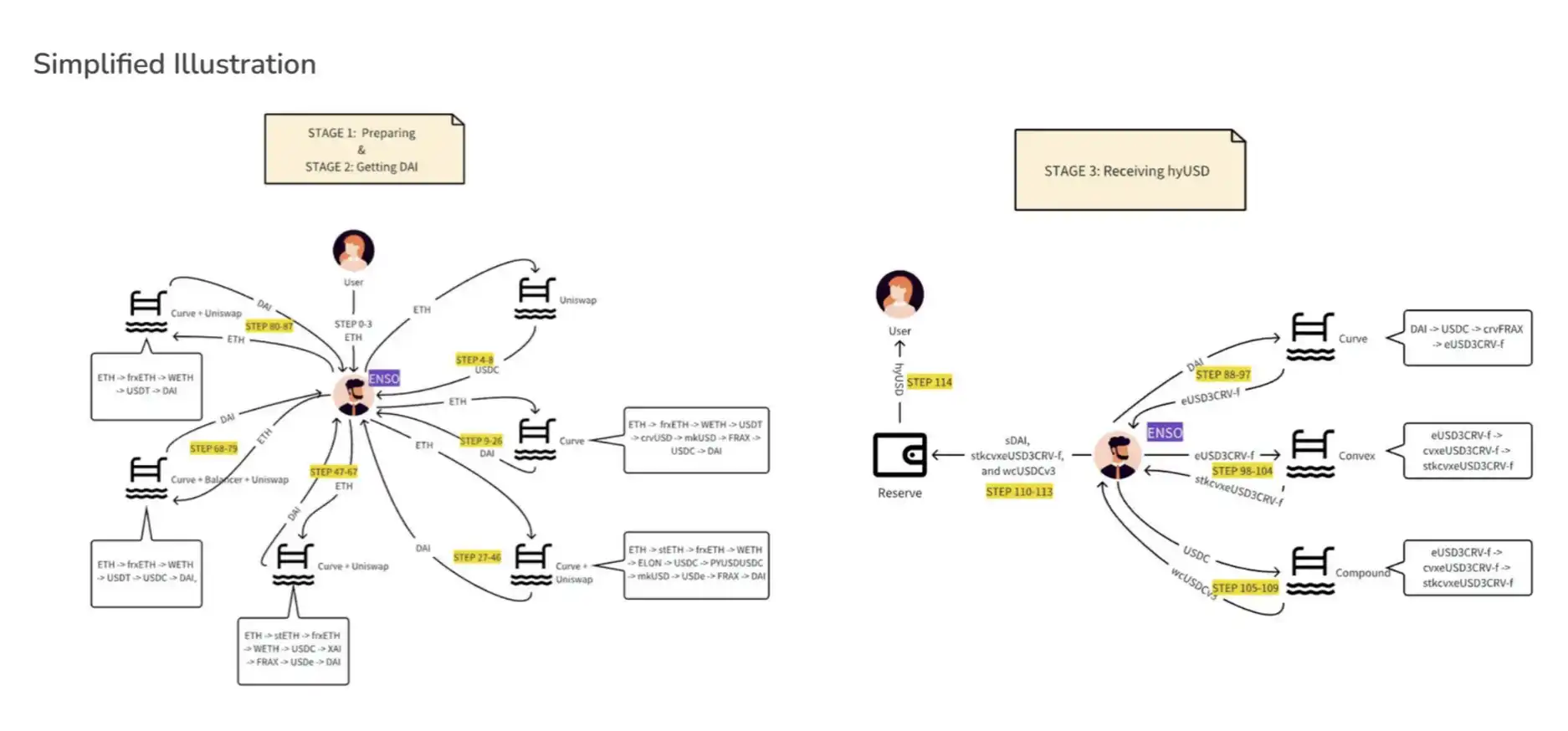
Enso's official team once showcased a typical case, vividly illustrating the core value of its product: simplifying complex processes into user-friendly interfaces. Developers only need to call Enso to easily integrate with over 40 DeFi protocols, using 25 different assets to complete a series of complex on-chain operations. The entire process appears simple, but in reality, it covers over 100 steps of on-chain interaction.

Why is Enso Essential Infrastructure in the DeFI Wave?

Using the example of a user swapping ETH for hyUSD, wcUSDCv3, and sDAI, the funds need to flow successively through multiple protocols such as Curve.fi, Compound, Balancer, and Uniswap. Without Enso, the team would need to independently integrate and audit these protocols, resulting in extremely high time and cost.

The value of Enso lies in encapsulating complex on-chain operation processes into a unified development interface. In the background, Enso precisely designs the optimal path for exchange rates and Gas costs and efficiently integrates multiple protocols. For developers, "swap ETH for a basket of assets" is just a simple operation call to the interface, while all the complex calculations and integrations are handled by Enso. This simplification not only reduces developers' maintenance and audit costs but also highlights the core role of middleware APIs in accelerating the development of the DeFi ecosystem. Through Enso, developers can focus on product innovation while leaving the underlying technical details to this powerful tool to solve.

Enso's Technical Implementation and Network Role Division

To understand the above product application scenario, we need to understand the concept proposed by Enso called shortcuts.

The so-called shortcuts are essentially pre-combinations of a series of on-chain actions. A single action may only contain one transaction or it may cover multiple steps that need to be completed consecutively. For example, merging approval and enter vault into a single deposit action, and further stacking leverage on this can be combined into a more complex functional module. Through this modular design, developers can greatly improve the efficiency of building on-chain applications.
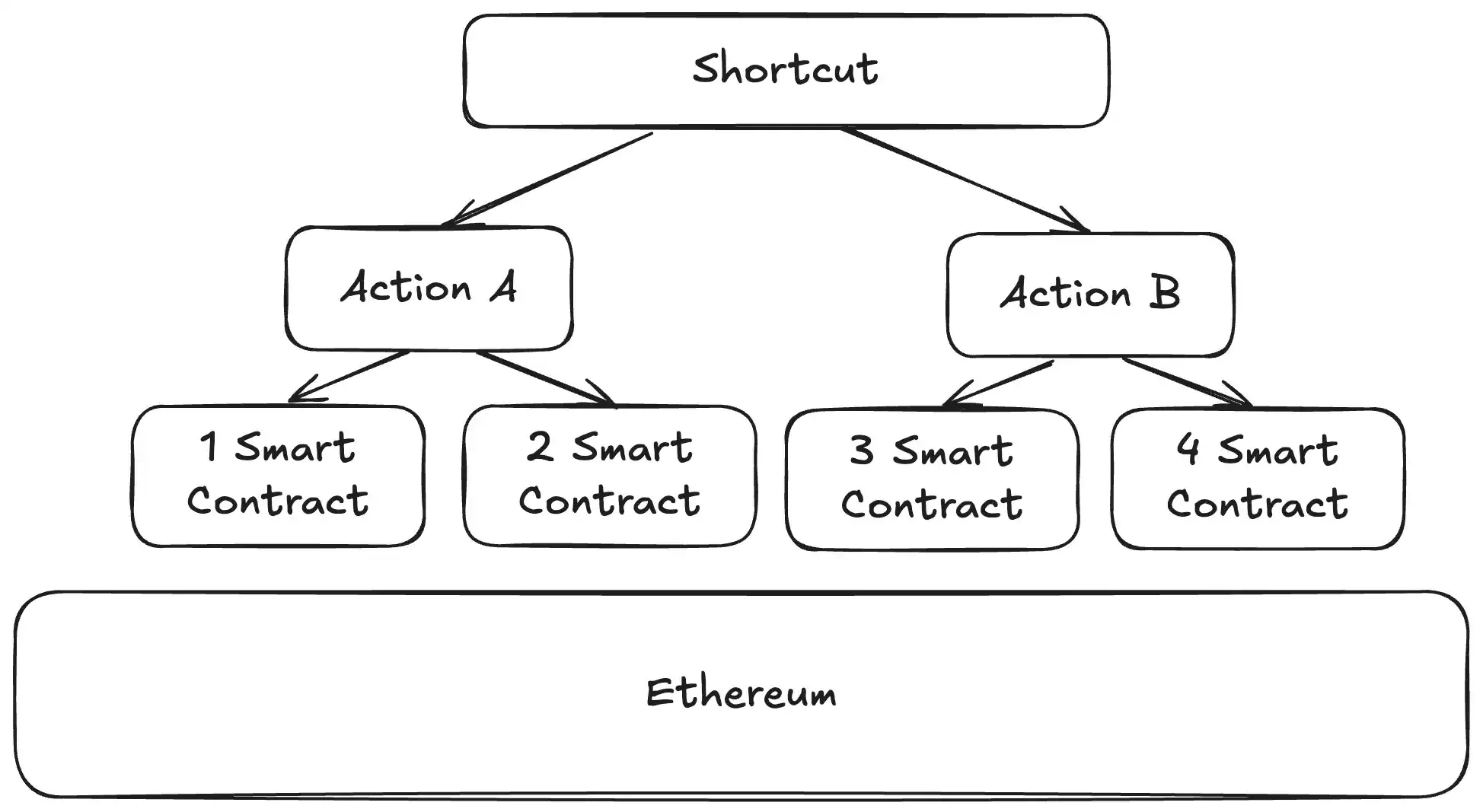
Currently, Enso's existing shortcuts include token exchange and DeFi routing, asset management, fund management tools and automation, DeFi protocol integration, smart contract interaction, complex trade bundling, and more.

Furthermore, Enso is gradually evolving into a more open decentralized network, where all contributors are network participants, rather than just a team behind a product. In the future, anyone can contribute their skills or resources around Enso's underlying architecture, avoiding bottlenecks caused by insufficient resources of a single team and allowing the network to iterate quickly through multi-party collaboration.

Enso also provides three pathways for operators to participate, catering to developers with different expertise and resource conditions.

1. Action Providers

For developers with programming abilities, they can contribute smart contract abstractions on the network, providing specific behavioral operation logic, such as defining how to lend on Aave. These action providers become core contributors of behaviors in the network by proposing methods to address user needs. Additionally, they can earn revenue through fee sharing, incentivizing more high-quality behavioral logic contributions.

2. Graphers

Some participants focus on algorithms and data processing, similar to solving the "shortest path on a map" problem. They listen to intent requests in the network, traverse all contributed behavioral operations, and find the optimal path. For example, converting from USDC to aDAI on Aave can have various methods, including multi-step paths or direct conversion paths.

Graphers are responsible for finding a route that balances Gas costs and final rewards through computation and providing the final solution to the network. In this process, as they optimize for different objectives (such as Gas savings or higher returns), there may be competition among graphers. These participants are usually experts in mathematics and algorithms, unconcerned with the source of data, focusing only on how to efficiently utilize data to complete computational tasks.

3. Validators

Any contribution submitted by action providers or paths proposed by graphers need validators to simulate and validate to ensure the security and validity of underlying logic and execution results. Validators are responsible for checking if operations include authorized behaviors, involve delegate calls, conduct transfer operations, and identify potential malicious behaviors.

In addition, validators will also run the resolver-proposed path call data, validate its output, Gas consumption, and other key parameters. For users with node operation experience, this is a relatively low-threshold role, but crucial for ensuring network security and execution accuracy.

It is important to emphasize that as Enso gradually evolves into a network, these three roles will collectively participate in the maintenance and operation of the network. Any developer, algorithm expert, or node operator can join seamlessly to contribute to the entire ecosystem and receive incentives.

Aside from developer-oriented contribution roles, Enso offers different types of usage scenarios for users as well. Enso's product provides three types of intent abstractions to meet users' varying needs and preferences.

1. Explicit Intent: Users explicitly specify the operation protocol, such as carrying out leverage in a specific protocol, for example, "I want to leverage on Aave."

2. Semi-Explicit Intent: Users only define the target leverage multiple or yield rate, allowing the system to automatically select the optimal path among protocols like Aave, Maker, or GMX.

3. Fully Abstract Intent: AI chooses the best solution based on user history and market conditions, requiring minimal explicit instructions from the user. This model significantly simplifies user involvement complexity.

Enso Adoption and Future Outlook

Currently, Enso has raised a total of $9.2 million, with over 60 angel investors participating. From DeFi Summer to the present, Enso's product iterations and protocol integration capabilities across cycles are widely acknowledged in the market.
For example, as mentioned earlier, projects like CowSwap, Berachain's Boyco, and the recently popular DeFAI are all integrating and connecting at the core level with Enso. Currently, Enso has integrated with over 180 protocols, with more than 60 applications adopting the Enso API.

We can explore several specific cases to understand how Enso collaborates with other DeFi projects or protocols in the current market to provide a more convenient development environment for developers.

Royco Protocol is an Incentivized Action Market (IAM) protocol that allows anyone to create a transaction market or a series of transaction markets around any on-chain activity. Enso collaborates with Royco to jointly create an incentivized Boyco market treasury for Berachain. The Boyco project supports project owners in integrating with the Royco Protocol, enabling them to directly receive liquidity support from Berachain to focus on project development and community operations.
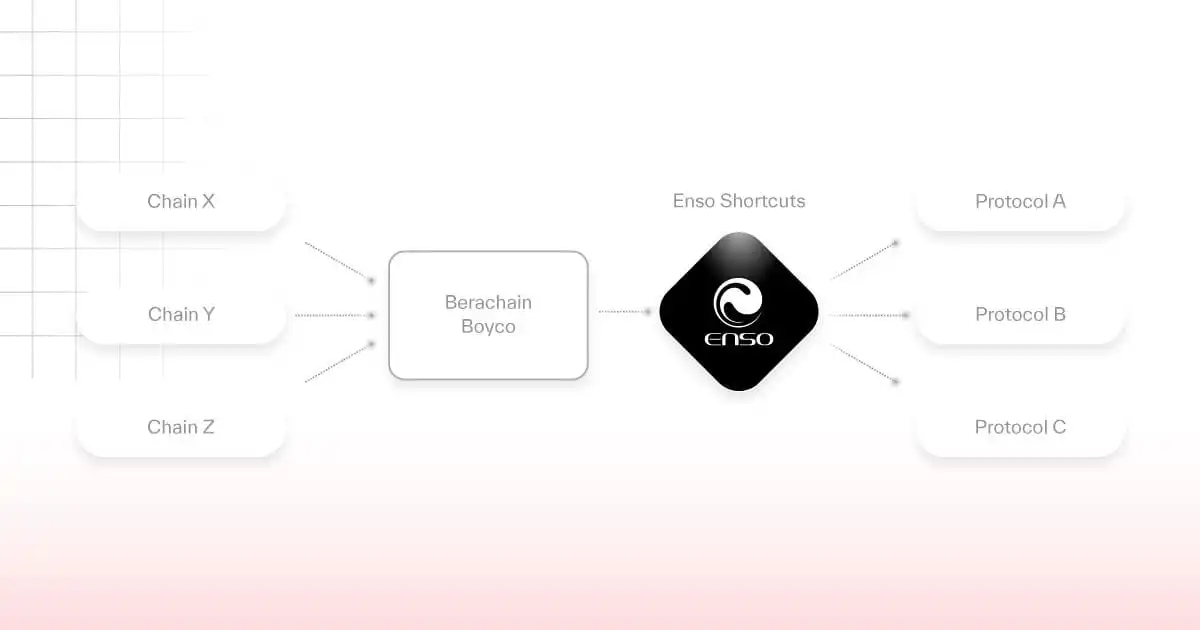
The complexity of the Boyco Market varies, encompassing both single-token deposits and multi-token strategies. Without Enso's support, the team would need to manually integrate multiple protocols, write custom code for each market's specific requirements, and invest a significant amount of engineering resources in testing and audits, making the process extremely cumbersome.

When users enter the Boyco Market and need to acquire specific deposit assets, the traditional approach would require users to leave the Boyco platform and complete multiple actions on other interfaces, including granting token permissions, submitting transactions, returning to Boyco, and so on, which can easily lead to user churn. With Enso integration, Boyco can keep users within its platform at all times and complete all operations in a single transaction: for example, using USDC, users only need to first approve the use of the required asset, and then exchange USDT for USDC in a single transaction and complete the deposit, all without the need to navigate between different application interfaces.

Enso also keeps up with the latest market trends and, leveraging the advantage of protocol integration, supports DeFAI projects. For example, BrianKnowsAI uses natural language prompts to execute transactions, search for resources, and retrieve on-chain data; SphereOne converts conversational commands such as 'send,' 'exchange,' or 'cross-chain' into executable transaction operations; and Velvet Unicorn provides AI-driven portfolio management tools.

Conclusion

"Enso" was originally a circular symbol in Japanese culture, symbolizing cyclical repetition, uniqueness, and the idea that the human mind can surpass boundaries and create infinitely. In the DeFi field, composability with each other is a core value. However, to truly support large-scale innovation, developers first need an efficient and unified infrastructure. Enso aims to be such a foundational pivot, providing developers with a 'road-building' abstraction in a fragmented multi-chain world.

If this step can be successfully taken, it is of significant importance to the industry and users. For DeFi protocol providers, they can quickly gain user traffic and funds. Developers can avoid repetitive code writing and high audit costs, focusing more on optimizing product functionality and user experience. Finally, end users can unknowingly enjoy the optimal returns and paths from multi-protocol combinations without having to understand the complex underlying logic.

In the blockchain field, behind every seemingly ordinary call may be a series of cumbersome cross-chain, cross-protocol operations. DeFi is hailed as a 'permissionless financial innovation paradise.' However, to enable true large-scale applications, developers and users must first feel the convenience of a 'flattened threshold.' When the cost of 'reinventing the wheel' greatly decreases, DeFi developers have the opportunity to unleash their creativity. With the increasing modularization and intelligence of Enso, the blockchain will also be one step closer to an 'Uber-like simple experience.'

You may also like

a16z Leads $18M Seed Round for Catena Labs, Crypto Industry Bets on Stablecoin AI Payment

Traditional finance is still stuck in a "human-to-human" model, while Catena aims to achieve "AI-to-AI" interaction.

Never Underestimate the Significance of the US Stablecoin 'Infrastructure Bill'

Original Title: "Never Underestimate the Significance of the US Stablecoin 'Genius Act'"Original Author: 0xTodd, Partner at Nothing Research


If the US stablecoin bill, the "GENIUS Act," passes smoothly this time, its significance will be tremendous. I even think it's significant enough to enter the top five in Crypto history.


Although abbreviated as the GENIUS Act, which translates directly to the Genius Act, it is actually the Guiding and Establishing National Innovation for U.S. Stablecoins, which translates to "Guiding and Establishing National Innovation for US Dollar Stablecoins."


The proposal is lengthy, with several key points summarized for everyone:


· Mandatory 1:1 Full Asset Backing: Assets include cash, demand deposits, and short-term US Treasuries. At the same time, misappropriation and rehypothecation are strictly prohibited.


· High-Frequency Disclosure: Reserve reports must be published at least monthly, introducing external audits.


· Licensing Requirement: Once the circulating market cap of the issuer's stablecoin exceeds $100 billion, it must transition into the federal regulatory system within a specified timeframe, adopting banking-grade regulation.


· Introduction of Custody: The custodian of the stablecoin and its reserve assets must be a regulated qualified financial institution.


· Clear Definition as a Payment Medium: The bill explicitly defines stablecoin as a new type of payment medium, primarily regulated by the banking regulatory system, rather than restricted by the securities or commodities regulatory system.


· Embracing Existing Stablecoins: A maximum 18-month grace period after the bill's enactment, aimed at encouraging existing stablecoin issuers (such as USDT, USDC, etc.) to promptly obtain licenses or become compliant.


After finishing the main content, let's talk about the significance of this matter with an excited heart.


Over the years, when others asked, "After working in the Crypto industry for 16 years, what application have you created?"


In the future, you can confidently tell others—Stablecoins.


First, Clearing Concerns is a Prerequisite


Some people have held opposing views. In the past, people's impression of stablecoins was that they were an opaque black box. Every few months, there would be FUD — whether Tether's assets were frozen or Circle had a significant black hole deficit.


In fact, if you think about it, Tether easily rakes in billions of dollars a year just from the interest on those underlying government bonds. Circle, slightly less, also made a $1.7 billion profit last year.


They basically made money while standing there. From a motivational standpoint, they have no malicious intentions. In fact, they are the most eager for compliance.


Now, this opaque black box will become a transparent white box.


In the past, the only complaint was that Tether's funds might have been frozen by the United States. Now, they will be directly placed into U.S. compliant custodial institutions, with high-frequency disclosures, so you can rest assured.


【No need to worry about a rug pull】 is such a huge advantage—I think especially all Crypto people understand this.


Second, Mastering the Standard is Very Important


Stablecoins were once almost on the verge of being overtaken by CBDCs. In any country, if a central bank digital currency really exists, it is highly likely not built on a blockchain, at most it is built on some internal central bank consortium chain, which to be honest, is meaningless.


When CBDCs were at their peak, that was the most dangerous time for stablecoins.


If CBDCs had become a reality back then, stablecoins today would have been relentlessly suppressed into a dark corner, and blockchain would only be able to play a minimal role.


The remaining half-dead stablecoins would even have to learn the standards of central bank digital currencies, completely relinquishing their standard-setting power.


And now, stablecoins have won (or are about to).


Instead, everyone should learn the 【Blockchain + Token】 standard.


Nowadays, many blockchains actually have no meaningful applications on top, only stablecoin transfers. For example, with Aptos, the only scenario I use Aptos for is transfers between Binance and OKX.


And now, stablecoins will be legislated, what does that mean?


That's right, blockchain will become the only standard.


In the future, every stablecoin user will be the first to learn how to use a wallet.


As an aside, I actually think Ethereum's concerted push for EIP-7702 is quite forward-thinking. While other chains are all about memes, thank you Ethereum for sticking to account abstraction.


EIP-7702 is about Account Abstraction, which can support, for example:


· Social Account Registration Wallet

· Paying GAS with Native Coin

· And more


This paves the way for future new users to heavily use stablecoins, solving the last-mile problem.


Third, Deposit Enters a New Era


Furthermore, once stablecoins receive legislative support, deposits and withdrawals will become even easier.


Let's imagine a scenario: previously, hindered by the gray nature of stablecoins, but after the bill passes, many traditional brokerages can support stablecoins themselves. The money from a US stock investor can be converted into stablecoins in minutes and instantly deposited into Coinbase. Believe it or not.


Let's imagine another scenario: if the brilliant bill smoothly passes through the House of Representatives, next, you will see:


Due to the extremely lucrative nature of this trading, existing stablecoin leaders and newly entering traditional giants will crazily start promoting their stablecoin products.


And an outsider, due to these promotions, will start using stablecoins. And then one day, after finding out that the wallet account has been created, will explore Bitcoin inside. Is mining Bitcoin difficult?


Stablecoins are a huge Trojan horse. The moment you start using stablecoins, you unwittingly step half a foot into the Crypto world.


Fourth, Conclusion


As a large reservoir for digesting US debt, although stablecoins cannot directly absorb debt, they at least provide ammunition for the US debt secondary market. These functions are quite important, and slowly, stablecoins are becoming a part of the US debt market's body. Therefore, once the US legislation is passed and experiences the benefits, there is no turning back.


And, we are also confident that stablecoins are indeed one of the great innovations in our industry. People who have used stablecoins will find it hard to return to the traditional cash-banking system.


Once the bill is passed, users can't go back. In the future, concerns are about to be resolved, standards will be mastered, and the era of large deposits seems to be on the horizon.


Original Article Link

Pharos, deeply integrated with AntChain, is about to launch. How can we get involved?

What is the relationship between the $8 million funded NewChain and Ant, and how will they interact?

$COIN Joins S&P 500, but Coinbase Isn't Celebrating

On May 13, S&P Dow Jones Indices announced that Coinbase would officially replace Discover Financial Services in the S&P 500 on May 19. While other companies like Block and MicroStrategy, closely tied to Bitcoin, were already part of the S&P 500, Coinbase became the first cryptocurrency exchange whose primary business is in the index. This also signifies that cryptocurrency is gradually moving from the fringes to the mainstream in the U.S.


On the day of the announcement, Coinbase's stock price surged by 23%, surpassing the $250 mark. However, just 3 days later, Coinbase was hit by two consecutive events: a hack where employees were bribed to steal customer data and a demand for a $20 million ransom, and an investigation by the U.S. Securities and Exchange Commission (SEC) into the authenticity of its claim of having over 100 million "verified users" in its securities filings and marketing materials. These two events acted as mini-bombs, and at the time of writing, Coinbase's stock had already dropped by over 7.3%.


Coincidentally, Discover Financial Services, being replaced by Coinbase, can also be considered the "Coinbase" of the previous payment era. Discover is a U.S.-based digital banking and payment services company headquartered in Illinois, founded in 1960. Its payment network, Discover Network, is the fourth largest payment network apart from Visa, Mastercard, and American Express.


In April, after the approval of the acquisition of Discover by the sixth-largest U.S. bank, Capital One, this well-established digital banking company of over 60 years smoothly handed over its S&P 500 "seat" to this emerging cryptocurrency "bank." This unexpected coincidence also portrayed the handover between the new and old eras in Coinbase's entry into the S&P 500, resembling a relay race scene. However, this relay baton also brought Coinbase's accumulated "external troubles and internal strife" to a tipping point.


Side Effects of ETFs


Over the past decade, cryptocurrency exchanges have been the most stable "profit machines." They play a role in providing liquidity to the entire industry and rely on trading fees to sustain their operations. However, with the comprehensive rollout of ETF products in the U.S. market, this profit model is facing unprecedented challenges. As the leader in the "American stack," with over 80% of its business coming from the U.S., Coinbase is most affected by this.


Starting from the approval of Bitcoin and Ethereum spot ETFs, traditional financial capital has significantly onboarded users and funds that originally belonged to exchanges in a more cost-effective, compliant, and transparent manner. The transaction fee revenue of cryptocurrency exchanges has started to decline, and this trend may further intensify in the coming months.


According to Coinbase's 2024 Q4 financial report, the platform's total trading revenue was $417 million, a 45% year-on-year decrease. The contribution of BTC and ETH's trading revenue dropped from 65% in the same period last year to less than 50%.


This decline is not a result of a decrease in market enthusiasm. In fact, since the approval of the Bitcoin ETF in January 2024, the inflow of BTC into the U.S. market has continued to reach new highs, with asset management giants like BlackRock and Fidelity rapidly expanding their management scale. Data shows that BlackRock's iShares Bitcoin ETF (IBIT) alone has surpassed $17 billion in assets under management. As of mid-May 2025, the cumulative net inflow of 11 major institutional Bitcoin spot ETFs on the market has exceeded $41.5 billion, with a total net asset value of $1214.69 billion, accounting for approximately 5.91% of the total Bitcoin market capitalization.


Chart showing the trend of net outflows for Grayscale among the 11 institutions


Institutional investors and some retail investors are shifting towards ETF products, partly due to compliance and tax considerations. On one hand, ETFs have much lower trading costs compared to cryptocurrency exchanges. While Coinbase's spot trading fee rate varies annually in a tiered manner but averages around 1.49%, for example, the management fee for IBIT ETF is only 0.25%, and the majority of ETF institution fees fluctuate around 0.15% to 0.25%.


In other words, the more rational users are, the more likely they are to move from exchanges to ETF products, especially for investors aiming for long-term holdings.


According to multiple sources, several institutions, including VanEck and Grayscale, have submitted applications to the SEC for a Solana (SOL) ETF, with some institutions also planning to submit an XRP ETF proposal. Once approved, this may trigger a new round of fund migration. According to a report submitted by Coinbase to the SEC, as of April, the platform's trading revenue from XRP and Solana accounted for 18% and 10%, nearly one-third of the platform's fee revenue.


However, the Bitcoin and Ethereum ETFs passed in 2024 also reduced the fees for these two tokens on Coinbase from 30% and 15% to 26% and 10%, respectively. If the SOL and XRP ETFs are approved, it will further undermine the core fee revenue of exchanges like Coinbase.


The expansion of ETF products is gradually weakening the financial intermediary status of cryptocurrency exchanges. From their original roles as matchmakers and clearers to now gradually becoming mere "on-ramps and off-ramps" for funds, exchanges are seeing their marginal value squeezed by ETFs.


Robinhood Takes a Stand, Traditional Brokerages Join the Fray


On May 12, 2025, SEC Chairman Paul S. Atkins gave a keynote speech at the Tokenization and Cryptocurrency Working Group roundtable. The theme of his speech revolved around "It is a new day at the SEC," where he indicated that the SEC would not approach enforcement and regulation the same way as before but would instead pave the way for cryptocurrency assets in the U.S. market.


With signs of cryptocurrency compliance such as the SEC's "NEW DAY" declaration, an increasing number of traditional brokerages are attempting to enter the cryptocurrency industry. One of the most representative cases is the well-known U.S. brokerage Robinhood, which began expanding its crypto business in 2018. By the time of its IPO in 2021, Robinhood's crypto business revenue accounted for over 50% of the company, with a significant boost from the Dogecoin "moonshot" promoted by Musk.


In Q1 2025 earnings report, Robinhood showcased strong growth, especially in revenue from cryptocurrency and options trading. Fueled by Trump's Memecoin, cryptocurrency-related revenue reached $250 million, nearly doubling year-over-year. Consequently, Robinhood Gold subscription users reached 3.5 million, a 90% increase from the previous year, with the rapid growth of Robinhood Gold providing the company with a stable source of income.


Meanwhile, RobinHood is actively pursuing acquisitions in the cryptocurrency space. In 2024, it announced a $2 billion acquisition of the long-standing European cryptocurrency exchange Bitstamp. Additionally, Canada's largest cryptocurrency CEX, WonderFi, which recently went public on the Toronto Stock Exchange, also announced its integration with RobinHood Crypto. After obtaining virtual asset licenses in the UK, Canada, Singapore, and other markets, RobinHood has taken a proactive approach in the compliant cryptocurrency trading market.


Furthermore, an increasing number of brokerage firms are exploring the same path. Futu Securities, Tiger Brokers, and others are also dipping their toes into cryptocurrency trading, with some having applied for or obtained the VA license from the Hong Kong SFC. Although their user bases are currently small, traditional brokerages have a natural advantage in user trust, regulatory licenses, and low fee structures. This could pose a threat to native cryptocurrency platforms in the future.


User Data Breach: Is Coinbase Still Secure?


In April 2025, security researchers discovered that some Coinbase user data was leaked on the dark web. While the platform initially responded by attributing it to a "technical misinformation," it still raised concerns among users regarding its security and privacy protection. Just two days before Dow Jones Indexes announced Coinbase's addition to the S&P 500 Index, on May 11, 2025, Coinbase received an email from an unknown threat actor claiming to have obtained customer account information and internal documents, demanding a $20 million ransom to keep the data private. Subsequent investigations confirmed the data breach.


Cybercriminals obtained the data by bribing overseas customer service agents and support staff, mainly in "non-U.S. regions such as India." These agents abused their access to Coinbase's internal customer support system and stole customer data. As early as February this year, blockchain detective ZachXBT revealed on X platform that between December 2024 and January 2025, Coinbase users lost over $65 million to social engineering scams, with the actual amount potentially higher.


Among the victims was a well-known figure, 67-year-old Ed Suman, an established artist in the art world for nearly two decades, having been involved in the creation of artworks such as Jeff Koons' "Balloon Dog" sculpture. Earlier this year, he fell victim to an impersonation scam involving fake Coinbase customer support, resulting in a loss of over $2 million in cryptocurrency. ZachXBT critiqued Coinbase for its inadequate handling of such scams, noting that other major exchanges have not faced similar issues and recommending Coinbase to enhance its security measures.


Amidst a series of ongoing social engineering incidents, although there has not been any impact on user assets at the technical level so far, it has raised concerns among many retail and institutional investors. Especially institutions holding massive assets on Coinbase. Just considering the U.S. BTC ETF institutions, as of mid-May 2025, they collectively hold nearly 840,000 BTC, and 75% of these are custodied by Coinbase. If we price BTC at $100,000, this amount reaches a staggering $63 billion, which is equivalent to the nominal GDP of two Iceland in the year 2024.


Visualization: ChatGPT, Source: Farside


In addition, Coinbase Custody also serves over 300 institutional clients, including hedge funds, family offices, pension funds, and endowments. As of the Q1 2025 financial report, Coinbase's total assets under management (including institutional and retail clients) reached $404 billion. The specific amount of institutional custodied assets was not explicitly disclosed in the latest report, but it should still be over 50% based on the Q4 2024 report.


Visualization: ChatGPT


Once this security barrier is breached, not only could the rate of user attrition far exceed expectations, but more importantly, institutional trust in it would undermine the foundation of its business. Therefore, after a hacking event, Coinbase's stock price plummeted significantly.


CEXs are All in Self-Rescue Mode


Facing a decline in spot trading fee revenue, Coinbase is also accelerating its transformation, attempting to find growth opportunities in derivatives and emerging assets. Coinbase acquired a stake in the options platform Deribit at the end of 2024 and announced the official launch of perpetual contract products in 2025. This acquisition fills in Coinbase's gap in options trading and its relatively small global market share.


Deribit has a strong presence in non-U.S. markets, especially in Asia and Europe. The acquisition has enabled Coinbase to gain a dominant position in bitcoin and ethereum options trading on Deribit, accounting for approximately 80% of the global options trading volume, with daily trading volume remaining above $2 billion.


Meanwhile, 80-90% of Deribit's customer base consists of institutional investors, with their professionalism and liquidity in the Bitcoin and Ethereum options market highly favored by institutions. Coinbase's compliance advantage, coupled with its already robust institutional ecosystem, makes it even more suitable. By using institutions as an entry point, it can face the squeeze from giants like Binance and OKX in the derivatives market.


Facing a similar dilemma is Kraken, which is attempting to replicate Binance Futures' model in non-U.S. markets. Since the derivatives market relies more on professional users, fee rates are relatively higher and stickiness is stronger, making it a significant source of revenue for exchanges. In the first half of 2025, Kraken completed the acquisition of TradeStation Crypto and a futures exchange, aiming to build a complete derivatives trading ecosystem to hedge the risk of declining spot transaction fee income.


With the surge of Memecoin in 2024, Binance, OKX, and various CEX platforms began massively listing small-market-cap, highly volatile tokens to activate active trading users. Due to the wealth effect and trading activity of Memecoins, Coinbase was also forced to join the battle, successively listing popular tokens from the Solana ecosystem such as BOOK OF MEME and Dogwifhat. Although these coins are controversial, they are frequently traded, with fee rates several times higher than mainstream coins, serving as a "blood-boosting" method for spot trading.


However, due to its status as a publicly traded company, this practice is a riskier endeavor for Coinbase. Even in the current crypto-friendly environment, the SEC is still investigating whether tokens like SOL, ADA, and SAND constitute securities.


In addition to the forced transformation strategies carried out by the aforementioned CEXs, they are also starting to lay out RWAs and the most talked-about stablecoin payment fields, such as the PYUSD launched through a collaboration between Coinbase and Paypal, Coinbase's support for the Euro stablecoin EURC by Circle that complies with EU MiCA regulatory requirements, or the USD1 launched through a collaboration between Binance and WIFL. In the increasingly crowded trading field, many CEXs have shifted their focus from just the trading market to the application field.


The golden age of transaction fees has quietly ended, and the second half of the crypto exchange platform game has silently begun.


Arthur Hayes: Why I'm Betting on ETH While the Market Is Obsessed with SOL

"I personally have also allocated 20% to gold, expecting the price of gold to potentially rise to $10,000-20,000 by the end of this market cycle."

CryptoPunks Changes Hands Twice, Did the Originator of NFTs Finally Find Its "Forever Home" This Time?

The original NFT pioneer CryptoPunks has once again officially changed ownership after being sold to the Bored Ape Yacht Club (BAYC) developer Yuga Labs.

Popular coins

Latest Crypto News

Read more