
 Buy Crypto
- Markets
 Futures
- Spot
- Copy Trade
- Earn
- More
Why Are Crypto Projects Rushing to Issue Credit Cards? A Battle Between Web3 and the Real World

Original Title: "Why Are Crypto Projects Rushing to Issue Cards? A Battle for Access between Web3 and the Real World"
Original Author: Fairy, ChainCatcher
The crypto industry is witnessing a peculiar "physicalization" movement: card issuance.
From ordering takeout and shopping on JD.com with USDT to swiping a card at a street corner convenience store, the once purely digital assets are now stealthily entering the real world through crypto cards.
Is card issuance the golden key to bridge Web3 and the real world, or is it just a short-lived traffic-boosting game? This article will dissect the driving factors, competitive landscape, and hidden risks behind this wave of crypto payment frenzy, shedding light on this industry transformation.
The Crypto Card Battle is in Full Swing
Capital is being wagered, projects are racing. According to RootData, there are currently 37 projects focusing on crypto card businesses, with many receiving significant backing from top institutions. For example, the crypto credit card project KAST completed a $10 million seed round led by Sequoia China and Sequoia India; the crypto card issuer Rain secured $24.5 million in funding with Norwest Venture Partners leading, and participation from Coinbase Ventures, Circle Ventures, among others.
Overview of Crypto Card Projects:
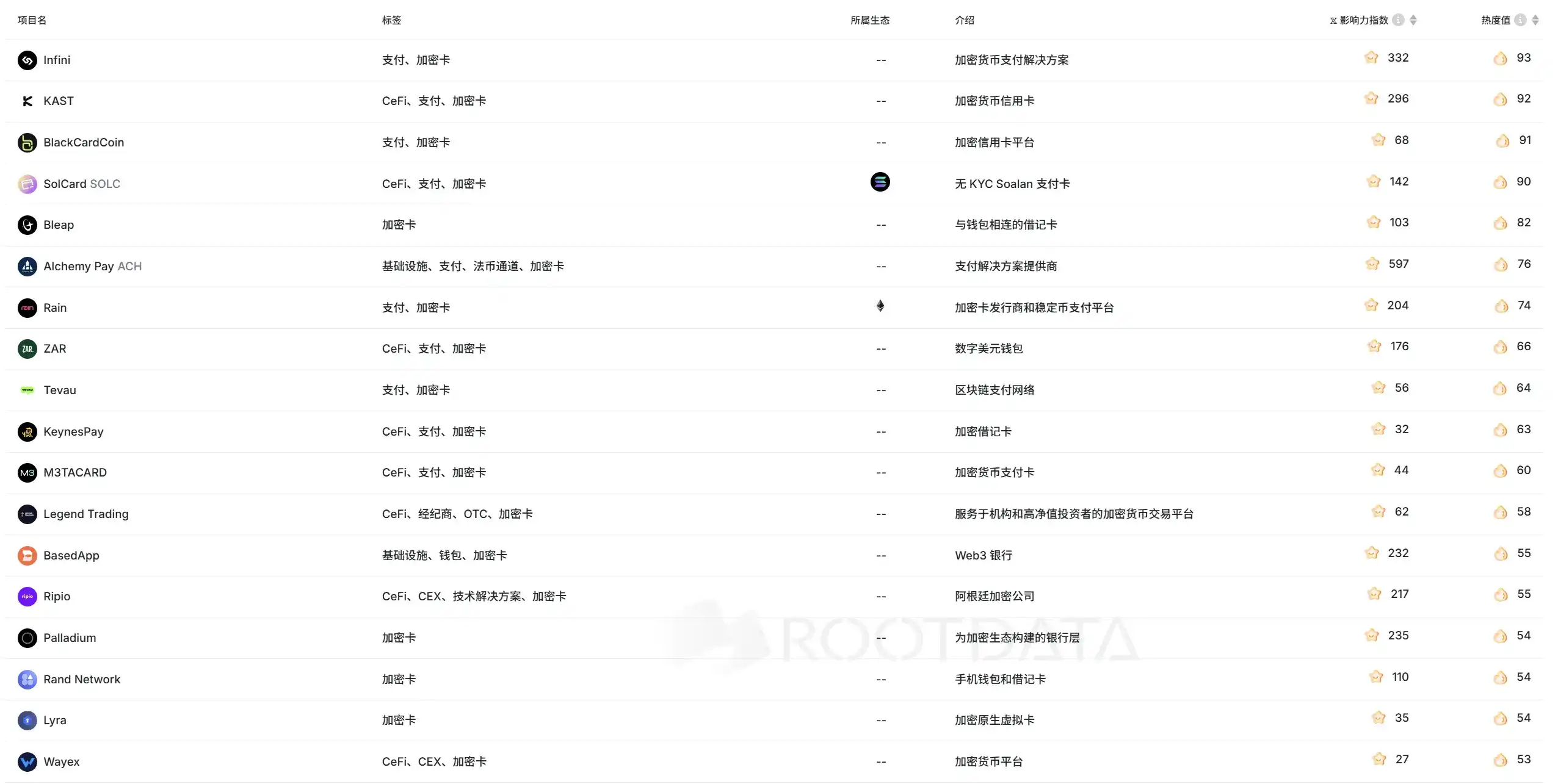
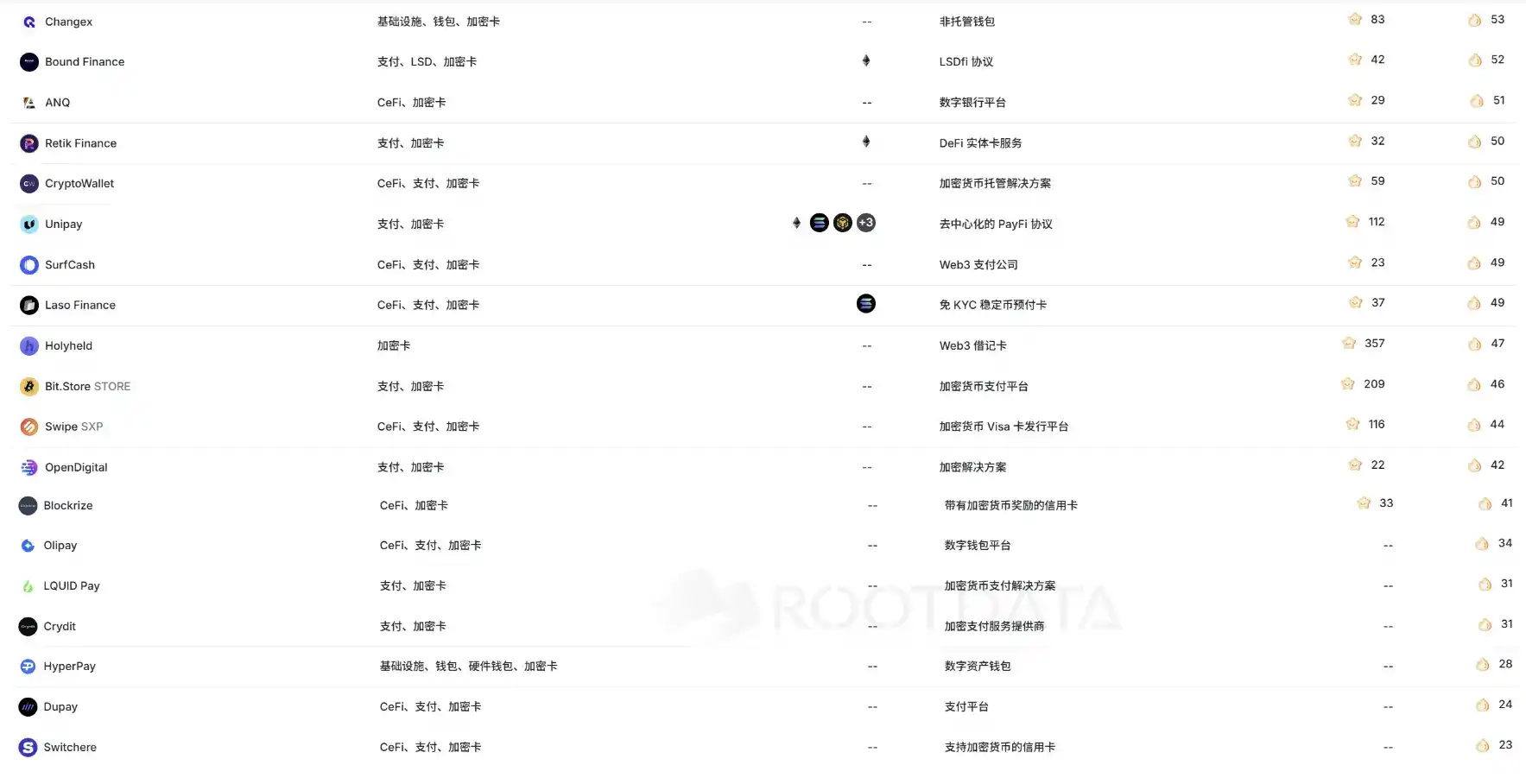
Image Source: RootData
From Metaverse, Metaverse, to now the "Cardverse Era." This competition is not just a stage for startups. More and more key players are personally entering the arena, with exchanges, wallets, and public chains unwilling to fall behind, attempting to secure a spot in the key gateway from on-chain assets to offline consumption.
The market is flooded with a variety of crypto card products; here is a comparison of some representative projects:
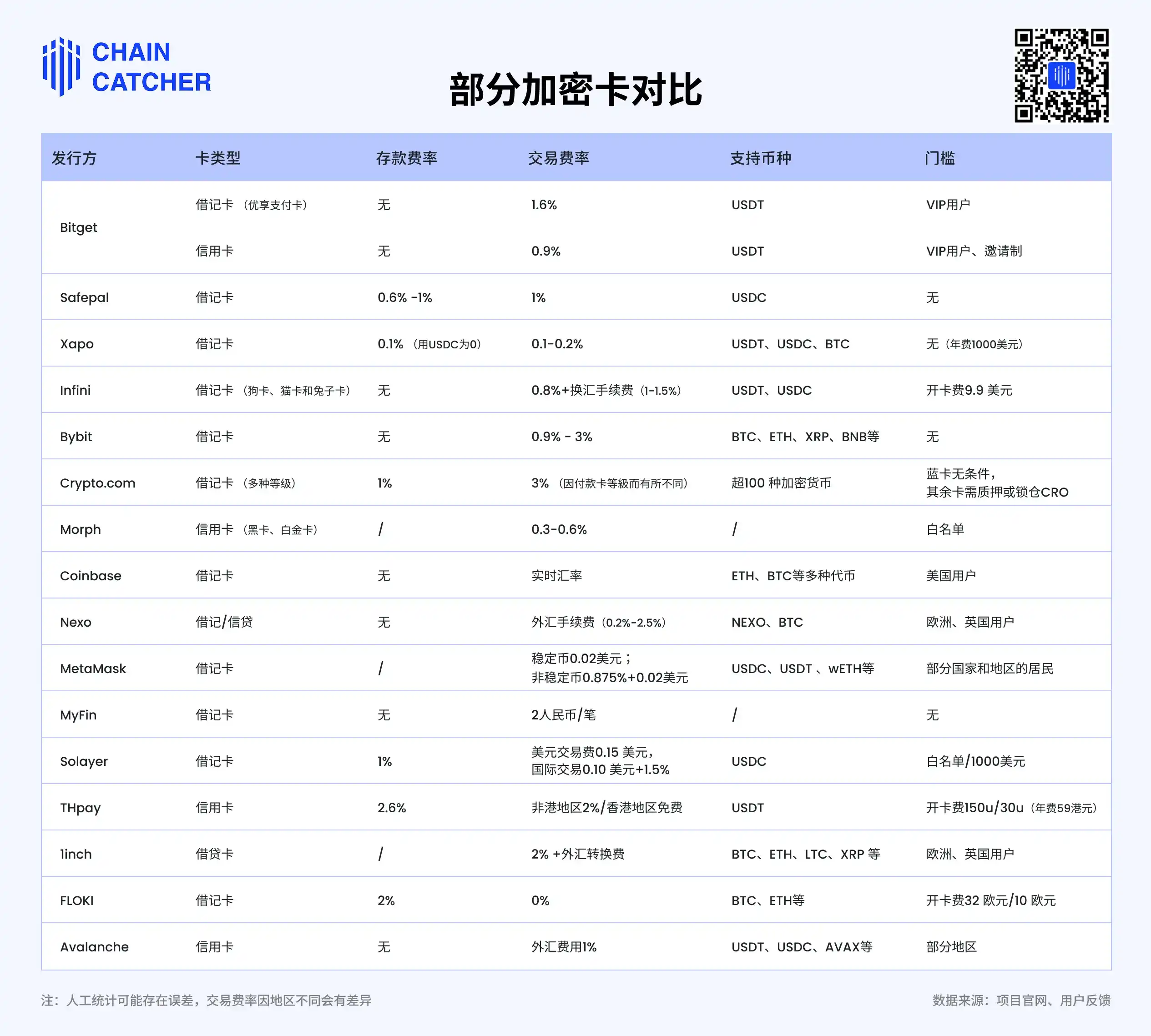
Meanwhile, more cards are on the way:
OKX will collaborate with Mastercard to launch the OKX CardKraken partners with Mastercard to release a crypto debit card MetaMask, CompoSecure, and Baanx will jointly launch a "metal card"....
A card that has become a key gateway to connect Web3 with the real world, and is also a symbol of the transformation of crypto assets from "speculative assets" to "utility assets." It serves as both a bridge and a battleground. Behind this seemingly lively card issuance trend, what is brewing?
The Business of Crypto Cards
Essentially, a crypto card is a form of prepaid card. When a user tops up this card with USDT, USDC, or other stablecoins, it does not "cash out" these assets into the card's balance. Instead, the issuing party allocates a corresponding amount to the user in a bank account opened within the Visa/Mastercard and other traditional card network systems.
The underlying operation is a highly centralized funding model, mainly consisting of three parts: asset custody (to meet user withdrawal needs), asset interest (for earning returns), and asset advance (for exchanging fiat quotas).
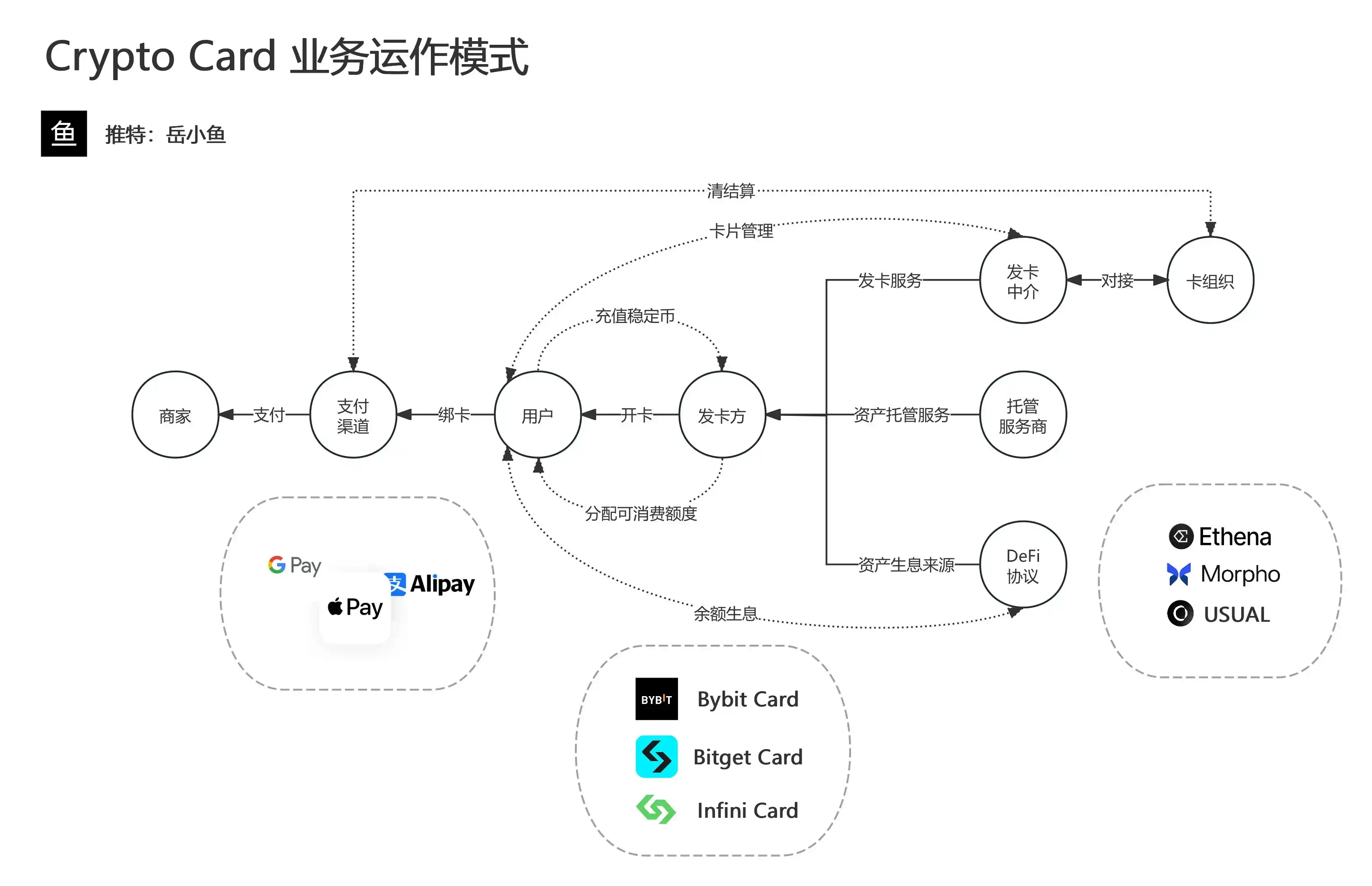
Image Source: @yuexiaoyu111
In this model, the revenue sources of the issuing platform are relatively clear. On one hand, there are card fees and exchange fees, while on the other hand, there are operational earnings from the platform's pooled funds. However, as seen in the comparison chart of crypto cards in the previous text, the competition on fees and charges is already intense, with almost all platforms lowering fee thresholds to attract users, and even adding various "sweeteners" such as airdrops, consumption rebates, and discounts.
Therefore, crypto cards are actually a low-margin business, and platforms can only achieve sustainable profitability through achieving large-scale transaction volumes and fund pooling. For platforms, the essence of this business is actually the competition for users' "payment access." The real competition lies not only in brand building and channel occupation but also in a game centered around user traffic.
Moreover, the natural advantages of payment platforms and wallet extensions in this business not only help enrich their business matrices but also enhance market potential and development prospects.
Trend and Challenges
This "card issuance trend" has brought many opportunities, but it also hides many challenges and risks. There have been various interpretations within the industry regarding the value and challenges of crypto cards.
From a regional perspective, different markets have varying degrees of acceptance for crypto cards. Researcher @sjbtc9 pointed out that in Australia, Europe, the Americas, and Latin America, crypto cards are widely popular due to their ability to avoid high inflation and compensate for inadequate local financial services. In contrast, in regions like Singapore with relatively complete regulatory systems, users already have smooth withdrawal channels, so the demand for crypto cards is relatively tepid. In the domestic market, crypto cards are often used for paying for overseas services subscriptions such as ChatGPT.
In addition, in some regions, crypto cards have also taken on the role of "alternative intermediaries." For example, in the context of high-risk OTC trades, the U Card has to some extent provided a more direct and stable fund gateway.
However, challenges lie ahead. Compliance and risk control have always been inevitable challenges for crypto cards. Crypto influencer Yue Xiaoyu once shared that the OneKey Card rapidly gained popularity due to its excellent product experience, but under compliance pressure, it successively suspended Mainland China KYC and completely shut down its Card business. This not only exposed the high uncertainty under policy regulation but also reflected the difficulty of crypto card businesses in sustaining expansion under weak user growth.
As community user @agintender stated, beneath the surface of crypto cards lies a "risk control hell": how to deal with frozen, stolen, or recovered funds, how to cooperate with investigations, how to hierarchically manage the flow of user funds, and how to establish reasonable customer-side narratives and storytelling abilities are all core issues that crypto cards must address.
Security risks are also a significant concern. In February of this year, card merchant Infini was attacked, resulting in a loss of over $49 million. Crypto influencer @_FORAB revealed that after the incident, multiple U Card service providers entered maintenance mode, and even suspended card issuance. This event highlights that security and risk prevention are key factors for the continuous development of crypto cards.

The wave of card issuance is not just a competition of cards but also a struggle for passage between Web3 and the real world. Each shimmering metal card not only displays a brand logo but also echoes the knock of the crypto economy on mainstream society's door.
Success or failure, who will stand out, time will provide the answer.
You may also like

Naval personally takes the stage: The historic collision between ordinary people and venture capital

a16z Crypto: 9 Charts to Understand the Evolution Trends of Stablecoins

Refutation of Yang Haipo's "The End of Cryptocurrency"

Can a hairdryer earn $34,000? Interpreting the reflexivity paradox of prediction markets

6MV Founder: In 2026, the "landmark turning point" for crypto investment has arrived

Abraxas Capital Mints $2.89 Billion USDT: Liquidity Boost or Just More Stablecoin Arbitrage?
Abraxas Capital just received $2.89 billion in freshly minted USDT from Tether. Is this a bullish liquidity injection for crypto markets, or is it business as usual for a stablecoin arbitrage giant? We analyze the data and the likely impact on Bitcoin, altcoins, and DeFi.
A VC from the Crypto world said AI is too crazy, and they are very conservative
The Evolutionary History of Contract Algorithms: A Decade of Perpetual Contracts, the Curtain Has Yet to Fall

Kicked out by PayPal, Musk aims to make a comeback in the cryptocurrency market

Solana ETF News: What Is a Solana ETF and Why Is Goldman Sachs Betting $108 Million on SOL?
Solana ETF news today shows Goldman Sachs disclosed a $108M position while total SOL ETF inflows reached $1.45B. Analysts now expect up to $6B in institutional demand as Solana trades 71% below its all-time high.

Bitcoin ETF News Today: $2.1B Inflows Signal Strong Institutional Demand for BTC
Bitcoin ETFs news recorded $2.1B inflows over 8 consecutive days, marking one of the strongest recent accumulation streaks. Here’s what the latest Bitcoin ETF news means for BTC price and whether the $80K breakout level is next.
Michael Saylor: Winter is Over – Is He Right? 5 Key Data Points (2026)
Michael Saylor tweeted yesterday “Winter‘s Over.” It is short. It is bold. And it has the crypto world talking.
But is he right? Or is this just another CEO pumping his bags?
Let us look at the data. Let us be neutral. Let us see if the ice has really melted.

WEEX Bubbles App Now Live Visualizes the Crypto Market at a Glance
WEEX Bubbles is a standalone app designed to help users quickly understand complex crypto market movements through an intuitive bubble visualization.

Polygon co-founder Sandeep: Writing after the chain bridge chain explosion

Major Upgrade on Web: 10+ Advanced Chart Styles for Deeper Market Insights
To deliver more powerful and professional analysis tools, WEEX has rolled out a major upgrade to its web trading charts—now supporting up to 14 advanced chart styles.
Morning Report | Aethir secures a $260 million enterprise contract with Axe Compute; New Fire Technology acquires Avenir Group's trading team; Polymarket's trading volume surpassed by Kalshi

Why a Million-Follower Crypto KOL Chooses WEEX VIP?
Discover why top crypto KOL Carl Moon partnered with WEEX. Explore the WEEX VIP ecosystem, 1,000 BTC protection fund, and exclusive rewards for serious traders.

CoinEx Founder: The Crypto Endgame in My Eyes
Naval personally takes the stage: The historic collision between ordinary people and venture capital
a16z Crypto: 9 Charts to Understand the Evolution Trends of Stablecoins
Refutation of Yang Haipo's "The End of Cryptocurrency"
Can a hairdryer earn $34,000? Interpreting the reflexivity paradox of prediction markets
6MV Founder: In 2026, the "landmark turning point" for crypto investment has arrived
Abraxas Capital Mints $2.89 Billion USDT: Liquidity Boost or Just More Stablecoin Arbitrage?
Abraxas Capital just received $2.89 billion in freshly minted USDT from Tether. Is this a bullish liquidity injection for crypto markets, or is it business as usual for a stablecoin arbitrage giant? We analyze the data and the likely impact on Bitcoin, altcoins, and DeFi.


 App
App