
When TRUMP becomes pastime, can the CAR of the Central African President get in the car?


Original Title: "President of the Central African Republic Asking Me to Buy a Coin? Can I Trust It?"
Original Author: Wenser, Odaily Planet Daily
After the brief "BNB Chain market" over the weekend, the daily "watering" ushered in a new "market express pass" on Monday—CAR.
Following Trump's "pearls before swine" official Meme coin release, Central African Republic President Faustin-Archange Touadéra (Faustin-Archange Touadéra) X Platform official account (Odaily Note: Based on current information, it cannot be confirmed as a self-post) posted a highly infectious tweet around 6 a.m., stating, "We will release a Meme coin called CAR and aim to use this experiment to leverage the power of memes to propel the Central African Republic onto the world stage," and even directly posted the token contract address.
After the news spread, hot money flooded in, and countless people exclaimed, "In 2025, you might even see the President of the Central African Republic calling on you to buy the coin." The CAR token market cap also surged all the way, peaking at nearly $1 billion. As of the time of writing, the CAR market cap is currently reported at $650 million. Odaily Planet Daily will organize the relevant information about the token in this article for readers' reference.
Note: Meme coins are highly volatile; please choose your targets carefully and DYOR (Do Your Own Research).
The Power of the Express Pass Token CAR: The Next TRUMP?
At around 8:30 a.m., after the Central African Republic President's concept Meme coin CAR briefly exceeded a market cap of $470 million, it quickly fell back to $270 million.
Subsequently, as market news gradually spread, some suggested that the "account may have been hacked," while others believed it was "worth a try," just like the drama that followed the TRUMP token release. CAR's market cap also soared amid questioning and FOMO, rising to a peak of $980 million around 10 a.m.
It is worth noting that earlier, the Central African Republic President Faustin-Archange Touadéra X Platform official account also emphasized in the tweet's comments section at the same time:
"As the world's second president to adopt Bitcoin as a legal tender country, I have always had a clear understanding of the potential of cryptocurrency and its benefits globally. For all information regarding the CAR Meme, please visit http://car.meme (Odaily Planet Daily Note: Currently, the website has been restricted by the domain provider namecheap.com and cannot be accessed)."
Currently, the market focus is primarily on the following aspects:
1. Is the "Central African President Coin" real?
Regarding this matter, based on the flow of funds in the market, the majority tends to hold a positive view (or in other words, most people are willing to believe it is real).
Those holding a contrary view mainly come from a technical perspective: Unrevealed XYZ founder Yokai Ryujin issued a warning stating that the process of registering the CAR domain on the domain provider namecheap.com does not look like something a "president or country would do," and pointed out that the domain was registered just three days ago. Subsequently, Namecheap officials stated that they have "suspended abusive services."
Additionally, Platform X has suspended the official X account @Carmeme_news dedicated to the Meme coin, but the Central African President has stated that he is "working with X" to restore the page as soon as possible.
Meanwhile, Jupiter officials have also stepped forward: Jupiter co-founder meow first posted, "As this is our first token of this kind, we have contacted the CAR office to further verify the validity of the token. We will provide real-time updates on any information we receive. The team has temporarily verified CAR to prevent users from mistakenly buying the token, but there is still much we do not know, including the token's origin, doubts about the lock-up, etc. Please be cautious of risks." Subsequently, he issued another warning, stating, "We are introducing an organic score in our platform's Trending Tokens module, which will not indicate the authenticity of the token, only showing that there are many genuine traders transacting the token. Jupiter will introduce a tag based on this to avoid verification in such cases."
In the latest update, Jupiter co-founder meow stated that they have contacted the CAR deployment team for on-chain verification but have not yet received any off-chain confirmation.
It is worth mentioning that according to AI tools, the deploying wallet address of CAR, 121ftnYRm3WJmDHCWrazzRoyZAzZQ4xc5XD7dp3sfpfo, is relatively "clean," as it has not previously issued any tokens.
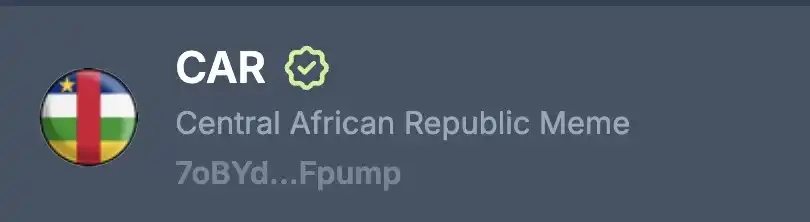
Jupiter's temporary verification does not constitute authenticity confirmation
Current Conclusion: Inconclusive.
2. Was the Central African President's Video a deepfake?
Around 7:30 a.m., the Central African President's X platform account posted another "shout-out video for a product."
However, with the advancement of AI deepfake technology, such videos still cannot be used as evidence to prove that the account's post was made by the Central African President himself.
Subsequently, there were reports that AI Deepfake detection models Deepware and Avatrify flagged the video of the Central African Republic President announcing the launch of the Meme coin CAR as suspicious.
Additionally, X platform user Crypto Dreamer raised doubts about the video content: "The wording used in the tweet video is very strange, and the current time is midnight locally. It makes no sense for them to launch a currency at that time, and their official language is French. The content in this tweet video is only in English, with no French version."
Current Conclusion: The video may be a deepfake face-swapping forgery.
3. What is the CAR Token's Economic Model?
According to Solscan data, the token distribution data aligns roughly with the CAR project's website's disclosed tokenomics. Among the top 4 wallet addresses:
The wallet 51MsZhT6xPSFZ3KriJKuuk2mivcnrszCw8Noo7NJsQDL holds 33.31% of the tokens;
The wallet 5aXLXUwt6KvsfHmv1zwyxdaezETbTu6i2rV5R2sFMhnV holds approximately 25% of the tokens;
The wallet 2Dd5LUBQmUHp17fTJgu5qNdAm2R9ZLLEFprYVJvdazmr holds 9.81% of the tokens;
The wallet HAZrZNBuvcy6M4G5M38wweZtgsZm43WgpbWbTErNU8MM holds 8.39% of the tokens.
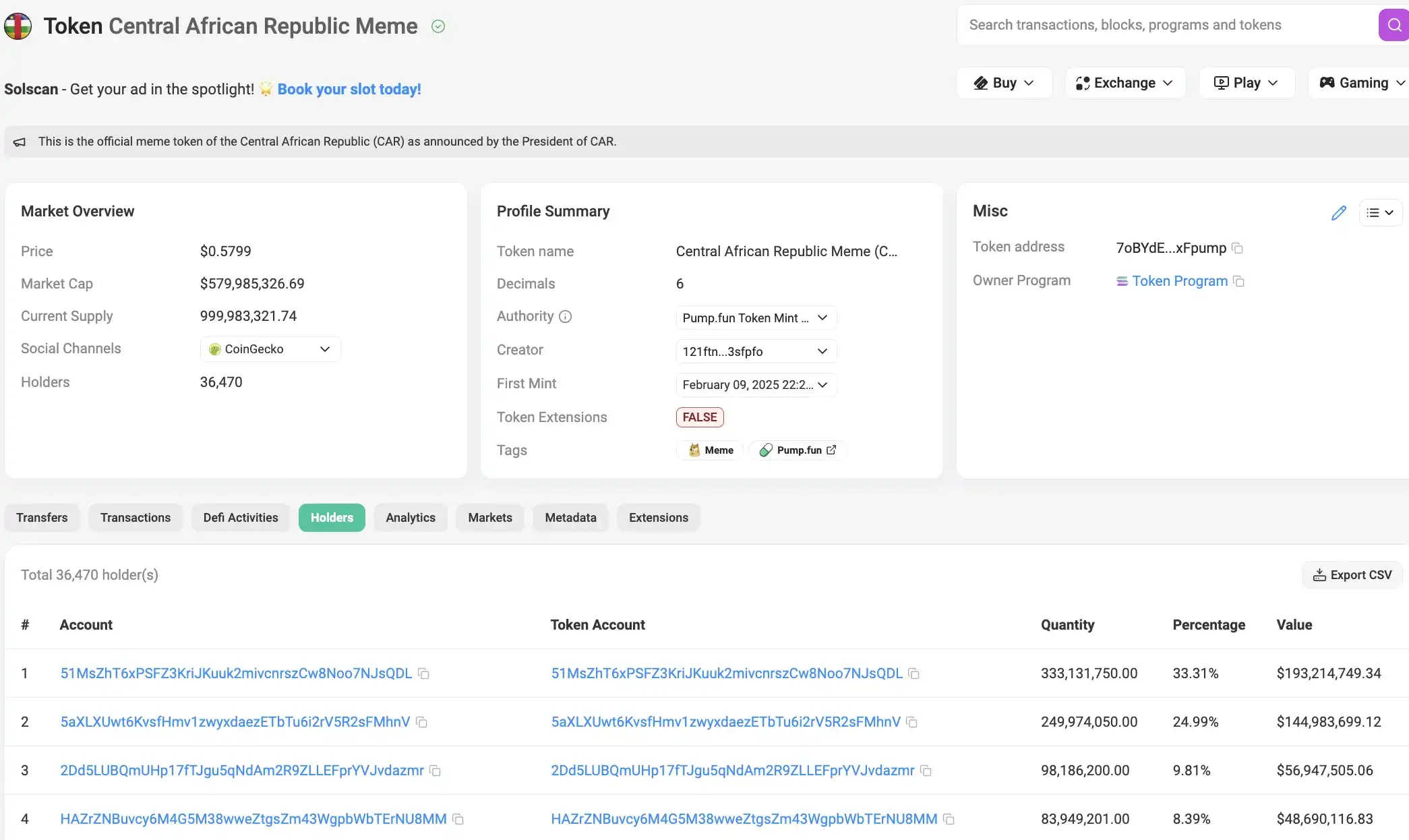
Solscan Interface Token Information
According to previous information on the project's official website, the CAR token has only a 9.3% public distribution, with 35% of that allocated to the development of the Central African Republic; the creator and company token share is 25%; liquidity injection accounts for 20.7%; and an additional 10% of the tokens will be allocated to charitable organizations. The former president of the Central African Republic had also mentioned in a tweet that "80% of the tokens have been locked via @streamflow_fi." However, it is suspicious that the 20% of the CAR supply promised to be allocated to the liquidity pool by the project's officials had not been added as of the time of writing.
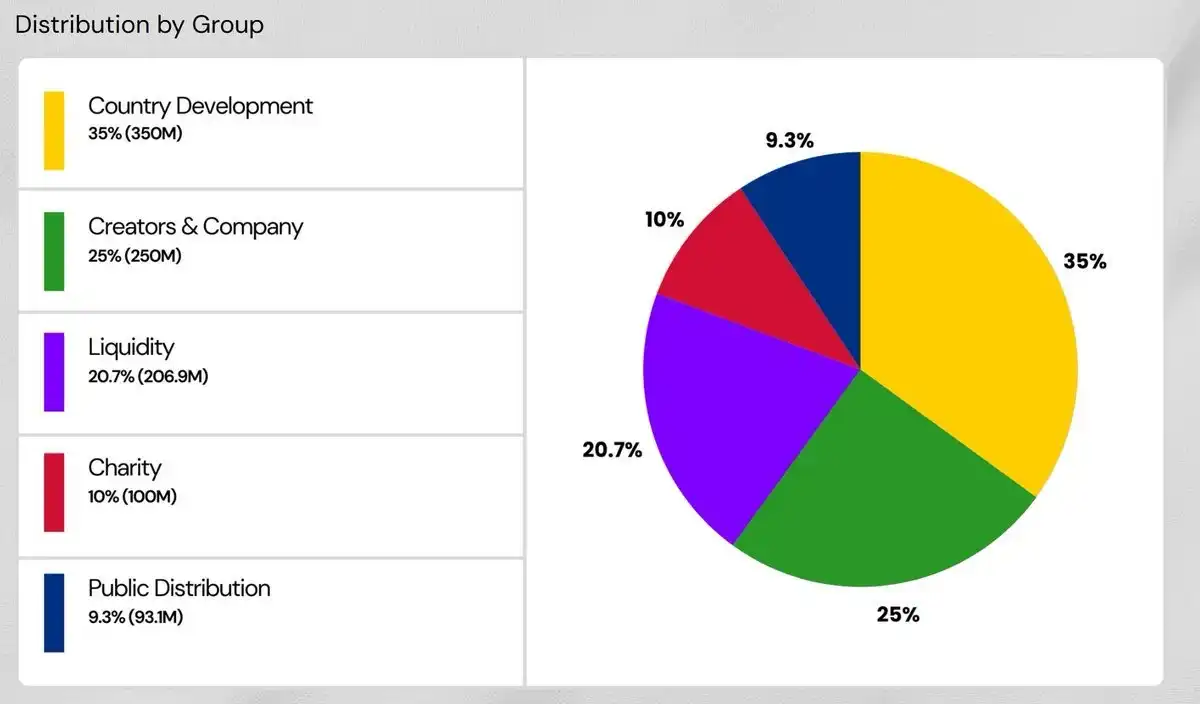
CAR Tokenomics
Whether CAR is the official Meme coin of the Central African Republic remains shrouded in mystery.
Meanwhile, on the other side of the market, there is a "speculator's frenzy" and a "rug puller's pain."
Who Got on the CAR Bandwagon? Some Profited Thousands of Times, While Others Rug Pulled Over $40 Million
Whether the CAR token is real or fake, trading in the market continues every moment. Some have profited hundreds or even thousands of times, while others have sadly rug pulled.
Wallet One: Invested $5,000, Profited 2450x
As monitored by Lookonchain, wallet address Fs7md made a profit of $12 million from an investment of only $5,000 in less than 3 hours, with a return of 2450x.
Immediately after the President of the Central African Republic (@FA_Touadera) released the CAR token contract address, this wallet address spent 25 SOL ($5,000) to purchase 46.57 million CAR tokens, then sold 22.65 million CAR tokens at a price of 8,395 SOL ($167,000), retaining 23.92 million CAR tokens ($10.5 million) and making a total profit of over $12 million.
Wallet Two: Rug Pulled Over $40 Million, But Made $440,000 in Scalping
According to Lookonchain monitoring, at the moment the President of the Central African Republic released the CAR contract address, a user spent 25 SOL ($4,905) to buy 49.6 million CAR tokens, which surged to a value of over $40 million at one point. Unfortunately, the user sold all the tokens at once for only 30 SOL ($5,957). Realizing the missed opportunity, the user quickly spent 139 SOL ($27,400) to buy back 4.08 million CAR tokens, then sold them for 2,358 SOL ($46,740), making a profit of $440,000.
Wallet Three: $3 Million Profit, 500x ROI
According to lmk.fun monitoring, 3 hours ago, a user made a $3 million profit on CAR with 30.13 SOL ($5656). He spent 29.73 SOL to buy 9.852 million CAR shortly after the Central African Republic President's post and paid a total transaction fee of 0.4 SOL.
Wallet Four: $3.08 Million Profit, 78x ROI
According to on-chain analyst AI Auntie's monitoring, savvy wallet 7rCbH spent 200 SOL to buy 14.54 million tokens on CAR half an hour after launch, with a cost as low as $0.002725 per token; subsequently, in stages during the price increase, he sold all tokens at an average price of $0.375, exited the market with a $3.08 million profit, and achieved a 7786% ROI.
Whale Rebalance: Dump TRUMP, Buy CAR
According to Onchain Lens monitoring, a wallet associated with SpiderCrypto exchanged 110,619 TRUMP for 2.49 million CAR, valued at $1.52 million.
There are always people participating in this high-stakes gamble because the returns always look so enticing.
Summary: CAR Token's Official Authenticity Pending Verification, but PolitiMeme is Set in Stone
Currently, CAR's market cap has dropped to $420 million, and whether it is the official coin issued by the Central African President is still up in the air. However, following the various political concept tokens dominating PolitiFi, PolitiMeme has become established with the Trump family launching an official Meme coin.
Some have compiled a list of various African presidents with the potential to issue coins, while others have pointed out that the CAR official website information mirrors that of the TRUMP token website, both mentioning that "the token is not intended to serve as any form of investment, security, or financial instrument. It is designed solely for entertainment and community participation and serves as a symbol of community unity. CAR has no intrinsic value and should not be seen as a financial asset."
Nevertheless, the process of cryptocurrency mainstreaming will continue with similar token controversies and pathways such as ETF funds, where everyone is both a participant and a witness. Just as Central African President Faustin-Archange Touadéra's X platform's official account pinned tweet says: "Bitcoin is a universal currency."
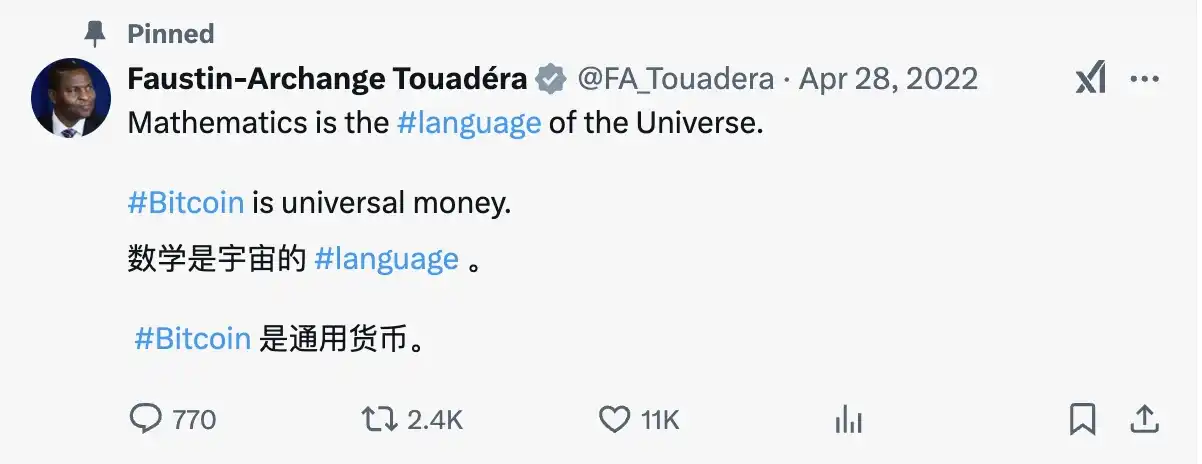
Top Post Information
You may also like

Cryptocurrency market makers collectively seek change as it becomes increasingly difficult to make money

a16z Crypto Partner: Cash flow is the moat

Citibank releases "2030 Asset Tokenization Market Outlook": 6 major trends may create a $8.2 trillion market

The trillion-dollar valuation test: Are the three major super IPOs a celebration for tech stocks or a nightmare for the crypto market?

Morning Report | Digital Asset completes $355 million financing led by a16z Crypto; Meta completes operational separation from Manus

Morning News | CME Group launches Nasdaq Cryptocurrency Index futures; Asset management giant Janus Henderson strategically invests in Ethena

Bitcoin Layer 2 Network Botanix: Why Did We Choose to Dissolve?

Why did Oracle deliver the strongest financial report in history, yet its stock price fell?
When the P2P illicit funds from ten years ago turned into 60,000 bitcoins

Dialogue with OmenX Founder: Why does the prediction market need an evolution from "spot" to "derivatives"?
Galaxy in-depth report: Is Solana still worth paying attention to?

Young people in South Korea make a "final effort" in the epic bull market
The pricing controversy of Trade.xyz exposes the fatal weakness of Pre-IPO perpetual contracts
How much longer can Ethereum's last big buyer hold on?

World Cup 2026 Coming – WEEX Celebrates with $1M Prize Pool & Michael Owen Live

Morning Report | OpenAI has submitted an S-1 registration statement draft to the U.S. SEC; Morpho completes $175 million financing

Galaxy Deep Research Report: How Hyperliquid's HIP-4 Upgrade Changes the Landscape of Prediction Markets?

Latest research from 13 top universities including Cornell University: The current state, challenges, and misconceptions of the fusion of Crypto and AI
Cryptocurrency market makers collectively seek change as it becomes increasingly difficult to make money
a16z Crypto Partner: Cash flow is the moat
Citibank releases "2030 Asset Tokenization Market Outlook": 6 major trends may create a $8.2 trillion market
The trillion-dollar valuation test: Are the three major super IPOs a celebration for tech stocks or a nightmare for the crypto market?
Morning Report | Digital Asset completes $355 million financing led by a16z Crypto; Meta completes operational separation from Manus
Morning News | CME Group launches Nasdaq Cryptocurrency Index futures; Asset management giant Janus Henderson strategically invests in Ethena


