
What will the early Hyperliquid prediction market look like?


On Friday evening, the US stock market and CME futures successively closed, and market-affecting information kept pouring in.
A trader stared at the screen, with three layers of judgment in his mind: he felt that there would be war-related news brewing over the weekend, the probability of BTC first going down and then up was underestimated; he felt that the outcome of the next Fed decision had not been priced in yet; he also wanted to buy a weekend gap insurance for his crude oil or precious metals position.

The trouble is, in the past, these three things often had to be done in three different places. Betting long or short on a futures exchange, betting on events in a prediction market, completing hedges on an options exchange, and the margin being divided into three parts. Although cognition is a whole, the position is fragmented.
Hyperliquid's new market framework HIP-4 addresses this fragmentation.
What is HIP-4?
HIP-4 turns the "outcome" itself into a tradable standardized asset, allowing judgments like "will something happen" or "will a price reach a certain level at a certain time" to enter Hyperliquid's trading system in the form of standardized assets. It went live on the Hyperliquid testnet on February 2.
A community member recently reverse-engineered the core contract of HIP-4 based on the deployed contracts on the testnet, allowing us to get a glimpse of its architecture before its mainnet launch.
Community-simulated HIP-4 frontend based on testnet contracts
HIP-4 adopts a dual-layer structure. Trading occurs on HyperCore, while fund custody, pool management, and some settlement take place on HyperEVM. The former is responsible for high-frequency matching, and the latter handles the more complex contract logic of prediction markets, with a clear division of labor.
Through HIP-4, the abstract "event" can be "transposed" into truly tradable assets.
Suppose someone opens a market on "Who will win the 100m sprint," with event ID 9, where outcome 0 represents "Hypurr wins." This outcome would then be mapped to the "#90" token on HyperCore, traded on the order book. Traders buy and sell it just like trading a spot asset.
For example, a market like "Will BTC touch a certain price within 15 minutes" operates as a type of option and settles directly on HyperCore based on real-time price data at expiration, without the need for an external oracle.
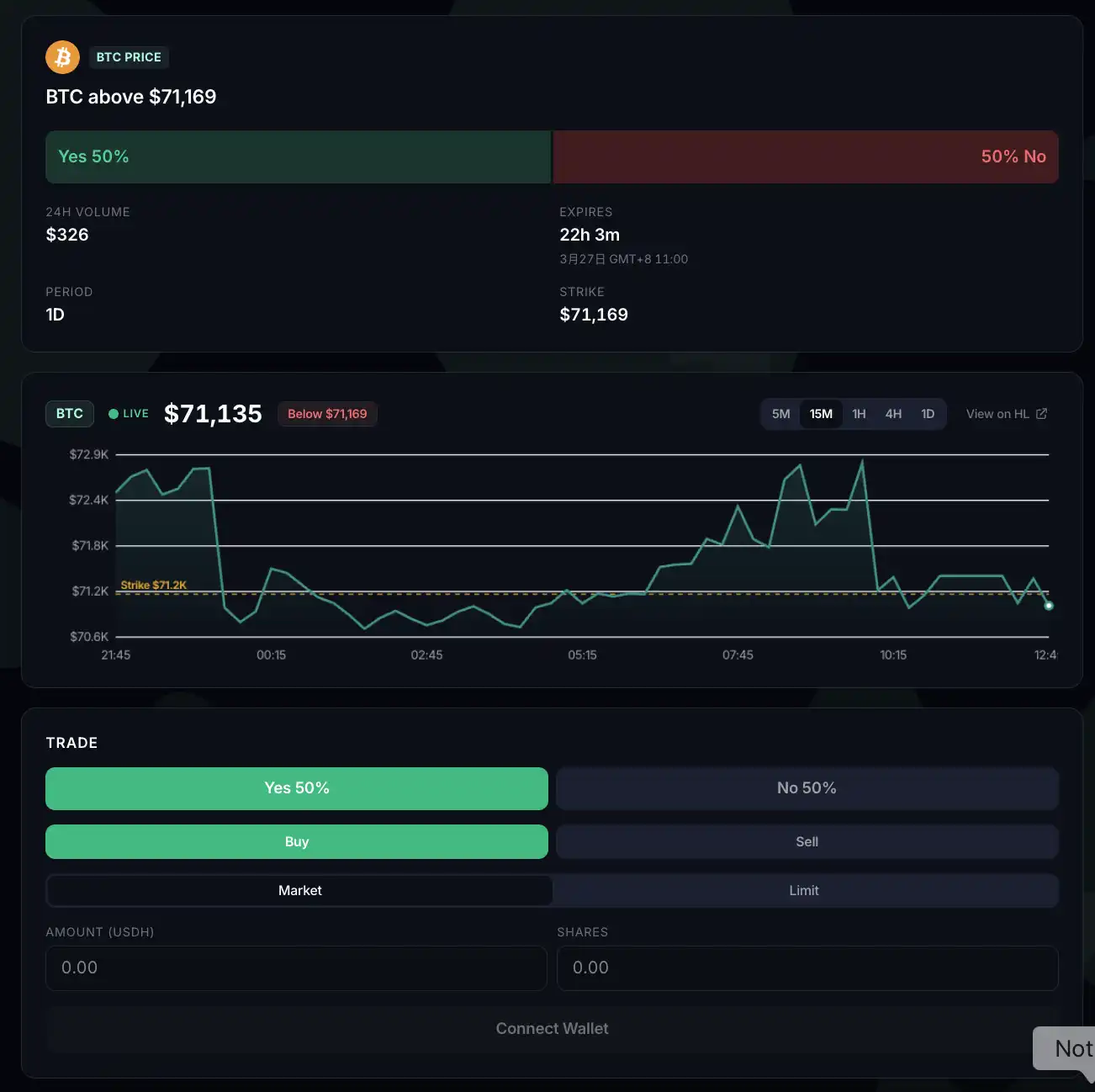
On the other hand, settlement rules for event contracts like "Who will win the 100m sprint" are still unclear.
User Profile Overlap with Polymarket
A study of nearly 15,000 active Polymarket addresses found that a group of top traders were also active on Hyperliquid.
This overlapping group of users contributed approximately $1.43 billion in trading volume on Polymarket, while collectively managing around $189 million in contract positions on Hyperliquid with a margin utilization of about $29 million. The long and short positions in these addresses' Hyperliquid accounts are evenly distributed, primarily trading mainstream assets such as BTC and ETH; on Polymarket, they tend to hold positions in long-cycle events like elections and Fed resolutions. It is evident that this is a group of experienced traders.
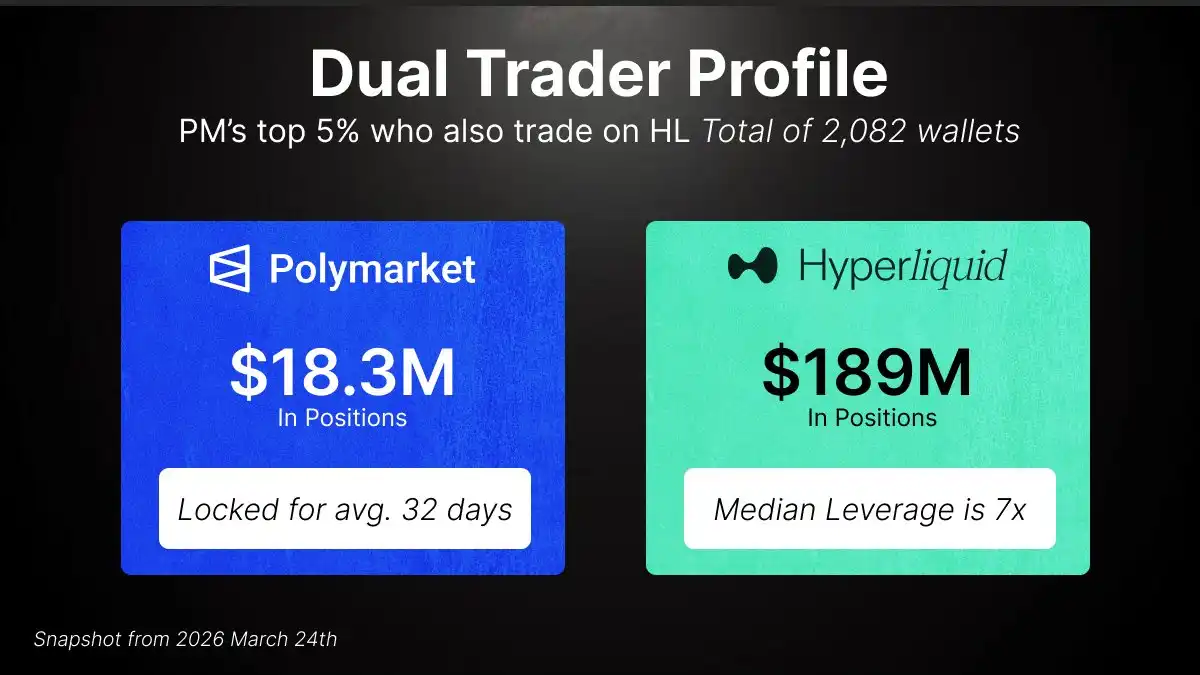
Today, these two sets of positions still reside in two separate and isolated systems. Approximately $18.3 million of open interest in prediction markets cannot enter the contract collateral system. Based on the average 7x leverage of these overlapping users on Hyperliquid, this theoretically corresponds to over $120 million in additional trading capacity.
Targeting TradFi Vulnerabilities: A New Space for DeFi Imagination
HIP-4's greatest imagination lies in composability.
The community has outlined several potential new product types:
Weekend Gap Options: In traditional markets, there is a significant gap period from Friday's close to Sunday's open. HIP-4 can directly turn this gap into a weekend gap option. Traders holding positions in oil, silver, or stocks from HIP-3, who are concerned about a sudden gap before Monday's opening, can buy an option to hedge against the difference between Friday's closing price and Sunday's opening price.
Internal-External Pricing Delta: Compensation for the maximum deviation between the internal pricing of HIP-3 exchanges and external oracle prices to hedge against clearing risks.
Funding Rate Option: Allows traders to hedge against a negative funding rate.
These structured instruments are precisely what sets HIP-4 apart from traditional prediction markets. The latter often lack natural counterparty positions, with the market being primarily dominated by insiders who continuously exploit uninformed retail and market makers.
In contrast, such structured products under HIP-4 have a native hedging demand, not just a speculative function. Market makers' pricing logic, liquidity quality, and market depth all operate at another level.
Cognition is never linear, and neither should be positions.
Same account, same margin, same settlement system; HIP-4 brings Hyperliquid one step closer to the vision of the House of All Finance.

You may also like

Morning News | CME Group launches Nasdaq Cryptocurrency Index futures; Asset management giant Janus Henderson strategically invests in Ethena

Bitcoin Layer 2 Network Botanix: Why Did We Choose to Dissolve?

Why did Oracle deliver the strongest financial report in history, yet its stock price fell?
When the P2P illicit funds from ten years ago turned into 60,000 bitcoins

Dialogue with OmenX Founder: Why does the prediction market need an evolution from "spot" to "derivatives"?
Galaxy in-depth report: Is Solana still worth paying attention to?

Young people in South Korea make a "final effort" in the epic bull market

The pricing controversy of Trade.xyz exposes the fatal weakness of Pre-IPO perpetual contracts

How much longer can Ethereum's last big buyer hold on?

World Cup 2026 Coming – WEEX Celebrates with $1M Prize Pool & Michael Owen Live

Morning Report | OpenAI has submitted an S-1 registration statement draft to the U.S. SEC; Morpho completes $175 million financing

Galaxy Deep Research Report: How Hyperliquid's HIP-4 Upgrade Changes the Landscape of Prediction Markets?

Latest research from 13 top universities including Cornell University: The current state, challenges, and misconceptions of the fusion of Crypto and AI

Deconstructing Anthropic: The Best AI Company, Possibly Also a Type of Organizational Invention

Every exchange is a "Universal Exchange."

The counterattack of traditional finance: Alliance chains are quietly reviving
Pantera Capital Partner: How Tokenization is Restructuring the Private Equity and Early Investment Ecosystem?

Mastercard Launches Agent Pay for AI, Plans to Record AI Agent Payment Authorizations on Polygon
Mastercard launched Agent Pay for AI, a new payment protocol designed to help AI agents make small payments such as pay-per-use access to data and APIs. The system plans to record human-granted AI agent permissions on Polygon, focusing on verifiable authorization, identity, and payment controls.
Morning News | CME Group launches Nasdaq Cryptocurrency Index futures; Asset management giant Janus Henderson strategically invests in Ethena
Bitcoin Layer 2 Network Botanix: Why Did We Choose to Dissolve?
Why did Oracle deliver the strongest financial report in history, yet its stock price fell?
When the P2P illicit funds from ten years ago turned into 60,000 bitcoins
Dialogue with OmenX Founder: Why does the prediction market need an evolution from "spot" to "derivatives"?
Galaxy in-depth report: Is Solana still worth paying attention to?


