
- Buy Crypto
- Markets
- Futures
- Spot
- Copy Trade
 Earn
Earn- More
What is the Curator role in DeFi? Could it be the dark horse of this cycle?

Original Article Title: "What Is the Curator Role in DeFi? Could It Be a Landmine in This Cycle?"
Original Article Author: Azuma, Odaily Planet Daily
Following two consecutive major security incidents (Balancer, Stream Finance), the issue of DeFi security has once again been thrust into the spotlight, especially the Stream Finance incident, which exposed the significant potential risk associated with the Curator role that has been pivotal in the DeFi market.
The so-called Curator mainly exists in DeFi lending protocols (such as Euler and Morpho affected by the Stream incident this time), usually referring to an individual or team responsible for designing, deploying, and managing a specific "strategically focused vault." Curators typically encapsulate complex yield strategies into user-friendly vaults, allowing ordinary users to "earn interest with one-click deposit," while the Curator determines the specific yield strategy for the assets on the backend, such as asset allocation weights, risk management, rebalancing periods, withdrawal rules, and more.
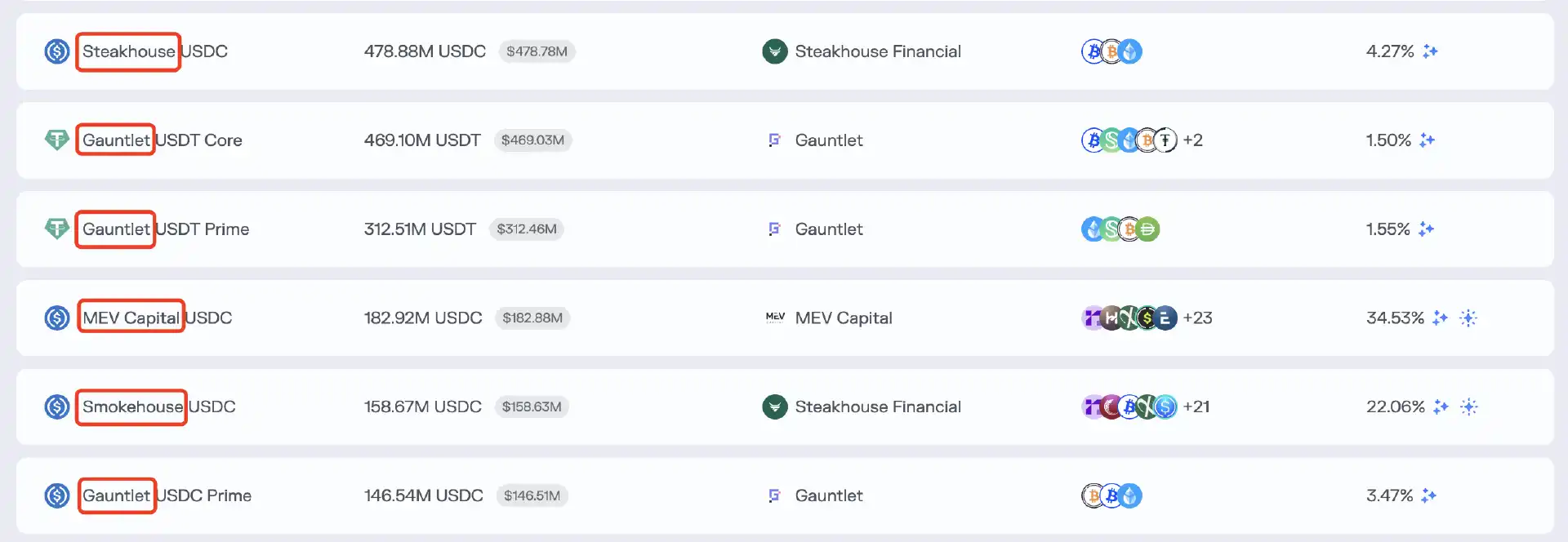
Odaily Note: The above image shows the Curator vault on Morpho, where entities like Steakhouse, Gauntlet, etc., represent the names of the Curator entities responsible for designing, deploying, and managing the vault.
Unlike traditional centralized wealth management services, Curators cannot directly access or control user funds. The assets deposited by users in the lending protocols will always be held in non-custodial smart contracts, and the Curator's permissions are limited to configuring and executing strategy operations through contract interfaces, with all operations subject to contract security restrictions.
Market Demand for Curators
The original intention of Curators was to leverage their professional strategy management and risk control capabilities to address the market's supply-demand matching issues—helping both ordinary users struggling to keep up with the increasingly complex DeFi landscape to maximize their earnings and assisting lending protocols in expanding TVL while reducing the probability of systemic events.
Since the asset pools curated by Curators often offer more attractive returns than the traditional lending marketplaces (such as Aave), this model naturally attracts capital inflows. Defillama data shows that the total size of asset pools managed by Curators has grown rapidly over the past year, surpassing $10 billion on October 31 and currently standing at $8.19 billion as of the time of writing.
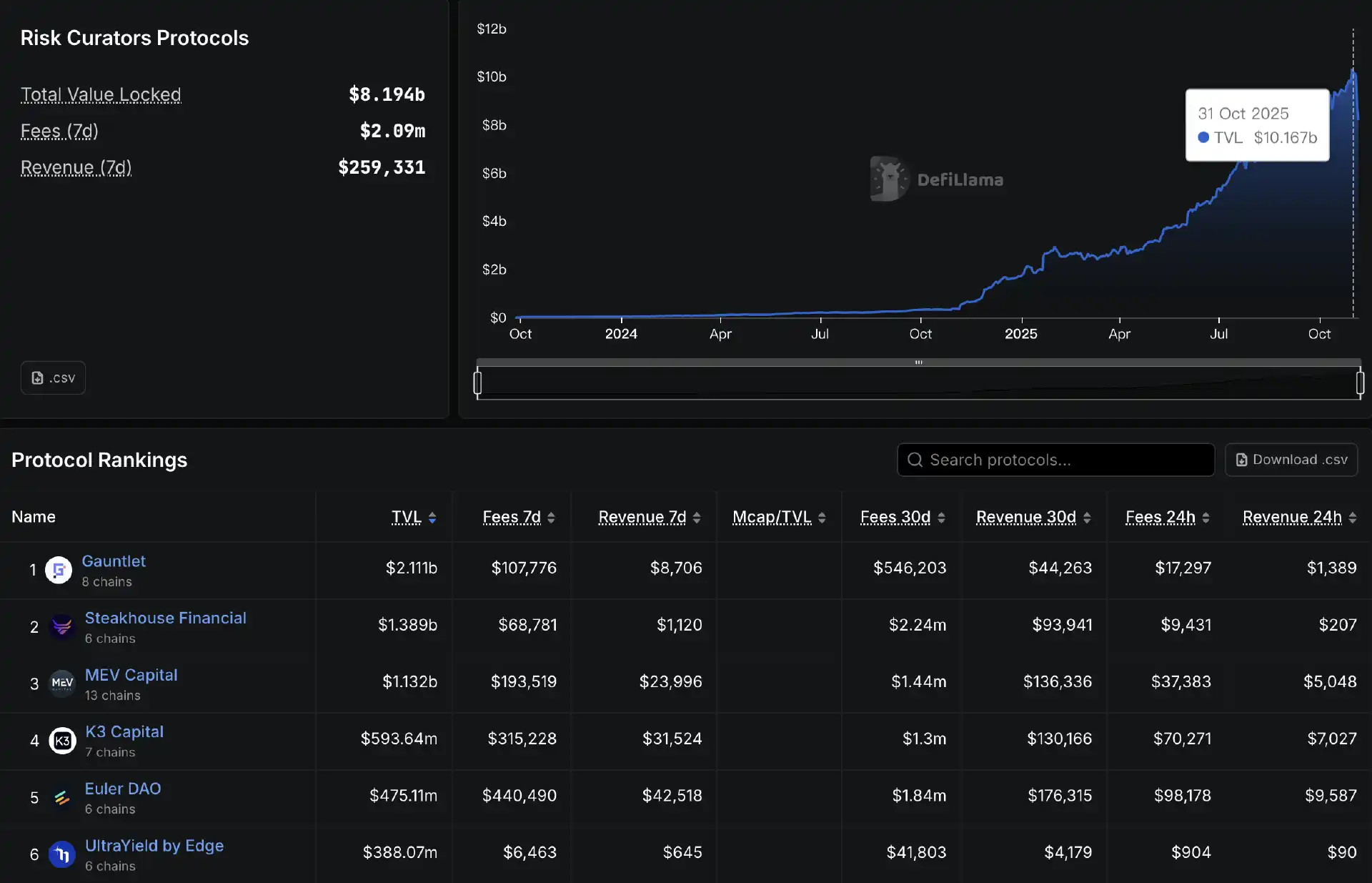
In a fierce competition, Gauntlet, Steakhouse, MEV Capital, and K3 Capital have gradually become the largest Curator managers, each managing billions of dollars in funds. At the same time, protocols such as Euler and Morpho, which focus on the Curator fund pool model, have also seen rapid growth in TVL, successfully reaching a prominent position in the market.
Curator's Profit Model
Up to this point, Curator's role seems quite clear and has sufficient market demand. So why has this become a potential risk threatening the DeFi world today?
Before analyzing the risks, we need to first understand the profit logic of the Curator business. Curators mainly profit in the following ways:
· Performance Fee: After the strategy generates revenue, the Curator takes a certain percentage of the net profit;
· Asset Management Fee: Based on the total fund pool assets, a certain annual percentage is charged;
· Protocol Incentives and Subsidies: Lending protocols generally provide token incentives to Curators to encourage them to create new high-quality strategies;
· Brand Derivative Income: For example, the Curator can also launch products or even tokens after establishing its brand.
In reality, the performance fee is the most common source of income for Curators. As shown in the figure below, in the USDC fund pool on the Ethereum mainnet managed by MEV Capital, Morpho receives a 7% performance fee.
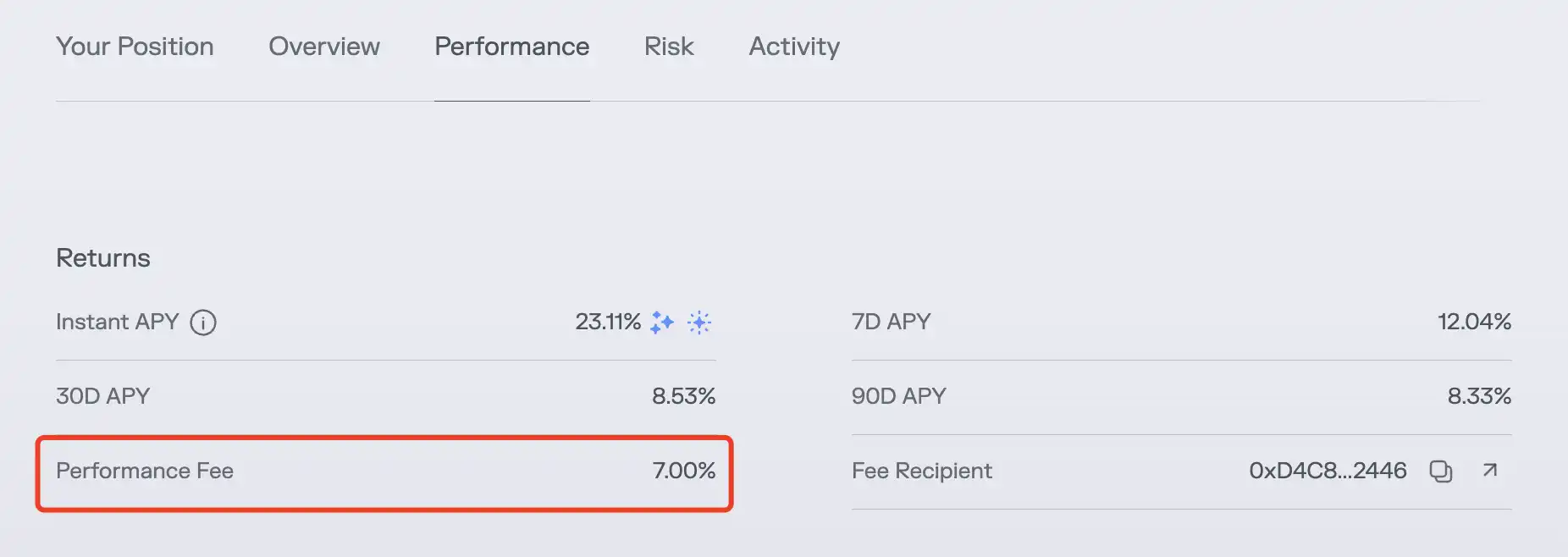
This profit model determines that the larger the fund pool size managed by the Curator and the higher the strategy yield, the greater the Curator's profit — of course, theoretically, a Curator can also increase revenue by raising the fee percentage. However, in a relatively competitive market, no Curator dares to easily take food from users' mouths.
At the same time, since most deposit users are not sensitive to the brand differences of Curators, choosing which pool to deposit into often depends solely on the publicly displayed APY number. This makes the level of attractiveness of the fund pool directly linked to the strategy yield, making the strategy yield the core factor that ultimately determines the Curator's profit situation.
Yield-Driven Environment Leads to Increasingly Overlooked Risks
Keen readers may have already sensed the issue at hand. In a yield-driven model, Curators are only motivated to constantly seek out higher-yielding "opportunities" to achieve greater profits. However, yield and risk are often positively correlated, leading to a scenario where some Curators gradually blur out security considerations, opting to take risks by justifying, "After all, the principal belongs to the user, while the profit is mine."
Using Stream Finance as an example, a major reason causing such a significant impact is that some Curators on Euler and Morpho (including MEV Capital, Re7, and other well-known brands) disregarded risk and allocated funds to Stream Finance's xUSD market. This directly affected users depositing funds into the relevant Curator liquidity pool, subsequently causing defaults in the lending protocol and indirectly expanding the impact.
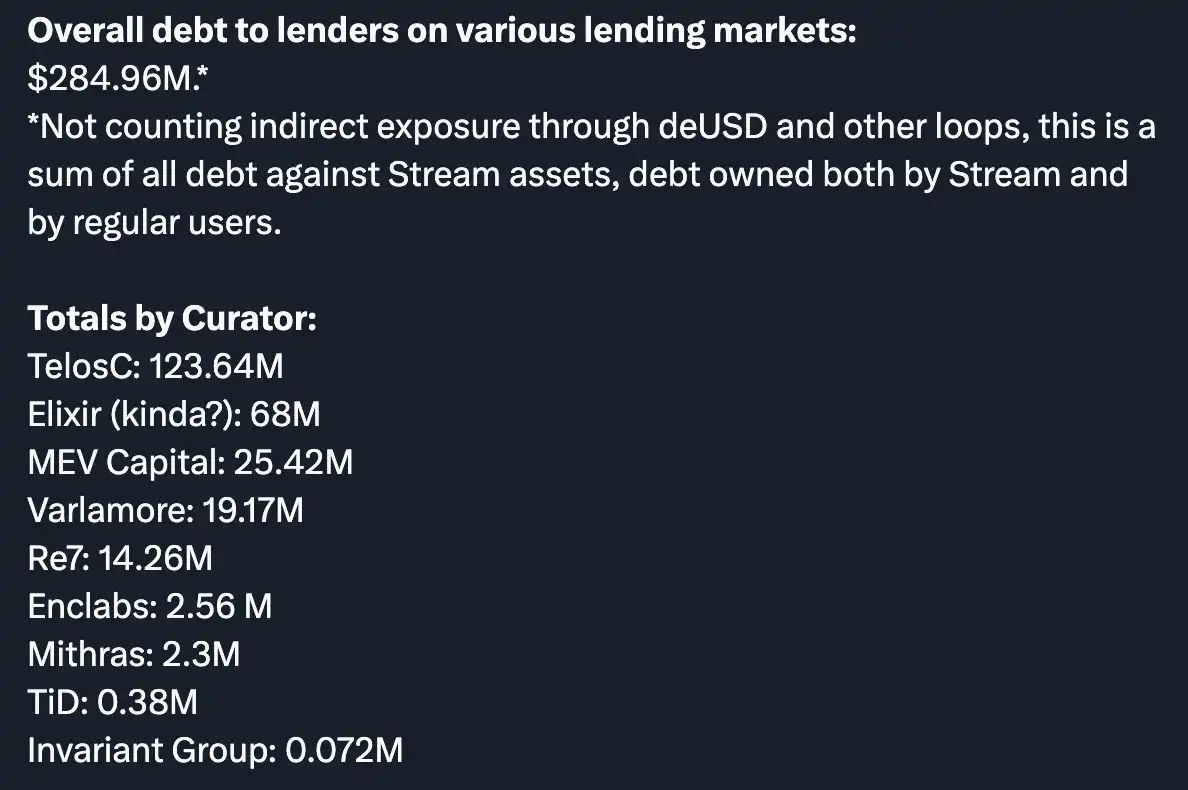
Odaily Note: The image shows DeFi community YAM's compilation of various Curators' debt positions in the Stream Finance incident.
Prior to the Stream Finance incident, several days earlier, multiple Key Opinion Leaders (KOL) and institutions, including CBB (@Cbb0fe), had warned about the potential transparency and leverage risks of xUSD. However, these Curators seemingly chose to ignore the warnings.
Of course, not all Curators were affected by the Stream Finance incident. Major Curators such as Gauntlet, Steakhouse, and K3 Capital never deployed funds to xUSD, demonstrating that in fulfilling their security responsibilities effectively, Curators, as professional entities, are capable of identifying and mitigating potential risks.
Will Curators Trigger Greater Risks?
Following the Stream Finance incident, the attention has shifted to Curators and the potential risks they may cause.
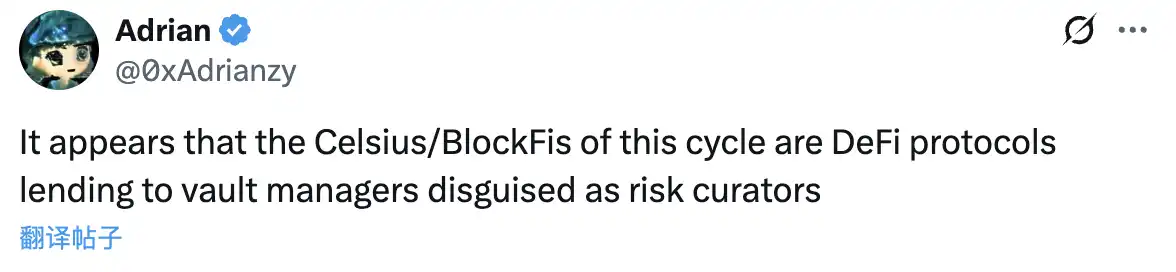
Chorus One investment analyst Adrian Chow recently published an article directly comparing Curator and its related lending protocol to Celsius and BlockFi in this cycle. Indeed, from a purely data-driven perspective, the Curator fund pool, with a total value exceeding 8 billion USD, has a impact scale comparable to the black swan events of the previous cycle. Additionally, the widespread presence of Curator across mainstream lending protocols implies a significant influence that cannot be ignored.
So, will Curator actually trigger a larger-scale risk incident in this cycle? This is a tough question to answer. Looking at the original intent of Curator's existence, the role of this entity should have been to reduce individual user risk through its specialized management capabilities, but its business model and profit path have made Curator itself a vulnerable entry point for centralization risk. For example, if multiple lending protocols in the market rely on a few Curators, a deviation in their model (such as incorrect oracle prices) could lead to simultaneous misconfigurations of all parameters, consequently impacting multiple fund pools simultaneously.
Another point worth mentioning is that in the current market environment, many users depositing funds into lending protocols are not even fully aware of Curator’s role, but rather simply believe they are depositing funds into a well-known lending protocol to earn interest. This leads to the role and responsibility of Curator being obscured, and in the event of an incident, it is the lending protocol that must directly face user outrage and accountability, further driving some Curators to pursue profits too aggressively.
DeFiance Capital founder Arthur also discussed this phenomenon yesterday: “This is why I have always been skeptical of Curator-based DeFi lending models. Lending platforms bear reputation risk and the responsibility of taking care of users. Whether they like it or not, a few poorly managed and non-compliant Curators can also impact the platform.”
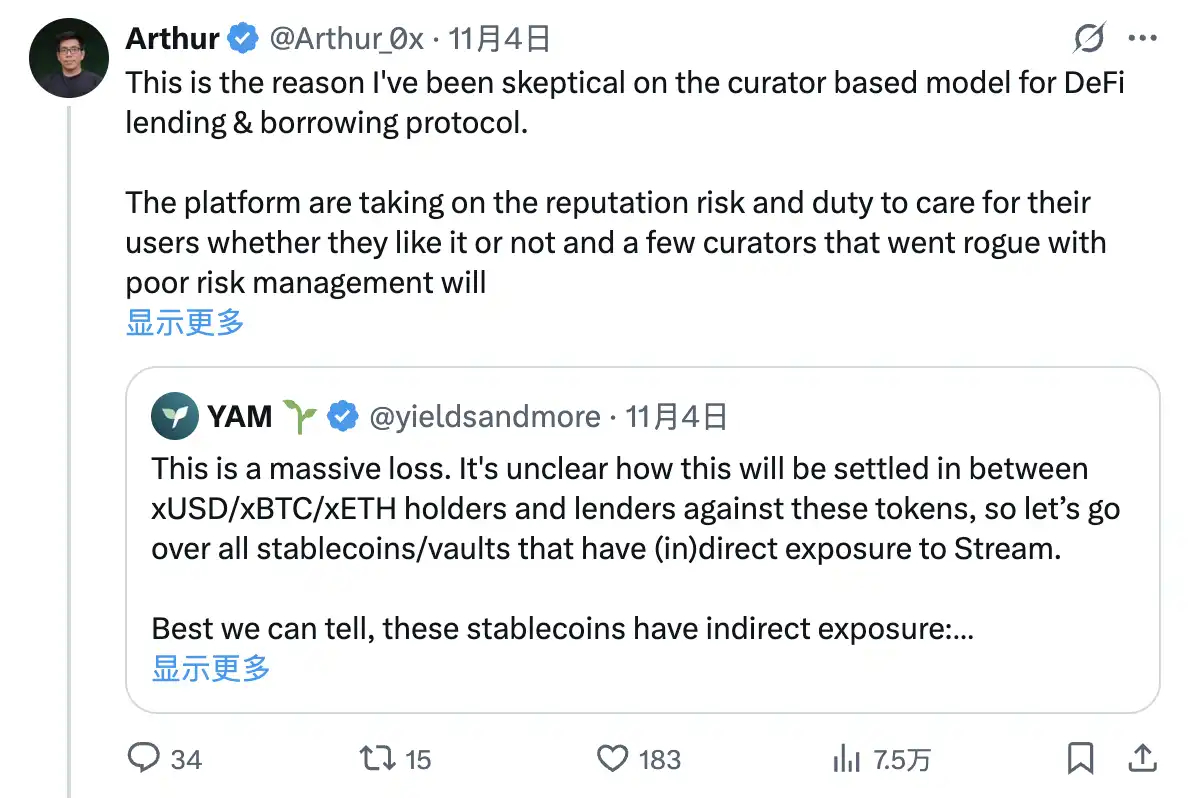
I personally do not believe that leveraging Curator to operate fund pools is a failed business model, and I also have funds deposited in some Curator fund pools (currently only in Steakhouse). However, I also acknowledge that the aggressive tendencies of some Curators may brew a broader range of risks, and the underlying reason for this situation lies in the inadequacy of the user base and some Curators in terms of risk control. Furthermore, due to the profit-driven nature mentioned earlier, the latter may have subjective factors at play.
While we always urge users to assess the protocol, liquidity pool, and strategy configuration on their own, this is evidently hard to achieve as most users lack the time, expertise, or willingness to do so. In this context, most users unconsciously allocate their funds to a Curator liquidity pool with generally higher yield, thus driving the rapid growth of the Curator-managed fund size. In turn, some Curators are savvy in taking advantage of this situation to attract more funds, using more aggressive strategies to boost the pool's yield and then attracting more fund inflow through higher yields.
How to Improve the Current Situation?
Growth always comes with growing pains. While the Stream Finance incident has dealt another blow to the DeFi market, it may serve as an opportunity for users to enhance their understanding of Curators and for the market to improve constraints on Curator behavior.
From the user's perspective, we still recommend users to conduct thorough research as much as possible. Before depositing funds into a specific Curator liquidity pool, pay attention to the reputation of the Curator entity and the design of the related pool. Research considerations include but are not limited to:
· Are there any publicly available risk models or stress test reports?
· Is the permission boundary transparent? Is it subject to multi-signature or governance restrictions?
· What is the withdrawal frequency of past strategies and how do they perform in extreme market conditions?
· Has there been any third-party audit?
· Are the incentive mechanisms aligned with user interests?
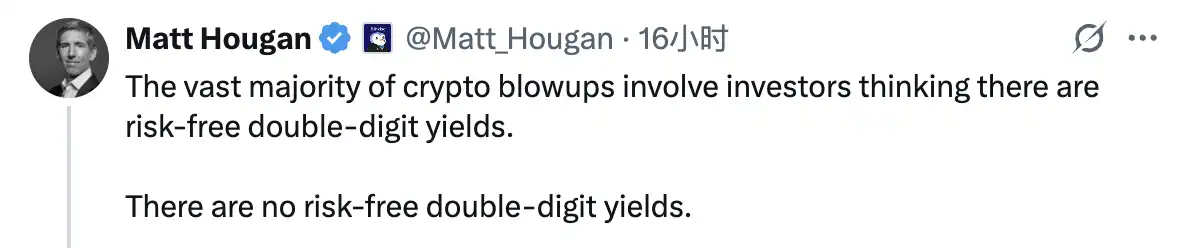
Most importantly, users need to realize that risk is always positively correlated with yield. Before making fund allocation decisions, it is best to think about the most extreme scenarios and be mindful of this quote from Bitwise's Chief Investment Officer Matt Hougan: "The vast majority of cryptocurrency collapses have occurred because investors believed in double-digit risk-free returns, which simply do not exist in the market."
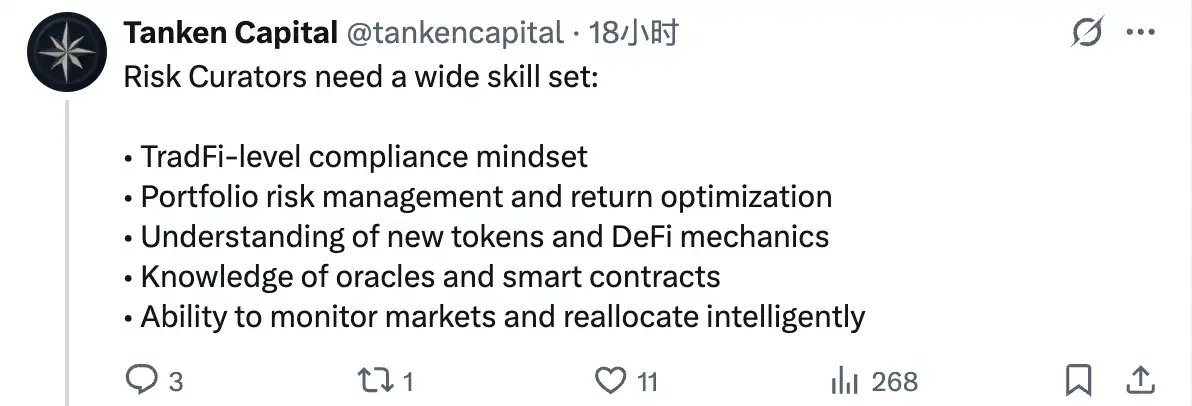
As for Curators, they need to enhance both risk self-awareness and risk control capabilities. DeFi research firm Tanken Capital has summarized key requirements for an excellent Curator in terms of risk control, specifically including:
· Possess a strong compliance awareness in the traditional financial sector;
· Portfolio risk management and return optimization;
· Understanding of new tokens and DeFi mechanisms;
· Familiarity with oracles and smart contracts;
· Ability to monitor the market and conduct smart reallocations.
As for a lending protocol directly associated with the Curator, continuous optimization of the constraints on the Curator should be achieved through measures such as requiring the Curator to disclose the policy model, independently validating the model's data, introducing a staking slash mechanism to maintain accountability towards the Curator, regularly assessing the Curator's performance, and deciding whether to replace them. Only through continuous active monitoring, by minimizing the risk space as much as possible, can the entire system's risk resonance be more effectively avoided.
You may also like
ETH Ecosystem Month: A $1.5 Million Trading Opportunity Focused on Ethereum Assets
Explore ETH trading opportunities on WEEX with ETH Ecosystem Month. A $1.5M campaign covering ETH spot trading, ETH futures rewards, leaderboards, and referral incentives across the Ethereum ecosystem.

Trade Finance: Unleashing Blockchain’s Most Potent Opportunity
Key Takeaways Blockchain technology has the potential to revolutionize the $9.7-trillion global trade finance market by addressing its…

New SEC Submissions Discuss Self-Custody and DeFi Regulation
Key Takeaways Recent submissions to the SEC tackle the regulation of self-custody rights and decentralized finance (DeFi) markets.…

Pendle Announces Token Upgrade as Its DeFi Yield Platform Scales
Key Takeaways Pendle has announced a significant upgrade to its native token, introducing sPENDLE to enhance liquidity and…

Pendle Announces Token Upgrade as Its DeFi Yield Platform Evolves
Key Takeaways Pendle introduces sPENDLE to enhance liquidity and diversify revenue. Boros platform enhances onchain rates trading, emphasizing…
AI News Today: Can AI Make Blockchain Systems More Reliable in Live Crypto Markets?
Learn how AI is used in blockchain systems to detect risks, improve reliability, and support secure crypto trading in live crypto market environments.

Analyzing the Impact of Cryptocurrency Regulations
Key Takeaways: Cryptocurrency regulations continue to evolve, impacting both global markets and individual investors. Rules and guidelines vary…

ETHGas Airdrop Eligibility Scrubbing, WLFI Proposal Sparks Controversy, What's Today's Overseas Crypto Community Buzzing About?

Tokenomics' Year of Reckoning

2026 Airdrop Interoperability Guide: Navigating 182 Projects Across Eight Key Tracks
Discover comprehensive interaction strategies for 182 projects across eight tracks to capitalize on 2026 airdrop opportunities. Understand the…

The CLARITY Act Stalling is a Boon for the Crypto Industry
Key Takeaways The delay in passing the CLARITY Act is seen as beneficial for the crypto market. Coinbase’s…

Paradex Rollback Roasted, HIP-3 Competition Heats Up, What’s New in the Mainstream Ecosystem?
Key Takeaways The NYSE’s move towards an on-chain securities trading platform signals a transformative intersection of blockchain and…

Key Market Insights for January 20th: What You Need to Know
Key Takeaways The newly open-sourced X Algorithm from Musk promises ongoing improvements, enhancing efficiency and functionality. ‘Distinguished Wall…

Why Can Coinbase Halt a CLARITY Act Vote with Just One Sentence?
Key Takeaways Coinbase CEO Brian Armstrong’s opposition to the Clarity Act halted a critical Senate vote, showcasing the…
ETHGas Foundation Coin Issuance, Believe Emotional Transaction Mechanism “Train Wreck”, What Key Points are Overseas Watching?
Key Takeaways Zama is preparing for a token sale using a Dutch auction on CoinList, drawing polarized reactions…

US Crypto Market Structure Bill Stalled as Industry Withdraws Support
Key Takeaways: The US crypto market structure bill has faced significant delays due to disagreements among lawmakers and…

WLFI Faces Backlash After ‘Team Wallets’ Push Through USD1 Growth Proposal
Key Takeaways World Liberty Financial (WLFI) is under scrutiny after nine dominant wallets exerted significant control over a…

DeFi Protocol Pendle Revamps Governance Token Amid Low Adoption
Key Takeaways Pendle plans to replace its governance token vePENDLE with the new sPENDLE to enhance flexibility and…
ETH Ecosystem Month: A $1.5 Million Trading Opportunity Focused on Ethereum Assets
Explore ETH trading opportunities on WEEX with ETH Ecosystem Month. A $1.5M campaign covering ETH spot trading, ETH futures rewards, leaderboards, and referral incentives across the Ethereum ecosystem.
Trade Finance: Unleashing Blockchain’s Most Potent Opportunity
Key Takeaways Blockchain technology has the potential to revolutionize the $9.7-trillion global trade finance market by addressing its…
New SEC Submissions Discuss Self-Custody and DeFi Regulation
Key Takeaways Recent submissions to the SEC tackle the regulation of self-custody rights and decentralized finance (DeFi) markets.…
Pendle Announces Token Upgrade as Its DeFi Yield Platform Scales
Key Takeaways Pendle has announced a significant upgrade to its native token, introducing sPENDLE to enhance liquidity and…
Pendle Announces Token Upgrade as Its DeFi Yield Platform Evolves
Key Takeaways Pendle introduces sPENDLE to enhance liquidity and diversify revenue. Boros platform enhances onchain rates trading, emphasizing…
AI News Today: Can AI Make Blockchain Systems More Reliable in Live Crypto Markets?
Learn how AI is used in blockchain systems to detect risks, improve reliability, and support secure crypto trading in live crypto market environments.


 App
App