
- Buy Crypto
- Markets
- Futures
- Spot
- Copy Trade
 Earn
Earn- More
Vitalik Revisits Quantum Threat Theory: Is the Foundation of Cryptocurrency Really at Stake?

Original Article Title: "The Resurgence of Quantum Threat, Is the Foundation of Cryptocurrency Shaken?"
Original Article Author: Azuma, Odaily Planet Daily
Lately, the threat of quantum computing to cryptocurrency has once again become a hot topic of discussion online. The reason behind this renewed interest is that several key figures in the quantum computing and cryptocurrency industries have recently made new predictions regarding the development of quantum computing and its potential capabilities.
Firstly, on November 13th, Scott Aaronson, a quantum computing guru and Director of the University of Texas Quantum Information Center, mentioned in an article: "I now believe that before the next US presidential election, we may have a fault-tolerant quantum computer capable of running the Shor algorithm..."
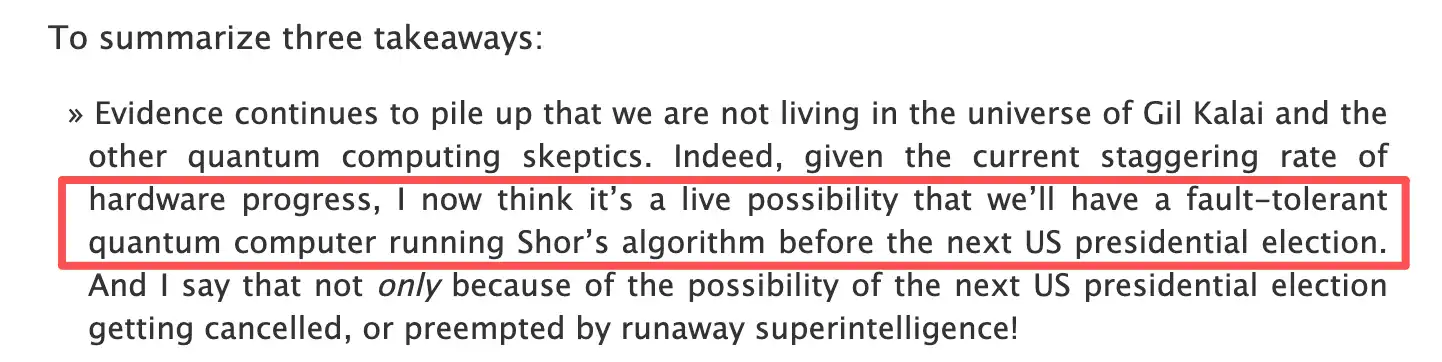
Following that, on November 19th, Ethereum co-founder Vitalik Buterin also spoke at the Devconnect conference in Buenos Aires, stating that Elliptic Curve Cryptography (ECC) could be broken by quantum computing by the US presidential election in 2028, and urged Ethereum to upgrade to a post-quantum algorithm within four years.

What is a Quantum Threat?
Before we interpret Scott and Vitalik's predictions, we need to briefly explain what a "quantum threat" is.
In simple terms, a quantum threat to cryptocurrency refers to the possibility that a sufficiently powerful quantum computer in the future could break the cryptographic foundations protecting the security of current cryptocurrencies, potentially undermining their security model.
Currently, the security of almost all cryptocurrencies (such as Bitcoin and Ethereum) relies on a technology known as "asymmetric encryption," with the two most critical parts being the "private key" and the "public key":
• Private Key: Kept secret by the user, used to sign transactions and prove ownership of assets;
• Public Key: Generated from the private key, can be made public, and is used as a wallet address or part of an address.
The cornerstone of cryptocurrency security lies in the fact that deriving a private key from a public key is currently computationally infeasible. However, quantum computing, leveraging principles of quantum mechanics, can greatly expedite the process of solving certain mathematical problems by running specific algorithms (such as the aforementioned Shor's algorithm), which is precisely the weakness of asymmetric encryption.
Let's further explain what Shor's algorithm is. We won't delve too much into the mathematics here, but in essence, the essence of Shor's algorithm is that it can transform a mathematical problem that is "almost unsolvable" on a classical computer into a "relatively solvable" period-finding problem on a quantum computer, potentially threatening the existing "private key - public key" cryptographic system of cryptocurrency.
For a more straightforward example, you can easily turn a basket of strawberries (analogous to a private key) into jam (analogous to a public key), but obviously cannot reverse the jam back into strawberries. However, suddenly a cheat code (analogous to quantum computing) emerges that may be able to achieve this expediently (analogous to the Shor's algorithm).
Has the Foundation of Cryptocurrency Been Shaken?
So, does this mean cryptocurrency is doomed?
Don't panic, the quantum threat is objectively real, but the issue is not as pressing. The reason for this statement mainly lies in two key points. First, there is still time before a real threat emerges; second, cryptocurrency can implement post-quantum algorithms through upgrades.
Firstly, regarding the first point, even if Scott's prediction comes true before the 2028 elections, it does not mean that cryptocurrency security will truly be compromised; Vitalik's statement is not suggesting that the foundation of Bitcoin and Ethereum will be shaken but merely points out a theoretical risk in the long term.
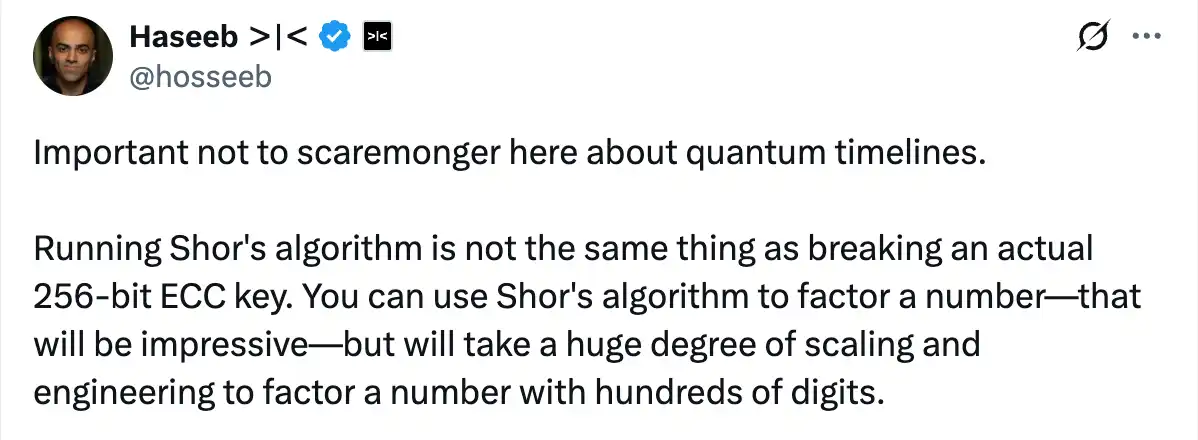
Haseeb, a Dragonfly Capital partner, explained that there is no need to panic about the new timeline for quantum computing, running Shor's algorithm does not equate to breaking a real 256-bit elliptic curve key (ECC key). You can use Shor's algorithm to break one number—that's impressive enough—but breaking down a number with hundreds of digits requires a significantly larger computational scale and engineering capacity... This is something to take seriously but is by no means imminent.
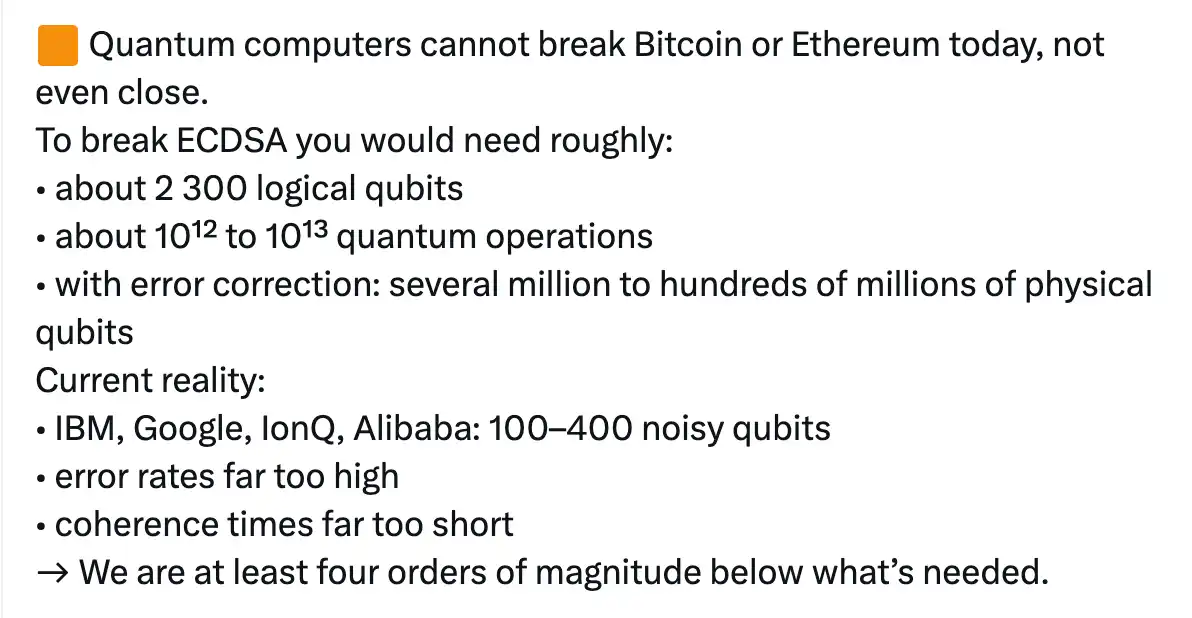
Cryptocurrency security expert MASTR has provided a clearer mathematical answer. Breaking the elliptic curve signature (ECDSA) currently used in cryptocurrencies such as Bitcoin and Ethereum would require approximately 2300 logical qubits, 10¹² to 10¹³ quantum operations, and, with error correction, would require millions to even billions of physical qubits. However, current quantum computers only have 100 to 400 noisy qubits with a high error rate and a short coherence time—the gap between the requirements to break the former is still at least four orders of magnitude.
As for the second point, industry cryptographers are also developing new post-quantum cryptography (PQC) algorithms that can resist quantum computing attacks, and mainstream blockchains have already prepared for this.
As early as March last year, Vitalik wrote an article titled "If Quantum Attack Comes Tomorrow, How Will Ethereum Solve It?" In the article, he mentioned the resilience to quantum threats of Winternitz signatures, STARKs, and even envisioned how Ethereum would urgently upgrade in case of an emergency.
Compared to Ethereum, Bitcoin may not be as flexible in upgrade implementation, but the community has long proposed various potential algorithm upgrade solutions such as Dilithium, Falcon, SPHINCS+. With the recent increase in related discussions, Bitcoin OG figure Adam Back has also stated that post-quantum cryptographic standards can be implemented long before a substantial quantum computing threat emerges.
In summary, the quantum threat is like a distant "master key" that theoretically can unlock all current blockchain cryptographic locks. However, the creators of the locks have long been studying new locks that this master key cannot open and are preparing to replace all the doors with new locks before the master key is created.
This is the current objective reality regarding the quantum threat. We cannot ignore its progress, but there is no need to blind panic because of it.
You may also like

ETH Ecosystem Month: A $1.5 Million Trading Opportunity Focused on Ethereum Assets
Explore ETH trading opportunities on WEEX with ETH Ecosystem Month. A $1.5M campaign covering ETH spot trading, ETH futures rewards, leaderboards, and referral incentives across the Ethereum ecosystem.

Bitcoin 30-Day Realized Losses and Gold Reaching Record Highs
Key Takeaways Bitcoin holders have experienced a rare stretch of 30-day realized losses for the first time since…

Central banks vs Bitcoin: Who truly earns the public’s trust?
Key Takeaways The debate over trust between central banks and Bitcoin continues, receiving global attention at the World…

Kaspa is Expected to Decline to $0.032939 by January 26, 2026
Key Takeaways Kaspa’s price is projected to drop 23.07% within the next five days. Current market sentiment for…

Bitcoin Fills New Year CME Gap with Sub-$88K BTC Price Drop
Key Takeaways Bitcoin’s price has closed a significant CME gap that appeared at the beginning of the year,…

Bitcoin Exhibits Resilience at $92K Amidst Economic Fluctuations: Is the Downturn Over?
Key Takeaways: Bitcoin remains robust at $92,000, though ETF outflows and geopolitical concerns loom. BTC futures premium close…

Crypto Mortgages in the US Tackle Valuation Risks and Regulatory Challenges
Key Takeaways The adoption of crypto mortgages is facing challenges around valuation risks and regulatory uncertainties in the…

Can Bitcoin Regain $90K? Bulls at Risk as Long-Term Holders Increase Selling
Key Takeaways: Bitcoin has declined below the $90,000 mark amid increased selling pressure from whales and long-term holders.…

Michael Saylor’s Strategy Surpasses 700,000 Bitcoin with a New $2.1B Acquisition
Key Takeaways: Michael Saylor’s Strategy has significantly increased its Bitcoin holdings to an impressive 709,715 BTC after purchasing…
Bitcoin Pursues $90K: Trump to Fast-Track Crypto Legislation
Key Takeaways Bitcoin is gaining momentum as President Trump indicates imminent crypto-friendly legislation. Trump’s World Economic Forum speech…

Crypto’s Next Challenge: Privacy and the Chicken-Egg Dilemma
Key Takeaways Privacy is becoming a central issue as cryptocurrencies move into traditional banking and state-backed systems. Regulatory…

Trump Takes on the Fed, Italy Warns Financial Influencers: A Global Overview
Key Takeaways President Trump initiates criminal charges against the Fed Chairman, potentially impacting U.S. monetary policy. Coinbase halts…
What Happened in Crypto Today: Key Updates and Insights
Key Takeaways A crucial crypto bill’s progress is delayed as the Senate pivots its focus to broader affordability…

Crypto’s Decentralization Dream Falters at Interoperability
Key Takeaways The promise of decentralization in the crypto industry is hindered by centralized intermediaries managing interoperability between…

Ethereum Price Prediction – ETH Price Estimated to Reach $ 3,660.02 By Jan 23, 2026
Key Takeaways Ethereum’s price is currently at $3,203.60 with a predicted increase to $3,660.02, marking a potential rise…

Midnight Price Prediction – NIGHT Price Anticipated to Decline to $ 0.047821 By January 25, 2026
Key Takeaways Midnight’s price is anticipated to decrease by 23.24% in the following five days, with a prediction…

AI News Today: Can AI Make Blockchain Systems More Reliable in Live Crypto Markets?
Learn how AI is used in blockchain systems to detect risks, improve reliability, and support secure crypto trading in live crypto market environments.

ETHGas Airdrop Eligibility Scrubbing, WLFI Proposal Sparks Controversy, What's Today's Overseas Crypto Community Buzzing About?
ETH Ecosystem Month: A $1.5 Million Trading Opportunity Focused on Ethereum Assets
Explore ETH trading opportunities on WEEX with ETH Ecosystem Month. A $1.5M campaign covering ETH spot trading, ETH futures rewards, leaderboards, and referral incentives across the Ethereum ecosystem.
Bitcoin 30-Day Realized Losses and Gold Reaching Record Highs
Key Takeaways Bitcoin holders have experienced a rare stretch of 30-day realized losses for the first time since…
Central banks vs Bitcoin: Who truly earns the public’s trust?
Key Takeaways The debate over trust between central banks and Bitcoin continues, receiving global attention at the World…
Kaspa is Expected to Decline to $0.032939 by January 26, 2026
Key Takeaways Kaspa’s price is projected to drop 23.07% within the next five days. Current market sentiment for…
Bitcoin Fills New Year CME Gap with Sub-$88K BTC Price Drop
Key Takeaways Bitcoin’s price has closed a significant CME gap that appeared at the beginning of the year,…
Bitcoin Exhibits Resilience at $92K Amidst Economic Fluctuations: Is the Downturn Over?
Key Takeaways: Bitcoin remains robust at $92,000, though ETF outflows and geopolitical concerns loom. BTC futures premium close…


 App
App