
Virtuals Robotics: Why Did We Enter the Embodied Intelligence Field?


Original Title: Introducing Virtual Robotics.
Original Author: Virtuals Protocol
Original Translation: DeepTech TechFlow
Since its inception, Virtuals' core goal has always been to build a society of AI agents—a network where agents can collaborate, transact, and create value.
· Through ACP, we have achieved business transactions between agents.
· Through Butler, we have built a collaboration bridge between humans and agents.
· Through Unicorn, we have addressed the capitalization issue for agents.
Each layer is expanding the boundaries of digital intelligence. And now, this network extends into the physical world through robotics, where intelligence has taken on a tangible presence, and action has become tangible.
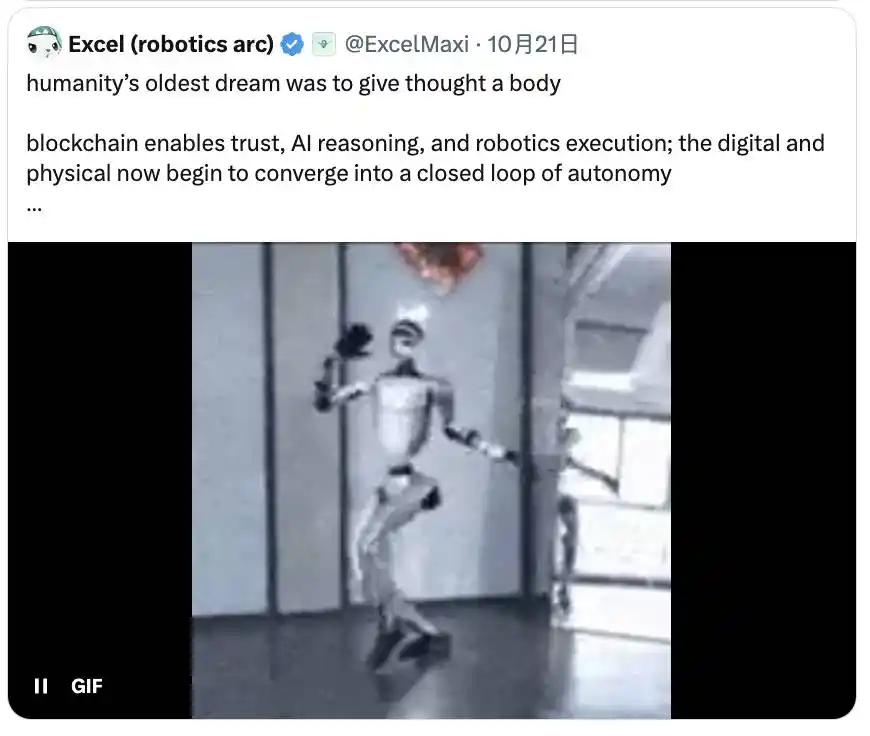
Artificial intelligence has automated reasoning, blockchain has empowered large-scale collaboration, and robotics has approached physical execution.
These three forces together form a closed loop, constructing a self-sustaining system where thoughts, actions, and transactions can autonomously propagate.
This fusion defines Agentic GDP (aGDP), the total output generated by the collaboration of humans, agents, and machines in the digital and physical domains.

Our exploration of robotics began within our internal venture capital division, investing in cutting-edge teams at the intersection of perception, control, and automation. These early experiments revealed the two core bottlenecks limiting the materialization of agents:
· Data: Without rich spatial datasets, embodied AI cannot learn to perceive or act effectively.
· Capital: Without scalable funding mechanisms, innovation in robotics will remain slow and fragmented.
Addressing these two issues is key to accelerating the development of physical intelligence.
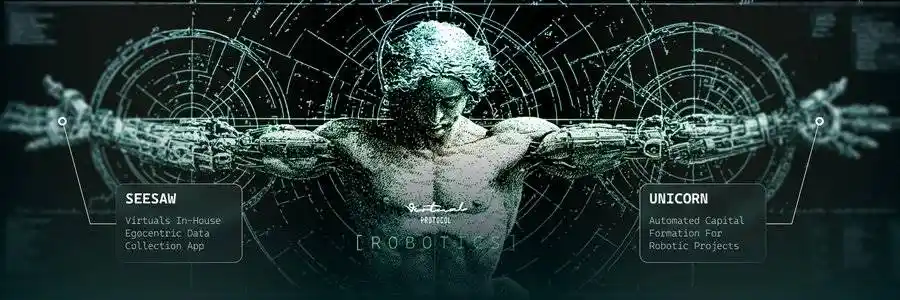
Virtuals have chosen a "Middle Way" strategy to tackle the challenges of robotics.
We are not directly involved in hardware or model development, but instead focus on the invisible yet pivotal levers, building data and capital infrastructure that supports the ecosystem.
· Through SeeSaw: We have introduced a self-centric data platform that redefines how the world is captured and learned, enabling robots to "see" and understand space through human-recorded experiences.
· Through Unicorn: We have reimagined the funding mechanism for cutting-edge technologies.
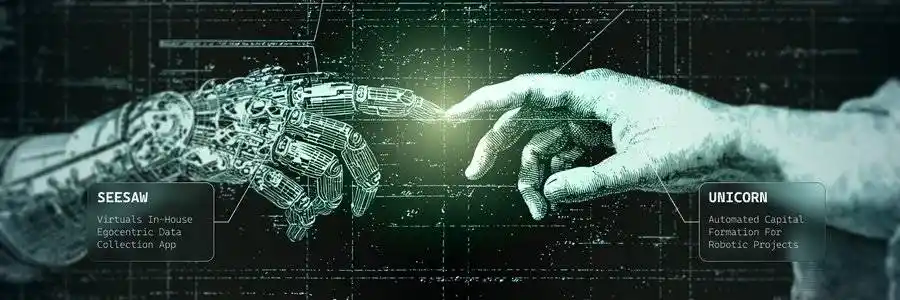
With the integration of these systems, Virtuals have evolved from a digital agent platform into a full-stack intelligent engine.
If the past decade was defined by information technology, the next decade will be defined by materialization, representing a moment where ideas take on physical form.
Through robotic technology, the agent's internet extends into the physical world, completing the loop between intelligence, collaboration, and existence.

You may also like

Morning Report | OpenAI has submitted an S-1 registration statement draft to the U.S. SEC; Morpho completes $175 million financing

Galaxy Deep Research Report: How Hyperliquid's HIP-4 Upgrade Changes the Landscape of Prediction Markets?

Latest research from 13 top universities including Cornell University: The current state, challenges, and misconceptions of the fusion of Crypto and AI

Deconstructing Anthropic: The Best AI Company, Possibly Also a Type of Organizational Invention

Every exchange is a "Universal Exchange."

The counterattack of traditional finance: Alliance chains are quietly reviving
Pantera Capital Partner: How Tokenization is Restructuring the Private Equity and Early Investment Ecosystem?

Mastercard Launches Agent Pay for AI, Plans to Record AI Agent Payment Authorizations on Polygon
Mastercard launched Agent Pay for AI, a new payment protocol designed to help AI agents make small payments such as pay-per-use access to data and APIs. The system plans to record human-granted AI agent permissions on Polygon, focusing on verifiable authorization, identity, and payment controls.

Curve Deploys Llamalend v2 on Optimism With 250,000 OP Incentives
Curve launched Llamalend v2 on Optimism with 250,000 OP incentives from the Optimism Foundation. The upgrade expands Llamalend beyond its earlier crvUSD-focused model, adding broader collateral support, LlamaRisk market reviews, and the ability to use Curve LP tokens as collateral.

Raydium Old Liquidity Pool Reportedly Exploited, With $1.34 Million Moved to Ethereum and Tornado Cash
An old Raydium liquidity pool was reportedly exploited for around $1.34 million in USDC, RAY, and wSOL, with the stolen funds bridged to Ethereum and deposited into Tornado Cash. The incident highlights the tail risks of legacy DeFi pools, old contracts, and cross-chain fund laundering paths.
Kalshi Executive Challenges “SBF Backed AI Unicorns” Narrative, Says Leopold Aschenbrenner Was Key Figure
Kalshi executive John Wang questioned the “SBF backed AI unicorns” narrative, saying Leopold Aschenbrenner was the key figure behind major AI investment decisions.

New York Proposes Stricter Stablecoin Issuer Rules Aligned With Federal GENIUS Act
NYDFS proposed stricter stablecoin issuer rules aligned with the GENIUS Act, covering reserves, custody, redemption timelines, audits, and capital buffers.

CryptoQuant Says Bitcoin Profitable Supply Is Near 45% Pressure Zone as On-Chain Data Points to Market Repricing
CryptoQuant said Bitcoin’s profitable supply is nearing the 45% pressure zone, signaling rising market stress, unrealized losses, and a possible on-chain repricing phase.

Bitcoin Falls Below 200-Week Moving Average as On-Chain Data Shows Over Half of Supply in Loss
Bitcoin dropped below its 200-week moving average as on-chain data showed over 50% of circulating supply is now in loss, signaling rising market stress.

CFTC Reportedly Plans New Prediction Market Rules Focused on Manipulation Risk and Public Interest Review
The CFTC is reportedly preparing new prediction market rules focused on manipulation risk, public interest review, and retail trader protections.

Meet the new WEEX trial fund—your gateway to greater profits

WEEX Labs Lands at Dutch Blockchain Week: A Disruptive Crypto × AI Conversation Sets Sail in Amsterdam
SK Hynix Reportedly Plans U.S. ADR Listing as Early as August, With SEC Approval Possible in Late June
SK Hynix may pursue a U.S. ADR listing as early as August, with SEC approval reportedly possible in late June amid strong AI chip supply chain demand.
Morning Report | OpenAI has submitted an S-1 registration statement draft to the U.S. SEC; Morpho completes $175 million financing
Galaxy Deep Research Report: How Hyperliquid's HIP-4 Upgrade Changes the Landscape of Prediction Markets?
Latest research from 13 top universities including Cornell University: The current state, challenges, and misconceptions of the fusion of Crypto and AI
Deconstructing Anthropic: The Best AI Company, Possibly Also a Type of Organizational Invention
Every exchange is a "Universal Exchange."
The counterattack of traditional finance: Alliance chains are quietly reviving


