
 Buy Crypto
- Markets
 Futures
- Spot
- Copy Trade
- Earn
- More
They knew in advance that Trump would tweet about a ceasefire, entered with $20k, and exited with $400k.


24 hours ago, the Iranian Ministry of Foreign Affairs publicly announced the closure of the negotiation window, while Trump toughly stated, "If Iran does not open the Strait of Hormuz, it will destroy the entire civilization."
At that time, the prediction market priced the probability of "US and Iran reaching a ceasefire by April 7" at 4%.
It was in this geopolitical background that in less than 12 hours, the three warring parties declared a ceasefire, each claiming a "victory". The single-digit ceasefire probability instantly surged to 99%, the crude oil index plummeted by 15%, and even now, the market is still repricing the post-information.
However, there was a wave of people who had already started positioning for this ceasefire last month. On March 26th, Beijing time, the prediction market monitoring channel PolyBeats sent out a news flash:
6 insider accounts collectively invested $395k in "US-Iran will reach a ceasefire." Among them, $185k was invested in "ceasefire by March 31," and $99k was invested in "ceasefire by April 30."
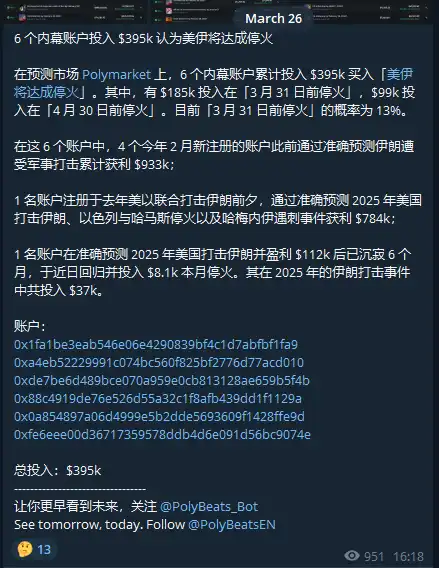
These people earned $1 million from this ceasefire event. The reason they are called "insiders" is precisely because they have replicated this astonishing trading operation multiple times.
A new account with a $20k deposit at the end of February withdrew $400k today
We take one of these 6 accounts as an example.
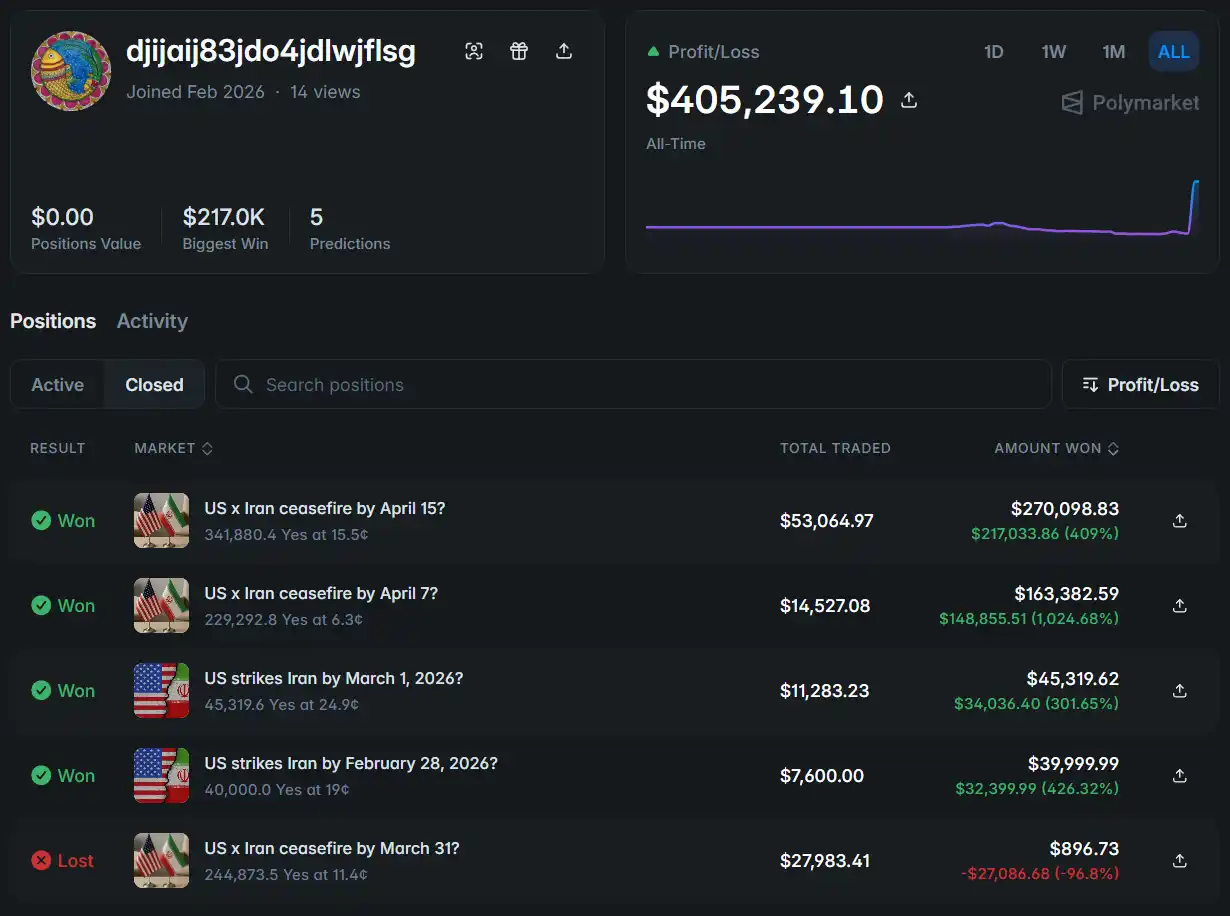
This account was registered six hours before the start of this round of Iran conflict. After depositing nearly $20,000, he used the entire $20,000 to "bet" that the United States would strike Iran in the next 48 hours.
We already know the outcome of this "bet": six hours later, the US and Israel jointly launched a fierce attack on Tehran, with US Tomahawk missiles reportedly hitting directly a girls' elementary school, causing at least 150 deaths of female students aged 7 to 12.
And this $20,000 "speculation" thus multiplied by 5 amidst the cries of the Iranian people.
Three weeks later, this account used nearly $100,000, including principal and interest, to bet that the US and Iran would cease fire at different time points. His final bet was at 5 a.m. on April 8th Beijing time.
1 hour and 32 minutes later, Trump posted on Truth Social claiming a "bilateral ceasefire" agreement had been reached.
This round of a $100,000 "bet" once again saw nearly 4x returns, with $20,000 turning into 20x in 5 weeks. Shortly after the ceasefire announcement, the account changed its username to a string of gibberish and promptly cashed out.
In addition to this account, the profiles of 5 other individuals were eerily similar:
4 were newly registered accounts in February this year, accurately timing the US strike against Iran during this round of Iran conflict, accumulating profits of nearly $1 million; 1 account registered in June 2025 bet on last year's Israel-Iran war, Israel-Hamas ceasefire, and the assassination of Iran's former Supreme Leader Khamenei, accumulating $780,000 in profits; and 1 account precisely timed the strike during the "Twelve-Day War" event in 2025, remained silent for a full 6 months after earning $110,000 in profits, and has recently returned to bet on this ceasefire.
These accounts' actions betting on the ceasefire since the end of March actually align perfectly with the contents of multiple reports after this ceasefire: the US-Iran ceasefire had been quietly laid out in the diplomatic background a month ago. Through multiple mediations and diplomatic efforts, a 10-point proposal initially rejected by Trump rapidly evolved into a "negotiable basis" in the past 48 hours.
These undisclosed negotiation details, unknown to the public, only manifested in the form of suspicious trades in the prediction markets following the trend of money. With this perspective, we continue to use prediction market data to analyze which direction the two weeks after the ceasefire will take.
Crude Oil Index Plummets: Will the Hormuz Strait Reopen?
Since the start of the war, data from the global shipping data institution IWF shows that vessels transiting the Hormuz Strait have plummeted from a pre-war moving average of around 100 ships to less than 5 ships on average in the past three weeks—a drop of over 95%.
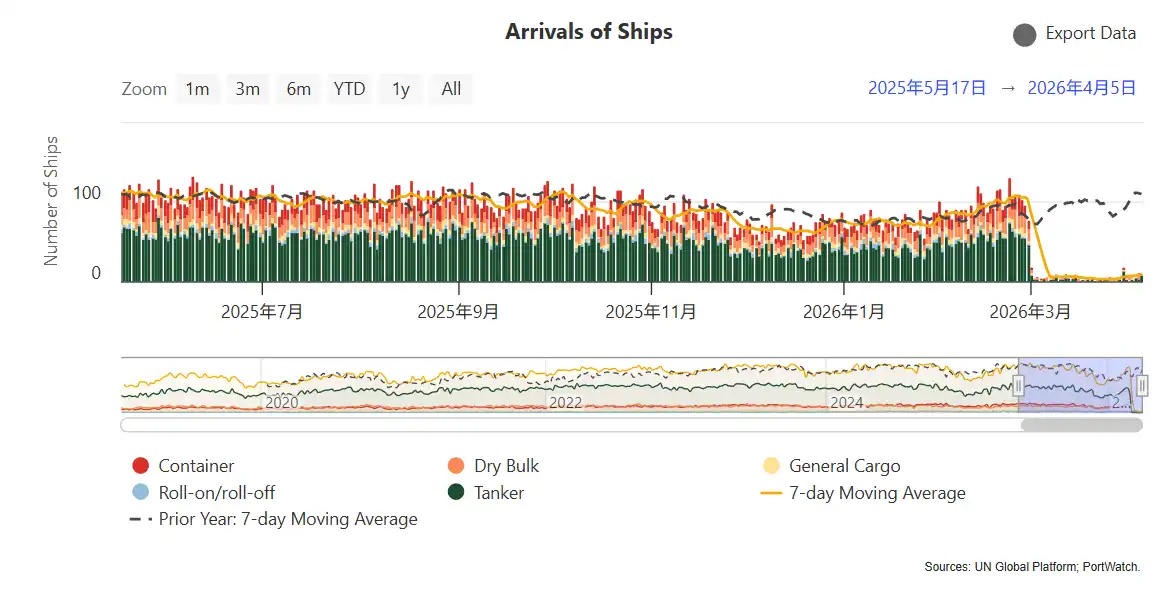
One of the most direct impacts of this ceasefire agreement is that the WTI crude oil price, which had soared around 70% since the start of the war, plummeted 15% from yesterday's $112. The market's initial reaction to the ceasefire is being interpreted as a signal that the Hormuz Strait is about to reopen.
The probability in the prediction market of "whether the Hormuz Strait will reopen this month" also had a similar response: the announcement of the ceasefire agreement has elevated the probability, initially at 14%, to a peak of 65%, and currently at 46%.
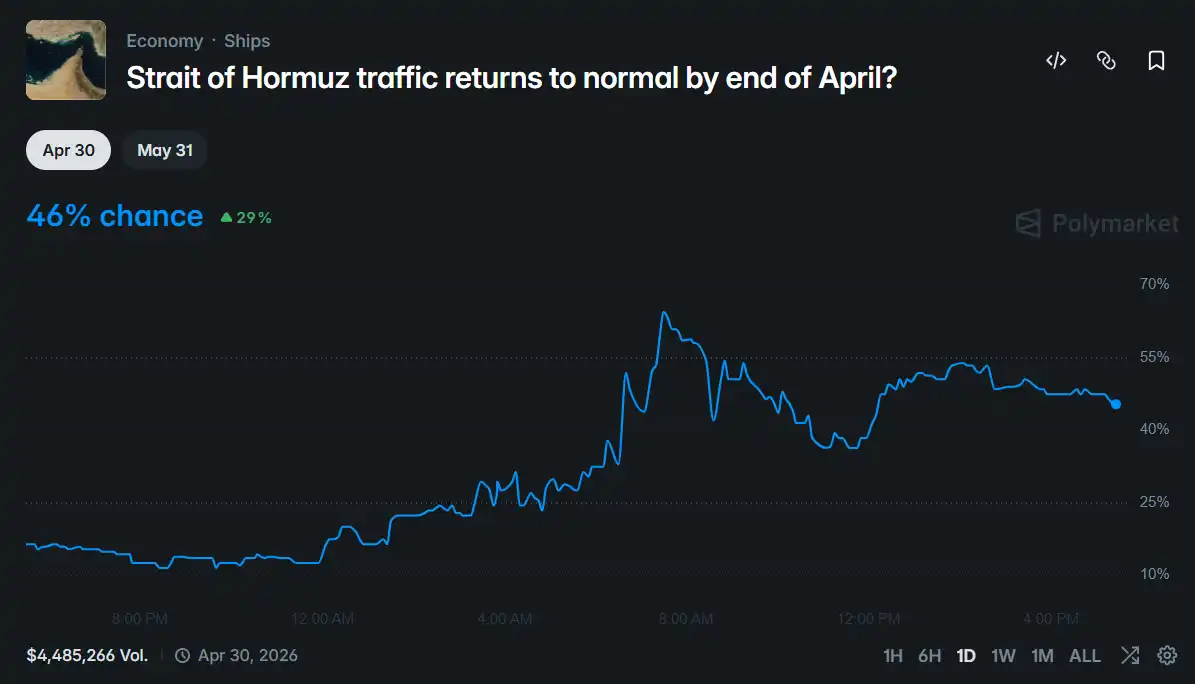
This data aligns closely with the current geopolitical situation: factors such as ship owner confidence, insurance rates, and Iran's actual openness are not as simple as a post by Trump. The current WTI crude oil price of $95 is still far from the pre-war level of around $55.
The NPA of Enriched Uranium
What is most unclear in the ceasefire terms is not the Strait of Hormuz, but the nuclear issue. The starting point difference between the two sides can be described as 'polar opposites.'
Prior to the war, the core of the failed US-Iran negotiations lay here: the US demanded Iran completely abandon its uranium enrichment capability, while Iran insisted on retaining the right to peaceful use of nuclear energy and offered to "downgrade" 60% enriched uranium in exchange for full sanctions relief.
The outbreak of war has further complicated this issue. According to the International Atomic Energy Agency (IAEA) records, Iran currently holds about 441 kilograms of 60% enriched uranium — with Iran's existing centrifuge capacity, they could theoretically reach weapons-grade purity in a matter of weeks.
In the ceasefire statement, Trump claimed that 'almost all points of dispute between the US and Iran have been agreed to in principle,' but the White House has not yet disclosed any terms details. The 10-point proposal text released by Iran is also very vague on the nuclear issue.
The probability on the prediction market of 'US-Iran nuclear agreement reached by April 30' was only 2% before the ceasefire announcement, but it has risen to 26% post-ceasefire.
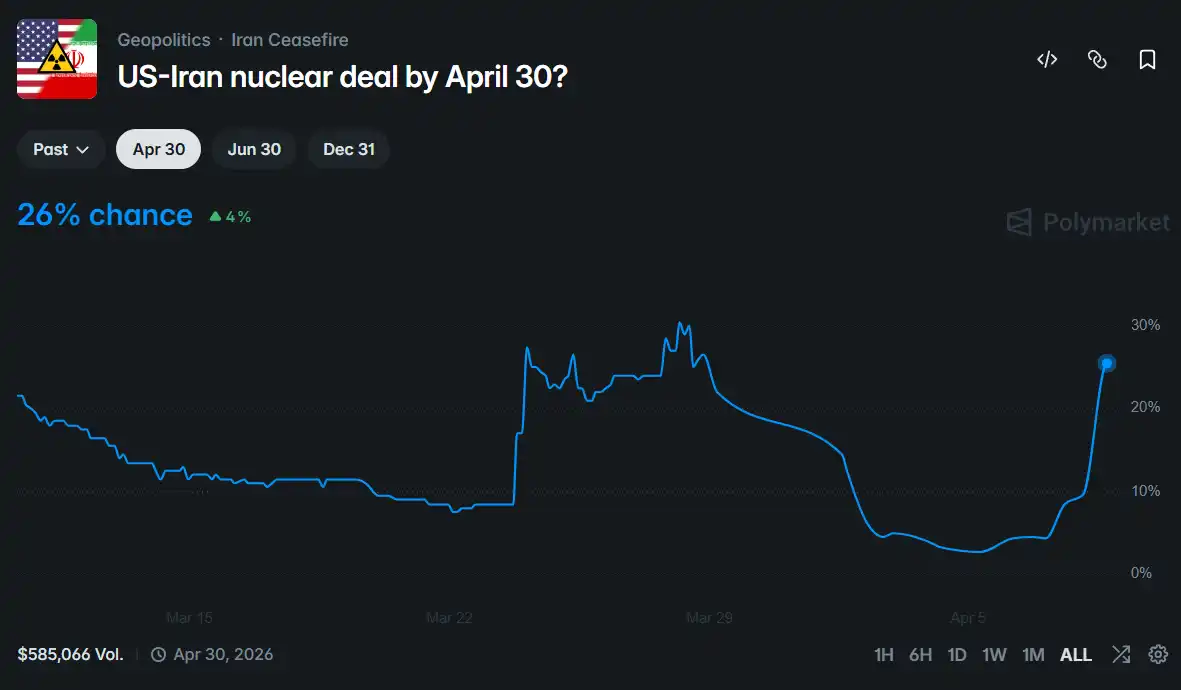
A 24% probability increase is significant, but the 76% 'no' consensus accurately reflects the true situation of the nuclear issue: the ceasefire has opened the door to negotiations, but what's inside that door is the toughest part of this conflict to crack.
The Palestinian Story, Replaying in Lebanon
Recent weeks have seen US-Iran news dominate the headlines, with many media outlets even completely ignoring an important participant in this round of ceasefire agreement reporting: Israel.
Israel has indeed agreed to the ceasefire: a statement from Netanyahu's office clearly asserts that 'Israel supports Trump's decision to temporarily halt strikes against Iran for two weeks, but — the ceasefire does not include Lebanon.'
This directly contradicts what Pakistani Prime Minister Sharif stated in the ceasefire announcement, that it includes 'all warring parties in Lebanon and other regions.' In the past six weeks, Israel's actions in Lebanon have been much deeper than what news reports have presented.
On March 1, on the same day as the US-Israel joint strike against Iran, Israel began deploying ground forces to southern Lebanon. On March 16, the IDF announced the official start of a ground invasion operation with the objective of occupying the entire area south of the Litani River, establishing a "Forward Defense Zone."
Subsequently, Israel deployed an additional three brigades to Lebanon, blowing up all major bridges over the Litani River to cut off the south from the outside world. Israeli Defense Minister Katz explicitly stated that this operation was "just like what we did in Gaza" and declared that Lebanese southern residents would not be allowed to return home until the Hezbollah threat was eliminated.
In Iran's proposed 10-point ceasefire plan, it explicitly demanded the "cessation of the war on all members of the Axis of Resistance"—Hezbollah being a core part of Iran's proxy network. However, Israel's position is equally clear: the Lebanon issue is not within the scope of this ceasefire.
The predicted market probability of an "Israel-Hezbollah ceasefire this month" is currently around 56%. This pricing reflects a certain reality: even if the US-Iran ceasefire agreement explicitly includes "Lebanon," whether Israel will actually back down is a completely separate variable.
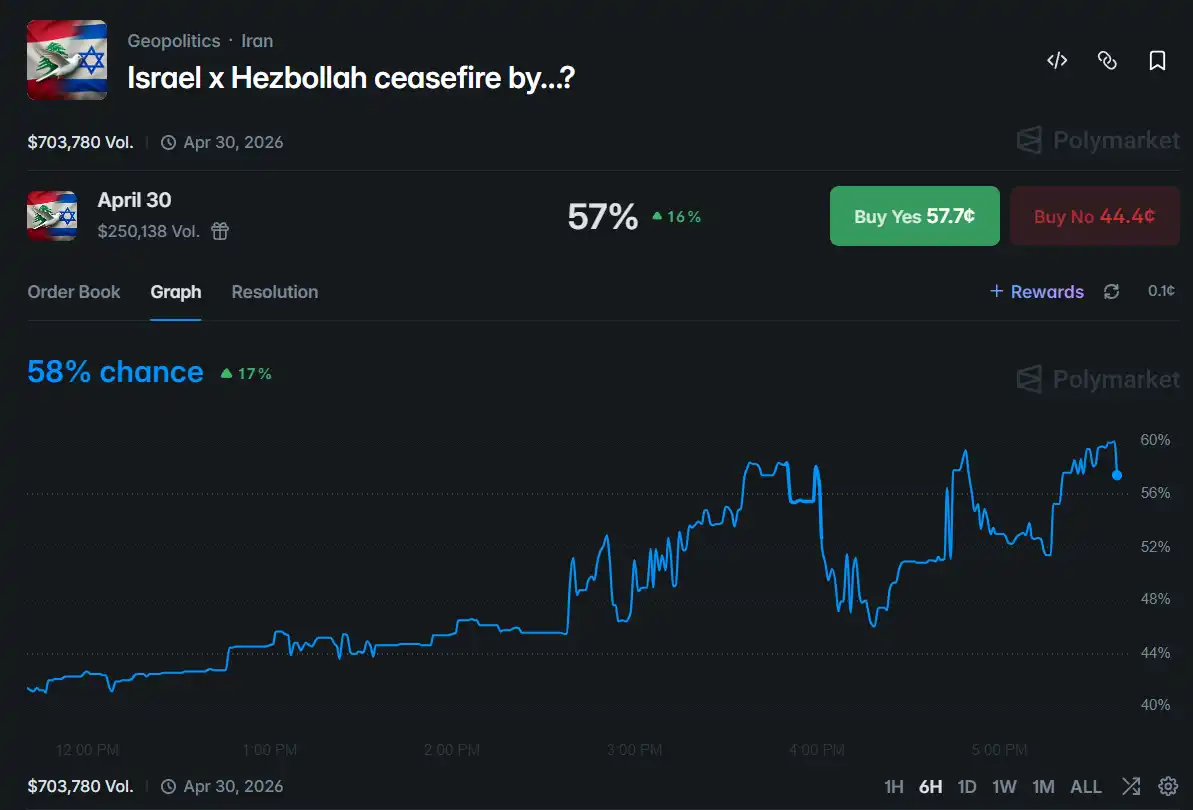
This logic is not unfamiliar. After the 2023 Gaza ceasefire agreement was signed, Israel's military actions did not cease. The reality left from that 29-month ground operation, from the ceasefire to today, can be copied word for word to the current situation in Lebanon: "ceasefire," "buffer zone," "temporary occupation," "waiting for the threat to be eliminated."
During a UN Security Council meeting on January 3, 2025, Palestinian Permanent Observer to the United Nations Riyad Mansour quoted a message from Gaza doctor Mahmoud Abu Nujaila on a whiteboard:
Do not forget us, do not turn us into numbers. We love life. We have dreams just like you. We have our beloved children and wives...
Since Trump's introduction of the "20-point Gaza Peace Plan," international reporting on the Gaza issue has gradually been replaced by other narratives. As the humanitarian topic of Gaza fades from view, Israel, under the cover of the "Peace Plan," continues to heavily strike the "Hamas terrorist forces" in Gaza, even with corresponding daily settlement events in the prediction market.
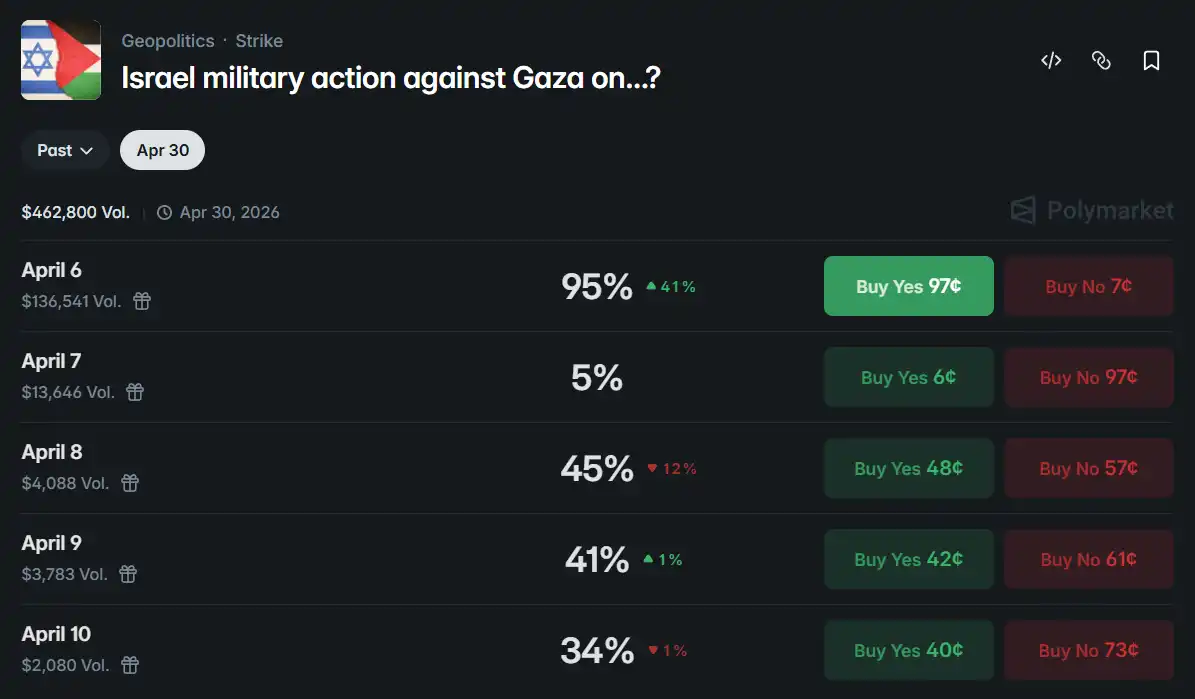
The story of Palestine, starting from the ceasefire, is still ongoing. The Lebanese version may have just begun.
From Ceasefire to Permanent Peace: How Far Away Are We?
This ceasefire between the US and Iran is the best option for both parties under current circumstances.
For Iran, it is currently the moment with the most negotiation leverage throughout the entire war—the Strait of Hormuz blockade has driven up global oil prices, the proxy network has not been completely dismantled, and the new leader's narrative of resistance has united domestic support. However, if the conflict continues, the positions of Gulf countries like Saudi Arabia and the UAE will gradually align with the US and Israel, eroding Iran's strategic advantage over time. A ceasefire now is the rational choice.
For Trump, the ceasefire is also a card he urgently needs. The S&P 500 index has been in continuous decline since the start of the war, gasoline prices have surged from $2.98 pre-war to $3.98, and Trump's overall approval rating has fallen to 36%. He vehemently declared "no new wars" during his campaign, yet he is now deeply involved in the Middle East conflict—a ceasefire, at least narratively, is a passable answer he can present to his domestic voters.
However, Iran has a fundamental historical suspicion that cannot be allayed by a two-week ceasefire: the last time US-Iran negotiations were described by all parties as "productive" and even "within reach of a historic agreement," the US and Israel launched a sudden attack directly at the negotiation table.
This time, Iran's acceptance of the ceasefire is not based on trust but on a calculation of interests. If the US defaults again, Iran will be in a more advantageous position in international public opinion than it is now; if the agreement is honored, Iran has secured the most favorable negotiation outcome under current conditions. This is a game choice that is not a loss no matter what.
But "not a loss" does not equate to "moving towards peace."
On April 10, the Islamabad negotiations officially began. The nuclear issue, the Strait of Hormuz, Hezbollah, sanctions relief—each of these four cards, presented individually, is enough to cause the negotiations to collapse. Whether a two-week window is enough to even form a preliminary framework on these issues remains unknown.
In the prediction market, of those 6 insiders, only 1 has left the betting table. Where the remaining 5 place their next bets may be more worth watching than any diplomatic statement.
You may also like

Prediction Markets Under Bias

Stolen: $290 million, Three Parties Refusing to Acknowledge, Who Should Foot the Bill for the KelpDAO Incident Resolution?

ASTEROID Pumped 10,000x in Three Days, Is Meme Season Back on Ethereum?

ChainCatcher Hong Kong Themed Forum Highlights: Decoding the Growth Engine Under the Integration of Crypto Assets and Smart Economy

Why can this institution still grow by 150% when the scale of leading crypto VCs has shrunk significantly?

Anthropic's $1 trillion, compared to DeepSeek's $100 billion

Geopolitical Risk Persists, Is Bitcoin Becoming a Key Barometer?

Annualized 11.5%, Wall Street Buzzing: Is MicroStrategy's STRC Bitcoin's Savior or Destroyer?

An Obscure Open Source AI Tool Alerted on Kelp DAO's $292 million Bug 12 Days Ago

Mixin has launched USTD-margined perpetual contracts, bringing derivative trading into the chat scene.
The privacy-focused crypto wallet Mixin announced today the launch of its U-based perpetual contract (a derivative priced in USDT). Unlike traditional exchanges, Mixin has taken a new approach by "liberating" derivative trading from isolated matching engines and embedding it into the instant messaging environment.
Users can directly open positions within the app with leverage of up to 200x, while sharing positions, discussing strategies, and copy trading within private communities. Trading, social interaction, and asset management are integrated into the same interface.
Based on its non-custodial architecture, Mixin has eliminated friction from the traditional onboarding process, allowing users to participate in perpetual contract trading without identity verification.
The trading process has been streamlined into five steps:
· Choose the trading asset
· Select long or short
· Input position size and leverage
· Confirm order details
· Confirm and open the position
The interface provides real-time visualization of price, position, and profit and loss (PnL), allowing users to complete trades without switching between multiple modules.
Mixin has directly integrated social features into the derivative trading environment. Users can create private trading communities and interact around real-time positions:
· End-to-end encrypted private groups supporting up to 1024 members
· End-to-end encrypted voice communication
· One-click position sharing
· One-click trade copying
On the execution side, Mixin aggregates liquidity from multiple sources and accesses decentralized protocol and external market liquidity through a unified trading interface.
By combining social interaction with trade execution, Mixin enables users to collaborate, share, and execute trading strategies instantly within the same environment.
Mixin has also introduced a referral incentive system based on trading behavior:
· Users can join with an invite code
· Up to 60% of trading fees as referral rewards
· Incentive mechanism designed for long-term, sustainable earnings
This model aims to drive user-driven network expansion and organic growth.
Mixin's derivative transactions are built on top of its existing self-custody wallet infrastructure, with core features including:
· Separation of transaction account and asset storage
· User full control over assets
· Platform does not custody user funds
· Built-in privacy mechanisms to reduce data exposure
The system aims to strike a balance between transaction efficiency, asset security, and privacy protection.
Against the background of perpetual contracts becoming a mainstream trading tool, Mixin is exploring a different development direction by lowering barriers, enhancing social and privacy attributes.
The platform does not only view transactions as execution actions but positions them as a networked activity: transactions have social attributes, strategies can be shared, and relationships between individuals also become part of the financial system.
Mixin's design is based on a user-initiated, user-controlled model. The platform neither custodies assets nor executes transactions on behalf of users.
This model aligns with a statement issued by the U.S. Securities and Exchange Commission (SEC) on April 13, 2026, titled "Staff Statement on Whether Partial User Interface Used in Preparing Cryptocurrency Securities Transactions May Require Broker-Dealer Registration."
The statement indicates that, under the premise where transactions are entirely initiated and controlled by users, non-custodial service providers that offer neutral interfaces may not need to register as broker-dealers or exchanges.
Mixin is a decentralized, self-custodial privacy wallet designed to provide secure and efficient digital asset management services.
Its core capabilities include:
· Aggregation: integrating multi-chain assets and routing between different transaction paths to simplify user operations
· High liquidity access: connecting to various liquidity sources, including decentralized protocols and external markets
· Decentralization: achieving full user control over assets without relying on custodial intermediaries
· Privacy protection: safeguarding assets and data through MPC, CryptoNote, and end-to-end encrypted communication
Mixin has been in operation for over 8 years, supporting over 40 blockchains and more than 10,000 assets, with a global user base exceeding 10 million and an on-chain self-custodied asset scale of over $1 billion.

$600 million stolen in 20 days, ushering in the era of AI hackers in the crypto world
Vitalik's 2026 Hong Kong Web3 Summit Speech: Ethereum's Ultimate Vision as the "World Computer" and Future Roadmap
On the same day Aave introduced rsETH, why did Spark decide to exit?
Full Post-Mortem of the KelpDAO Incident: Why Did Aave, Which Was Not Compromised, End Up in Crisis Situation?

After a $290 million DeFi liquidation, is the security promise still there?
ZachXBT's post ignites RAVE nearing zero, what is the truth behind the insider control?

Vitalik 2026 Hong Kong Web3 Carnival Speech Transcript: We do not compete on speed; security and decentralization are the core





 App
App