
The mysterious team that dominated Solana for three months is now launching their own coin on Jupiter?

An anonymous team with no official website or community has devoured nearly half of the transaction volume on Jupiter in just 90 days.
To delve deeper into this mysterious project, we must first witness an ongoing on-chain transaction revolution happening on Solana.
HumidiFi accounts for 42% of Jupiter's transaction volume
Source: Dune, @ilemi
How Proprietary AMMs Are Restructuring On-Chain Transactions
In the context of AMMs, toxic order flow refers to high-frequency arbitrageurs leveraging low-latency connections and advanced algorithms to preemptively capture price differentials and swiftly arbitrage the price delta between on-chain and price-discovery venues (typically centralized exchanges like Binance). The profits taken by these toxic order flows are ultimately borne by traders, liquidity providers, and on-chain market makers.
In traditional financial markets that utilize a Central Limit Order Book (CLOB) to match trades, professional market makers can cope with toxic order flow in various ways (such as adjusting spreads or pausing quotes). By analyzing order flow patterns, they can identify traders with an informational edge and adjust quotes accordingly to mitigate losses caused by adverse selection. Therefore, market makers operating on Solana naturally opted for DEXes like Phoenix that employ a CLOB. However, during Solana's "meme frenzy" period from 2024 to early 2025, the Solana network, overwhelmed by unprecedented demand, struggled to handle market maker orders, and updating quotes required significant expensive computation, leading to a steep increase in market makers' costs.
A series of thorny practical issues is compelling a cohort of the most seasoned AMM market makers to fundamentally rethink how on-chain markets operate, giving rise to a revolutionary new market structure.
This new paradigm is known as a Proprietary AMM (Prop AMM), aiming to provide lower spreads and more efficient liquidity on-chain while minimizing the risk of exploitation by high-frequency arbitrageurs.
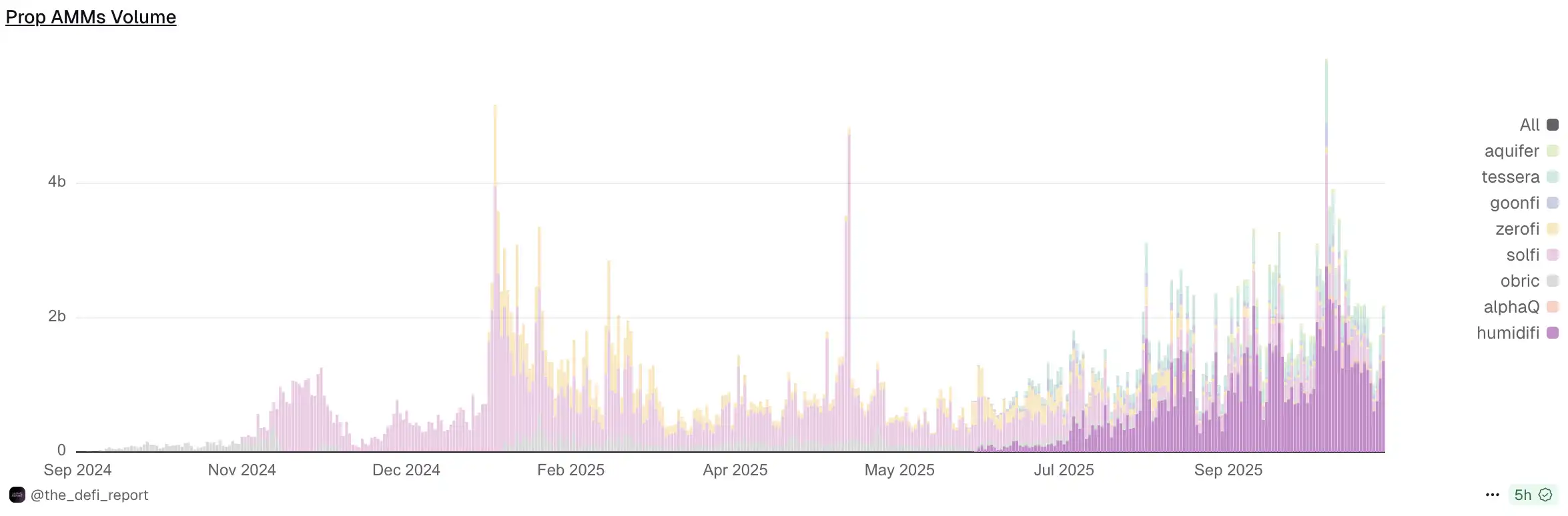
SolFi, ZeroFi, and Obric were the initial triumvirate of Proprietary AMMs, which did not expose contract interfaces publicly but instead directly provided interfaces to major trading routes like Jupiter and demanded that Jupiter route orders to their AMMs. This design makes it extremely difficult for external professional arbitrageurs like Wintermute to directly interact with the contracts as they cannot comprehend or predict the trading logic, thereby preventing the replacement of market maker quotes and the adverse selection problem of informational advantaged entities.
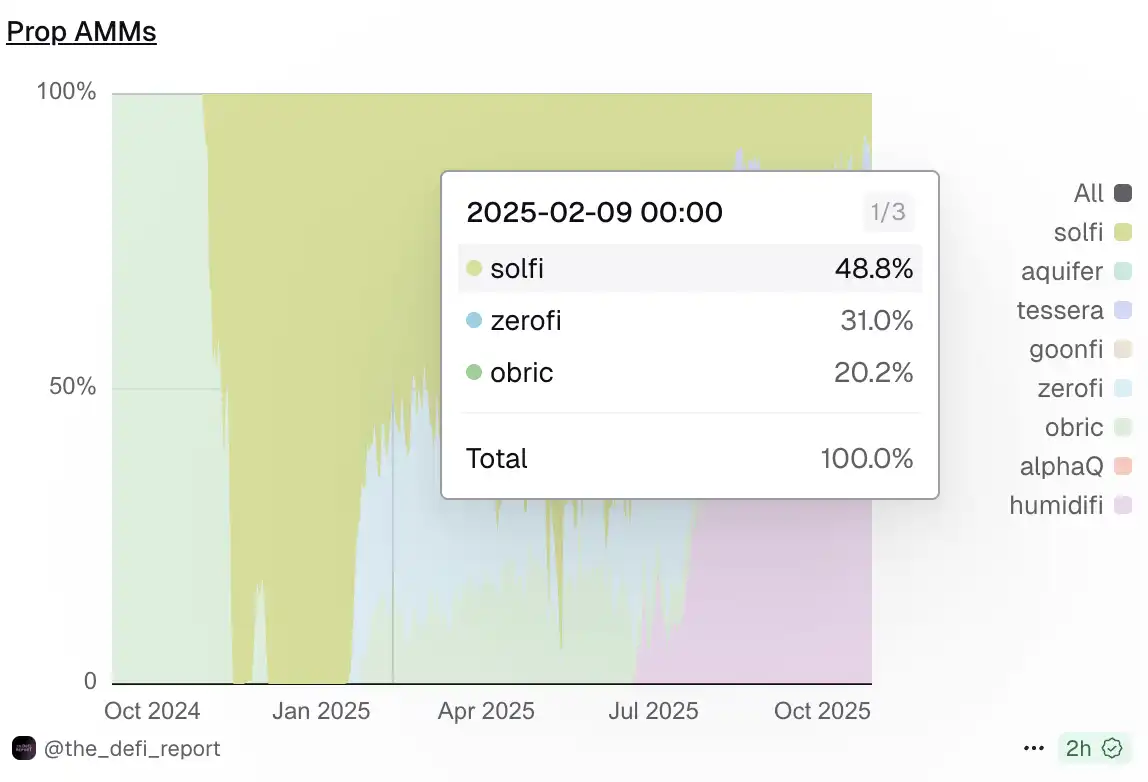
In February 2025, SolFi, ZeroFi, and Obric were the three main proprietary AMMs.
Source: Dune @the_defi_report
HumidiFi's Blitzkrieg
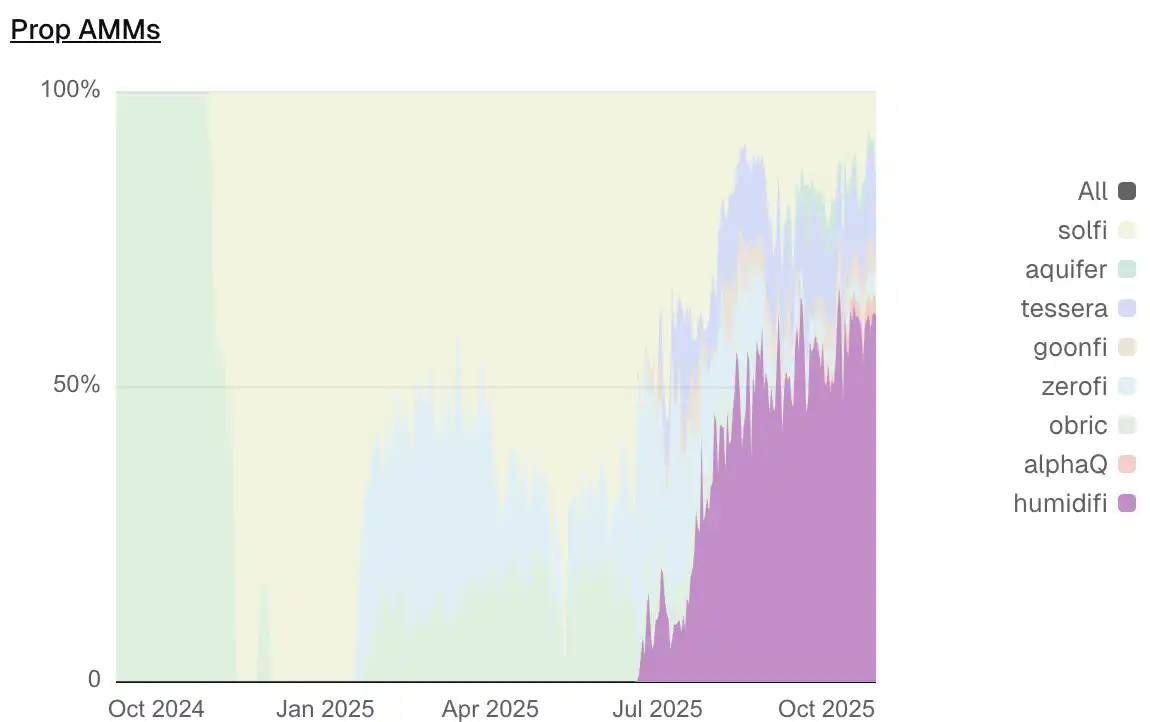
The competition among proprietary AMMs had heated up by July 2025, and a project called HumidiFi rapidly reshaped the entire market landscape.
HumidiFi officially launched in mid-June 2025, and just two months later, it had captured 47.1% of all proprietary AMM trading volume, establishing itself as the undisputed market leader. In contrast, the former dominator SolFi saw its market share plummet from 61.8% two months prior to 9.2%.
Source: Dune @the_defi_report
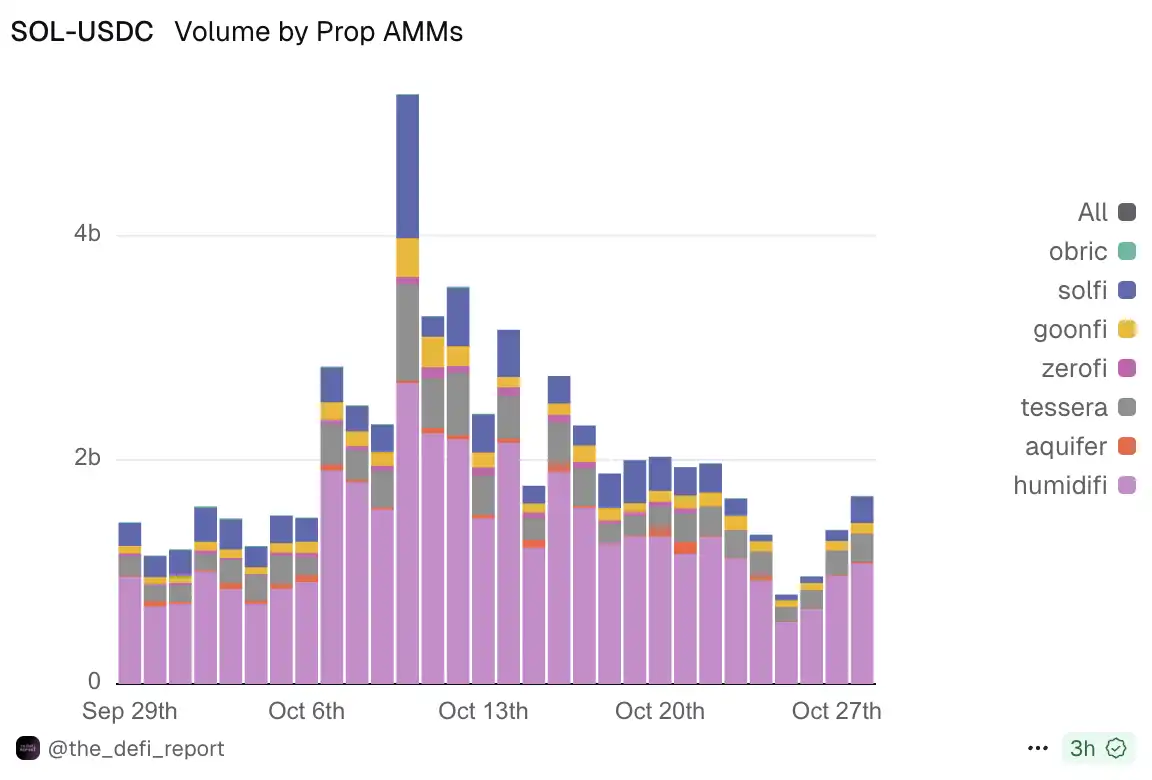
HumidiFi's dominance was particularly evident in the SOL/USDC trading pair. On October 28th, HumidiFi processed $1.08 billion in SOL/USDC trades in a single day, accounting for 64.3% of that day's total volume for the pair.
Source: Dune @the_defi_report
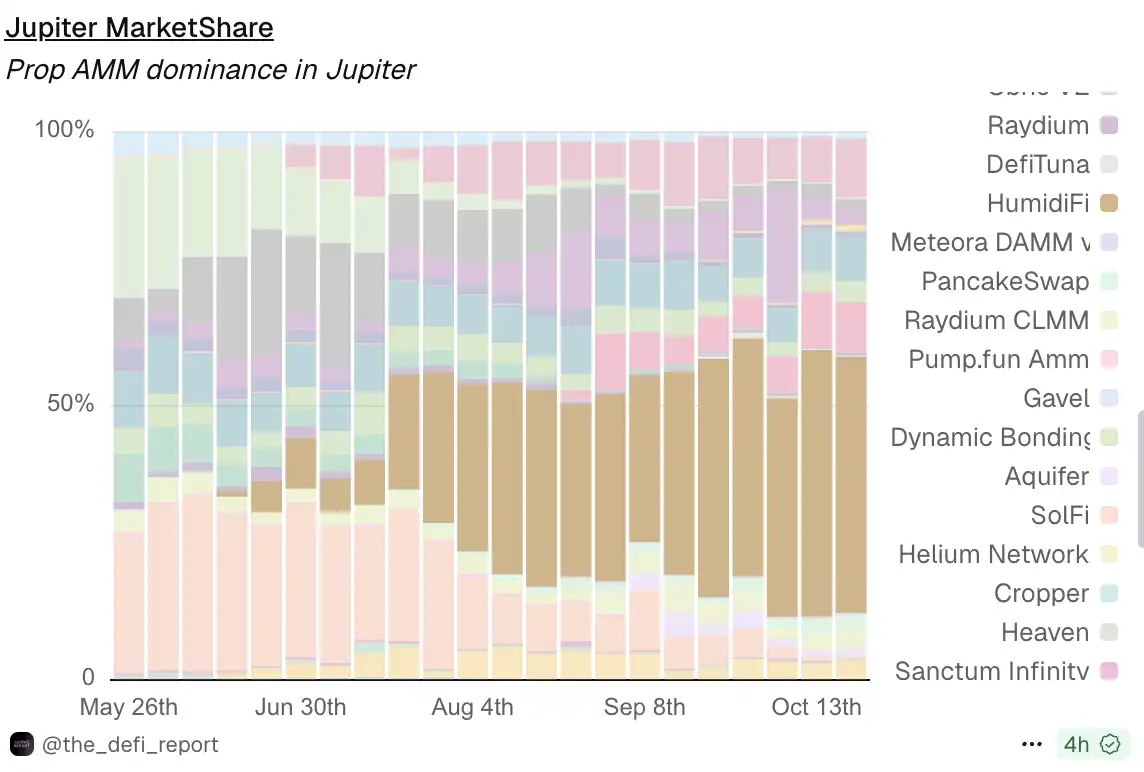
HumidiFi also exhibited a high penetration rate in the Jupiter routing. As an aggregator that holds an 86.4% market share on Solana, Jupiter's routing choices largely dictate traders' actual experiences. Data from October 20th showed that HumidiFi held a market share of 46.8% in Jupiter, more than four times that of the second-place TesseraV (10.7%).
Source: Dune @the_defi_report
Zooming out to the entire self-custody AMM ecosystem, HumidiFi's dominance remains strong. On October 28, the total trading volume of all self-custody AMMs reached $21.8 billion, with HumidiFi alone occupying $13.5 billion, accounting for a significant 61.9%. This number not only far exceeds the second-place SolFi's $3.09 billion but even surpasses the total trading volume of competitors ranked 2-8.
Source: Dune @the_defi_report
This victory of HumidiFi was achieved almost in complete "stealth" mode. It had no official website, no early Twitter account, and no information about team members was ever disclosed.
HumidiFi doesn't need marketing, airdrops, or storytelling. It only needs to provide better price spreads and execution prices than its competitors in every transaction. When Jupiter's routing algorithm repeatedly chose HumidiFi, the market had already cast its vote in its own way.
The Race to the Limits of Speed and Cost
The key to HumidiFi's success lies in compressing the computational cost of oracle updates to the extreme and cleverly converting this technological advantage into absolute market dominance through the Jito auction mechanism.
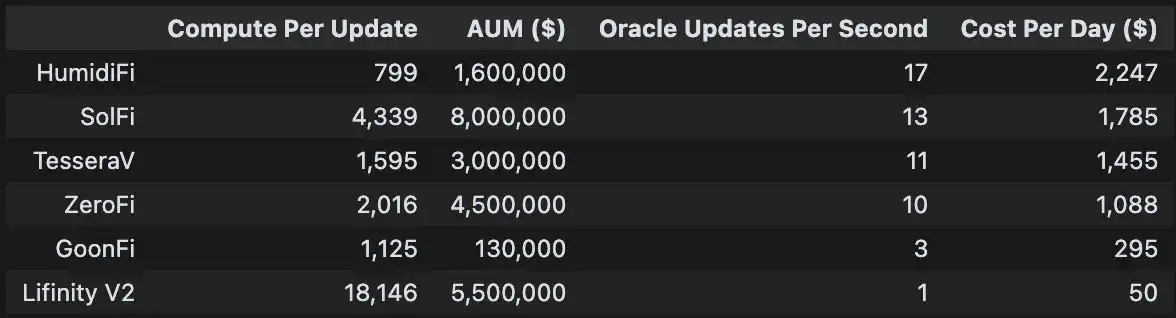
Firstly, HumidiFi has low resource consumption. According to data provided by @bqbrady, each oracle update of HumidiFi consumes only 799 CUs (Compute Units). In comparison, its main competitor SolFi requires 4339 CUs. TesseraV, operated by top market maker Wintermute, also needs 1,595 CUs, which is double that of HumidiFi.
Source: X, @bqbrady
HumidiFi also leveraged its advantage of low CU consumption to gain absolute transaction priority in Solana's MEV infrastructure Jito auction. In the Jito auction, transaction priority is not determined by an absolute tip but by a Tip per CU. HumidiFi pays around 4,998 lamports as a fee for each oracle update. Due to its extremely low CU consumption (799 CUs), its Tip per CU ratio reaches an astonishing 6.25 lamports/CU.
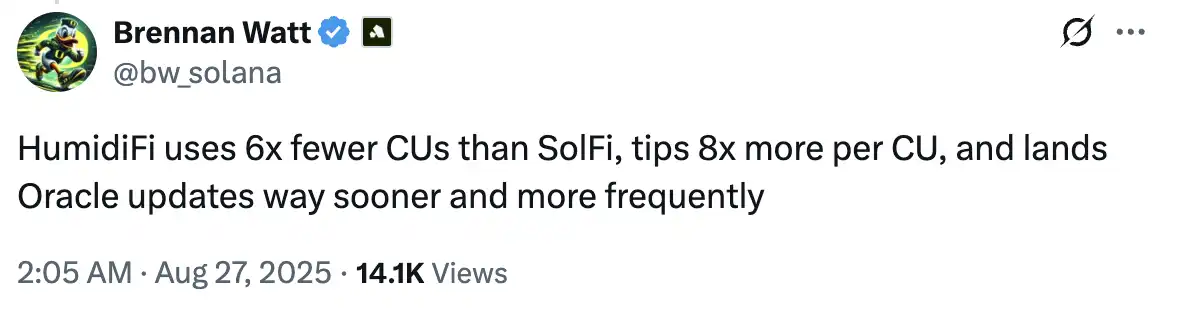
According to data provided by Brennan Watt, an engineer at Anza, a core developer of Solana, HumidiFi used 6 times less CU than the former flagship SolFi Prop AMM and paid over 8 times more in gas fees.
Another key advantage of HumidiFi is the oracle update frequency. HumidiFi updates its oracle 17 times per second, far exceeding its main competitors (SolFi at 13 times, TesseraV at 11 times, and ZeroFi at 10 times).
In the intense volatility of the cryptocurrency market, this almost real-time price tracking ability enables it to always peg near fair value, avoiding opportunities for arbitrageurs, and providing tighter liquidity without the need to self-protect through widening spreads.
Furthermore, HumidiFi has also done well in cost control. HumidiFi's daily operating cost is only $2,247. In comparison, although SolFi manages 5 times the assets under management (AUM) of HumidiFi ($80 billion vs. $16 billion), its daily cost is only 20% lower than HumidiFi at $1,785.
WET Token Launches on Jupiter DTF
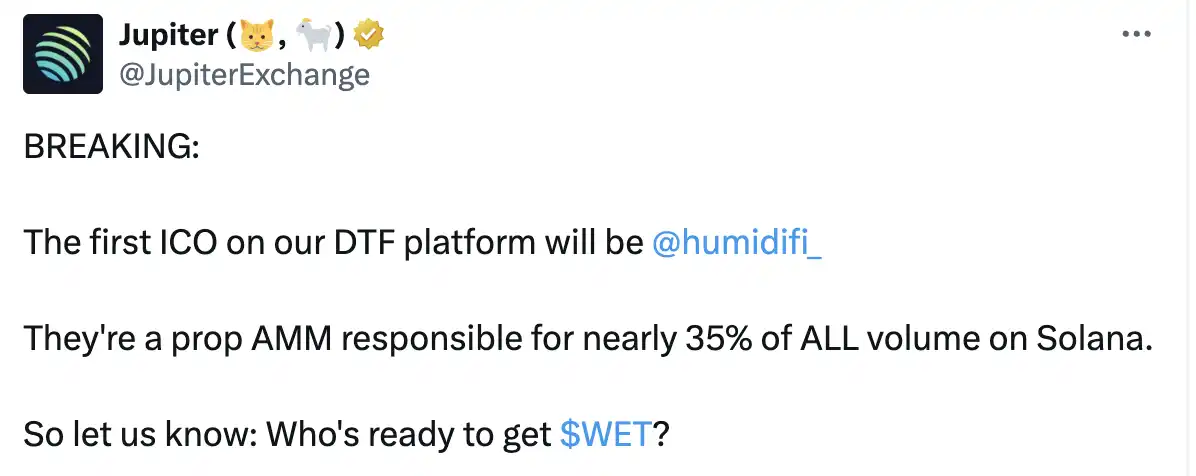
During the community call on the evening of October 30, the Jupiter team announced their ICO platform DTF's inaugural launch project: HumidiFi, with the token symbol WET.
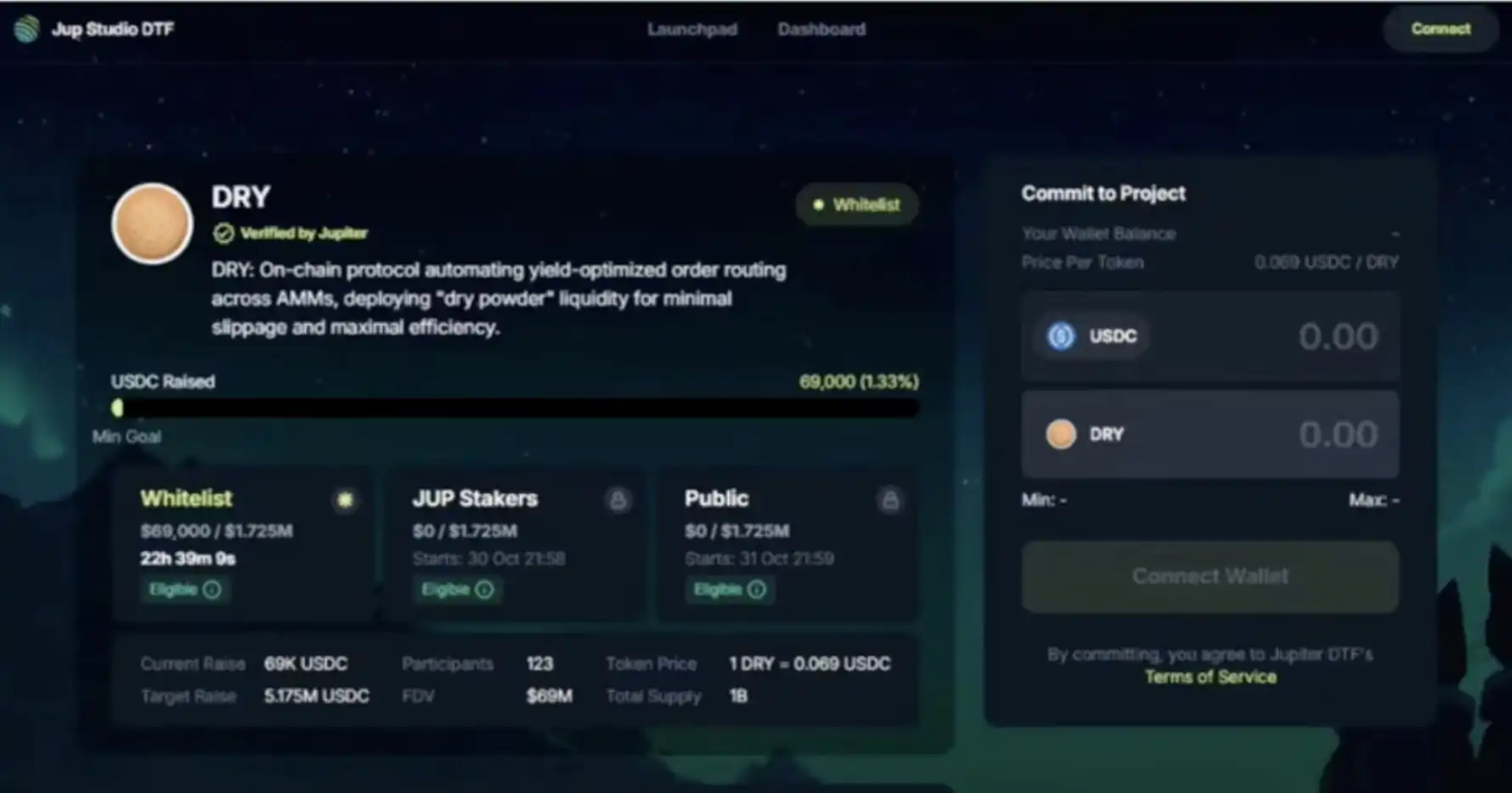
According to the disclosed demo webpage, the allocation is divided into three parts:
A whitelist (acquisition rules to be determined) can ensure a portion of the allocation.
JUP stakers can secure an allocation based on their staked amount.
The public allocation follows a first-come, first-served (FCFS) model, with immediate on-chain circulation once filled, without a lock-up period.

It is worth noting that the HumidiFi team explicitly stated on Twitter that there are "no VC allocations," which is particularly rare in the current market environment dominated by VC presales and low-circulating high FDV projects.
Proprietary AMM is a "winner-takes-all" race, and HumidiFi has achieved its dominant position today based on its technological prowess. However, this also means that once a new competitor makes a breakthrough in CU efficiency or oracle speed, it could quickly erode its market share. This Prop AMM war is clearly just beginning.
You may also like

Bloomberg: As Bitcoin Weakens, Stablecoins and RWA Continue to Drive Expansion in Crypto Businesses
In June, Bloomberg reported that despite Bitcoin falling below $60,000 last week, wiping out about $235 billion in market value within seven days, and dropping close to 50% from last year’s peak, some core businesses in the crypto industry are still expanding, mainly in stablecoins, real-world asset tokenization (RWA), payments, and infrastructure. The report also noted that overall altcoin activity has contracted significantly: altcoin market capitalization has fallen from a peak of about $431 billion in November 2021 to around $170 billion, and among the tens of millions of tokens issued in recent years, fewer than 1,700 still maintain meaningful trading activity.

Galaxy Deep Research Report: How Hyperliquid's HIP-4 Upgrade Changes the Landscape of Prediction Markets?

Binance Research: RWA Market Expected to Expand Nearly 6x from Early 2025, with Public Equities and Onchain Payments Heating Up Together
In June, Binance Research said in its monthly market report that the real-world asset (RWA) market is expected to grow by about 589% from the beginning of 2025. Bond- and money market fund-related RWA expanded by about $6.5 billion, up 83% year over year, while publicly traded equity RWAs grew by about 422%. The report also noted that monthly crypto debit card transaction volume exceeded $747 million in May, up 48.6% year to date.

Japan to Assess a Framework for Yen Stablecoins and Crypto ETFs as Asia’s Compliant Payments Narrative Heats Up
Recently, according to the original report, Japan is considering the launch of yen stablecoins and cryptocurrency ETFs. Public information remains limited at this stage, and there is still no complete policy text, regulatory draft, or clear implementation timeline, so this is better characterized as a “policy discussion” rather than formal implementation. The original wording also noted that advancing stablecoin regulation in Asia is driving XRP usage and supporting growth in the XRPL ecosystem. However, based on currently available public information, there is not enough evidence to directly establish a clear causal relationship between this round of discussion in Japan and XRP or XRPL.

ZachXBT: Humanity private key leak and abnormal surge in H token should be viewed separately
On June 9, according to related disclosures, on-chain investigator ZachXBT posted an update on Humanity’s roughly $31 million security incident, saying that after further analyzing fund flows, he currently tends to believe the project team was not involved in an “inside job” or a self-staged attack. According to him, the official explanation about the private key leak was broadly accurate, but before the token unlock, the price of H had been artificially pushed higher, and the hacker later took advantage of that market environment; therefore, the private key leak and the earlier abnormal price pumping should be regarded as two separate and independent events. This reframing has shifted the market’s understanding of the nature of the incident. Earlier discussion around Humanity had focused on whether the team directly participated in the attack or used the security incident to cover up internal operations. ZachXBT’s latest remarks shift the focus from “whether it was self-theft” to “whether there were pre-unlock market structure issues.” He also questioned whether the team may have.

Morning Report | OpenAI has submitted an S-1 registration statement draft to the U.S. SEC; Morpho completes $175 million financing

Morning Report | BitMine increased its holdings by 126,971 ETH last week; trader Eugene announced his exit from the crypto market

Wang Chuan: How can one not feel anxious after the neighbor Old Wang made thirty times profit by investing in storage stocks? (Seven) - A quarter-century cycle

Cryptocurrency CEXs are flocking to sell US stocks, and traditional brokerages are facing an "uninvited guest."
$75 billion in foreign capital has fled, and South Korean retail investors have absorbed it all using leverage

Japan’s Three Megabanks Plan Joint Stablecoin Issuance in Fiscal 2026
MUFG, SMBC, and Mizuho reportedly plan to jointly issue fiat-pegged stablecoins in fiscal 2026, signaling Japan’s growing push into bank-led digital payment infrastructure.

Humanity Discloses H Token Dual-Chain Attack Details, With Losses on Ethereum and BSC Exceeding $36 Million
Humanity said the H token attack across Ethereum and BSC caused more than $36 million in losses after leaked ProxyAdmin keys enabled malicious contract upgrades and token minting.
White House Discusses CLARITY Act With Law Enforcement Ahead of Senate Vote
The White House discussed the CLARITY Act with law enforcement ahead of a Senate vote, focusing on illicit finance risks and developer protections.

Bitcoin Trading Guide 2026: Strategies for Experienced Traders

What Is XAUT and PAXG? Why Tokenized Gold Is Booming in 2026

Will the SpaceX IPO Hurt Bitcoin? Here's What Traders Are Watching

Foreign selling in the South Korean stock market accelerates, with cumulative net sales reportedly reaching $75 billion this year
On June 9, The Kobeissi Letter, citing Goldman Sachs data, reported that global investors are selling South Korean stocks at an unusually rapid pace. In the latest trading session, foreign investors sold about $801 million worth of Kospi constituent stocks again; total foreign outflows last week reached about $10 billion, and the market has been in net foreign selling on nearly every trading day over the past month. According to the data cited in the report, foreign investors have sold about $75 billion worth of South Korean stocks so far this year. Meanwhile, South Korean retail and institutional investors together recorded roughly $69 billion in net buying over the same period, suggesting that the market’s main buying support has come from domestic capital rather than returning overseas funds. The information currently disclosed still mainly comes from The Kobeissi Letter’s retelling and Goldman Sachs data summaries, while public details on the statistical period and the specific definition of “selling” remain relatively limited.

Fortune Warns of Strategy’s Financing Structure Risks as Bitcoin Premium Narrows
Fortune warned that Strategy’s Bitcoin treasury model faces growing financing risks as MSTR’s net asset premium narrows and preferred stock dividend pressure increases.
Bloomberg: As Bitcoin Weakens, Stablecoins and RWA Continue to Drive Expansion in Crypto Businesses
In June, Bloomberg reported that despite Bitcoin falling below $60,000 last week, wiping out about $235 billion in market value within seven days, and dropping close to 50% from last year’s peak, some core businesses in the crypto industry are still expanding, mainly in stablecoins, real-world asset tokenization (RWA), payments, and infrastructure. The report also noted that overall altcoin activity has contracted significantly: altcoin market capitalization has fallen from a peak of about $431 billion in November 2021 to around $170 billion, and among the tens of millions of tokens issued in recent years, fewer than 1,700 still maintain meaningful trading activity.
Galaxy Deep Research Report: How Hyperliquid's HIP-4 Upgrade Changes the Landscape of Prediction Markets?
Binance Research: RWA Market Expected to Expand Nearly 6x from Early 2025, with Public Equities and Onchain Payments Heating Up Together
In June, Binance Research said in its monthly market report that the real-world asset (RWA) market is expected to grow by about 589% from the beginning of 2025. Bond- and money market fund-related RWA expanded by about $6.5 billion, up 83% year over year, while publicly traded equity RWAs grew by about 422%. The report also noted that monthly crypto debit card transaction volume exceeded $747 million in May, up 48.6% year to date.
Japan to Assess a Framework for Yen Stablecoins and Crypto ETFs as Asia’s Compliant Payments Narrative Heats Up
Recently, according to the original report, Japan is considering the launch of yen stablecoins and cryptocurrency ETFs. Public information remains limited at this stage, and there is still no complete policy text, regulatory draft, or clear implementation timeline, so this is better characterized as a “policy discussion” rather than formal implementation. The original wording also noted that advancing stablecoin regulation in Asia is driving XRP usage and supporting growth in the XRPL ecosystem. However, based on currently available public information, there is not enough evidence to directly establish a clear causal relationship between this round of discussion in Japan and XRP or XRPL.
ZachXBT: Humanity private key leak and abnormal surge in H token should be viewed separately
On June 9, according to related disclosures, on-chain investigator ZachXBT posted an update on Humanity’s roughly $31 million security incident, saying that after further analyzing fund flows, he currently tends to believe the project team was not involved in an “inside job” or a self-staged attack. According to him, the official explanation about the private key leak was broadly accurate, but before the token unlock, the price of H had been artificially pushed higher, and the hacker later took advantage of that market environment; therefore, the private key leak and the earlier abnormal price pumping should be regarded as two separate and independent events. This reframing has shifted the market’s understanding of the nature of the incident. Earlier discussion around Humanity had focused on whether the team directly participated in the attack or used the security incident to cover up internal operations. ZachXBT’s latest remarks shift the focus from “whether it was self-theft” to “whether there were pre-unlock market structure issues.” He also questioned whether the team may have.
Morning Report | OpenAI has submitted an S-1 registration statement draft to the U.S. SEC; Morpho completes $175 million financing


