
 Buy Crypto
- Markets
 Futures
- Spot
- Copy Trade
- Earn
- More
Stablecoins and PayFi Leadership: Decoding the New Wave of RWA and Future Blueprint

Original Article Title: "WOO X Research: Can RWA Become the Next Wave of Wealth Growth?"
Original Source: WOO X Research
Narrative:
RWA (Real World Assets), literally translated as real-world assets, derives its value from bridging traditional assets with the web3 world to achieve the digital representation of real-world assets. This allows for the efficient utilization or mobilization of real-world assets (such as real estate, art, etc.) to enhance asset liquidity. Moreover, with the integration of RWA and blockchain technology, RWAs can transcend geographical limitations. Regardless of location, currency system, or other influencing factors, users can easily transact or otherwise leverage assets through this combined approach. When RWA is mentioned, people often think of real estate, stocks, and the like. Looking at the fundamental feature of RWA tokenization, stablecoins also fall under the RWA track. It seems like RWA is now closer to us. This also represents another aspect of the RWA narrative, namely, "inclusive," enabling investors who do not have sufficient capital to enter high-value markets to indirectly invest in high-value RWA tokenized products.
What Lies Ahead?
Over the past year, the overall TVL of RWA has shown a fluctuating upward trend. In this cycle, RWA, AI, MEME, and others are relatively popular tracks. RWA has always been one of the more closely watched tracks.
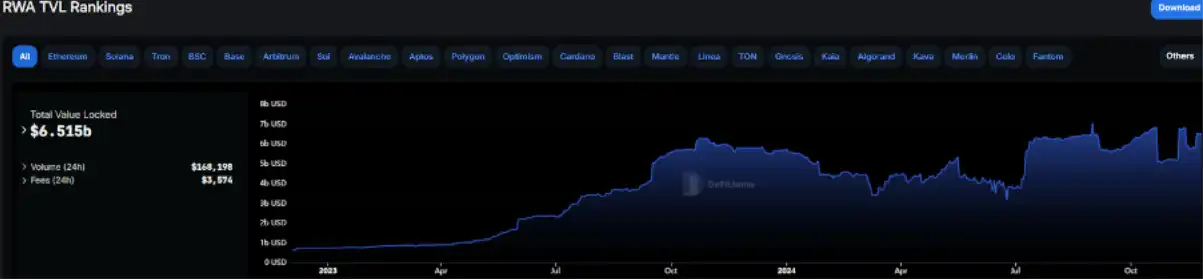
Image Source: https://defillama.com/protocols/RWA
In the future, RWA is likely to continue its trend, and the integration of RWA with the DeFi track may attract more and more investors' attention. In fact, high-value assets such as real estate and commodities face settlement challenges in transactions, and various countries have different laws and regulations. Most likely, projects related to these types of high-value assets will be constrained in development due to the challenges in implementation and regulation. Therefore, for projects of this kind in the RWA track to make better progress, there must be significant progress in PayFi or cross-border settlement regulation and RWA asset validation rather than relying on third parties in various locations for settlement or validation.
In addition, the RWA project related to stablecoins is relatively stable. Basically, the mainstream market may still be dominated by the US dollar, with the euro following. However, in the future, this type of project may see country/region differentiation, where "investors from a certain country/region mostly choose a specific stablecoin." In this scenario, a stablecoin with local regulatory approval can seize the market first. The last trend, which should also be a major trend in the future, is that stablecoins' pegged assets could be bonds, securities, stocks, or funds, leading to more products and projects in the future. The reason behind this is that the settlement and regulatory aspects mentioned earlier have a better advantage than assets like real estate. However, in the early stages of such projects, only institutions with some influence in the traditional financial sector (such as BlackRock) participating in related projects may generate a considerable wave of economic benefits. After that, projects involving institutions/organizations with more influence in the Web 3 space may create more community-centric RWA projects.
Projects
Below is an overview of recently funded projects, presented from an objective perspective for discussion purposes.
OpenTrade
OpenTrade was founded in late 2022 and is headquartered in London, UK. Its investors include a16z CSX, Circle, Draper Dragon, CMCC Global, Ryze Labs, Polygon, and Kronos Ventures, among others. The current total funding amounts to $8.7 million.
It currently offers four products:
1. US Treasury Bonds Vaults: Fixed-term; USDC returns with a fixed term and fixed rate, backed by US Treasury Bonds;
2. USDC Vault: Demand deposit; variable USDC returns. Backed by short-term US Treasury Bonds, money market funds, and other cash equivalents;
3. EURC Vault: Demand deposit; variable EURC returns, backed by euros and short-term euro bonds, money market funds, and other cash equivalents;
4. Fee Rate+ Vault: Fixed-term; backed by investment-grade corporate bonds, commercial paper, emerging market bonds, etc.
Uses the Vault token as a benchmark in accounting and other operations.
USUAL-Government Bonds
It has raised a total of $8.5 million and is a Binance Launchpool project.
Overall, it revolves around three types of tokens:
1. USD0: This is a stablecoin backed 1:1 by Real-World Assets (RWA), permissionless, and fully compliant, aggregating various U.S. Treasury tokenizations.
2. USD0++: It is an enhanced Treasury bond that uses USD0 as collateral locked principal, with USUAL as an incentive.
3. USUAL is its governance token.
Tokenomics: Total supply of 4 billion tokens, with an initial circulating supply proportion of 12.37%.

Image Source: https://docs.usual.money/usual-products/usual-governance-token/usual-tokenomics/distribution-model
Token distribution is as follows:

Huma Finance
Currently, it has raised a total of $46.3 million, with a co-founder of Chinese descent. In general, it is a PayFi lending project. The most recent round of financing includes $10 million in equity investment and $28 million in Huma Platform real asset investment. Distributed Global led the investment, with participation from Hashkey Capital, Folius Ventures, Stellar Development Foundation, and others. In April 17, 2024, it merged with Arf, focusing on real-world asset tokenization-related PayFi.
Contributors utilizing the Huma Points tracking protocol. Currently providing cross-border payment financing, digital asset-backed credit cards. This is achieved through various liquidity pools, such as Arf-Cross-Border Payment Financing Pool (based on USDC instant settlement, simplifying cross-border payments); Rain Accounts Receivable Pool (assisting entities like DAOs in managing expenditures through salary card); Jia Pioneer Fund Pool (providing decentralized financing for small businesses, rewarding borrowers who repay with ownership. i.e., "Small Business Credit") and other liquidity pools to facilitate cross-border payment financing.
This article is contributed content and does not represent the views of BlockBeats.
You may also like

How to Get Free USDT Welcome Bonus in 2026: Earn Up to 700 USDT on WEEX
Legit Free Welcome Bonus 2026: Learn how to earn up to 700 USDT on WEEX with Auto Earn Boost Fest. Increase your balance, activate Auto Earn, and qualify automatically.

AI Agent Payments Just Got Real: Utexo × x402 Brings 50ms USDT Transactions to Internet Scale
Utexo integrates USDT into the x402 protocol, enabling 50ms instant payments embedded natively in HTTP requests. Explore how this breakthrough is rewriting the rules for AI agent payments, API monetization, and the machine-to-machine economy.

DWF Deep Report: AI in DeFi Outperforms Humans in Yield Optimization, but Complex Trades Still Lag Behind by 5 Times

What Separates Smart Money from the Crowd in Crypto? Insights from Freedom of Money
Most crypto traders lose money not because of bad luck, but because they misunderstand how the market really works. From Freedom of Money to the rise and fall of Sam Bankman-Fried, they highlight a key divide in crypto: those who build the market and those who chase it. This reading guide explores essential books that reveal how narrative, regulation, capital, and psychology shape long-term success in the crypto industry.

The Risk Management Core Team has just been ousted, and Aave is now facing a $200 million default.

The $293 million bug wasn't in the code; so, what's the deal with the "DVN Configuration Bug," which led to the largest hack of 2026?

a16z on Recruitment: How to Choose Between Crypto-Native and Traditional Talent?

The biggest DeFi heist of 2026, hackers easily took advantage of Aave

Will Robots Replace Humans? He Says No!

Binance Coin's Price Skyrockets 15x to All-Time High, Saved by Three Bull Market Lifelines

The organization has accessed the prediction market, but is stuck at the third stage

Head of crypto VC collective shrinks: a16z crypto fund management scale plummets by 40%, Multicoin cut in half

Arthur Hayes New Post: It's "No Trade" Time Now
Claude Opus 4.7 Review: Is It Worthy of the Title of Strongest Model?

DWF In-Depth Report: AI Outperforms Humans in Yield Farming Optimization in DeFi, But Complex Transactions Still Lag Behind 5x
The financial tricks of the crypto giant Kraken

When proactive market makers start to take initiative

Massive Whale Movement: Unstaking $84.96 Million in HYPE Tokens
Key Takeaways A crypto whale, known as TechnoRevenant, has unstaked approximately $84.96 million in HYPE tokens. The tokens…
How to Get Free USDT Welcome Bonus in 2026: Earn Up to 700 USDT on WEEX
Legit Free Welcome Bonus 2026: Learn how to earn up to 700 USDT on WEEX with Auto Earn Boost Fest. Increase your balance, activate Auto Earn, and qualify automatically.
AI Agent Payments Just Got Real: Utexo × x402 Brings 50ms USDT Transactions to Internet Scale
Utexo integrates USDT into the x402 protocol, enabling 50ms instant payments embedded natively in HTTP requests. Explore how this breakthrough is rewriting the rules for AI agent payments, API monetization, and the machine-to-machine economy.
DWF Deep Report: AI in DeFi Outperforms Humans in Yield Optimization, but Complex Trades Still Lag Behind by 5 Times
What Separates Smart Money from the Crowd in Crypto? Insights from Freedom of Money
Most crypto traders lose money not because of bad luck, but because they misunderstand how the market really works. From Freedom of Money to the rise and fall of Sam Bankman-Fried, they highlight a key divide in crypto: those who build the market and those who chase it. This reading guide explores essential books that reveal how narrative, regulation, capital, and psychology shape long-term success in the crypto industry.




 App
App