
- Buy Crypto
- Markets
- Futures
- Spot
- Copy Trade
 Earn
Earn- More
Soon to come "Santa Rally," which is more promising, Bitcoin or Gold?

Original Title: "Santa Claus Rally": Bitcoin vs. Gold
Original Author: Ashrith Rao, Blockhead
Original Translation: Chopper, Foresight News
The so-called "Santa Claus Rally" refers to the phenomenon where the cryptocurrency market typically experiences a price surge in the last few weeks of December to early January. This trend is driven by multiple factors, including annual portfolio rebalancing by institutions and traders, as well as a seasonal boost in investor confidence.
During the holiday period, market liquidity decreases, which can amplify price fluctuations, further fueling the upward momentum. There is a noticeable difference in the market behavior of crypto assets between the full year and the Christmas period. While this trend originated in the traditional stock market, it has begun to manifest in the gold market and more recently in the Bitcoin market.
Whenever global markets slow down due to holidays, market participants reassess the possibility of a Santa Claus Rally. During periods of low liquidity or shifts in market sentiment, the reactions of gold and Bitcoin may vary significantly.
Now investors are discussing: in the anticipated seasonal uptrend in December, which asset, gold or Bitcoin, will benefit more?
To protect wealth from the impact of inflation, people have been buying gold for generations. Central banks around the world also hold significant amounts of gold in reserve as a crucial part of their foreign exchange reserve management and monetary policy.
At the end of each year, the seasonal demand for gold tends to rise, driven by various factors:
· During festivals and wedding seasons in India and China, jewelry purchases typically increase;
· Central banks continue to adjust their reserve structures, leaning towards increasing their gold holdings;
· Institutions engage in year-end risk management and portfolio adjustments.
Gold's Holiday Performance
December is not typically a month of surging gold prices but rather a gradual uptrend. During economic downturns or geopolitical unrest, gold often exhibits more safe-haven characteristics than other assets.
Although the price of gold may fluctuate with overall economic conditions, it rarely delivers the staggering returns seen in cryptocurrencies.
Nevertheless, this year, the price of gold has been soaring, reaching historic highs multiple times, with a peak of $4380 per ounce, followed by an unprecedented pullback.
Over the past few weeks, gold has rebounded from a steep decline, with the current trading price surpassing $4,100 per ounce, showing a strong performance. In this highly active trading market, long positions have seen significant profits.
With the end of the U.S. government shutdown and the national debt expected to reach a historical high of $40 trillion, this precious metal has bounced back from a deep decline.
Currently, the price of gold is only 7% away from its all-time high, and investors are well aware that after the government shutdown, deficit spending will only increase further.
Bitcoin: A New Choice for Value Storage
Since Bitcoin's price touched around $16,000 in November 2022, the view that "Bitcoin is digital gold" has been widely recognized, and its price has continued to rise.
On December 5, 2024, Bitcoin first broke through the $100,000 mark, and has since repeatedly reached that level. During the peak period in October of this year, Bitcoin's price surpassed $125,000, but like gold, it then experienced a sharp pullback.
Nevertheless, Bitcoin has generally held above the key psychological level of $100,000, only briefly dipping below this level on a few occasions.
Bitcoin's decentralized structure and fixed supply of 21 million coins make it a potential choice to hedge against currency inflation.
However, overall, Bitcoin is considered a riskier investment compared to gold: when investor confidence is high, its price may skyrocket; when confidence is low, it could also see a sharp drop.
From historical data, Bitcoin's performance in the fourth quarter of each year has often been noteworthy.
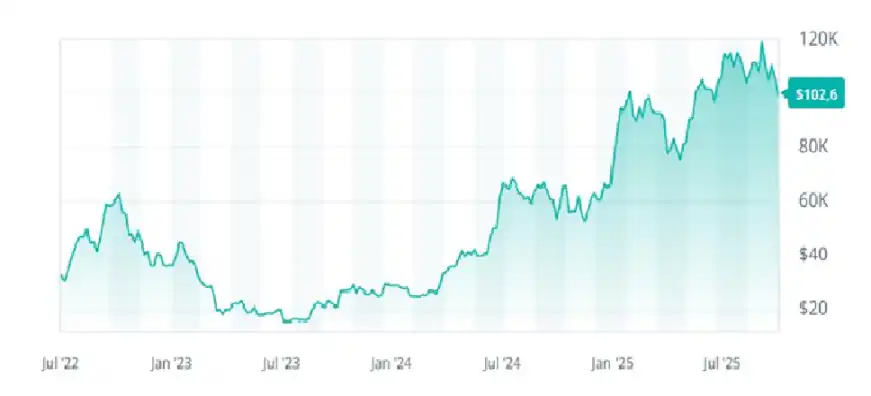
Data Source: TradingView
Macroeconomic Factors Drive This Year's Core Momentum
This year, the economic situation has become the most critical factor determining whether the Christmas rebound will occur as expected.
Market liquidity, inflation metrics, and central bank policies around the world (especially the Fed's policy) are all key driving factors.
At the October 2025 Fed interest rate meeting, the central bank cut the federal funds rate by 25 basis points, setting the new target range at 3.75%-4.00%. This rate cut was in line with market expectations and was another move after the September cut, bringing borrowing costs to the lowest level since the end of 2022.
A decrease in interest rates usually leads to a depreciation of the U.S. dollar, which may in turn increase investors' interest in alternative assets such as Bitcoin.
A report shows that in September 2025, the official inflation rate in the United States was 3.0%, higher than August's 2.9%; however, the core inflation rate saw a slight decrease from 3.1% to 3.0%. During times of high inflation, the market's focus on alternative assets like Bitcoin and the safe-haven asset gold tends to significantly increase.
Unlike traditional assets, Bitcoin's liquidity exhibits higher volatility.
Institutional buying behavior of Bitcoin Exchange-Traded Funds (ETFs) and small fund inflows can both have a significant impact on short-term price fluctuations.
The core difference between the two assets lies in their buyer base: gold's main buyers are jewelry manufacturers, sovereign wealth funds, and central banks, while Bitcoin's core supporters are young digital currency enthusiasts, tech pioneers, and retail investors.
Comparison of Gold and Bitcoin Performance
Over the past few years, both assets have experienced synchronous rallies, especially notable in 2025. However, there have also been instances of "one asset rallying first, followed by the other asset entering an uptrend."
In 2020, in response to the economic downturn caused by the pandemic, various governments implemented large-scale stimulus plans. With fiat currency depreciation, investors seeking asset preservation flocked to assets with stability guarantees.
At the beginning of the year, gold prices surged; in the latter half of the year, Bitcoin gained momentum. In December 2020, gold closed at $1900, a slight increase, while Bitcoin approached its interim high and closed at around $29,000.
This case illustrates that during periods of ample market liquidity and low interest rates, Bitcoin's performance tends to outshine traditional assets like gold. In
From 2021 to 2022, as inflation soared, central banks worldwide hiked interest rates significantly.
During this market crash period, speculative assets like Bitcoin suffered heavy losses. Market participants turned to gold, a traditional safe-haven asset, and its price experienced multiple rallies, demonstrating exceptional resilience.
This indicates that during times of monetary tightening and market pressure, gold's ability to preserve value usually surpasses that of Bitcoin.
With the government shutdown causing data freeze, now that the Washington fiscal standoff has ended, the release of inflation data will to a large extent determine which of the two asset classes will win the Christmas rally.
You may also like

Bitcoin 30-Day Realized Losses and Gold Reaching Record Highs
Key Takeaways Bitcoin holders have experienced a rare stretch of 30-day realized losses for the first time since…

Central banks vs Bitcoin: Who truly earns the public’s trust?
Key Takeaways The debate over trust between central banks and Bitcoin continues, receiving global attention at the World…

Kaspa is Expected to Decline to $0.032939 by January 26, 2026
Key Takeaways Kaspa’s price is projected to drop 23.07% within the next five days. Current market sentiment for…

Bitcoin Fills New Year CME Gap with Sub-$88K BTC Price Drop
Key Takeaways Bitcoin’s price has closed a significant CME gap that appeared at the beginning of the year,…

Bitcoin Exhibits Resilience at $92K Amidst Economic Fluctuations: Is the Downturn Over?
Key Takeaways: Bitcoin remains robust at $92,000, though ETF outflows and geopolitical concerns loom. BTC futures premium close…

Crypto Mortgages in the US Tackle Valuation Risks and Regulatory Challenges
Key Takeaways The adoption of crypto mortgages is facing challenges around valuation risks and regulatory uncertainties in the…

Can Bitcoin Regain $90K? Bulls at Risk as Long-Term Holders Increase Selling
Key Takeaways: Bitcoin has declined below the $90,000 mark amid increased selling pressure from whales and long-term holders.…

Michael Saylor’s Strategy Surpasses 700,000 Bitcoin with a New $2.1B Acquisition
Key Takeaways: Michael Saylor’s Strategy has significantly increased its Bitcoin holdings to an impressive 709,715 BTC after purchasing…
Bitcoin Pursues $90K: Trump to Fast-Track Crypto Legislation
Key Takeaways Bitcoin is gaining momentum as President Trump indicates imminent crypto-friendly legislation. Trump’s World Economic Forum speech…

What Happened in Crypto Today: Key Updates and Insights
Key Takeaways A crucial crypto bill’s progress is delayed as the Senate pivots its focus to broader affordability…

Crypto’s Decentralization Dream Falters at Interoperability
Key Takeaways The promise of decentralization in the crypto industry is hindered by centralized intermediaries managing interoperability between…

Midnight Price Prediction – NIGHT Price Anticipated to Decline to $ 0.047821 By January 25, 2026
Key Takeaways Midnight’s price is anticipated to decrease by 23.24% in the following five days, with a prediction…

AI News Today: Can AI Make Blockchain Systems More Reliable in Live Crypto Markets?
Learn how AI is used in blockchain systems to detect risks, improve reliability, and support secure crypto trading in live crypto market environments.

Tokenomics' Year of Reckoning

Stop Looking for the Sword in the Same Place: The Current Bitcoin Market Is Not a Replay of the 2022 Bear Market
ARK Founder “Wood Sister” 2026 Forecast: Gold Hits a Peak, Dollar Recovers, Bitcoin Sets Its Path
Key Takeaways Cathie Wood anticipates a “golden age” for the US stock market influenced by deregulation, tax cuts,…
Why Digital Asset Treasuries That Only Hodl May Fall Short
Key Takeaways Digital Asset Treasuries (DATs) that solely focus on holding crypto assets such as Bitcoin face significant…

Wintermute: The Four-Year Cycle is Dead, Crypto Breakthrough 2026, Where to Next?
Key Takeaways The traditional four-year crypto cycle, once deemed a fundamental market principle, is becoming obsolete as market…
Bitcoin 30-Day Realized Losses and Gold Reaching Record Highs
Key Takeaways Bitcoin holders have experienced a rare stretch of 30-day realized losses for the first time since…
Central banks vs Bitcoin: Who truly earns the public’s trust?
Key Takeaways The debate over trust between central banks and Bitcoin continues, receiving global attention at the World…
Kaspa is Expected to Decline to $0.032939 by January 26, 2026
Key Takeaways Kaspa’s price is projected to drop 23.07% within the next five days. Current market sentiment for…
Bitcoin Fills New Year CME Gap with Sub-$88K BTC Price Drop
Key Takeaways Bitcoin’s price has closed a significant CME gap that appeared at the beginning of the year,…
Bitcoin Exhibits Resilience at $92K Amidst Economic Fluctuations: Is the Downturn Over?
Key Takeaways: Bitcoin remains robust at $92,000, though ETF outflows and geopolitical concerns loom. BTC futures premium close…
Crypto Mortgages in the US Tackle Valuation Risks and Regulatory Challenges
Key Takeaways The adoption of crypto mortgages is facing challenges around valuation risks and regulatory uncertainties in the…


 App
App