
Seraph Foundation Releases $SERAPH Tokenomics, Leading the AI-Powered Web3 Gaming New Era




Article Source: Seraph
The Seraph Foundation has officially unveiled its $SERAPH tokenomics, marking a significant step towards advancing decentralized ecosystems and Web3 infrastructure development.
Seraph is a next-generation 3A-grade blockchain Action Role-Playing Game (ARPG) developed by Seraph Studio. The game aims to bridge the Web2 and Web3 player communities, providing an immersive, highly interactive, and rewarding gaming experience by integrating blockchain technology with AI-driven systems.
The Seraph TGE will officially launch on January 6, 2025, at 12:00 UTC. The Seraph Foundation has introduced a well-balanced tokenomics model designed to foster long-term user engagement, reward loyal community members, and drive ecosystem sustainable growth.
Redefining the GameFi Experience
Built with care by Seraph Studio, Seraph combines dark-themed looting gameplay, AI companions, and MMO multiplayer features with decentralization and player-driven markets seamlessly. This innovative design redefines the blockchain gaming experience, offering dynamic team battles, competitive PVP leaderboards, and a sustainable free-market economy to players.
Seraph is deployed on the BNB Chain and Ethereum networks, aiming to onboard Web2 players into the decentralized Web3 world. The augmentation with AI technology further enhances the game's visuals, character interactions, and adaptive gameplay. Smart in-game pets can analyze player behavior and provide strategic advice while ensuring privacy, security, and transparency by storing AI data securely on-chain.
$SERAPH Tokenomics: Driving the Future of Web3 Gaming
Token Overview:
Token Ticker: $SERAPH
Total Supply: 1 Billion
Networks: Ethereum Mainnet and BNB Chain
TGE Date: January 6, 2025 12:00 UTC
Token Allocation:
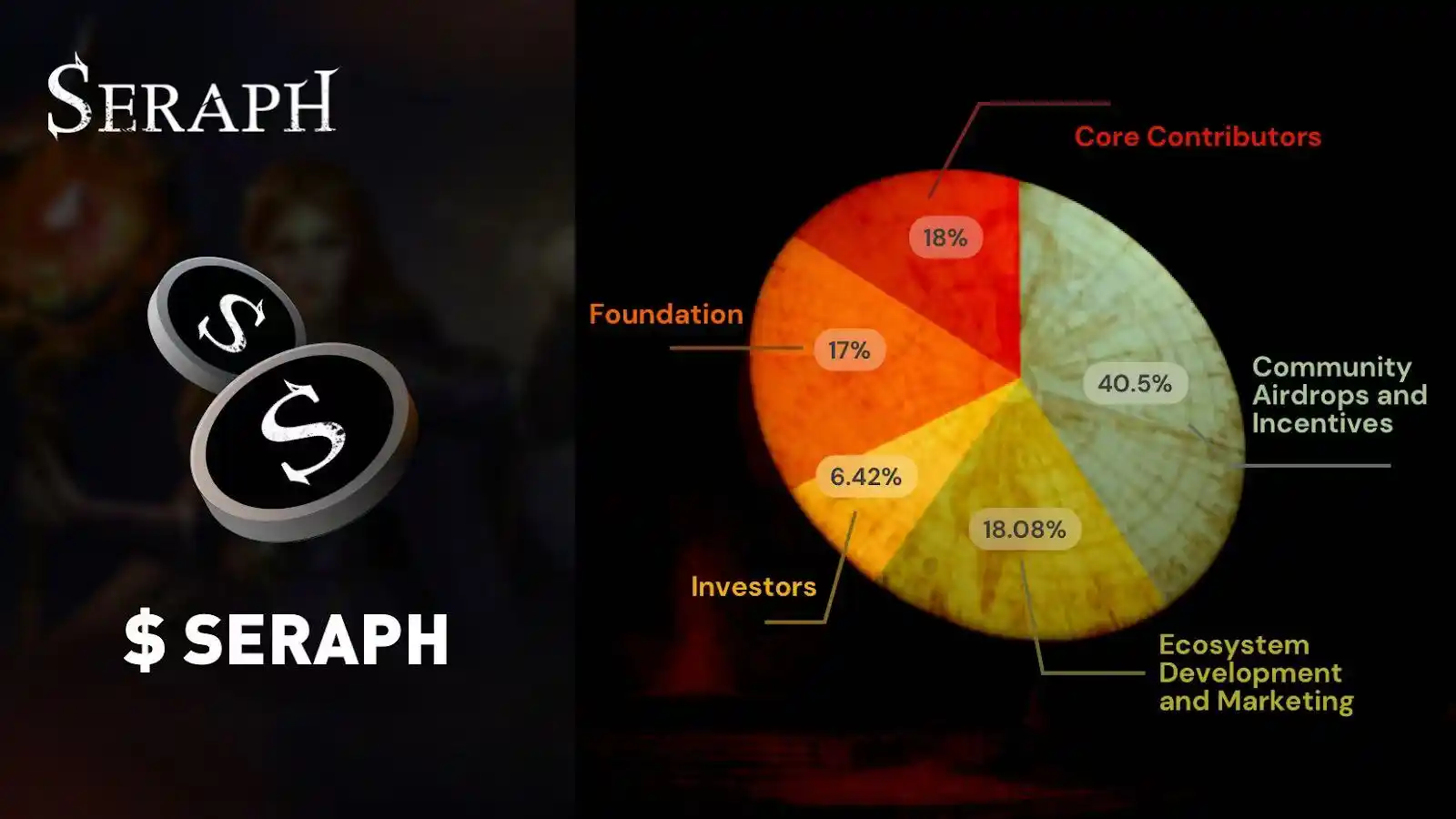
Community Airdrop and Incentives (40.5%): Rewards NFT holders, players, and community event participants to foster long-term engagement.
Core Contributors (18%): Allocated to the team and advisors with a vesting period to ensure long-term commitment.
Investors (6.42%): Support ecosystem growth with a reasonable vesting period to ensure sustainability.
Foundation (17%): Reserved for partnerships, exchange listings, and long-term development.
Ecosystem Development and Marketing (18.08%): Focus on promotion, liquidity, and global market activities.
A fair allocation mechanism ensures the sustainable development of the ecosystem and solidifies $SERAPH's position as the core of the Seraph GameFi economy.
Breakthrough Growth, Leading the AI-Driven Web3 Gaming Revolution
Seraph has achieved several significant milestones. As the top-ranked game on the BNB Chain, Seraph attracted over 90,000 players in Season 0, generating $10 million in revenue, showcasing strong economic performance and user retention.
As the TGE approaches, Seraph will officially launch the S1 Genesis Season on January 6, 2025, at 09:00 UTC. The S1 season will introduce new challenges, events, and rewards to maintain player enthusiasm and engagement. The seasonal structure ensures continuous content updates, and the incentive mechanisms continuously attract new players to join the ecosystem.
Seraph is not just a blockchain game but a pioneer in AI-driven Web3 gaming. The deep integration of AI technology enhances the gaming experience, including smart companions, adaptive difficulty settings, and dynamic visual performance. AI-generated voice-overs, character designs, and personalized game assistance provide players with an immersive experience. Additionally, AI-driven in-game pets can offer strategic analysis, market data, and real-time suggestions, creating an ever-evolving dynamic gaming environment.
Seraph is leading the future of GameFi. With the launch of the $SERAPH tokenomics and Genesis Season, players will embrace a new gaming experience and endless possibilities.
About Seraph
Seraph is a next-generation AAA blockchain game that combines AI and blockchain technology to bring players an immersive and rewarding ARPG experience. Developed by Seraph Studio and governed by the Seraph Foundation, Seraph is built on Ethereum and BNB Chain, integrating NFT, GameFi mechanics, and AI-driven features to create a decentralized and interactive gaming world.
For more details, please visit:
Website: https://seraph.game
Twitter: https://x.com/Seraph_global
Media Contact: Nell Loo, nell@seraph.game
This article is contributed content and does not represent the views of BlockBeats.
You may also like

Pantera Capital Partner: How Tokenization is Restructuring the Private Equity and Early Investment Ecosystem?

New York Proposes Stricter Stablecoin Issuer Rules Aligned With Federal GENIUS Act
NYDFS proposed stricter stablecoin issuer rules aligned with the GENIUS Act, covering reserves, custody, redemption timelines, audits, and capital buffers.
Every exchange is a "Universal Exchange."

The counterattack of traditional finance: Alliance chains are quietly reviving

CryptoQuant Says Bitcoin Profitable Supply Is Near 45% Pressure Zone as On-Chain Data Points to Market Repricing
CryptoQuant said Bitcoin’s profitable supply is nearing the 45% pressure zone, signaling rising market stress, unrealized losses, and a possible on-chain repricing phase.

Bitcoin Falls Below 200-Week Moving Average as On-Chain Data Shows Over Half of Supply in Loss
Bitcoin dropped below its 200-week moving average as on-chain data showed over 50% of circulating supply is now in loss, signaling rising market stress.

CFTC Reportedly Plans New Prediction Market Rules Focused on Manipulation Risk and Public Interest Review
The CFTC is reportedly preparing new prediction market rules focused on manipulation risk, public interest review, and retail trader protections.

Meet the new WEEX trial fund—your gateway to greater profits

WEEX Labs Lands at Dutch Blockchain Week: A Disruptive Crypto × AI Conversation Sets Sail in Amsterdam

SK Hynix Reportedly Plans U.S. ADR Listing as Early as August, With SEC Approval Possible in Late June
SK Hynix may pursue a U.S. ADR listing as early as August, with SEC approval reportedly possible in late June amid strong AI chip supply chain demand.

SpaceX vs Tesla vs xAI: Which Elon Musk Trade Has the Biggest Upside in 2026?
OpenAI Reveals It Has Confidentially Submitted an S-1 to the SEC, Keeping the Door Open for a Future IPO
On June 9, according to an OpenAI announcement, the company recently confidentially submitted a draft S-1 registration statement to the U.S. Securities and Exchange Commission (SEC), beginning the preliminary compliance process for a potential initial public offering. OpenAI said it chose to disclose this proactively because it expected the news might leak; however, the company has not yet set a specific listing timeline, and related arrangements may still take some time.

Latest research from 13 top universities including Cornell University: The current state, challenges, and misconceptions of the fusion of Crypto and AI
Deconstructing Anthropic: The Best AI Company, Possibly Also a Type of Organizational Invention
Apollo and Blackstone Reportedly Back $35 Billion Anthropic Chip Financing as Deal Details Remain Unclear
On June 9, according to currently available news alerts, Apollo and Blackstone Group participated in a $35 billion financing for an Anthropic “chip project.” Based on the original wording of the report, the funding has already been raised, but public information remains limited. The financing structure, use of proceeds, project entity, and whether Apollo and Blackstone participated through equity, debt, or project financing have not yet been disclosed.

Humanity Protocol Security Incident Escalates: More Than $31 Million Stolen From Related Addresses as Attacker Continues Selling H for ETH
On June 9, according to monitoring by Onchain Lens, more than $31 million has been stolen from addresses linked to Humanity Protocol, and the attack is still ongoing, with the hacker continuously swapping H tokens for ETH. Project founder Terence Kwok later confirmed the security incident on X, saying the issue involved a private key leak.

Bloomberg: As Bitcoin Weakens, Stablecoins and RWA Continue to Drive Expansion in Crypto Businesses
In June, Bloomberg reported that despite Bitcoin falling below $60,000 last week, wiping out about $235 billion in market value within seven days, and dropping close to 50% from last year’s peak, some core businesses in the crypto industry are still expanding, mainly in stablecoins, real-world asset tokenization (RWA), payments, and infrastructure. The report also noted that overall altcoin activity has contracted significantly: altcoin market capitalization has fallen from a peak of about $431 billion in November 2021 to around $170 billion, and among the tens of millions of tokens issued in recent years, fewer than 1,700 still maintain meaningful trading activity.

Galaxy Deep Research Report: How Hyperliquid's HIP-4 Upgrade Changes the Landscape of Prediction Markets?
Pantera Capital Partner: How Tokenization is Restructuring the Private Equity and Early Investment Ecosystem?
New York Proposes Stricter Stablecoin Issuer Rules Aligned With Federal GENIUS Act
NYDFS proposed stricter stablecoin issuer rules aligned with the GENIUS Act, covering reserves, custody, redemption timelines, audits, and capital buffers.
Every exchange is a "Universal Exchange."
The counterattack of traditional finance: Alliance chains are quietly reviving
CryptoQuant Says Bitcoin Profitable Supply Is Near 45% Pressure Zone as On-Chain Data Points to Market Repricing
CryptoQuant said Bitcoin’s profitable supply is nearing the 45% pressure zone, signaling rising market stress, unrealized losses, and a possible on-chain repricing phase.
Bitcoin Falls Below 200-Week Moving Average as On-Chain Data Shows Over Half of Supply in Loss
Bitcoin dropped below its 200-week moving average as on-chain data showed over 50% of circulating supply is now in loss, signaling rising market stress.


