
OpenSea has experienced seven years of ups and downs. The former NFT exchange king has still chosen to do a token offering.


Original Article Title: "OpenSea's Seven-year Roller Coaster Ride: The Former NFT Exchange 'King' Chooses to Issue Tokens"
Original Article Authors: Babywhale, Glendon, Techub News
Editor's Note: On February 18, OpenSea suspended its XP reward system due to user criticism of its new airdrop mechanism. Community members believe this mechanism is detrimental to builders, promotes wash trading, and prioritizes fee collection. OpenSea co-founder and CEO Devin Finzer announced the suspension of XP rewards for listing and bidding, focusing instead on the XP distribution mechanism launched on February 14. While the airdrop activity has been adjusted, the issuance of tokens by the former "king" still created a stir in the NFT market.
On the evening of February 13, OpenSea announced the launch of the OS2 beta version on X and revealed the upcoming platform token, SEA, hinting at an airdrop. Although the specific timeline and details have not been disclosed, this announcement undoubtedly resonated with many veteran players in the crypto community. Within just one hour, the tweet had garnered over a thousand comments and retweets, igniting a surge in community discussions.
OpenSea CEO Devin Finzer also emphasized in a tweet that "the upcoming OS2 is not just a new product, and SEA is not just a token, but an entirely rebuilt OpenSea from the ground up." There have been rumors suggesting that OpenSea's new version will adopt a UI centered around trading, inspired by Blur.
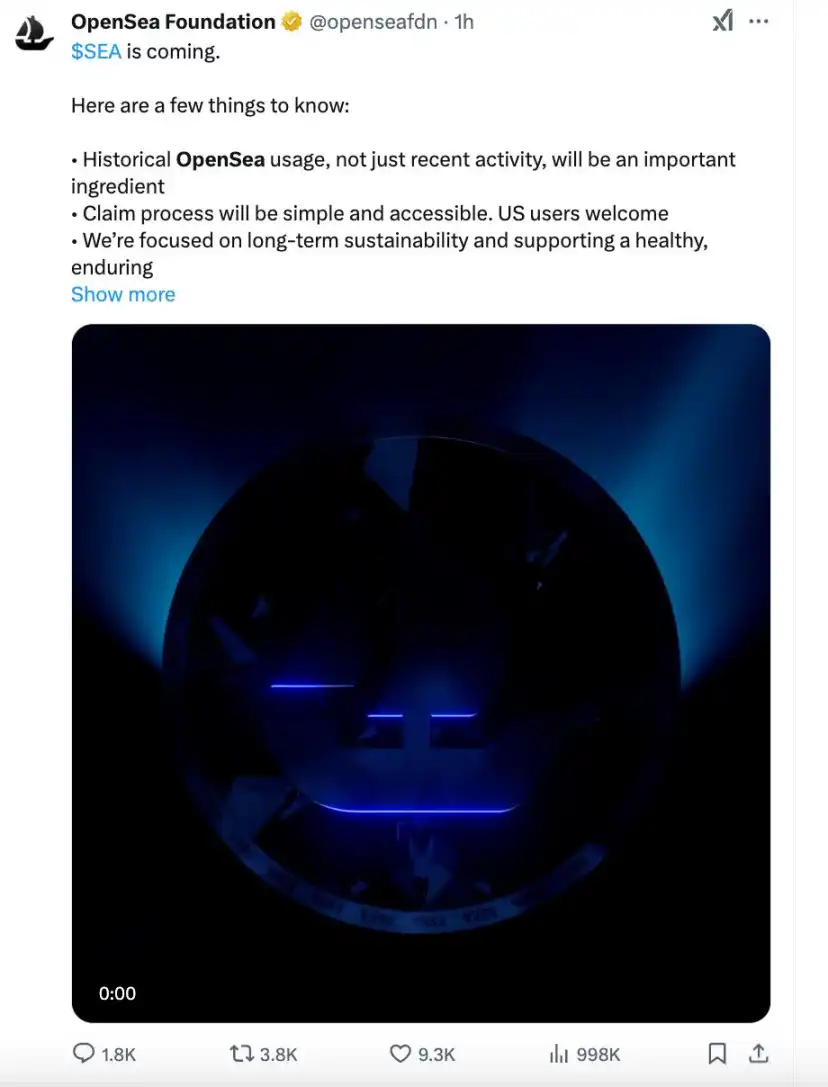
OpenSea is finally issuing tokens. If this had happened three years ago, it would have undoubtedly been a highly anticipated event in the crypto world. However, times have changed, and the crypto space is now dominated by MemeCoins, with NFTs long having been "out of fashion." What's even more lamentable is that even if we focus solely on the NFT sector, OpenSea's glory days are over. According to Dune data, OpenSea's January trading volume was only $195 million, a 96% drop from its peak of $5 billion at the beginning of 2022, with annual revenue shrinking to around $33.26 million.
According to nftpulse data, as of the time of writing, OpenSea's market share over the past 30 days has plummeted from 95% in December 2021 to 29%; furthermore, OpenSea's valuation has tumbled from a peak of $13.3 billion at the start of 2023 to around $1.5 billion, with it even reaching the point of being "up for sale."
So, how did OpenSea, once a dominant force in the NFT trading market, end up in this state?
Let's take a look back at OpenSea's brief history to see how it rose rapidly and then fell from grace in the competitive NFT market. Finally, let's discuss OpenSea's decision to launch its token at this time and the potential impact on the overall NFT market landscape.
Early Days: Surviving in the NFT Wilderness
Much questioned aspect is that among the startups in the Web3 space, OpenSea is undoubtedly a legendary company that started from scratch. Especially in the two years from 2021 to 2022, the company skyrocketed at an astonishing speed from obscurity to a valuation of $13.3 billion, positioning itself as a super "unicorn" and firmly holding the top spot in the NFT trading market. However, behind this brilliance lies a dramatic history of market ups and downs. Therefore, the rise and fall of OpenSea may also be seen as a microcosm of the NFT industry's evolution from chaotic growth to rational competition.
In September 2017, Devin Finzer and Alex Atallah secured seed funding from the renowned venture capital incubator Y Combinator with their innovative project "Wificoin," which aimed to use cryptocurrency for shared WiFi payments and was not related to the NFT space.
However, in November 2017, Dapper Labs officially launched CryptoKitties, a Ethereum-based crypto cat game, triggering a wave of hype. The frenzy of bidding at one point drove the NFT collectible price of CryptoKitties to 247 ETH, approximately $118,000 at the time.
That same year, CryptoKitties co-founder and CTO Dieter Shirley introduced the concept of NFTs (Non-Fungible Tokens) and promoted the release of the EIP-721 standard to define NFTs. (Techub News Note: EIP-721 was later discussed and improved, formally adopted in 2018 as the current ERC-721 protocol standard.)
It was the proposal of this standard that changed the entrepreneurial direction of Devin Finzer and his team. They decided to abandon the original "Wificoin" project and founded the NFT trading platform OpenSea in February 2018.
According to The Generalist, Devin Finzer expressed his view on this: "Seeing the potential of the NFT market, because there was a standard for digital projects, everything that came after CryptoKitties would adhere to this standard."
At that time, it was still the early stage of blockchain and cryptocurrency development, and the concept of NFT had not yet become widespread, making the entire NFT market almost a barren land.
Nevertheless, OpenSea was not the only NFT trading platform at that time. On the same day as its launch on Product Hunt, there was Rare Bits, which claimed to be a "zero-fee encrypted asset market similar to eBay," a more competitive rival than OpenSea. Interestingly, OpenSea also described itself as the "Ebay of crypto goods." (Techub News note, Ebay is an online auction and shopping website that allows people worldwide to buy and sell items online)
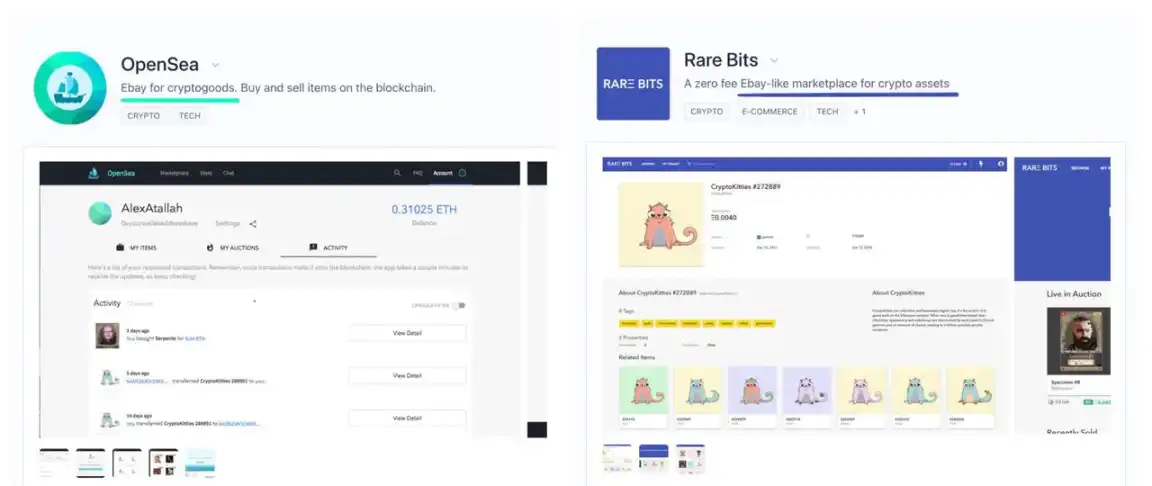
In May 2018, OpenSea raised $2 million from investors including 1confirmation, Founders Fund, Coinbase Ventures, and Blockchain Capital. However, Rare Bits had already secured $6 million in funding a month earlier from investors such as Spark, First Round, and Craft.
From a venture capital investment perspective, although OpenSea was at a disadvantage, Richard Chen, a partner at 1confirmation, favored OpenSea more. He believed that "Rare Bits did not understand NFTs as well as OpenSea did, OpenSea's team was more efficient and competitive, Devin and Alex did a great job in discovering new NFT projects and driving their launch on OpenSea. Moreover, when we invested in April 2018, OpenSea's transaction volume was already four times that of Rare Bits."
In addition, the sales strategies of the two companies were also different. OpenSea insisted on charging a 1% transaction fee (later gradually increased to 2.5%) to sustain operations through stable revenue. Rare Bits, on the other hand, adopted a "zero-fee" strategy in 2018 and promised to refund users the gas fees incurred in transactions, attempting to attract traffic by reducing user costs. This strategy initially garnered some attention, appearing more user-friendly, but was actually not conducive to the long-term development of the platform. The high operating costs also meant that Rare Bits would find it difficult to continue, especially as the "crypto winter of 2018" approached.
During this period, in order to expand its user base and increase platform trading volume, Rare Bits also attempted to expand its business from NFTs to a broader range of virtual goods trading, such as partnering with the anime platform Crunchyroll to release "digital stickers," and exploring the trading of non-NFT assets such as in-game items.
Unlike Rare Bits' diversification, OpenSea has remained focused, with its main focus always being on improving the NFT trading business.
However, on the long road to dawn, OpenSea's days were also challenging. The platform's early trading volume remained low, and early projects were limited to only a few NFTs such as CryptoKitties and CryptoPunks.
According to Titanium Media, in March 2020, the team size was only 5 people, with a monthly trading volume of around $1 million. Calculated based on a 2.5% commission rate at the time, OpenSea's monthly revenue was only $28,000. If it weren't for the "lifesaving funds" of $2.1 million injected by strategic investors like Animoca Brands at the end of 2019, this startup might have long disappeared into the industry's winter. As for Rare Bits, it showed signs of being on the brink as early as 2019 and eventually completely exited the market in 2020.
In hindsight, OpenSea's rise to become a leader in the NFT space can be attributed to its focused core business and streamlined operational decisions. Devin Finzer once said in an interview, "We are willing to develop in this field for the long term, regardless of the current growth trajectory. We want to establish a decentralized market for NFTs and hope it can last for 3-4 years."
As 2020 drew to a close, dawn was approaching. This year can be seen as a turning point in OpenSea's destiny. With the gradual recovery of the crypto market in the second half of the year, OpenSea, taking advantage of its status as a pioneer in the NFT market, began to reap the benefits, and its platform trading volume began to rapidly increase. According to Dune Analytics, in October 2020, OpenSea's monthly trading volume reached about $4.18 million, a 66% increase from September's $2.46 million.
In order to have a wider variety of NFT assets on the platform and attract more liquidity, OpenSea began to fully implement its "Open Market" product strategy.
In December 2020, OpenSea launched the new "Collection Manager" feature, allowing users to mint NFTs without fees (gas fees are borne by the buyer), and the official termed this feature "Lazy Minting," separating on-chain minting from metadata, allowing users to upload an item's metadata to OpenSea for free, and the item will only be minted as an on-chain ERC-1155 NFT when it is first sold.
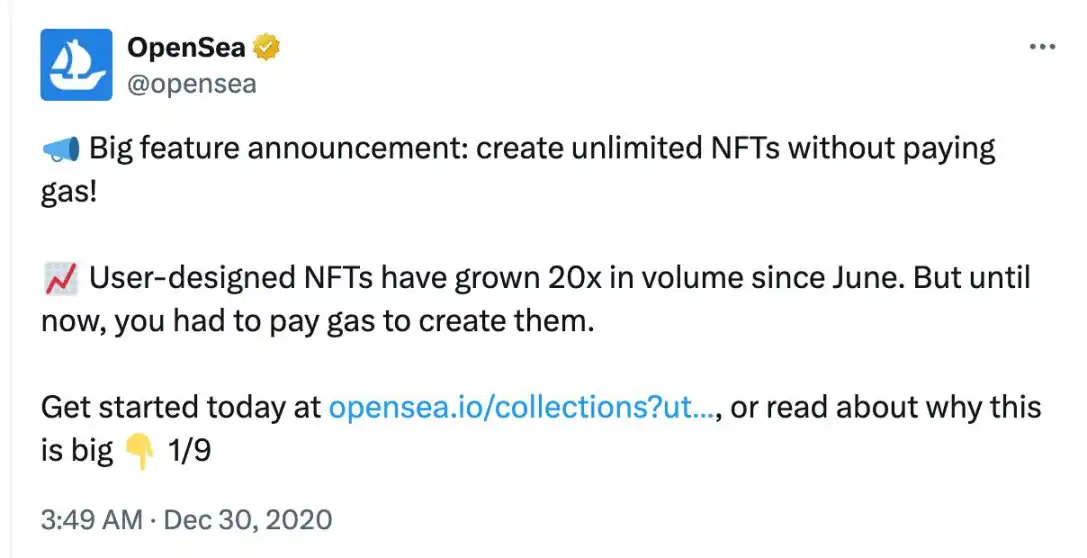
This feature significantly reduces the barrier to entry for creators and, based on the feature of listing NFTs on OpenSea without review, every user can directly mint and release NFTs on OpenSea. Besides this advantage, OpenSea also covers the widest range of transaction types among similar platforms, including digital avatars, music, domain names, virtual worlds, trading cards, artworks, and various other NFT collections. Its strategy maximizes the supply of creators' works to attract more users in both the primary and secondary markets.
Objectively speaking, the pent-up potential of the NFT market has contributed to later success of OpenSea, but the rapid onset of the market's boom would absolutely not be possible without OpenSea's contribution.
In 2021, the Crypto market saw a comprehensive "bull market," and OpenSea, which had been dormant for two years, truly began to shine.
NFT Frenzy Explodes, OpenSea Tops the Throne with Monthly Transaction Volume in the Billions
According to Dune Analytics, in February 2021, OpenSea's data experienced explosive growth for the first time. On February 2nd, OpenSea's daily transaction volume exceeded $5 million, while the total transaction volume for January was just over $7.5 million. Ultimately, OpenSea's monthly transaction volume in February approached $95 million, more than a 10-fold increase compared to the previous month.
Also starting from the beginning of 2021, a large number of commemorative NFTs began to be issued on OpenSea. Bands, entertainment stars, sports celebrities, renowned artists, and many other well-known figures started releasing their NFTs. Many well-known brands also began releasing commemorative NFTs or launching customer loyalty activities using NFTs. It can be said that starting from CryptoKitties, the first wave of NFTs brought Web3 and traditional industries together and introduced many people who were originally unfamiliar with Crypto to a whole new "species" for the first time.
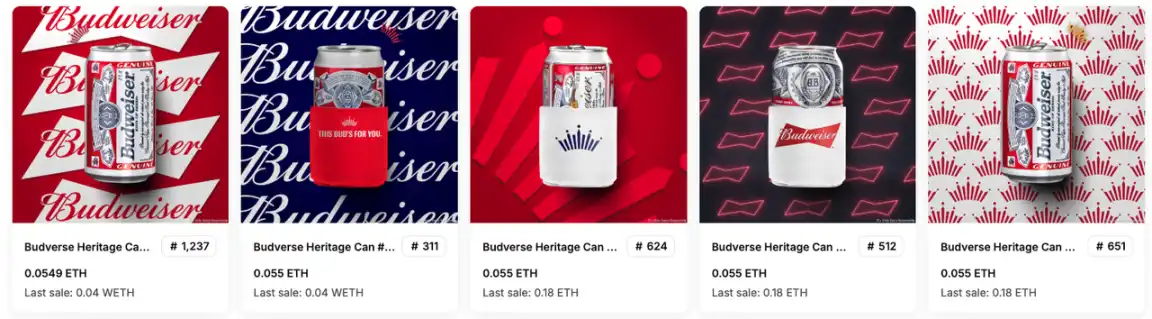
Budweiser's NFT Series
As the largest NFT trading platform, OpenSea finally rode the wave. Data shows that in March 2021, the transaction volume on OpenSea surpassed the $100 million mark for the first time, exceeding $300 million in July, and in August, that number grew more than tenfold month-on-month to reach $34.4 billion. It was also in March that OpenSea completed a $23 million financing round led by a16z, with many angel investors including Mark Cuban participating in this round of investment.
Although NFTs did experience rapid growth starting in early 2021, with the floor price of CryptoPunks NFTs rising from single-digit ETH at the beginning of the year to tens to twenties ETH by mid-year, the primary narrative in the market for the first half of 2021 still revolved around DeFi. At that time, the focus had not fully shifted to NFTs. The reasons for this can be attributed to the ongoing rise in DeFi's popularity and the fact that the NFT space had not yet seen any assets or concepts that could be hyped up.
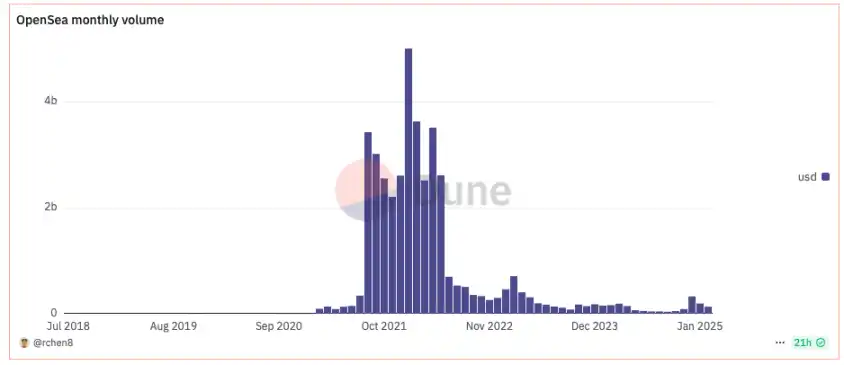
As we entered the second half of the year, a series of PFP projects led by Bored Ape Yacht Club (BAYC) ignited the market, and NFTs were considered another phenomenal concept following DeFi. With the increasing trading activity in the NFT space, the monthly trading volume on OpenSea consistently remained at a high level of billions of dollars. In January 2022, this number even surpassed $5 billion. Nate Chastain, the product lead at OpenSea, tweeted at the end of August 2021 that the company had only 37 employees, yet in that month alone, OpenSea's fee revenue exceeded $80 million. The per capita contribution of over $2 million is extremely remarkable in any industry.
By the end of 2021, OpenSea had been in a relentless sprint most of the time. Apart from Nate Chastain, who was mentioned earlier, leaving due to an insider trading scandal, OpenSea hardly had any other negative news. Even though other NFT trading platforms received large funding, they could not shake OpenSea's position. In fact, almost all NFT trading platforms have more or less referenced OpenSea in their products.
While challengers are watching closely, is OpenSea "betraying" Web3 with plans for an IPO?
Amidst a flourishing era, a turning point is quietly approaching, and it all begins with the rumors of OpenSea's IPO...
In early December 2021, Bloomberg reported that Brian Roberts, the CFO of the US ride-hailing company Lyft, would join OpenSea as CFO, and Roberts indicated that he was planning an IPO for OpenSea. While this was initially seen as mundane news, it sparked some discussions within the Web3 industry. Many believed that OpenSea should issue a token to reward its users, as this is what Web3 projects should do.
Perhaps feeling some pressure, two days later, Brian Roberts personally came forward to clarify, stating that there is currently no IPO plan, and saying, "There is a big gap between what an IPO would ultimately look like and actively planning an IPO, we do not have plans to IPO, if we did, we would seek community involvement."
This somewhat ambiguous statement not only did not dispel the community's concerns, but instead further solidified everyone's belief that OpenSea will eventually go public, because he didn't even mention anything about issuing a token.
If OpenSea had decided to issue a token at that time, perhaps the NFT trading platform space would not have had such a subsequent exciting story, and it was precisely the choice of an IPO, a "selfish" decision, that tore open a crack in the once unbreakable wall.
At that time, OpenSea held over 90% of the NFT trading market share on Ethereum, and after its non-issuance attitude spread, some entrepreneurs saw an opportunity and quickly launched NFT trading platforms that issued tokens. LooksRare was one of them, although not the first project to launch a "vampire attack" on OpenSea, its impact was significant after OpenSea prepared for listing.
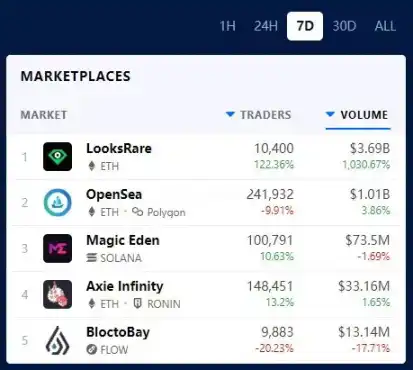
On January 10, 2022, LooksRare officially launched, with the team stating that users who have traded on OpenSea with a volume greater than or equal to 3 ETH can receive an airdrop by listing an NFT on LooksRare. In addition, users can stake the received LOOKS airdrop to share all platform transaction fees. Just 2 days after the launch of LooksRare, its daily trading volume exceeded that of OpenSea, and as of the 7-day trading volume data until January 19, 2022, LooksRare had more than triple the volume of OpenSea.
When the crack was torn open and the market discovered that OpenSea was not completely invincible, everyone began to show their strengths. Projects like X2Y2 launched in February 2022, Element focused on the BNB Chain, Zora focused on high-end art NFTs, and Magic Eden focused on the Solana NFT market, all continuously eroded OpenSea's existing market and potential market expansion. Perhaps it is a bit excessive to say that arrogance led to this, but at least the lack of precaution at the height of its power was indeed a major strategic mistake for OpenSea.
However, OpenSea's market influence remains unshakable. As we enter the second quarter of 2022, on one hand Yuga Labs is about to launch the APE token, while on the other hand, transactions of "blue-chip NFTs" such as Moonbirds, Doodles, etc., are still active. As the most liquid NFT trading marketplace, OpenSea still holds the pulse of the NFT market.
The key figure who changed the entire NFT landscape or should we say, the person responsible for the NFT market crash emerged at this time, fundamentally altering everyone's stereotypical impression of what the NFT market should be like.
Blur Emerges and Takes the Crown of the NFT Market
By the end of March 2022, Blur announced the completion of a $11 million funding round. At that time, many people might still wonder why a new NFT trading platform appeared. However, after Blur officially launched at the end of October, it took everyone by surprise.
A completely different UI that clearly stated there would be airdrops for listing, bidding, and buying, and the airdrop would be a "treasure chest" of an unknown amount of tokens. The UI designed purely for trading and the clear yet ambiguous airdrop feature, Blur excelled in product and gameplay design. Although many initially criticized Blur for its very user-unfriendly UI, once people got used to it, they found that this design was indeed much more user-friendly for trading than OpenSea. To make an analogy, if OpenSea is the e-commerce platform of NFTs, then Blur is the exchange of NFTs.
Prices are listed from low to high, displaying real-time trades and price distribution on the right. This trading-friendly UI design along with the airdrop expectations led to a significant influx of funds into Blur. Previously, many NFT trading platforms relied on tokens to attract traffic in the short term, but OpenSea's market share in terms of transaction volume was not challenged in monthly or quarterly data. However, with the emergence of Blur, OpenSea's share of transaction volume returned to above 50% just a week ago.
However, it was also because of this that large funds gained the ability to manipulate the market, engaging in frantic buying and selling. Coupled with the fact that the Crypto market had already entered a deep bear market, seeing big funds indiscriminately leveraging airdrop incentives led to the prices of numerous NFTs almost crashing through. Retail investors lost interest in NFTs, and as Bitcoin fell to around $20,000, the "last gatekeeper" of crypto assets also left the scene. With the collapse of the NFT market and the crowning of the new king Blur, OpenSea became cannon fodder.
In early 2022, OpenSea achieved a valuation of $13 billion and completed a $300 million Series C funding round. Two years later in early 2024, the OpenSea CEO has openly considered acquisition. During this "one-person Bitcoin bull market," many former blue-chip NFT floor prices have plummeted to an unbearable level, apart from the Pudgy Penguins with airdrop expectations. For OpenSea, without making changes, they may risk losing years of effort, which is certainly not what they want to see.
Therefore, OpenSea has now decided to launch the platform token SEA, partly as a self-rescue measure to deal with the continuous decline of their platform business, and partly because the former king may also have some unwillingness and ambition to return to the peak. So the question is, will OpenSea's token issuance potentially change the competitive landscape of the NFT market?
With recent surge in trading volume, can OpenSea reshape the competitive landscape of the NFT market?
Undoubtedly, with the issuance of the OpenSea token and the release of the OS2 beta version, the project most likely to be impacted is Blur. As a powerful rival that undermines OpenSea's position, Blur, despite showing signs of decline in line with the downturn in the Crypto market, still holds over 44% of the NFT market share in the past 30 days, firmly seated as the top player in the NFT market.
In addition to the unique product UI and gameplay design mentioned earlier, Blur initially attracted a large number of users with Bid Airdrop and a zero-fee model. In 2023, it conducted multiple airdrops to seize market share, as can be seen from the data:
On February 15, 2023, Blur carried out the first season airdrop of 3.6 billion BLUR tokens, which accounted for 12% of the initial total supply, and were immediately released. According to Glassnode's report, following the BLUR token airdrop, Blur's market share surged, with its NFT trading volume market share jumping from 48% to 78%, while OpenSea fell by 21%.
On February 23, 2023, Blur launched the second season airdrop of 3 billion BLUR tokens. This airdrop directly propelled Blur's trading volume well beyond that of OpenSea. DappRadar data shows that on February 22, 2023, BLUR trading volume reached around $108 million, while OpenSea was only $19.27 million.
To some extent, Blur's two large token airdrops played a crucial role in breaching OpenSea's "moat." As the saying goes, fight fire with fire, in the current NFT market downturn, if OpenSea's SEA token attracts users through airdrops or staking rewards, it is very likely to replicate this strategy. It may even emulate the "vampire attack" launched by past "OpenSea killers" such as LooksRare and x2y2 against Blur to compete for its core users.
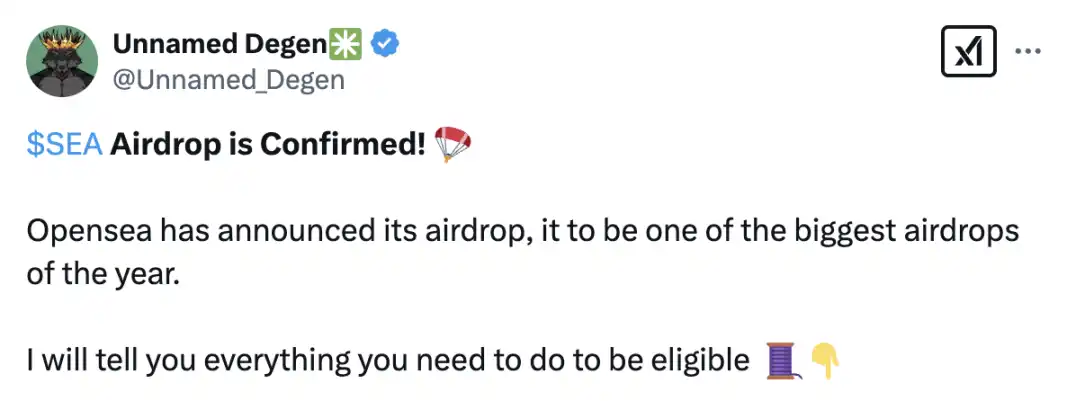
In fact, since OpenSea confirmed the upcoming airdrop, it has sparked anticipation and discussion among many Twitter users, with many believing it will be one of the biggest airdrops of the year.
Furthermore, in terms of fees, the recent launch of OpenSea's OS2 beta has reduced the marketplace fee to 0.5% and the transaction fee to 0%. This directly mirrors Blur's zero-fee model. When SEA goes live, OS2, with its combination of "low fees + token incentives," is highly likely to establish a very flexible competitive strategy.
Objectively speaking, most users are fundamentally profit-driven. If the SEA token's reward mechanism is more attractive, coupled with the fact that some of Blur's existing users originally came from OpenSea, it may not be unlikely that these users will return to OpenSea. However, Blur's "moat" lies in its faster transaction speed than OpenSea and higher gas efficiency, giving it a technological advantage in the short term.
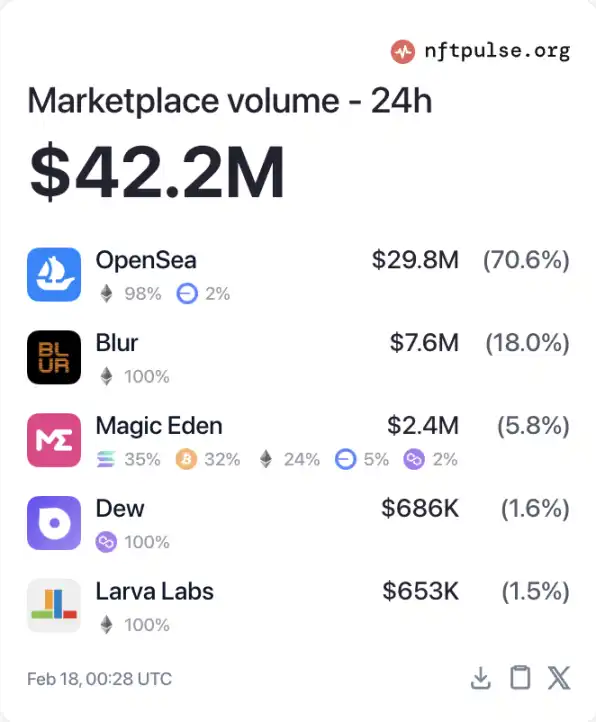
Affected by the token issuance news, the market has already reacted. According to nftpulse data, as of the time of writing, OpenSea's daily trading volume has reached approximately $29.8 million, with trading volume share soaring to 70.6% of the total daily volume.
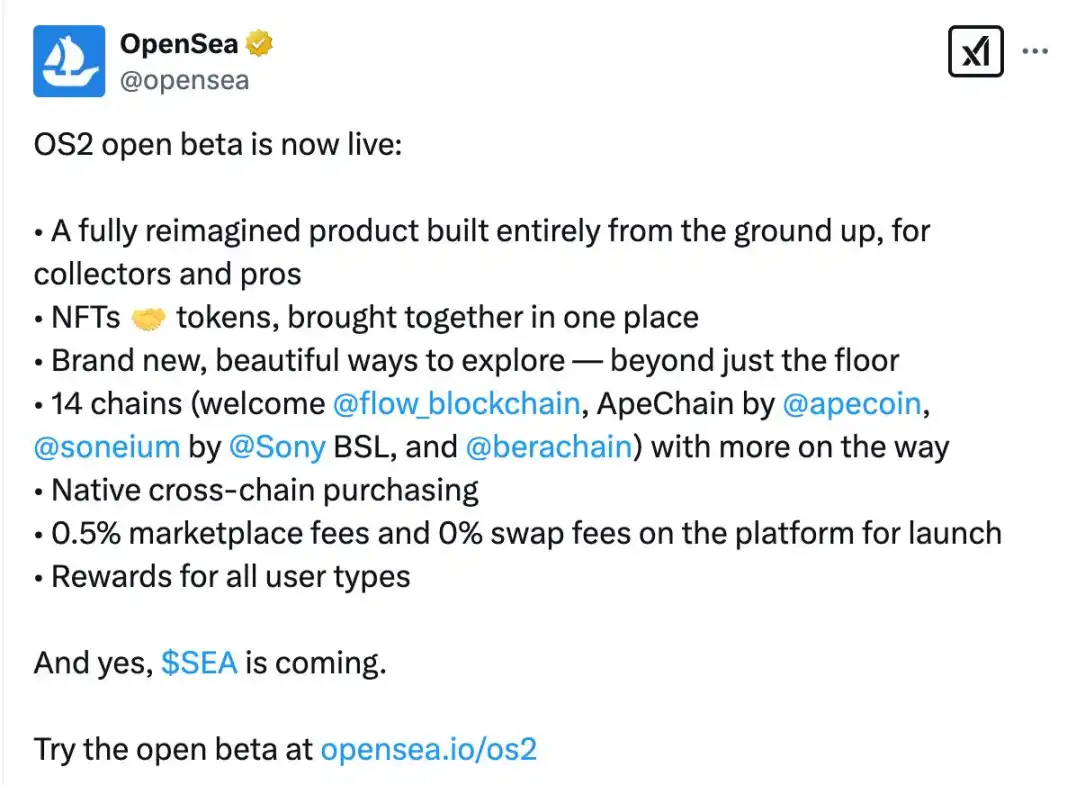
For the entire NFT market, the launch of the SEA token by OpenSea is undoubtedly a good thing. In addition to stimulating a significant increase in NFT trading volume in the short term, OpenSea also mentioned in a tweet that OS2 now supports cross-chain transactions for 14 chains including Flow, ApeChain, and Soneium. Therefore, could the SEA token become a universal token for a multi-chain NFT ecosystem, thereby driving the development of NFT markets on Ethereum sidechains (e.g., Solana)? This is something we can look forward to.
However, from another perspective, the intense competition between OpenSea and Blur will once again squeeze the survival space of second-tier platforms like LooksRare and X2Y2. Blur is unlikely to sit idly by as its past rivals make a comeback. Blur may introduce more token use cases or further incentivize user loyalty with token rewards. Additionally, Magic Eden, also a rising star, should not be underestimated, with its dominant position on the Bitcoin and Solana chains. In the past year, the platform's total market trading volume has reached $3.2 billion, accounting for over 30%, second only to Blur's $3.8 billion (around 36%), while OpenSea's trading volume over the past year was only $1.2 billion, accounting for less than 12%.
In short, the author believes that OpenSea's SEA token is not only key to the platform's self-rescue, but may also become a driving force to help the NFT market recover from its slump. In the long run, the competition between OpenSea and Blur will also push the NFT space towards a more complex financialized and multi-chain direction. As for whether OpenSea can regain its dominant position, the future landscape will depend on the performance after the SEA token is launched. Let's wait and see!
You may also like

Citibank releases "2030 Asset Tokenization Market Outlook": 6 major trends may create a $8.2 trillion market

The trillion-dollar valuation test: Are the three major super IPOs a celebration for tech stocks or a nightmare for the crypto market?

Morning Report | Digital Asset completes $355 million financing led by a16z Crypto; Meta completes operational separation from Manus

a16z Crypto Partner: Cash flow is the moat

Cryptocurrency market makers collectively seek change as it becomes increasingly difficult to make money

How TradeXYZ, xStocks, and Alpaca break down the SpaceX IPO into three different strategies

$75 billion in risk asset redistribution: How will SpaceX's IPO affect U.S. stocks and Bitcoin?

Why Is BlackRock Investing $5 Billion in the SpaceX IPO?
Morning News | CME Group launches Nasdaq Cryptocurrency Index futures; Asset management giant Janus Henderson strategically invests in Ethena

Bitcoin Layer 2 Network Botanix: Why Did We Choose to Dissolve?

Why did Oracle deliver the strongest financial report in history, yet its stock price fell?
When the P2P illicit funds from ten years ago turned into 60,000 bitcoins
Dialogue with OmenX Founder: Why does the prediction market need an evolution from "spot" to "derivatives"?
Galaxy in-depth report: Is Solana still worth paying attention to?
Young people in South Korea make a "final effort" in the epic bull market
The pricing controversy of Trade.xyz exposes the fatal weakness of Pre-IPO perpetual contracts

How much longer can Ethereum's last big buyer hold on?

World Cup 2026 Coming – WEEX Celebrates with $1M Prize Pool & Michael Owen Live
Citibank releases "2030 Asset Tokenization Market Outlook": 6 major trends may create a $8.2 trillion market
The trillion-dollar valuation test: Are the three major super IPOs a celebration for tech stocks or a nightmare for the crypto market?
Morning Report | Digital Asset completes $355 million financing led by a16z Crypto; Meta completes operational separation from Manus
a16z Crypto Partner: Cash flow is the moat
Cryptocurrency market makers collectively seek change as it becomes increasingly difficult to make money
How TradeXYZ, xStocks, and Alpaca break down the SpaceX IPO into three different strategies


