
On his first day in office, Trump pardoned a veteran prisoner of the crypto community who had served 11 years.
No one understands better than Trump how to use political leverage to manipulate public sentiment.
Recently, Trump has been under some pressure. To circumvent presidential investment restrictions, on the eve of his inauguration in the "Goose City," the Trump family directly issued a coin to allow an entire interest group behind him to achieve "money for nothing" at the fastest speed.
There can be many people who harvest in the coin circle, but the one person who cannot be the president. Many members of the cryptocurrency community who once supported him openly opposed this behavior. However, there is another voice among those in the crypto community who are dissatisfied with Trump's coin issuance:
"I cannot forgive Trump for issuing a coin on the eve of his inauguration unless he releases Ross Ulbricht tomorrow."
This is a perfect example of Trump's sophisticated political maneuvering. Under pressure from the crypto industry, he immediately called the mother of Silk Road founder Ross Ulbricht and personally told the mother who has been waiting for her son to come home for ten years:
"I have just signed a full and unconditional pardon for your son Ross." Ross can come home.
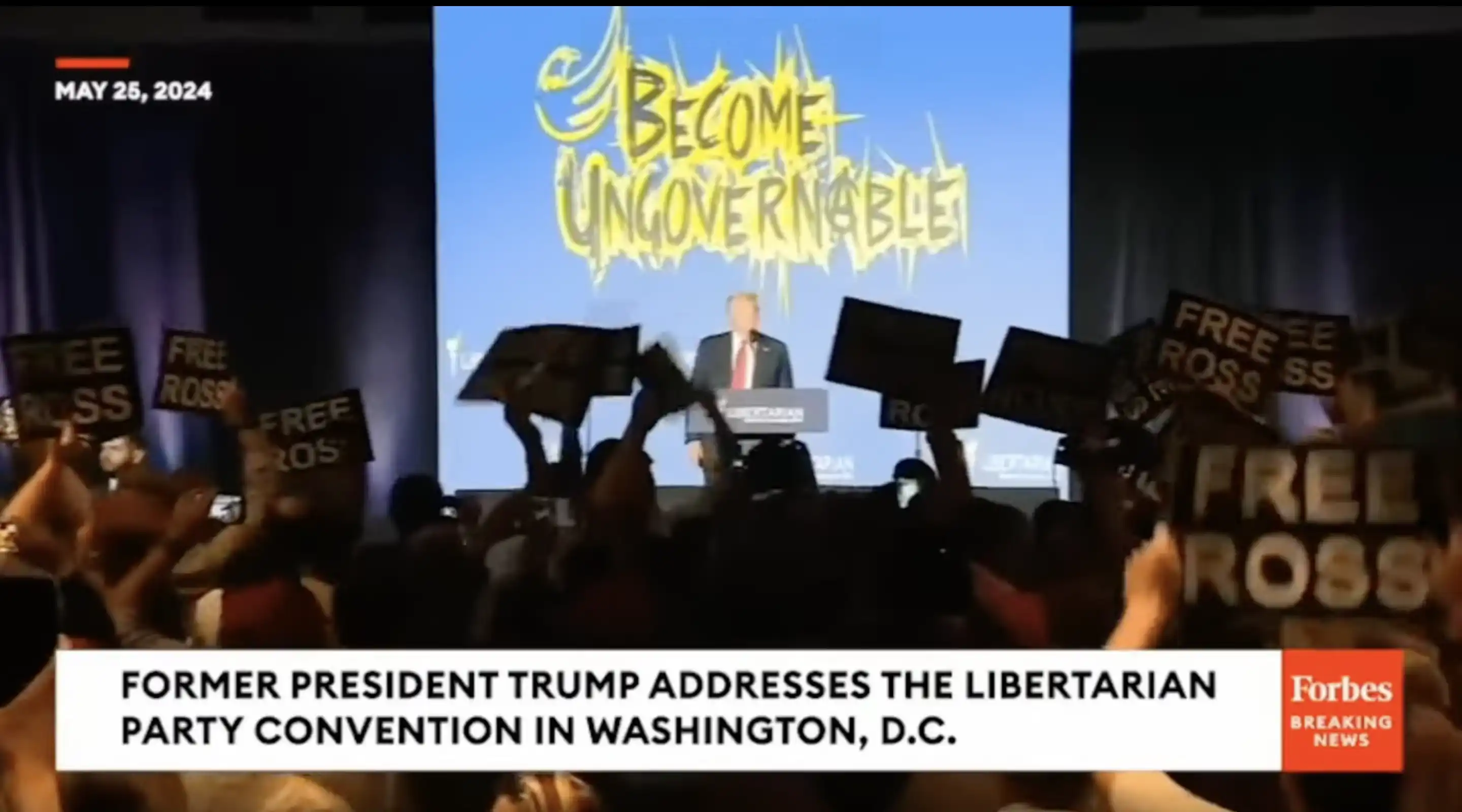
This was Trump's promise during his campaign. He promised that if re-elected, he would grant clemency or even pardon Ross on his first day in office. Six months have passed since the Bitcoin 2024 Conference, and he has already fulfilled most of his promises at that time: firing the current SEC chairman Gray Gensler, appointing a Bitcoin/crypto presidential advisory committee, granting clemency or pardon to Ross, and establishing a strategic Bitcoin reserve for the U.S. government.
Every word and action seems to prove and imply that "I will fulfill all my promises made during the campaign one by one, and the next one may be the Bitcoin strategic reserve." The Bitcoin strategic reserve is undoubtedly the G-spot of the crypto industry. This way, Trump has dampened most of the crypto industry's anger over his coin issuance.
For those far removed from the crypto industry, it may be difficult to understand why releasing Ross could appease the crypto industry's anger over Trump issuing a coin that allowed the interest group to achieve 'money for nothing'.
This story dates back to 2011 when many significant events occurred, including the killing of Bin Laden and the death of Kim Jong Il. But there were also some events that didn't seem so important at the time, such as Bitcoin's birth just two years prior. Unlike now, when one is worth $100,000, in the first one or two years after its birth, Bitcoin stayed at $0.1 per coin.
While Bitcoin may now seem like a brilliantly designed system, at the time, it was seen as a useless design by many. It wasn't until 2010 that Ross heard about Bitcoin from a client, which became a turning point.

Ross Ulbricht
In 2011, Ross founded the infamous darknet market "Silk Road," which was not a marketplace for trading tea, silk, or porcelain. Instead, it became the most well-known and notorious darknet marketplace in history. The primary commodities traded on this website were drugs, sex slaves, child pornography, hitmen, arms deals, and fake identities.
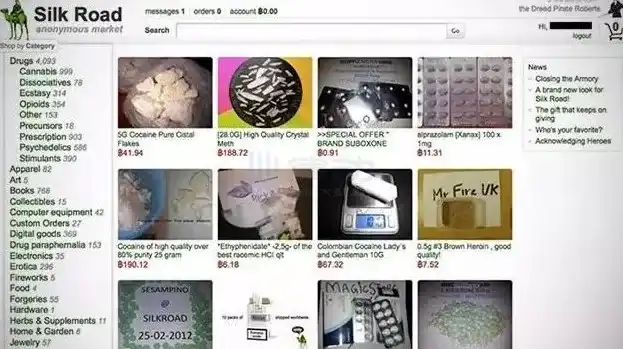
Screenshot of the Silk Road website, image source: internet
To ensure anonymity, Ross designed the platform to be accessed only through the Tor onion router (search engines couldn't access it, and entry required special software) and conducted transactions solely in Bitcoin. The government's crackdown on illicit activities revolves around financial control, which is rooted in the banking system firmly held by the government. Bitcoin, on the other hand, is a payment tool divorced from the banking system—until now, banks and Bitcoin continue to coexist separately.
With the rise of Silk Road, Bitcoin finally found its first use case as a payment instrument for illicit transactions. Data shows that the Silk Road circulated over 9.5 million Bitcoins, which accounted for 80% of the circulating supply at that time.
To his real-life friends, Ross described his work as "building an economic simulator" with the aim of using economic theory to eliminate coercion and aggression between individuals, allowing people to experience what it's like to live in a world without systemic violence.
No one could have imagined that this seemingly sunny, ambitious young man was actually a major drug lord and the architect of the underground criminal world. However, there are no airtight walls in the world, as several regulatory agencies had their eyes on him, and even an FBI informant befriended him for a lengthy three-year period.

Ross once received an email from an FBI informant offering to buy him out for 1 billion dollars, image source: internet
The DEA already knew Ross's identity by following the network cable, and the FBI's arrest of him was also quite dramatic.
In October 2013, Ross was using a bookstore's Wi-Fi when the arrest happened. To prevent Ulbricht from deleting or encrypting files on his laptop, a pair of undercover agents posing as a couple walked past him and then loudly argued next to him.
With Ross distracted by curiosity, he turned to look at them, and at that moment, one agent swiftly took his laptop, while two other agents pounced on him. The agents inserted a USB device into the laptop and used software to copy key files, as Ross's laptop was logged into the "Silk Road" admin account at the time.
On August 21, 2014, Ross was officially charged with money laundering, computer hacking, and conspiracy to traffic narcotics. On February 4, 2015, he was found guilty on all charges. On May 29, 2015, the court sentenced Ross to double life imprisonment without parole for 40 years.
Undeniably, Ross was an extremely important figure in Bitcoin's development history. Just as Bitcoin was about to be overlooked by the world, he ended Bitcoin's history as a mere toy and gave it real-world significance — serving crime.
Just as the consensus of fools is still a consensus, the demand for the dark side is still a demand. Driven by illicit transactions, Bitcoin experienced its first major price surge, reaching $31 in June 2011. However, two months after Ross's arrest, Bitcoin soared to $1,100 per coin.
Due to the practice of liberalism, during Ross's 11 years in prison, there has continued to be broad support in society, including the cryptocurrency industry, for a more lenient treatment. Many in both parties also believe that Ross's sentence was unjust and that he should be given a second chance. Over 250 organizations, public figures, and leaders have expressed support, with over 600,000 people signing a petition for Ross's release.
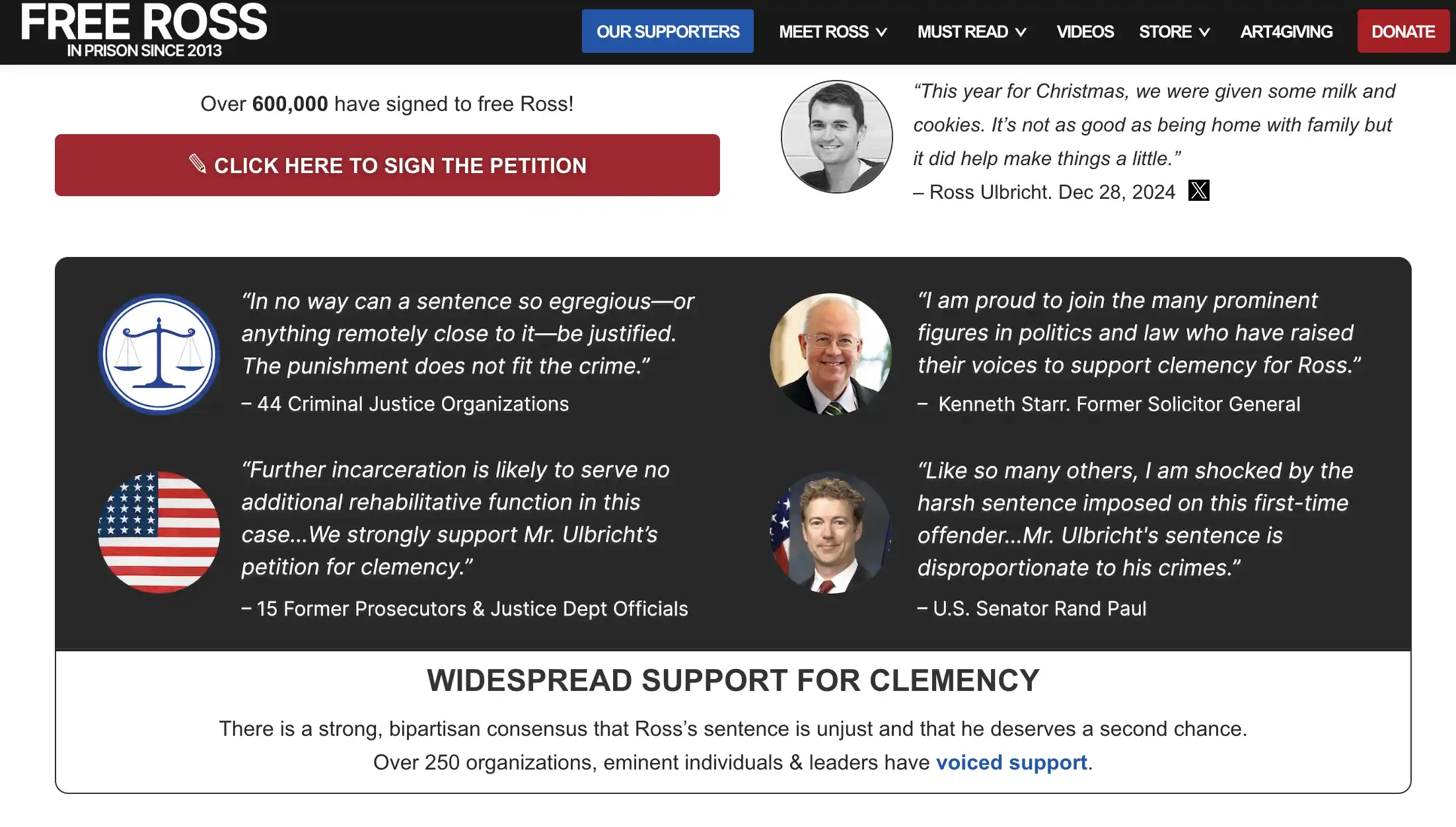
Today, as times have changed, with Trump's election odds steadily rising on Polymarket (a highly accurate blockchain prediction platform), most people believe that Ross may be granted clemency or even a pardon.
Similarly, in the PolyMarket betting topic "Who will Trump pardon within the first 100 days in office?" there is a high likelihood of Ross being pardoned, with the odds of Ross's pardon steadily increasing. For a long time, Ross's probability of being pardoned was 73%.
A double life sentence plus 40 years on top was indeed too heavy for the young man who was just 26 years old at the time of his arrest.
Now, with the price of Bitcoin at $105,247, the United States has also welcomed its first "Bitcoin" president. Ross, who has been in prison for 11 years, is now 41 years old and as he walks out of prison, he can finally smile in front of the camera with ease.

First Photo of Ross Ulbricht After Pardon Revealed, Image Source BitcoinMagazine
You may also like
Never Underestimate the Significance of the US Stablecoin 'Infrastructure Bill'
If the US stablecoin bill, the "GENIUS Act," passes smoothly this time, its significance will be tremendous. I even think it's significant enough to enter the top five in Crypto history.
Although abbreviated as the GENIUS Act, which translates directly to the Genius Act, it is actually the Guiding and Establishing National Innovation for U.S. Stablecoins, which translates to "Guiding and Establishing National Innovation for US Dollar Stablecoins."
The proposal is lengthy, with several key points summarized for everyone:
· Mandatory 1:1 Full Asset Backing: Assets include cash, demand deposits, and short-term US Treasuries. At the same time, misappropriation and rehypothecation are strictly prohibited.
· High-Frequency Disclosure: Reserve reports must be published at least monthly, introducing external audits.
· Licensing Requirement: Once the circulating market cap of the issuer's stablecoin exceeds $100 billion, it must transition into the federal regulatory system within a specified timeframe, adopting banking-grade regulation.
· Introduction of Custody: The custodian of the stablecoin and its reserve assets must be a regulated qualified financial institution.
· Clear Definition as a Payment Medium: The bill explicitly defines stablecoin as a new type of payment medium, primarily regulated by the banking regulatory system, rather than restricted by the securities or commodities regulatory system.
· Embracing Existing Stablecoins: A maximum 18-month grace period after the bill's enactment, aimed at encouraging existing stablecoin issuers (such as USDT, USDC, etc.) to promptly obtain licenses or become compliant.
After finishing the main content, let's talk about the significance of this matter with an excited heart.
Over the years, when others asked, "After working in the Crypto industry for 16 years, what application have you created?"
In the future, you can confidently tell others—Stablecoins.
Some people have held opposing views. In the past, people's impression of stablecoins was that they were an opaque black box. Every few months, there would be FUD — whether Tether's assets were frozen or Circle had a significant black hole deficit.
In fact, if you think about it, Tether easily rakes in billions of dollars a year just from the interest on those underlying government bonds. Circle, slightly less, also made a $1.7 billion profit last year.
They basically made money while standing there. From a motivational standpoint, they have no malicious intentions. In fact, they are the most eager for compliance.
Now, this opaque black box will become a transparent white box.
In the past, the only complaint was that Tether's funds might have been frozen by the United States. Now, they will be directly placed into U.S. compliant custodial institutions, with high-frequency disclosures, so you can rest assured.
【No need to worry about a rug pull】 is such a huge advantage—I think especially all Crypto people understand this.
Stablecoins were once almost on the verge of being overtaken by CBDCs. In any country, if a central bank digital currency really exists, it is highly likely not built on a blockchain, at most it is built on some internal central bank consortium chain, which to be honest, is meaningless.
When CBDCs were at their peak, that was the most dangerous time for stablecoins.
If CBDCs had become a reality back then, stablecoins today would have been relentlessly suppressed into a dark corner, and blockchain would only be able to play a minimal role.
The remaining half-dead stablecoins would even have to learn the standards of central bank digital currencies, completely relinquishing their standard-setting power.
And now, stablecoins have won (or are about to).
Instead, everyone should learn the 【Blockchain + Token】 standard.
Nowadays, many blockchains actually have no meaningful applications on top, only stablecoin transfers. For example, with Aptos, the only scenario I use Aptos for is transfers between Binance and OKX.
And now, stablecoins will be legislated, what does that mean?
That's right, blockchain will become the only standard.
In the future, every stablecoin user will be the first to learn how to use a wallet.
As an aside, I actually think Ethereum's concerted push for EIP-7702 is quite forward-thinking. While other chains are all about memes, thank you Ethereum for sticking to account abstraction.
EIP-7702 is about Account Abstraction, which can support, for example:
· Social Account Registration Wallet
· Paying GAS with Native Coin
· And more
This paves the way for future new users to heavily use stablecoins, solving the last-mile problem.
Furthermore, once stablecoins receive legislative support, deposits and withdrawals will become even easier.
Let's imagine a scenario: previously, hindered by the gray nature of stablecoins, but after the bill passes, many traditional brokerages can support stablecoins themselves. The money from a US stock investor can be converted into stablecoins in minutes and instantly deposited into Coinbase. Believe it or not.
Let's imagine another scenario: if the brilliant bill smoothly passes through the House of Representatives, next, you will see:
Due to the extremely lucrative nature of this trading, existing stablecoin leaders and newly entering traditional giants will crazily start promoting their stablecoin products.
And an outsider, due to these promotions, will start using stablecoins. And then one day, after finding out that the wallet account has been created, will explore Bitcoin inside. Is mining Bitcoin difficult?
Stablecoins are a huge Trojan horse. The moment you start using stablecoins, you unwittingly step half a foot into the Crypto world.
As a large reservoir for digesting US debt, although stablecoins cannot directly absorb debt, they at least provide ammunition for the US debt secondary market. These functions are quite important, and slowly, stablecoins are becoming a part of the US debt market's body. Therefore, once the US legislation is passed and experiences the benefits, there is no turning back.
And, we are also confident that stablecoins are indeed one of the great innovations in our industry. People who have used stablecoins will find it hard to return to the traditional cash-banking system.
Once the bill is passed, users can't go back. In the future, concerns are about to be resolved, standards will be mastered, and the era of large deposits seems to be on the horizon.
Original Article Link
MOG Coin Skyrockets as Elon Musk and Garry Tan Embrace "mog/acc" Identity
The End and Rebirth of NFTs: How the Meme Coin Craze Ended the PFP Era?
Binance Sparks "Delist Concept": Can CEX Still Produce the Next ALPACA?
On April 24, Binance announced that it would delist four tokens, including Alpaca Finance ($ALPACA), on May 2, and cease trading of these pairs' perpetual futures contracts at 00:00 on May 1, 2025, Beijing time. Fast forward to the last day of perpetual futures trading delisting, ALPACA surged on the liquidation heat map. Over the past 24 hours, a total of $52.21 million evaporated in ALPACA's contract trading, exceeding the sum of the token's liquidation volume over the past two years.
Historically, when a token is listed on Binance, many traders would buy the news instantly ("Buy the News"). As the Binance listing effect gradually waned, traders found another path, which is to short sell the tokens set to be delisted from Binance ("Sell the News"). This strategy often has a very high success rate. However, as traders followed this path, they encountered the Alpaca on their short-selling journey.
Every thrilling market manipulation game requires careful preparation. Before Binance's official announcement, on April 10, $ALPACA was ranked 7th in the preliminary list of the second batch of "Vote for Delisting" on Binance, causing its price to plummet almost by half. However, in the five days leading up to Binance's official announcement, from April 19 to April 23, trading volume suddenly surged.
The story traces back to the start of Binance's second round of "Vote for Delisting," where ALPACA was included in the delisting candidates list, ranked 7th among 17 projects. After the completion of Binance's delisting vote count, $ALPACA was included in the projects to be delisted. The market did not react significantly, price fluctuations were not substantial, but trading volumes expanded abnormally, suggesting the entry of "manipulative funds" into the community.
On April 24, Binance officially announced the delisting of the $ALPACA spot trading pair on May 2 and the settlement of the futures contracts on April 30. Following the announcement, the spot price of $ALPACA dropped from $0.0329 to $0.029, with a market cap of only about $5 million. However, what followed were two price "rollercoaster" moments; within an hour, the price surged from $0.029 to $0.0857, an increase of about 195%, only to rapidly drop back to $0.04 within 3 hours. Shorts were caught off guard, and the open interest of contracts surged rapidly, initiating the "long and short grinder" mode.
On April 25, Alpaca Finance officially announced that the trading volume in the past 24 hours had exceeded 1 billion tokens. The liquidity provider had suggested a "minting for stability" to be returned to the treasury after a decrease in trading volume. However, as public opinion began to ferment, opposition filled the community. Alpaca Finance deleted the previous tweet and posted a new one at 9 p.m. on the same night, announcing the cancellation of the minting due to community opposition.
On April 26, Binance amended the contract funding rate rules, shortening the maximum rate cap settlement period to hourly and setting it at up to ±2%. Some high-leverage accounts continued to hold short positions against the high rate and were liquidated. Millions of dollars disappeared within a few hours, with $13 million in short positions vanishing on a token with a market cap of less than $30 million.
With the establishment of this short-selling trend, the price skyrocketed nearly 12 times from a low of $0.029 to $0.3477 within 3 days. The contract's open interest surged significantly, especially with a notable increase in short positions, resembling a microcosm of the Wall Street battle of GME's retail investors. However, this time, the retail investors' opponents could continue to mint additional chips.
From April 26 to April 29, these days were relatively calm, with the price fluctuating around $0.2 to $0.34. On April 29, Binance announced another increase in the rate cap to ±4%. Theoretically, such a high rate would severely impact short positions. If the rate remains at -4%, the bears will face a 96% "cost of ruin" after holding a short position for 24 hours. However, miraculously, the price plummeted from $0.27 to $0.067.
On April 30, with the contract delisting and liquidation scheduled in the final 24 hours, the price continued to experience intense fluctuations. ALPACA's attention peaked, with its highest price reaching $1.2 at one point. From a week before the delisting announcement to the eve of the contract delisting, ALPACA's price surged 40 times, creating an independent market for the token delisted by Binance. The total liquidation volume across the network also reached $50 million, with $42 million in "bearish fuel" beneath the price surge.
After the first surge of ALPACA, Heyi, the co-founder of Binance, replied to a netizen asking, "Can the teacher who buys the shell guarantee breakeven?" This has also triggered endless speculation among community members.
KOL Tunbtc believes that Heyi's reply to this matter was the starting point of ALPACA's surge. "The large holders of Alpaca's native token, by transferring spot chips, operating rights, and distribution rights, have pledged allegiance to Binance's deep-water core interest circle, allowing it to fully harvest market liquidity before delisting, slaughtering opposing positions." Through a triple path of fees, contract liquidations, and spot volatility, they converted user attention into profits.
He also called on Binance to thoroughly investigate this matter, clarify which market maker is manipulating the candlestick patterns, as ALPACA saw an 18x surge within 24 hours with users liquidated of tens of millions of dollars, while previously GPS's 500% surge was promptly halted, and expressed his sentiment: "All of this is thought-provoking."
Wenze, the founder of Beta Capital, believes that bypassing the regular listing process, buying shells, renaming, and restarting has crossed Binance's bottom line of maintaining listing credibility and brand compliance. Binance sometimes has a high tolerance for market fluctuations, and the OM issuance only adjusts the collateralization ratio, with many projects only allowed for leveraged trading. However, once the project, such as these "shell projects," is identified, it is easily labeled for observation, triggering a vote for delisting, ultimately leading to delisting rather than using mild measures.
Renowned KOL Rui, "YeruiZhang," likened the ALPACA incident to "crazy revenge on an ex" and shared a piece of insider information, claiming that the original whale behind ALPACA was a team that controlled BSC's MEV for a period of time and expressed dissatisfaction with Binance's current management for some reason. The comments section is rampant with speculation that it is BSC's whale 48CLUB, and 48CLUB's Ian even personally appeared to eat "his own melon."
With the recent buzz around VOXEL's surge and the wealth effect and discussion surrounding ALPACA, more and more "delisting concepts" have emerged. This concept does not necessarily refer to tokens that have already been delisted but rather shares some common characteristics of delisted tokens.
Famous KOL Chuanmo recently shared on Twitter his logic for choosing concept tokens and listed several tokens, all of which experienced varying degrees of price increase after his recommendation.
His "Concept Delisting" strategy involves selecting low-cap tokens from Bybit and Binance, arranging them by market cap from lowest to highest, with almost 100% price increase for the tokens with the highest holdings/circulating market cap. He buys three tokens daily following this order with a fixed amount, and based on the holdings/circulating supply ratio, he removes tokens that no longer meet the criteria daily and continues to buy the new top three tokens.
Many community members have tested this strategy, with some creating helpful tools. The dreamer Disney "discountifu" has created a dashboard, and Vivek10 early bird "vivekw_eth" has developed a monitoring and alert system that can be directly pushed to WeChat with a copyable link, although it is currently deployed locally and not yet entirely stable.
However, when using tools created for free by community members, please be cautious. While there are many enthusiastic contributors in the community, there are also many uncertain factors in this dark forest.
In an increasingly insular market, retail investors not only have to contend with whales and other retail investors but also must bear many unstable elements. The recent ALPACA incident serves as a warning to us. Whether it's a primary or secondary listing on a top-tier exchange or the "Concept Delisting" approach, we need to make rational asset allocations amidst FOMO to protect our principal and reach the other shore.
The mention of all tokens above does not constitute financial investment advice "NFA".
RWA Evergreen Product Crisis: Why is the GLP Model Doomed to Collapse Under RWA Evergreen?
Sentient In-Depth Research Report: Secures $85 Million in Funding to Build a Decentralized AGI New Paradigm
Sui Q1 Advanced Report: The Rise of BTCfi Infrastructure, the Boom of Lending Protocols, and the Future of Rollup-Based Scalability
Monero's Market Cap Surges $1.5 Billion in One Day: Why Aren't Hackers Loving Bitcoin Anymore?
April 29th Market Key Insights, How Much Did You Miss?
PENGU Experiences Strong Rebound from Bottom with 360% Surge, How Will the Fat Penguin Leverage IP Marketing for a Comeback?
Ika Receives Strategic Investment from Sui Foundation, Total Funding Exceeds $21 Million
Switzerland Zug, April 28, 2025, Chainwire
The world's fastest parallel MPC network, Ika, is set to launch on the Sui blockchain, announces a strategic investment from the Sui Foundation. Previously, Ika successfully completed a record-breaking 1.4 million SUI NFT art event on Sui. Ika is the world's first sub-second MPC network, capable of achieving zero-trust interoperability among hundreds of signing nodes, unprecedented in scale and rock-solid security.
Ika's core values of performance, speed, and high decentralization align perfectly with Sui. With its upcoming launch on the Sui blockchain, Ika will bring its unparalleled MPC technology into the Sui ecosystem, providing Sui Move smart contract developers with secure cross-Web3 interoperability. This further solidifies Sui's position as the preferred solution in cross-chain DeFi, decentralized custody, chain abstraction, AI-agent defense, native Bitcoin programmability, leveraging the first truly scalable and secure MPC signature scheme.
Ika addresses key bottlenecks of existing MPC networks and delivers unparalleled performance through innovative 2PC-MPC encryption scheme and Sui's Mysticeti consensus protocol:
1. Record Throughput: Ika's transaction processing capability is up to 10,000 times higher than current MPC networks, supporting unprecedented transaction volumes.
2. Ultra-Low Latency: While traditional network signatures may experience delays of 30 seconds or more, Ika can generate signatures in sub-seconds, supporting cross-chain real-time applications.
3. Tremendous Scalability: Ika breaks the conventional limit of 4-8 nodes, and the 2PC-MPC can scale to hundreds or even thousands of signers, enhancing decentralization without sacrificing performance.
4. Zero-Trust Security: Ika's architecture ensures that even in the most extreme scenarios, user assets remain secure, setting a new standard for decentralized security.
Ika's ultra-fast MPC network supports various applications on the Sui blockchain, and several Sui developers have utilized Ika to build tech, including:
· DeFi Interoperability: Ika's sub-second speed and scalability enable instant secure operations within the Web3 ecosystem, bringing liquidity from chains like Bitcoin and Ethereum into Sui. Sui developers Full Sail and Rhei have announced upcoming tech launches based on Ika.
· Decentralized Custody: Ika provides a secure, decentralized custody solution for digital assets on Sui, delivering unparalleled security for both institutional and individual users. Sui developers Aeon and Human Tech have announced the integration of Ika into their technology.
· Chain Abstraction: Ika helps Sui developers abstract away multi-chain complexity for users, combining with Sui's zkLogin feature to deliver a seamless user experience. Sui developers Covault and Lucky Kat have announced the integration of Ika into their technology.
· Programmable Bitcoin: Ika unlocks new possibilities for native BTC on Sui, enabling programmable and secure DeFi and custody. Sui developers Native and Nativerse have announced the upcoming launch of Ika-based technology.
· AI Agent Protection: Ika enhances AI applications on Sui by providing secure MPC protection, ensuring AI agents do not possess unrestricted power and safeguarding user asset security. Sui developers Atoma and Ekko have announced the upcoming launch of Ika-based technology.
The strategic investment in Ika by the Sui Foundation underscores Sui's commitment to driving cutting-edge technology for high performance and decentralization. This amplifies the technical synergy within the Sui ecosystem, propelling Sui and Ika to the forefront of the Web3 revolution, jointly advancing the future of secure, scalable, decentralized infrastructure.
Ika has raised over $21 million in funding, with a peak private valuation of $6 billion FDV, backed by support from Sui Foundation, DCG, Big Brain Holdings, Blockchange, Node Capital, Amplify Partners, Liquid2 Ventures, FalconX, Tykhe Block Ventures, Lightshift, Token Bay Capital, Collider, Zero Knowledge Ventures, NoLimit Holdings, Rubik Ventures, Dispersion Capital, Insignius Capital, Impatient Ventures, Cerulean Ventures, Earl Grey Capital, HDI Ventures, Flowdesk, TPC Ventures, Purechain Capital, Solr DAO, Heroic Ventures, Naval Ravikant, NotVCs, G-20 Group, Artifact Capital, DSRV, Encapsulate, and many other key players in the Web3 space.
Ika also demonstrated the strong support of Sui users by launching the "MF Squid Market" NFT art event, which became the largest and most successful NFT event in Sui's history, raising over 1.4 million SUI and establishing an active grassroots community.
The IKA token is set to native launch on the Sui blockchain, unlocking new decentralized security features and utilities. As the native token of the Ika MPC Network, IKA will play a key role in its ultra-fast, scalable infrastructure, used for paying MPC signature services, enabling seamless transactions within the Web3 ecosystem. Leveraging Sui's unparalleled speed and performance, Ika enhances the security and scalability of the entire ecosystem, introducing the most promising MPC technology in blockchain to the fastest-growing L1 of Web3.
Ika is the world's fastest parallel MPC network, offering sub-second latency, unprecedented scale and decentralization, and zero-trust security. As the preferred choice for interoperability, decentralized custody, and chain abstraction, Ika will fundamentally transform digital asset security and multi-chain DeFi.
Sui is the first Layer 1 blockchain and smart contract platform designed from the ground up to provide fast, private, secure, and inclusive digital assets. Built on the Move programming language, its object-centric model supports parallel execution, sub-second finality, and rich on-chain assets. Through horizontally scalable processing and storage capacity, Sui supports widespread applications at low cost with unparalleled speed. Sui represents a significant advancement in blockchain technology, offering creators and developers a platform to build exceptional user experiences.
Contact:
Ika PR
pr@ika.xyz (mailto:pr@ika.xyz)
AI Track Regains Momentum, Thoroughly Reviewing Potential Projects and Market Hype Logic
Key Market Insights for April 28th, how much did you miss?
LetsBONK's market cap surpasses $30 million in just 6 hours, Raydium launches counterattack against Pumpfun
RWAiFi Summit Dubai Grand Opening Soon | GAIB, Plume, StakeStone Discuss the New Era of AI x RWA x DeFi
This Week in Review | Trump to Host Dinner for TRUMP Holders; Musk and US Treasury Secretary Engage in Heated Argument at the White House
Dialogue Backpack CEO: Everything is a Meme, Bitcoin is always the ultimate value
DCG Founder's Interview: From Bitcoin Pioneer to AI Revolution, Barry's Crypto Empire and Bittensor Vision
Never Underestimate the Significance of the US Stablecoin 'Infrastructure Bill'
If the US stablecoin bill, the "GENIUS Act," passes smoothly this time, its significance will be tremendous. I even think it's significant enough to enter the top five in Crypto history.
Although abbreviated as the GENIUS Act, which translates directly to the Genius Act, it is actually the Guiding and Establishing National Innovation for U.S. Stablecoins, which translates to "Guiding and Establishing National Innovation for US Dollar Stablecoins."
The proposal is lengthy, with several key points summarized for everyone:
· Mandatory 1:1 Full Asset Backing: Assets include cash, demand deposits, and short-term US Treasuries. At the same time, misappropriation and rehypothecation are strictly prohibited.
· High-Frequency Disclosure: Reserve reports must be published at least monthly, introducing external audits.
· Licensing Requirement: Once the circulating market cap of the issuer's stablecoin exceeds $100 billion, it must transition into the federal regulatory system within a specified timeframe, adopting banking-grade regulation.
· Introduction of Custody: The custodian of the stablecoin and its reserve assets must be a regulated qualified financial institution.
· Clear Definition as a Payment Medium: The bill explicitly defines stablecoin as a new type of payment medium, primarily regulated by the banking regulatory system, rather than restricted by the securities or commodities regulatory system.
· Embracing Existing Stablecoins: A maximum 18-month grace period after the bill's enactment, aimed at encouraging existing stablecoin issuers (such as USDT, USDC, etc.) to promptly obtain licenses or become compliant.
After finishing the main content, let's talk about the significance of this matter with an excited heart.
Over the years, when others asked, "After working in the Crypto industry for 16 years, what application have you created?"
In the future, you can confidently tell others—Stablecoins.
Some people have held opposing views. In the past, people's impression of stablecoins was that they were an opaque black box. Every few months, there would be FUD — whether Tether's assets were frozen or Circle had a significant black hole deficit.
In fact, if you think about it, Tether easily rakes in billions of dollars a year just from the interest on those underlying government bonds. Circle, slightly less, also made a $1.7 billion profit last year.
They basically made money while standing there. From a motivational standpoint, they have no malicious intentions. In fact, they are the most eager for compliance.
Now, this opaque black box will become a transparent white box.
In the past, the only complaint was that Tether's funds might have been frozen by the United States. Now, they will be directly placed into U.S. compliant custodial institutions, with high-frequency disclosures, so you can rest assured.
【No need to worry about a rug pull】 is such a huge advantage—I think especially all Crypto people understand this.
Stablecoins were once almost on the verge of being overtaken by CBDCs. In any country, if a central bank digital currency really exists, it is highly likely not built on a blockchain, at most it is built on some internal central bank consortium chain, which to be honest, is meaningless.
When CBDCs were at their peak, that was the most dangerous time for stablecoins.
If CBDCs had become a reality back then, stablecoins today would have been relentlessly suppressed into a dark corner, and blockchain would only be able to play a minimal role.
The remaining half-dead stablecoins would even have to learn the standards of central bank digital currencies, completely relinquishing their standard-setting power.
And now, stablecoins have won (or are about to).
Instead, everyone should learn the 【Blockchain + Token】 standard.
Nowadays, many blockchains actually have no meaningful applications on top, only stablecoin transfers. For example, with Aptos, the only scenario I use Aptos for is transfers between Binance and OKX.
And now, stablecoins will be legislated, what does that mean?
That's right, blockchain will become the only standard.
In the future, every stablecoin user will be the first to learn how to use a wallet.
As an aside, I actually think Ethereum's concerted push for EIP-7702 is quite forward-thinking. While other chains are all about memes, thank you Ethereum for sticking to account abstraction.
EIP-7702 is about Account Abstraction, which can support, for example:
· Social Account Registration Wallet
· Paying GAS with Native Coin
· And more
This paves the way for future new users to heavily use stablecoins, solving the last-mile problem.
Furthermore, once stablecoins receive legislative support, deposits and withdrawals will become even easier.
Let's imagine a scenario: previously, hindered by the gray nature of stablecoins, but after the bill passes, many traditional brokerages can support stablecoins themselves. The money from a US stock investor can be converted into stablecoins in minutes and instantly deposited into Coinbase. Believe it or not.
Let's imagine another scenario: if the brilliant bill smoothly passes through the House of Representatives, next, you will see:
Due to the extremely lucrative nature of this trading, existing stablecoin leaders and newly entering traditional giants will crazily start promoting their stablecoin products.
And an outsider, due to these promotions, will start using stablecoins. And then one day, after finding out that the wallet account has been created, will explore Bitcoin inside. Is mining Bitcoin difficult?
Stablecoins are a huge Trojan horse. The moment you start using stablecoins, you unwittingly step half a foot into the Crypto world.
As a large reservoir for digesting US debt, although stablecoins cannot directly absorb debt, they at least provide ammunition for the US debt secondary market. These functions are quite important, and slowly, stablecoins are becoming a part of the US debt market's body. Therefore, once the US legislation is passed and experiences the benefits, there is no turning back.
And, we are also confident that stablecoins are indeed one of the great innovations in our industry. People who have used stablecoins will find it hard to return to the traditional cash-banking system.
Once the bill is passed, users can't go back. In the future, concerns are about to be resolved, standards will be mastered, and the era of large deposits seems to be on the horizon.
Original Article Link
MOG Coin Skyrockets as Elon Musk and Garry Tan Embrace "mog/acc" Identity
The End and Rebirth of NFTs: How the Meme Coin Craze Ended the PFP Era?
Binance Sparks "Delist Concept": Can CEX Still Produce the Next ALPACA?
On April 24, Binance announced that it would delist four tokens, including Alpaca Finance ($ALPACA), on May 2, and cease trading of these pairs' perpetual futures contracts at 00:00 on May 1, 2025, Beijing time. Fast forward to the last day of perpetual futures trading delisting, ALPACA surged on the liquidation heat map. Over the past 24 hours, a total of $52.21 million evaporated in ALPACA's contract trading, exceeding the sum of the token's liquidation volume over the past two years.
Historically, when a token is listed on Binance, many traders would buy the news instantly ("Buy the News"). As the Binance listing effect gradually waned, traders found another path, which is to short sell the tokens set to be delisted from Binance ("Sell the News"). This strategy often has a very high success rate. However, as traders followed this path, they encountered the Alpaca on their short-selling journey.
Every thrilling market manipulation game requires careful preparation. Before Binance's official announcement, on April 10, $ALPACA was ranked 7th in the preliminary list of the second batch of "Vote for Delisting" on Binance, causing its price to plummet almost by half. However, in the five days leading up to Binance's official announcement, from April 19 to April 23, trading volume suddenly surged.
The story traces back to the start of Binance's second round of "Vote for Delisting," where ALPACA was included in the delisting candidates list, ranked 7th among 17 projects. After the completion of Binance's delisting vote count, $ALPACA was included in the projects to be delisted. The market did not react significantly, price fluctuations were not substantial, but trading volumes expanded abnormally, suggesting the entry of "manipulative funds" into the community.
On April 24, Binance officially announced the delisting of the $ALPACA spot trading pair on May 2 and the settlement of the futures contracts on April 30. Following the announcement, the spot price of $ALPACA dropped from $0.0329 to $0.029, with a market cap of only about $5 million. However, what followed were two price "rollercoaster" moments; within an hour, the price surged from $0.029 to $0.0857, an increase of about 195%, only to rapidly drop back to $0.04 within 3 hours. Shorts were caught off guard, and the open interest of contracts surged rapidly, initiating the "long and short grinder" mode.
On April 25, Alpaca Finance officially announced that the trading volume in the past 24 hours had exceeded 1 billion tokens. The liquidity provider had suggested a "minting for stability" to be returned to the treasury after a decrease in trading volume. However, as public opinion began to ferment, opposition filled the community. Alpaca Finance deleted the previous tweet and posted a new one at 9 p.m. on the same night, announcing the cancellation of the minting due to community opposition.
On April 26, Binance amended the contract funding rate rules, shortening the maximum rate cap settlement period to hourly and setting it at up to ±2%. Some high-leverage accounts continued to hold short positions against the high rate and were liquidated. Millions of dollars disappeared within a few hours, with $13 million in short positions vanishing on a token with a market cap of less than $30 million.
With the establishment of this short-selling trend, the price skyrocketed nearly 12 times from a low of $0.029 to $0.3477 within 3 days. The contract's open interest surged significantly, especially with a notable increase in short positions, resembling a microcosm of the Wall Street battle of GME's retail investors. However, this time, the retail investors' opponents could continue to mint additional chips.
From April 26 to April 29, these days were relatively calm, with the price fluctuating around $0.2 to $0.34. On April 29, Binance announced another increase in the rate cap to ±4%. Theoretically, such a high rate would severely impact short positions. If the rate remains at -4%, the bears will face a 96% "cost of ruin" after holding a short position for 24 hours. However, miraculously, the price plummeted from $0.27 to $0.067.
On April 30, with the contract delisting and liquidation scheduled in the final 24 hours, the price continued to experience intense fluctuations. ALPACA's attention peaked, with its highest price reaching $1.2 at one point. From a week before the delisting announcement to the eve of the contract delisting, ALPACA's price surged 40 times, creating an independent market for the token delisted by Binance. The total liquidation volume across the network also reached $50 million, with $42 million in "bearish fuel" beneath the price surge.
After the first surge of ALPACA, Heyi, the co-founder of Binance, replied to a netizen asking, "Can the teacher who buys the shell guarantee breakeven?" This has also triggered endless speculation among community members.
KOL Tunbtc believes that Heyi's reply to this matter was the starting point of ALPACA's surge. "The large holders of Alpaca's native token, by transferring spot chips, operating rights, and distribution rights, have pledged allegiance to Binance's deep-water core interest circle, allowing it to fully harvest market liquidity before delisting, slaughtering opposing positions." Through a triple path of fees, contract liquidations, and spot volatility, they converted user attention into profits.
He also called on Binance to thoroughly investigate this matter, clarify which market maker is manipulating the candlestick patterns, as ALPACA saw an 18x surge within 24 hours with users liquidated of tens of millions of dollars, while previously GPS's 500% surge was promptly halted, and expressed his sentiment: "All of this is thought-provoking."
Wenze, the founder of Beta Capital, believes that bypassing the regular listing process, buying shells, renaming, and restarting has crossed Binance's bottom line of maintaining listing credibility and brand compliance. Binance sometimes has a high tolerance for market fluctuations, and the OM issuance only adjusts the collateralization ratio, with many projects only allowed for leveraged trading. However, once the project, such as these "shell projects," is identified, it is easily labeled for observation, triggering a vote for delisting, ultimately leading to delisting rather than using mild measures.
Renowned KOL Rui, "YeruiZhang," likened the ALPACA incident to "crazy revenge on an ex" and shared a piece of insider information, claiming that the original whale behind ALPACA was a team that controlled BSC's MEV for a period of time and expressed dissatisfaction with Binance's current management for some reason. The comments section is rampant with speculation that it is BSC's whale 48CLUB, and 48CLUB's Ian even personally appeared to eat "his own melon."
With the recent buzz around VOXEL's surge and the wealth effect and discussion surrounding ALPACA, more and more "delisting concepts" have emerged. This concept does not necessarily refer to tokens that have already been delisted but rather shares some common characteristics of delisted tokens.
Famous KOL Chuanmo recently shared on Twitter his logic for choosing concept tokens and listed several tokens, all of which experienced varying degrees of price increase after his recommendation.
His "Concept Delisting" strategy involves selecting low-cap tokens from Bybit and Binance, arranging them by market cap from lowest to highest, with almost 100% price increase for the tokens with the highest holdings/circulating market cap. He buys three tokens daily following this order with a fixed amount, and based on the holdings/circulating supply ratio, he removes tokens that no longer meet the criteria daily and continues to buy the new top three tokens.
Many community members have tested this strategy, with some creating helpful tools. The dreamer Disney "discountifu" has created a dashboard, and Vivek10 early bird "vivekw_eth" has developed a monitoring and alert system that can be directly pushed to WeChat with a copyable link, although it is currently deployed locally and not yet entirely stable.
However, when using tools created for free by community members, please be cautious. While there are many enthusiastic contributors in the community, there are also many uncertain factors in this dark forest.
In an increasingly insular market, retail investors not only have to contend with whales and other retail investors but also must bear many unstable elements. The recent ALPACA incident serves as a warning to us. Whether it's a primary or secondary listing on a top-tier exchange or the "Concept Delisting" approach, we need to make rational asset allocations amidst FOMO to protect our principal and reach the other shore.
The mention of all tokens above does not constitute financial investment advice "NFA".