
On-Chain Data School (Part 6): A Brand New, Ark-Participated BTC Magical Pricing Methodology (I)

Original Title: "On-chain Data Academy (Part 6): A Brand New, Ark-Participated $BTC Magical Pricing Methodology (I)"
Original Author: Mr. Berg, On-chain Data Analyst
Cointime Price has advanced significantly compared to the previous five articles. If this is your first time reading this series of articles and you want to learn about on-chain knowledge, it is recommended to start by reading the first five articles.
Related Reading: "On-chain Data Academy (Part 5): How Many People Are Really Making Money? A Five-Minute Guide to the Objective Sentiment Index PSIP"
Reading a long article is not easy. Readers are advised to first select the content of interest based on the major headings.
If you want to directly understand the application part, you can read the second and third parts first.
TLDR
- The Cointime Price series consists of three articles, and this article is the first one.
- Introducing the basic principles and buy-the-dip application of Cointime Price
- Cointime Price is a new and efficient $BTC pricing method
- It is stricter than Realized Price and more sensitive than LTH-RP
1. Introduction to Cointime Price
The concept of Cointime Price originated on August 23, 2023, proposed by "Cointime Economics," a collaboration between Ark Invest and Glassnode.
The calculation logic of Cointime Price is relatively complex, and this article will try to explain the principle in a simple and clear manner.
Cointime Price = Pricing Model Designed for the Unique UTXO Structure of $BTC
In traditional pricing methods, when BTC, as a blockchain network, is involved in block creation or transaction transfers, it goes through a validation process. However, Cointime Price differs from traditional pricing methods by using a "time-weighted" calculation approach.
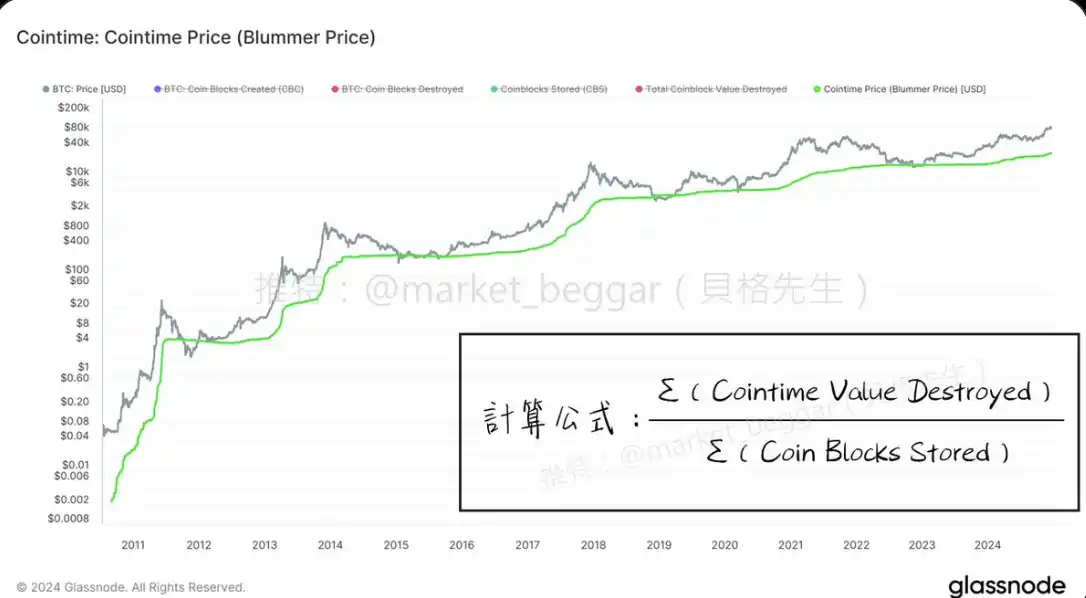
Cointime Price Calculation Logic (as shown in Figure 2, where the green line represents Cointime Price)
The Cointime Price calculation involves three key concepts:
· Coin Blocks Created (CBC):
CBC = The total circulating BTC supply when Block N is generated.
· Coin Blocks Destroyed (CBD):
When BTC is transferred, it is considered destroyed. The calculation is as follows: Transferred BTC amount × Holding time (number of blocks elapsed). This yields CBD (time-weighted BTC amount).
· Coin Blocks Stored (CBS):
CBS = CBC - CBD, which can be understood as the "total time-weighted BTC amount unspent."
In the formula calculation, the numerator's Cointime Value Destroyed is obtained by multiplying CBD by the BTC price at the time of transfer, resulting in the "BTC spent U-value at the time of transaction."
· Key Features of Cointime Price
· Time-weighted design: When long-term holders transfer large amounts of BTC (distribute), the Cointime Price change rate will accelerate.
· Buyer's perspective analysis: The numerator in the formula represents the "total time-weighted spending amount" in the market. Dividing it by CBS yields the market's time-weighted average cost of chips.
· Excluding lost chip impact: Since CBD calculates transfer behavior, BTC that has not been transferred is not counted, so it is not affected by ancient lost BTC.
II. Comparison with LTH-RP
In a previous article, I introduced LTH-RP (Long-Term Holder's Average Holding Cost). Readers interested in this topic can refer to the following post: [Introduction to LTH-RP](https://x.com/market_beggar/status/1864600434129948724)
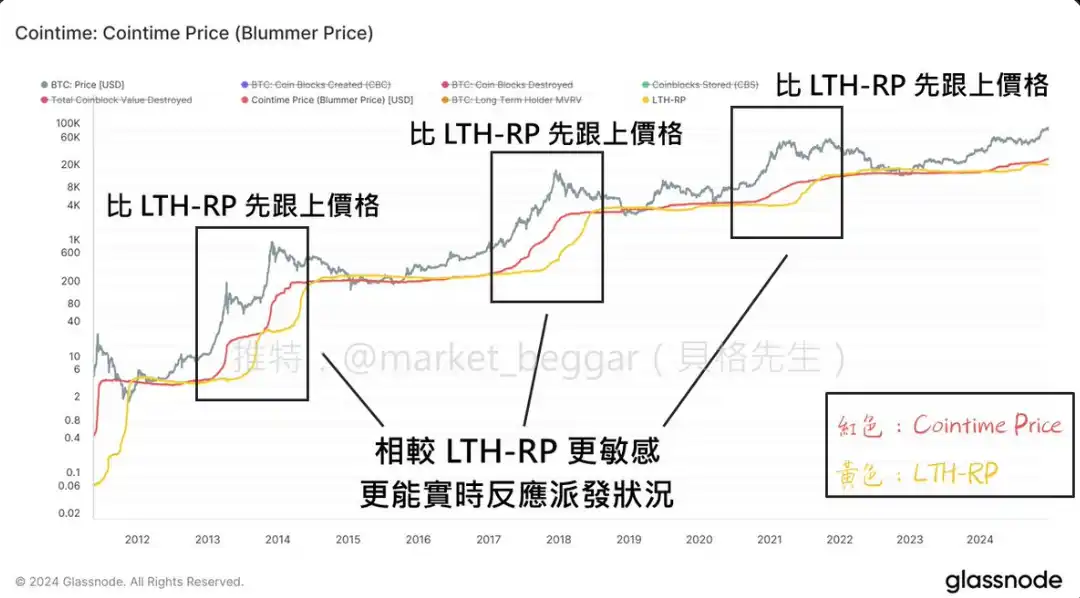
LTH-RP vs. Cointime Price
· Calculation Method of LTH-RP:
- Glassnode defines LTH as BTC held for>155 days
- LTH-RP = Average cost of these LTH BTC
- Limitation: Only for long-term holders, relatively rough definition.
· Calculation Method of Cointime Price:
- Considers the holding time each time BTC is transferred
- More precise and sensitive than LTH-RP
Performance of Cointime Price vs. LTH-RP in Market Trends
As shown in Chart Three, before each market uptrend, Cointime Price always reacts earlier than LTH-RP, better reflecting the real-time occurrence of supply distribution behavior.
Therefore, in my personal analysis, I tend to use Cointime Price for market judgment. The peak model I designed in my weekly market report also includes the Cointime Price indicator.
Application One: Bottom Fishing
Cointime Price = Time-weighted fair valuation of BTC, so when the market price falls below the Cointime Price, it means the market price is below the true value of BTC, usually a good bottom fishing opportunity.
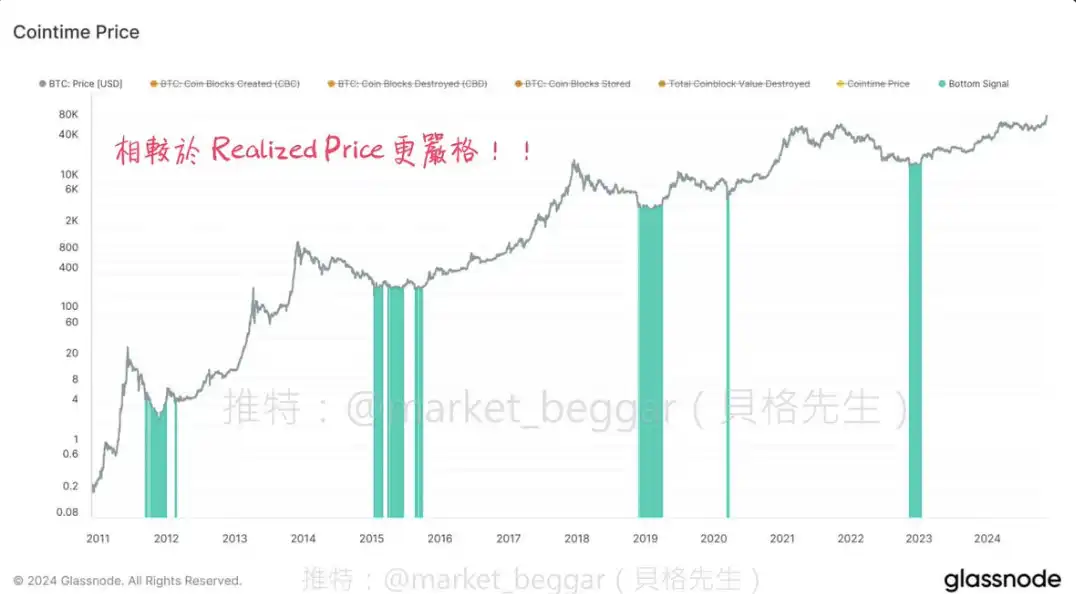
· Historical Data Validation
As shown in Chart Four, I marked the times when the BTC price was below the Cointime Price, and these moments were often good entry points.
Conclusion
This article is the first in the Cointime Price series, introducing the basic concept of Cointime Price and its bottom fishing application.
The next two articles will focus on the application of Cointime Price in Rug Pull scenarios, stay tuned
You may also like

Will MicroStrategy fall into a death spiral? What will the macro trend be in the second half of the year?

Blockchain Capital Partner: The Core Secret of Arbitrage

STRC unanchored by 11%, can the perpetual motion machine of Strategy still operate?

Bitcoin Market Analysis 2026: Can BTC Reach $150K by Year-End?

Bitcoin ETF Outflows Hit a Record $4.4 Billion: What Are Traders Doing With Their Cash?

WEEX App Just Got Smarter – New Tabs for Faster Trades & Easy Asset Management

WEEX All-New Search Features: Find, Trade & Earn Faster Than Ever

Morning Report | Illinois signs the strictest digital asset tax law in the U.S.; RWA tokenization market size surpasses $43 billion, institutions accelerate the migration of on-chain assets

Full version of the debut Q&A! Federal Reserve Chairman Waller: Sticking to the 2% inflation target, establishing five special working groups, individual did not submit the dot plot

From Disruptor to Shadow Market: The Crypto Market is Becoming a Colony of Traditional Finance
Dalio's important long article: How to position in the current market environment?
OKX Star analyzes Binance's competitive advantages: when regulation levels the playing field, competition has just begun

New gameplay for participating in initial offerings on cryptocurrency exchanges
Why Is Bitcoin Down Today? What the Hawkish FOMC Means for SpaceX, Gold and Nasdaq

DeepSeek Financing Story

Morning Report | DeepSeek completes over $7 billion in financing, with a valuation exceeding $50 billion; Musk's personal wealth has surpassed the total market value of Bitcoin

Cursor, why did you get on Musk's spaceship?
In the name of charity, for the benefit of the family: How the Trump family turned charity into profit?
Will MicroStrategy fall into a death spiral? What will the macro trend be in the second half of the year?
Blockchain Capital Partner: The Core Secret of Arbitrage
STRC unanchored by 11%, can the perpetual motion machine of Strategy still operate?
Bitcoin Market Analysis 2026: Can BTC Reach $150K by Year-End?
Bitcoin ETF Outflows Hit a Record $4.4 Billion: What Are Traders Doing With Their Cash?
WEEX App Just Got Smarter – New Tabs for Faster Trades & Easy Asset Management


