
On-Chain Data Analysis: When Will the Next Season of Altcoins Begin?

Original Author: Murphy, On-chain Data Analyst
On-chain Data Evaluation Model - Altseason
One day while I was in class, Xiaochi from @FC_0X0 sent me a message on WeChat saying, "There is a piece of data that shows the scissor difference between the total stablecoin inflow into exchanges and the USD value of withdrawn BTC, indicating the remaining potential buying power and the volatility of altcoins may have a direct relationship. Can we use this logic to explore the timing of altcoin seasons?"
Coincidentally, my lecture also mentioned observing data on the potential conditions of "capital outflow," which aligned with certain high-market-cap altcoins' launch timeframes. However, at that time, it was just a rough outline, vaguely hinting at some overlooked areas...
When I returned, I organized the data and, inspired by Xiaochi's idea, reconsidered a set of visual indicators that can effectively assess the "Altseason." Here, I share my train of thought:
Altseason Condition 1: Capital Outflow Evaluation
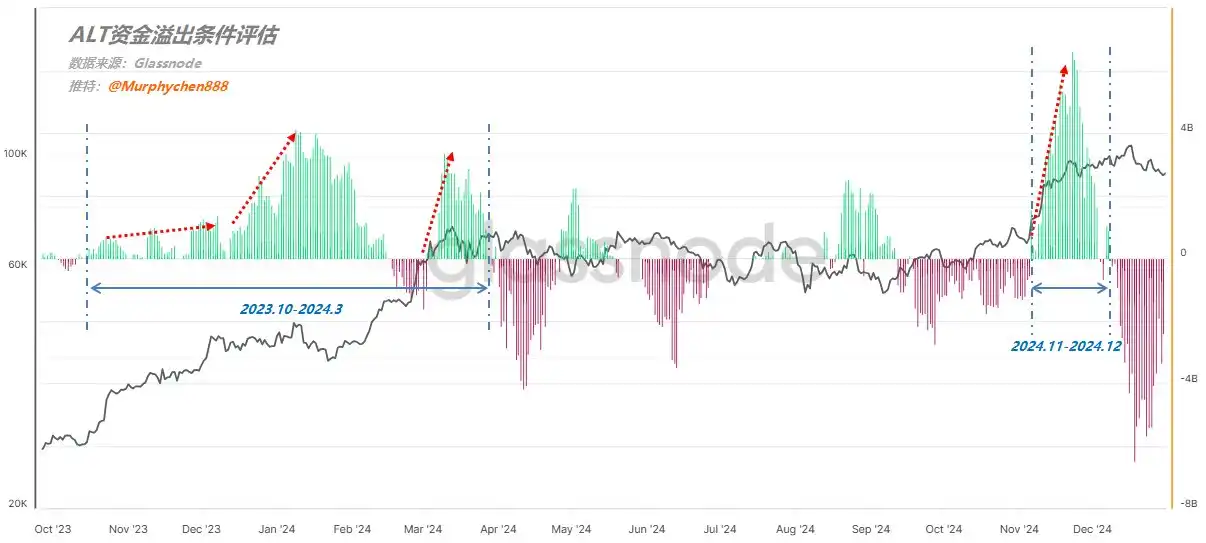
(Chart 1)
In Chart 1, the green color indicates whether the total stablecoin inflow into exchanges in the last 30 days is greater than the USD value of BTC withdrawn from exchanges. If it is, it means that, besides buying BTC, there is also a possibility of outflow into altcoins. The higher the green signal bar, the greater the theoretical outflow value, indicating a stronger prerequisite for the Altseason initiation.
From the data perspective, during the periods of 2023.10-2024.3 and 2024.11-2024.12, the theoretical outflow value was the highest, implying a higher likelihood of the Altseason occurring during these two periods. Additionally, there was a brief period between August and September, but in terms of both scale and duration, it was not as strong as the two aforementioned periods, making its influence relatively weaker.
Altseason Condition 2: Inflow of Mainstream Assets
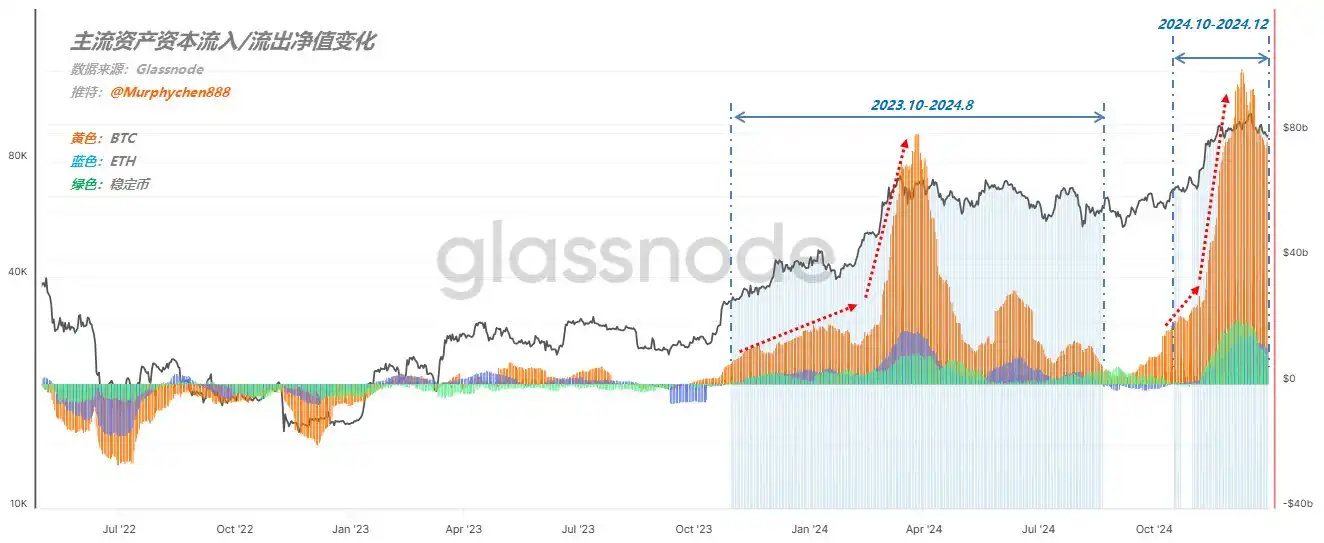
(Chart 2)
Historically, BTC often leads the overall sentiment of the crypto market, followed by market confidence flowing into other high-market-cap mainstream coins before further tilting towards alts. Visualizing this capital rotation involves using the 30-day change in realized market cap of BTC and ETH, along with the total supply of stablecoins (as shown in Chart 2). When all three major mainstream assets experience net capital inflows, it signals that the market sentiment is becoming exuberant, overall risk appetite is rising, which is also one of the macro necessary conditions to kickstart the Altseason.
From the data, it can be seen that during the periods of 2023.10-2024.8 and 2024.10-2024.12, all three major mainstream assets experienced net capital inflows, peaking in March 2024 and December 2024. This is also the most FOMO moment in market sentiment so far in this cycle.
Altcoin Season Indicator 3: Positive Momentum in Altcoin Market Cap Disparity
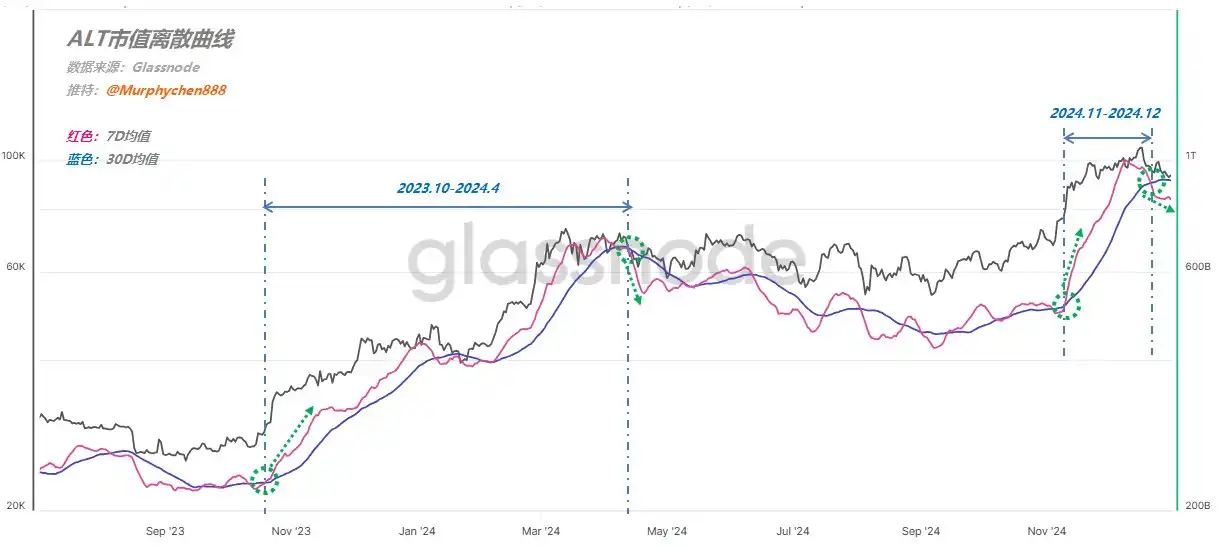
(Figure 3)
The third condition required to determine the start of the altcoin season is the isolation of positive momentum in the disparity of altcoin total market capitalization. We need to identify time periods within the altcoin space where the 7D SMA of total valuation is greater than the 30D SMA of total valuation. Because this can represent an amplification of altcoin valuation in the short term, and liquidity flowing into altcoins is rapidly increasing.
In Figure 3, the red line represents the 7D average, and the blue line represents the 30D average; from the data, during the periods of 2023.10-2024.4 and 2024.11-2024.12, the red line crossed above the blue line, indicating that liquidity in the crypto space is starting to tilt towards altcoins, and altcoin market cap is shifting towards positive momentum growth.
Summary
These three conditions are considered from different perspectives: Condition 1 represents the potential for capital overflow; Condition 2 represents overall sentiment and risk appetite; Condition 3 represents liquidity skew. When all three conditions are met simultaneously, it is highly likely that the altcoin season is approaching.
The current Condition 2 is met, but Conditions 1 and 3 are not; therefore, we can consider that the foundation for the altcoin season is there, but liquidity is still concentrated in mainstream assets (especially BTC), and on-chain funds have not overflowed significantly into altcoins.
However, we can also see that the "negative overflow" in Condition 1 is gradually diminishing, which is a positive signal. Although altcoin season anticipation may require some more patience, what is supposed to happen will happen.
The content shared in this article is for communication and research purposes only and should not be considered as investment advice.
You may also like

New York Proposes Stricter Stablecoin Issuer Rules Aligned With Federal GENIUS Act
NYDFS proposed stricter stablecoin issuer rules aligned with the GENIUS Act, covering reserves, custody, redemption timelines, audits, and capital buffers.

Every exchange is a "Universal Exchange."

The counterattack of traditional finance: Alliance chains are quietly reviving

CryptoQuant Says Bitcoin Profitable Supply Is Near 45% Pressure Zone as On-Chain Data Points to Market Repricing
CryptoQuant said Bitcoin’s profitable supply is nearing the 45% pressure zone, signaling rising market stress, unrealized losses, and a possible on-chain repricing phase.

Bitcoin Falls Below 200-Week Moving Average as On-Chain Data Shows Over Half of Supply in Loss
Bitcoin dropped below its 200-week moving average as on-chain data showed over 50% of circulating supply is now in loss, signaling rising market stress.

CFTC Reportedly Plans New Prediction Market Rules Focused on Manipulation Risk and Public Interest Review
The CFTC is reportedly preparing new prediction market rules focused on manipulation risk, public interest review, and retail trader protections.

Meet the new WEEX trial fund—your gateway to greater profits

WEEX Labs Lands at Dutch Blockchain Week: A Disruptive Crypto × AI Conversation Sets Sail in Amsterdam

SK Hynix Reportedly Plans U.S. ADR Listing as Early as August, With SEC Approval Possible in Late June
SK Hynix may pursue a U.S. ADR listing as early as August, with SEC approval reportedly possible in late June amid strong AI chip supply chain demand.

SpaceX vs Tesla vs xAI: Which Elon Musk Trade Has the Biggest Upside in 2026?
OpenAI Reveals It Has Confidentially Submitted an S-1 to the SEC, Keeping the Door Open for a Future IPO
On June 9, according to an OpenAI announcement, the company recently confidentially submitted a draft S-1 registration statement to the U.S. Securities and Exchange Commission (SEC), beginning the preliminary compliance process for a potential initial public offering. OpenAI said it chose to disclose this proactively because it expected the news might leak; however, the company has not yet set a specific listing timeline, and related arrangements may still take some time.

Latest research from 13 top universities including Cornell University: The current state, challenges, and misconceptions of the fusion of Crypto and AI
Deconstructing Anthropic: The Best AI Company, Possibly Also a Type of Organizational Invention
Apollo and Blackstone Reportedly Back $35 Billion Anthropic Chip Financing as Deal Details Remain Unclear
On June 9, according to currently available news alerts, Apollo and Blackstone Group participated in a $35 billion financing for an Anthropic “chip project.” Based on the original wording of the report, the funding has already been raised, but public information remains limited. The financing structure, use of proceeds, project entity, and whether Apollo and Blackstone participated through equity, debt, or project financing have not yet been disclosed.

Humanity Protocol Security Incident Escalates: More Than $31 Million Stolen From Related Addresses as Attacker Continues Selling H for ETH
On June 9, according to monitoring by Onchain Lens, more than $31 million has been stolen from addresses linked to Humanity Protocol, and the attack is still ongoing, with the hacker continuously swapping H tokens for ETH. Project founder Terence Kwok later confirmed the security incident on X, saying the issue involved a private key leak.

Bloomberg: As Bitcoin Weakens, Stablecoins and RWA Continue to Drive Expansion in Crypto Businesses
In June, Bloomberg reported that despite Bitcoin falling below $60,000 last week, wiping out about $235 billion in market value within seven days, and dropping close to 50% from last year’s peak, some core businesses in the crypto industry are still expanding, mainly in stablecoins, real-world asset tokenization (RWA), payments, and infrastructure. The report also noted that overall altcoin activity has contracted significantly: altcoin market capitalization has fallen from a peak of about $431 billion in November 2021 to around $170 billion, and among the tens of millions of tokens issued in recent years, fewer than 1,700 still maintain meaningful trading activity.

Galaxy Deep Research Report: How Hyperliquid's HIP-4 Upgrade Changes the Landscape of Prediction Markets?
Binance Research: RWA Market Expected to Expand Nearly 6x from Early 2025, with Public Equities and Onchain Payments Heating Up Together
In June, Binance Research said in its monthly market report that the real-world asset (RWA) market is expected to grow by about 589% from the beginning of 2025. Bond- and money market fund-related RWA expanded by about $6.5 billion, up 83% year over year, while publicly traded equity RWAs grew by about 422%. The report also noted that monthly crypto debit card transaction volume exceeded $747 million in May, up 48.6% year to date.
New York Proposes Stricter Stablecoin Issuer Rules Aligned With Federal GENIUS Act
NYDFS proposed stricter stablecoin issuer rules aligned with the GENIUS Act, covering reserves, custody, redemption timelines, audits, and capital buffers.
Every exchange is a "Universal Exchange."
The counterattack of traditional finance: Alliance chains are quietly reviving
CryptoQuant Says Bitcoin Profitable Supply Is Near 45% Pressure Zone as On-Chain Data Points to Market Repricing
CryptoQuant said Bitcoin’s profitable supply is nearing the 45% pressure zone, signaling rising market stress, unrealized losses, and a possible on-chain repricing phase.
Bitcoin Falls Below 200-Week Moving Average as On-Chain Data Shows Over Half of Supply in Loss
Bitcoin dropped below its 200-week moving average as on-chain data showed over 50% of circulating supply is now in loss, signaling rising market stress.
CFTC Reportedly Plans New Prediction Market Rules Focused on Manipulation Risk and Public Interest Review
The CFTC is reportedly preparing new prediction market rules focused on manipulation risk, public interest review, and retail trader protections.


