
**Military Lockdown Shakes Up South Korean Crypto Market: $33 Billion Sell-Off Wave and Native Project Exoduses**


Original Article Title: Martial law in South Korea and the crypto market outlook
Original Source: Tiger Research Reports
Original Translation: Deep Tide TechFlow
Key Points Summary:
· Market Volatility: The announcement of martial law triggered a massive sell-off on South Korean cryptocurrency exchanges, with a total sell-off amounting to around 33.3 billion USD. The price of Bitcoin dropped to 62,300 USD, with the local market recording the highest trading volume globally at one point.
· Investor Exodus: Due to price fluctuations and system failures in local exchanges, South Korean investors are expected to pivot to overseas exchanges and DeFi platforms.
· Industry Contraction: Political instability is prompting South Korean blockchain projects to move overseas. Key legislation, such as the Virtual Asset User Protection Law, may be delayed as a result.
1. Introduction

Source: Yonhap News
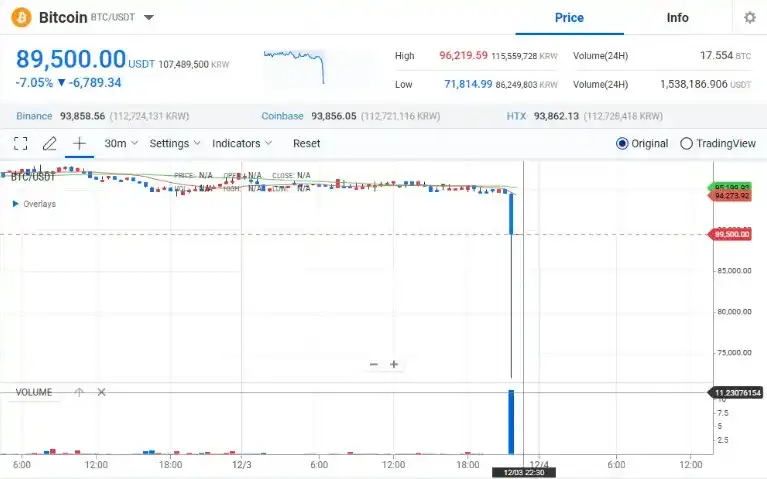
Last night, President Yoon Suk-yet suddenly announced and lifted martial law, causing a shock to South Korea's cryptocurrency market. Bitcoin's price on South Korea's largest exchange Upbit dropped to 62.3K USD. Upbit and Bithumb, the two major South Korean exchanges, saw 24-hour trading volumes of 26.9 billion USD and 6.4 billion USD, respectively, reaching their highest levels this year. This reflects the large-scale sell-off by South Korean investors following the declaration of martial law. During this period, South Korean exchanges briefly became the highest-volume market globally, highlighting the extreme volatility of its market.
2. Decline in Trust in the Won Assets and Rise in Cryptocurrency Demand

The martial law event severely eroded trust in won-denominated assets. With foreign capital exiting, the stock and bond markets may become even more volatile. As a result, investors are gradually shifting their focus to decentralized assets such as cryptocurrency.
Against the backdrop of rising geopolitical risks, investors are turning to cryptocurrency to protect their assets. Major cryptocurrencies like Bitcoin are garnering attention for being beyond government control. In past crises such as the Hong Kong protests and the Russia-Ukraine conflict, cryptocurrency has been seen as a safe-haven asset.
3. The Double-Edged Sword of Stringent Regulation and the Acceleration of Exchange Exodus
South Korean cryptocurrency exchanges maintain high security through strict travel rules and KYC regulations. The enactment of designated financial transaction information reporting and usage laws has strengthened anti-money laundering (AML) measures and enhanced investor protection. These efforts have positioned South Korea as a leader in regulatory compliance.
Source: Upbit
However, the market crash revealed the double-edged sword effect of stringent regulation. The strict rules have sustained a Kimchi Premium, widened the price gap with global markets, and made it difficult for investors to make rational decisions.
The significant price fluctuations and system instability of local exchanges have eroded investor trust. With overnight trading volumes reaching $33.3 billion, servers of Upbit and Bithumb experienced crashes. Unlike overseas exchanges, this instability has made local exchanges appear unreliable.
These issues are expected to accelerate South Korean investors' shift to overseas exchanges and DeFi platforms. Binance and Coinbase provide a stable trading environment and diverse financial products, making them the preferred choice for South Korean investors.
4. Acceleration of South Korean Blockchain Project Exodus
Due to political instability, the investment environment for South Korean blockchain projects has been affected. Many large projects have already moved overseas, and this trend is expected to continue. Nexon's blockchain division Nexpace has relocated to Abu Dhabi, Klaytn and LINE Finschia's Kaia Foundation have moved to Singapore, and Wemade's Wemix has shifted to Dubai. These companies have chosen blockchain-friendly countries to avoid South Korea's regulatory uncertainty and political risk. More projects are expected to move to Singapore and the UAE, where regulations remain clear and stable.
The overseas migration of blockchain startups has raised concerns about talent drain. This trend could weaken South Korea's competitiveness in the blockchain field. Against the backdrop of rapid development in Web3 and blockchain technology, talent outflow may have a long-term negative impact on South Korea's technological advantage. This brain drain has intensified the industry's sense of crisis.
Furthermore, the impeachment issue may delay the progress of key legislation. Laws such as the Virtual Asset User Protection Act currently being discussed in the National Assembly may face delays. These delays could further hinder the institutionalization process of South Korea's cryptocurrency market.
5. Conclusion
The martial law incident exposed structural weaknesses in the South Korean cryptocurrency market. Overnight, $333 billion in value vanished from sight, with major exchanges’ servers crippled. The market experienced extreme price volatility, with significant price discrepancies compared to global exchanges. These events underscored political risks in the market and the fragility of the current trading system under pressure.
In the short term, market instability is expected to persist. However, with appropriate institutional improvements and system enhancements, this crisis could also serve as a turning point. These efforts will help strengthen the stability of the South Korean cryptocurrency ecosystem and drive its globalization. The future trajectory is worth close monitoring.
You may also like

Pantera Capital Partner: How Tokenization is Restructuring the Private Equity and Early Investment Ecosystem?

New York Proposes Stricter Stablecoin Issuer Rules Aligned With Federal GENIUS Act
NYDFS proposed stricter stablecoin issuer rules aligned with the GENIUS Act, covering reserves, custody, redemption timelines, audits, and capital buffers.
Every exchange is a "Universal Exchange."

The counterattack of traditional finance: Alliance chains are quietly reviving

CryptoQuant Says Bitcoin Profitable Supply Is Near 45% Pressure Zone as On-Chain Data Points to Market Repricing
CryptoQuant said Bitcoin’s profitable supply is nearing the 45% pressure zone, signaling rising market stress, unrealized losses, and a possible on-chain repricing phase.

Bitcoin Falls Below 200-Week Moving Average as On-Chain Data Shows Over Half of Supply in Loss
Bitcoin dropped below its 200-week moving average as on-chain data showed over 50% of circulating supply is now in loss, signaling rising market stress.

CFTC Reportedly Plans New Prediction Market Rules Focused on Manipulation Risk and Public Interest Review
The CFTC is reportedly preparing new prediction market rules focused on manipulation risk, public interest review, and retail trader protections.

Meet the new WEEX trial fund—your gateway to greater profits

WEEX Labs Lands at Dutch Blockchain Week: A Disruptive Crypto × AI Conversation Sets Sail in Amsterdam

SK Hynix Reportedly Plans U.S. ADR Listing as Early as August, With SEC Approval Possible in Late June
SK Hynix may pursue a U.S. ADR listing as early as August, with SEC approval reportedly possible in late June amid strong AI chip supply chain demand.

SpaceX vs Tesla vs xAI: Which Elon Musk Trade Has the Biggest Upside in 2026?
OpenAI Reveals It Has Confidentially Submitted an S-1 to the SEC, Keeping the Door Open for a Future IPO
On June 9, according to an OpenAI announcement, the company recently confidentially submitted a draft S-1 registration statement to the U.S. Securities and Exchange Commission (SEC), beginning the preliminary compliance process for a potential initial public offering. OpenAI said it chose to disclose this proactively because it expected the news might leak; however, the company has not yet set a specific listing timeline, and related arrangements may still take some time.

Latest research from 13 top universities including Cornell University: The current state, challenges, and misconceptions of the fusion of Crypto and AI
Deconstructing Anthropic: The Best AI Company, Possibly Also a Type of Organizational Invention
Apollo and Blackstone Reportedly Back $35 Billion Anthropic Chip Financing as Deal Details Remain Unclear
On June 9, according to currently available news alerts, Apollo and Blackstone Group participated in a $35 billion financing for an Anthropic “chip project.” Based on the original wording of the report, the funding has already been raised, but public information remains limited. The financing structure, use of proceeds, project entity, and whether Apollo and Blackstone participated through equity, debt, or project financing have not yet been disclosed.

Humanity Protocol Security Incident Escalates: More Than $31 Million Stolen From Related Addresses as Attacker Continues Selling H for ETH
On June 9, according to monitoring by Onchain Lens, more than $31 million has been stolen from addresses linked to Humanity Protocol, and the attack is still ongoing, with the hacker continuously swapping H tokens for ETH. Project founder Terence Kwok later confirmed the security incident on X, saying the issue involved a private key leak.

Bloomberg: As Bitcoin Weakens, Stablecoins and RWA Continue to Drive Expansion in Crypto Businesses
In June, Bloomberg reported that despite Bitcoin falling below $60,000 last week, wiping out about $235 billion in market value within seven days, and dropping close to 50% from last year’s peak, some core businesses in the crypto industry are still expanding, mainly in stablecoins, real-world asset tokenization (RWA), payments, and infrastructure. The report also noted that overall altcoin activity has contracted significantly: altcoin market capitalization has fallen from a peak of about $431 billion in November 2021 to around $170 billion, and among the tens of millions of tokens issued in recent years, fewer than 1,700 still maintain meaningful trading activity.

Galaxy Deep Research Report: How Hyperliquid's HIP-4 Upgrade Changes the Landscape of Prediction Markets?
Pantera Capital Partner: How Tokenization is Restructuring the Private Equity and Early Investment Ecosystem?
New York Proposes Stricter Stablecoin Issuer Rules Aligned With Federal GENIUS Act
NYDFS proposed stricter stablecoin issuer rules aligned with the GENIUS Act, covering reserves, custody, redemption timelines, audits, and capital buffers.
Every exchange is a "Universal Exchange."
The counterattack of traditional finance: Alliance chains are quietly reviving
CryptoQuant Says Bitcoin Profitable Supply Is Near 45% Pressure Zone as On-Chain Data Points to Market Repricing
CryptoQuant said Bitcoin’s profitable supply is nearing the 45% pressure zone, signaling rising market stress, unrealized losses, and a possible on-chain repricing phase.
Bitcoin Falls Below 200-Week Moving Average as On-Chain Data Shows Over Half of Supply in Loss
Bitcoin dropped below its 200-week moving average as on-chain data showed over 50% of circulating supply is now in loss, signaling rising market stress.


