
Megaeth Public Sale, an Airdropless Renaissance


Source: Namik (Megaeth CSO)
We have built a non-consensus blockchain (this is a pun). On one hand, it pursues high performance by abandoning the old-fashioned broadcast for achieving consensus, and on the other hand, it takes a non-mainstream high-performance route in the mainstream narrative.
The block production concentration in Megaeth combined with maximal decentralized validation has thus upheld the blockchain's fundamental principles in the face of extreme speed. Our architecture is closely linked to Ethereum, and our name also includes the word ETH. Frankly, if Ethereum loses its decentralization or its token price goes to zero, our story will end.
These choices stem from objective physical laws. Our guiding star is to solve the high-performance problem rather than to build a sci-fi novel for endless sales pitches.
Megaeth is the sole architecture building all cryptographic high-speed transactions, often referred to as the Endgame. We refuse to compromise, and we extend the same principles to the business aspect.
So, how do you truly build an excellent blockchain?
We need two things:
· Founder: A founder with unwavering belief and perseverance, capable of building a groundbreaking application.
· Users: A user base that helps iterate, validate, and scale the application.
The old playbook was simple: raise a large sum of money from tier-one VCs, conduct an airdrop, and label it as "community-owned." Post "community-owned," pitch the number of on-chain users to app developers, eventually leading to selling air to centralized exchanges. Meaningless testnet interactions make it impossible to accurately measure the value these users bring, and worse, it only attracts speculators, not true evangelists.
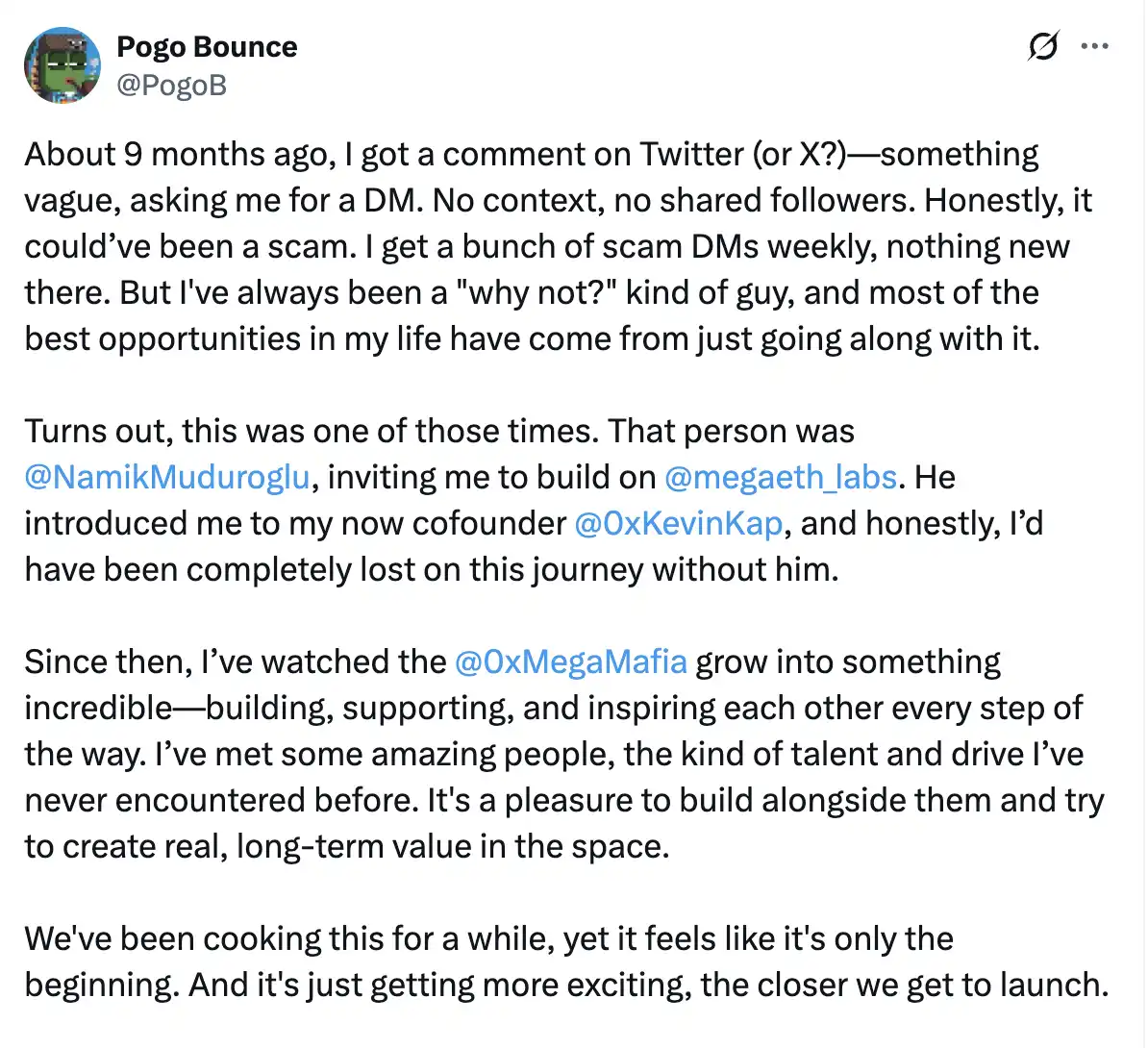
We chose a different path, rolled up sleeves, took our farming tools, and went to the grassroots. We directly DM elite developers on Twitter, seek out underestimated founders who aspire to build unconstrainedly and launch a proud suite of applications. Interestingly, many founders in the Megaeth ecosystem embarked on their entrepreneurial journey starting from our proactive DMs.
These teams have raised over $75 million in funds in new categories such as attention markets (e.g., Mindshare of transactions) and click trades (Euphoria of Tap to Trade).
Following in Ethereum's footsteps, we may be the only blockchain application whose funding surpassed that of the chain itself (up until this public sale). In fact, we might even be the only one to have bought back investor shares before the TGE.
The second goal is to build a "community"
Frankly, this is a term that I didn't really believe in before the project launched. "Community" lacks a prefix: investors. The original Ethereum community was just an investor community. The local Ethereum communities in London, Istanbul, and Milan were all started by ICO participants, not millions of airdrop hunters.
Therefore, we took a very old-school approach to fundraising to make it equal for everyone. We didn't fundraise at a high valuation but focused on achieving equal access through stakeholder alignment:
Echo Sale: Selling 5% of the stake on Echo under the same conditions as Vitalik, Cobie, and Joe. Yes, you and the crypto heavyweights are on the same starting line because everyone is part of the investor community.
Fluffles NFT: No KYC required, while maintaining anti-money laundering standards. Based on on-chain activity, we identified 5,000 Onchain Degen for targeted invite-only investment.
As we prepare to launch the mainnet, the public sale is about to begin. Another collaboration with Cobie's team will make the investor community the largest single shareholder in the MegaETH network. Worth noting, it will have a larger share than even venture capitalists and the team.
After the mainnet launch, we will provide additional tokens to everyone who participated in the public sale, even if their final purchase did not receive a share allocation.
Original Article Link
This article is a contributed submission and does not represent the views of BlockBeats.
You may also like

Morning Report | OpenAI has submitted an S-1 registration statement draft to the U.S. SEC; Morpho completes $175 million financing

Galaxy Deep Research Report: How Hyperliquid's HIP-4 Upgrade Changes the Landscape of Prediction Markets?

Latest research from 13 top universities including Cornell University: The current state, challenges, and misconceptions of the fusion of Crypto and AI

Deconstructing Anthropic: The Best AI Company, Possibly Also a Type of Organizational Invention

Every exchange is a "Universal Exchange."

The counterattack of traditional finance: Alliance chains are quietly reviving
Pantera Capital Partner: How Tokenization is Restructuring the Private Equity and Early Investment Ecosystem?

Mastercard Launches Agent Pay for AI, Plans to Record AI Agent Payment Authorizations on Polygon
Mastercard launched Agent Pay for AI, a new payment protocol designed to help AI agents make small payments such as pay-per-use access to data and APIs. The system plans to record human-granted AI agent permissions on Polygon, focusing on verifiable authorization, identity, and payment controls.

Curve Deploys Llamalend v2 on Optimism With 250,000 OP Incentives
Curve launched Llamalend v2 on Optimism with 250,000 OP incentives from the Optimism Foundation. The upgrade expands Llamalend beyond its earlier crvUSD-focused model, adding broader collateral support, LlamaRisk market reviews, and the ability to use Curve LP tokens as collateral.

Raydium Old Liquidity Pool Reportedly Exploited, With $1.34 Million Moved to Ethereum and Tornado Cash
An old Raydium liquidity pool was reportedly exploited for around $1.34 million in USDC, RAY, and wSOL, with the stolen funds bridged to Ethereum and deposited into Tornado Cash. The incident highlights the tail risks of legacy DeFi pools, old contracts, and cross-chain fund laundering paths.
Kalshi Executive Challenges “SBF Backed AI Unicorns” Narrative, Says Leopold Aschenbrenner Was Key Figure
Kalshi executive John Wang questioned the “SBF backed AI unicorns” narrative, saying Leopold Aschenbrenner was the key figure behind major AI investment decisions.

New York Proposes Stricter Stablecoin Issuer Rules Aligned With Federal GENIUS Act
NYDFS proposed stricter stablecoin issuer rules aligned with the GENIUS Act, covering reserves, custody, redemption timelines, audits, and capital buffers.

CryptoQuant Says Bitcoin Profitable Supply Is Near 45% Pressure Zone as On-Chain Data Points to Market Repricing
CryptoQuant said Bitcoin’s profitable supply is nearing the 45% pressure zone, signaling rising market stress, unrealized losses, and a possible on-chain repricing phase.

Bitcoin Falls Below 200-Week Moving Average as On-Chain Data Shows Over Half of Supply in Loss
Bitcoin dropped below its 200-week moving average as on-chain data showed over 50% of circulating supply is now in loss, signaling rising market stress.

CFTC Reportedly Plans New Prediction Market Rules Focused on Manipulation Risk and Public Interest Review
The CFTC is reportedly preparing new prediction market rules focused on manipulation risk, public interest review, and retail trader protections.

Meet the new WEEX trial fund—your gateway to greater profits

WEEX Labs Lands at Dutch Blockchain Week: A Disruptive Crypto × AI Conversation Sets Sail in Amsterdam
SK Hynix Reportedly Plans U.S. ADR Listing as Early as August, With SEC Approval Possible in Late June
SK Hynix may pursue a U.S. ADR listing as early as August, with SEC approval reportedly possible in late June amid strong AI chip supply chain demand.
Morning Report | OpenAI has submitted an S-1 registration statement draft to the U.S. SEC; Morpho completes $175 million financing
Galaxy Deep Research Report: How Hyperliquid's HIP-4 Upgrade Changes the Landscape of Prediction Markets?
Latest research from 13 top universities including Cornell University: The current state, challenges, and misconceptions of the fusion of Crypto and AI
Deconstructing Anthropic: The Best AI Company, Possibly Also a Type of Organizational Invention
Every exchange is a "Universal Exchange."
The counterattack of traditional finance: Alliance chains are quietly reviving


