
Meeting OpenClaw Founder at a Hackathon: What Else Can Lobsters Do?



Original Title: "Spotting OpenClaw Founder at Hackathon: What Else Can Lobsters Do?"
Original Author: jk, Odaily Planet Daily
In March 2026, the UK AI Agent Hackathon 2026, initiated by the Imperial College London Blockchain Association, was held in London. This hackathon, centered around OpenClaw, attracted over 1200 registered participants. On Demo Day, it set a record with 5000 live online viewers and briefly topped the global trending list on X Platform.
Many participants saw it as the "world's first University OpenClaw Hackathon," with OpenClaw's creator, Peter Steinberger, personally flying to London for the event.

Which Projects Were the Most Interesting?
On March 7, teams from multiple universities showcased prototype products they had built in a week, spanning a wide range of areas from agriculture to biosafety, urban governance to DeFi protection. Here are 6 projects worth highlighting:
AgroMind: Satellite Data + AI Agent, Making Agricultural Risk Hedging a Reality
AgroMind integrates satellite crop monitoring, weather data, and market signals to build a predictive and automated hedging system for agricultural supply chain risks, with its core scenario being an automatic hedging workflow.
Information asymmetry in the agricultural supply chain has always been a money issue. The sharp price fluctuations of commodities often stem from climate risks lurking in a specific production area months earlier, with the market reacting only when the news is out. AgroMind aims to fill this gap. It combines satellite crop monitoring, weather data, and market signals. When satellite images show early signs of drought stress in a soybean production area in Brazil, without any official reports yet, the system is already running. It cross-checks the user's inventory with the current market volatility, drafts hedging plans, and, if conditions are right, places orders directly on the commodity trading platform. Rather than calling it an AI tool, it's more like an analyst watching the satellite images for you, except it never sleeps.
ClawBio: The Hugging Face of Bioinformatics
Bioinformatics has a longstanding issue: top-notch analysis tools and knowledge are essentially locked in a few universities and a handful of pharma companies, out of reach for the average researcher.
ClawBio's goal, to draw a good analogy, is to replicate what Hugging Face did with AI models, but in the field of bioinformatics. It is an open repository of biological skills, housing validated and reproducible analysis skills that any Agent can directly invoke, including toxin screening and hazardous biological function identification.
One interesting scenario is this: a user takes a photo of a drug package, the Agent queries ClawBio's skills against the local genomic archive, and within seconds, returns a personalized dosage card. All data processing is local, without uploading anything to servers. This "Local-First" approach is particularly sensitive in healthcare scenarios and is essential for privacy protection.
BioSentinel: From Pathogen Identification to Drug Candidates, End-to-End Automation
BioSentinel aims even higher. Starting with global public health data, it continuously fetches information from sources like WHO, CDC, CIDRAP, etc. Once a new threat is identified, it automatically targets the pathogen's protein, then leverages two computational biology tools, RFdiffusion and ProteinMPNN, to design potentially effective therapeutic binding molecular candidates.
Each candidate molecule undergoes toxin database screening before proceeding to the next step, ensuring that nothing dangerous is inadvertently created. The entire process can be driven through a chat interface. Researchers don't need to run commands one by one; they just express their needs, and the Agent orchestrates the tools; this is a significant barrier reduction in computational biology.
"London Neural System": From Smart City to "Thinking City"
The project's premise is straightforward: London generates a massive amount of sensor data daily, including traffic, air quality, and infrastructure status, but these data are mostly siloed, leaving no one with a real-time snapshot of the city's true status.
The project team used OpenClaw to simultaneously access real-time traffic flow, air quality sensors, and financial market data monitoring. If the air quality in a certain area suddenly drops, the system doesn't just log it in the background; it actively pushes low-pollution route suggestions to nearby schools and commuters. If a streetlight or sensor malfunctions, the system's response time is much faster than waiting for manual reports. The team's long-term goal is to open up this framework to local governments, integrating it into existing city systems rather than starting from scratch.
Highstreet AI: Creating a "Digital Employee" for London Street Corner Shops
The vast majority of AI products are designed with tech companies in mind, not the small seafood restaurant on Kingston High Street. Highstreet AI aims to bridge that gap.
It targets those small and medium-sized businesses that deal with emails, WhatsApp messages, and phone orders every day but have no IT systems.
Highstreet's solution is to deploy a set of collaborative Agents: one to understand incoming requests, one to check real-time inventory, one to draft invoices and payment links, and finally, to provide the owner with an "approve" button on a dashboard.
The entire process requires human intervention only at the final confirmation step. Highstreet claims that this system can save a store owner over 10 hours per week without requiring any technical knowledge.
AlphaMind AI: Bringing Institutional-Grade Investment Logic to Retail Investors
There is a deep divide between retail investors and institutional investors, not only due to differences in fund size but more so because of analytical capabilities and response speed.
AlphaMind is a product that bridges this gap. Users can compare their investment portfolios with publicly disclosed holdings like Buffett's, but the system does more than show you a comparison chart. Through OpenClaw's Agent across multiple brokerages and trading platforms, it analyzes your asset concentration risk and then automatically executes rebalancing operations.
Its positioning is this: while traditional tools tell you what happened, AlphaMind tells you why, and then takes care of it for you.
The "Lobster Godfather" Peter Steinberger Makes a Personal Appearance
In November, Austrian developer Peter Steinberger released a project called "Clawdbot," which allowed users to manage calendars, handle emails, run scripts, and even browse the web through Telegram or WhatsApp messages.
No one expected this project to sweep the global AI scene in just two months. OpenClaw skyrocketed at the end of January 2026, and on February 14, Steinberger announced joining OpenAI to drive the next generation of personal AI Agent research, while the OpenClaw project was transferred to an independent open-source foundation for continued operation. This is the story of a developer who had just become a prominent figure in the AI world because of a hackathon that brought him to London.
This trip to London almost didn't happen. The organizer revealed that Peter discovered a visa issue at the last minute before departure, and the "entire team was basically in a panic," until the issue was narrowly resolved just two days before the event started. After sorting out the visa, he even rescheduled his flight to ensure he could participate in all the scheduled activities. When he first walked into the Imperial College classroom, he simply kept his head down, focusing on his phone, taking notes seriously, and preparing for his speech, without any air of being an "AI influencer."
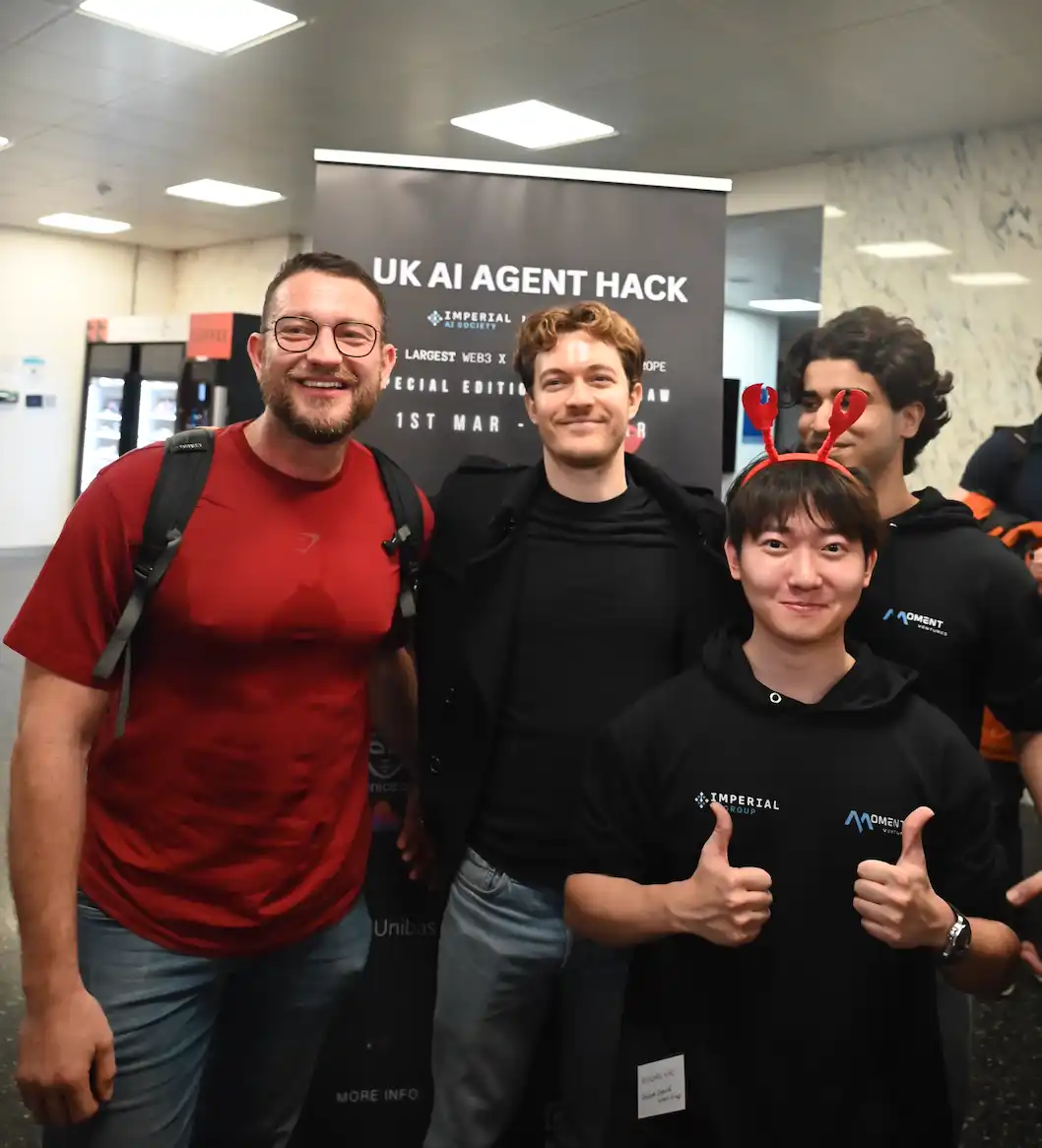
Peter at this hackathon
At the subsequent Sequoia Ventures party, a developer who didn't get a ticket stood outside the venue in the rain. When Peter noticed this, without hesitation, he walked over and started a conversation with him. When asked grand questions like, "How will the rise of Agents change the future of large-scale models," his response was straightforward and honest: "I don't know. I'm better at using the tools at hand to build interesting things."
The speech was originally scheduled for only 30 minutes, but the atmosphere on-site was so great that the audience kept asking questions, and Peter ended up staying for over two hours. The organizers later said, "This was very meaningful for us, to be fair, we owe him an apology."
When Peter left London, he left behind a saying: "You're not going to find meaning, you're going to create meaning." Perhaps, this is exactly what everyone who wants to make a difference in the AI era needs to hear.
OpenClaw × Web3: Massive Potential, but Security is the Biggest Constraint
Steinberger himself doesn't have much love for the crypto community, but the submission list for this hackathon presented a stark contrast to his personal stance. On the DoraHacks project page, there are several specific directions for Web3 implementation.
· The identity and sovereignty of Agents were the most frequently discussed topics. clawOS is built on the Nostr protocol, where each Agent has an independent identity and wallet, not relying on any platform; Cortex.OS, on the other hand, aims to address the black box issue of AI in Web3, making every decision of the Agent traceable on the chain.
· Directly managing money is another direction, with Trading Narwhal and Vibe4Trading both betting on Agents upgrading from merely assisting in trading to directly executing trades, although the OpenClaw architecture itself is not very friendly to private keys.
· Governance and public oversight have also seen several interesting projects: WatchDog uses 6 autonomous Agents to continuously scan UK government contracts for anomalies, CivicLift allows citizens to interact with local government through Agents, and GreenClaw is building a multi-Agent collaborative city security operations center.
Yet throughout, security has always been the toughest nut to crack for OpenClaw entering Web3. While Agents can access your files, APIs, and systems, there's nothing watching to see what it's actually doing. When it comes to scenarios involving real assets, caution is still needed when adopting OpenClaw.
You may also like

Citibank releases "2030 Asset Tokenization Market Outlook": 6 major trends may create a $8.2 trillion market

The trillion-dollar valuation test: Are the three major super IPOs a celebration for tech stocks or a nightmare for the crypto market?

Morning Report | Digital Asset completes $355 million financing led by a16z Crypto; Meta completes operational separation from Manus

a16z Crypto Partner: Cash flow is the moat

Cryptocurrency market makers collectively seek change as it becomes increasingly difficult to make money

How TradeXYZ, xStocks, and Alpaca break down the SpaceX IPO into three different strategies

$75 billion in risk asset redistribution: How will SpaceX's IPO affect U.S. stocks and Bitcoin?

Why Is BlackRock Investing $5 Billion in the SpaceX IPO?
Morning News | CME Group launches Nasdaq Cryptocurrency Index futures; Asset management giant Janus Henderson strategically invests in Ethena

Bitcoin Layer 2 Network Botanix: Why Did We Choose to Dissolve?

Why did Oracle deliver the strongest financial report in history, yet its stock price fell?
When the P2P illicit funds from ten years ago turned into 60,000 bitcoins
Dialogue with OmenX Founder: Why does the prediction market need an evolution from "spot" to "derivatives"?
Galaxy in-depth report: Is Solana still worth paying attention to?
Young people in South Korea make a "final effort" in the epic bull market
The pricing controversy of Trade.xyz exposes the fatal weakness of Pre-IPO perpetual contracts

How much longer can Ethereum's last big buyer hold on?

World Cup 2026 Coming – WEEX Celebrates with $1M Prize Pool & Michael Owen Live
Citibank releases "2030 Asset Tokenization Market Outlook": 6 major trends may create a $8.2 trillion market
The trillion-dollar valuation test: Are the three major super IPOs a celebration for tech stocks or a nightmare for the crypto market?
Morning Report | Digital Asset completes $355 million financing led by a16z Crypto; Meta completes operational separation from Manus
a16z Crypto Partner: Cash flow is the moat
Cryptocurrency market makers collectively seek change as it becomes increasingly difficult to make money
How TradeXYZ, xStocks, and Alpaca break down the SpaceX IPO into three different strategies


