
Market's Darkest Hour: Global Assets Plunge in Sync, Crypto Market Cap Down 10%, When Will the Dawn Break?


Original Article Title: "Market Dark Hour: Global Assets Simultaneously Plunge, Crypto Total Market Cap Down 10%, When Will the Dawn Come?"
Original Article Author: Luke, Mars Finance
Asset Meltdown: Global Market in Turmoil
The global financial market is currently experiencing a dark hour as a storm triggered by U.S. President Donald Trump's new tariff policy sweeps through major asset classes. At the Monday opening, the U.S. stock futures market was bleak, with S&P 500 futures down 3.2%, Nasdaq 100 futures plummeting 5.7%, the VIX fear index futures skyrocketing by 34.4% to 45.8, reaching the highest level since 2022. Safe-haven sentiment drove up the price of the 10-year U.S. Treasury bond, the Japanese yen appreciated by 1.3% against the U.S. dollar, and spot gold fell to $2988.61 per ounce.
Last Thursday, the S&P 500 Index plunged 4.8% to close at 4850 points, marking the largest single-day drop since 2024. On Friday, the selling frenzy further engulfed the market, with the Dow Jones Industrial Average plummeting 2231 points, a 5.5% decline, closing at 38900 points, wiping out nearly two months of gains. The tech-heavy Nasdaq Composite Index fell by 11.8% over two days, officially entering bear market territory. Big Tech performed poorly: Apple fell to $205, a 5.5% drop; Tesla plunged by 10.3% intraday, closing at $310; NVIDIA saw its market value evaporate by over $300 billion in a single day, a 9.1% drop. Global stock markets came under pressure simultaneously, with the Japanese Nikkei 225 Index falling by 5.6% at Monday's opening, triggering a 7% circuit breaker during the session, halting trading for 15 minutes; the South Korean KOSPI Index fell by 4.9%, hitting a six-month low; and the European STOXX 600 Index opened down by 3.8%.
The commodities market also did not escape unscathed. Gold broke below the $3000 per ounce psychological barrier, hitting a low of $2988.61, a 1.9% drop, while silver fell by 2.3% to $34.50 per ounce. The energy market suffered heavy losses, with WTI crude oil futures dropping to $59.80 per barrel, a 12% decline from the previous week's high, hitting a new low since April 2021; Brent crude fell to $63.20 per barrel. Industrial metal prices slid, with COMEX copper falling by 8.2% to $3.85 per pound, reflecting the market's pessimistic outlook on global manufacturing. The foreign exchange market saw heightened volatility, with the Australian dollar falling by 1.1% against the U.S. dollar to 0.6350, the euro weakening by 0.9% against the U.S. dollar to 1.0450, and the U.S. dollar index rising to 104.50, reaching a three-month high.
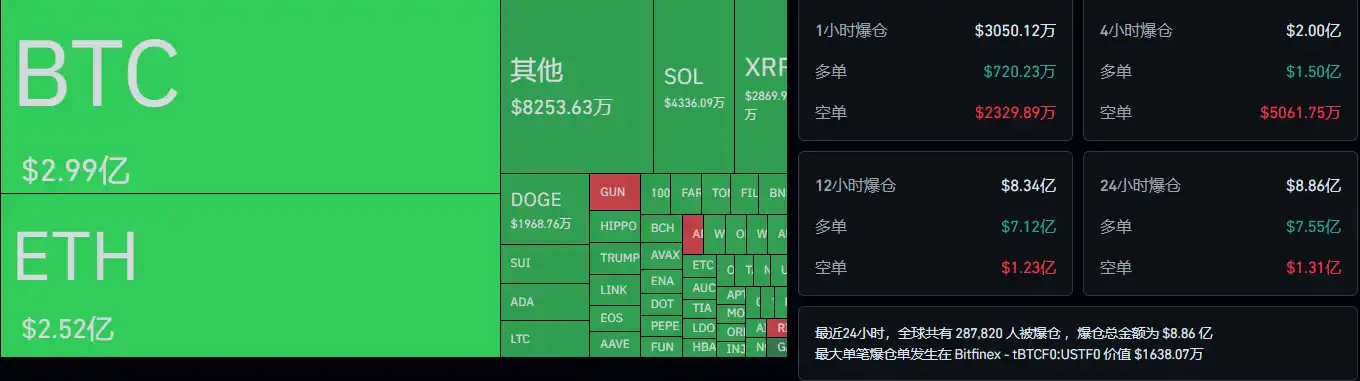
The cryptocurrency market has failed to escape its fate as a risk asset. CoinMarketCap data shows that the global crypto market cap has shrunk from $2.4 trillion to $2.16 trillion, a 10% decrease. Bitcoin fell by 6%, hitting a low of $77,100; Ethereum dropped by 12.4% to $1,540; the crypto market's performance is highly synchronized with the Nasdaq, highlighting its nature as a "high-beta asset." The total liquidation amount across the market in the past 24 hours was $886 million.
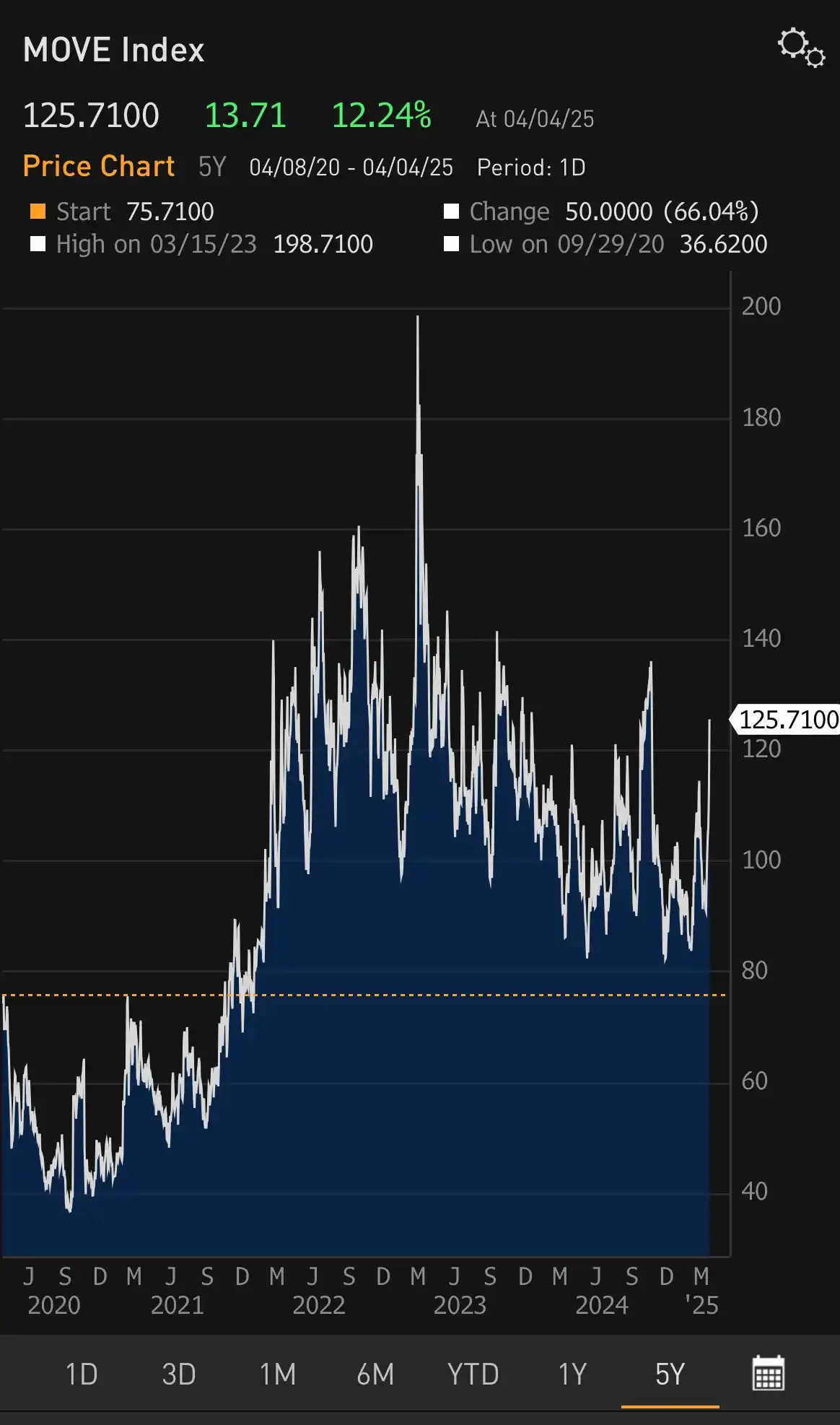
Concerns in the bond market are also escalating. The MOVE Index (Merrill Lynch Option Volatility Estimate Index), a gauge of the implied volatility of U.S. bonds, has surged from 108.50 at the end of March to 125.71, a 15.8% increase. BitMEX co-founder Arthur Hayes pointed out, "To predict when the Fed will capitulate and ease significantly, the MOVE Index is a key indicator. The higher the index, the higher the margin requirements for bond and credit financing trades, and selling pressure will sweep through the market. This is an area the Fed will fight to the death to defend. If it breaks above 140, easing is inevitable." The current level is just a step away from the critical point, indicating that greater turmoil is on the horizon.
Trump's Gambit and the Market Standoff
Facing a market meltdown, the Trump administration has shown an unusually calm demeanor. Treasury Secretary Steven Mnuchin stated on Sunday, "Market volatility is temporary, and the economic fundamentals have not collapsed." Commerce Secretary Robert Lighthizer took a tough stance, saying, "Tariffs are a necessary safeguard for the U.S. economy and will not retreat." Trump posted on the social platform "True Social," saying, "Don't be afraid, this is just a little episode on the way to prosperity." Hayes analyzed, "Many of Trump's core voters do not hold stocks or financial assets. For them, a market downturn even brings a psychological satisfaction towards the 'Wall Street elite.' This gives Trump the confidence to push tariffs because he knows the votes will not be lost."
However, the market remains unmoved. U.S. federal funds futures show that investors are betting on a 120-basis-point interest rate cut by the Fed this year, implying an expectation of five 25-basis-point rate cuts. JPMorgan predicts that the Fed may start cutting rates from May onwards and lower the federal funds rate to 2.75%-3.0% by January 2026. Goldman Sachs warns that if tariffs are fully implemented, the U.S.' GDP growth rate for 2025 may be revised down to 1.2%, while the inflation rate could rise to 3.8%, putting the Fed in a dilemma. An anonymous Wall Street hedge fund manager stated, "Investors no longer believe in the government's optimistic promises, they only look at the data and the Fed's next move."
Trump's remarks have further exacerbated uncertainty. He shared a video on "Truth Social," implying his intention to cause a 20% stock market drop to boost Treasury demand, weaken the dollar, and lower mortgage rates. White House economic advisor Kevin Hassett urgently clarified: "This is just the President's personal idea, not a policy objective." However, market trust has been severely damaged, with the VIX index rising further to 47.2 in pre-market trading on Monday.
A Lesson from History: Bitcoin Struggles to Stand Alone, Seeks Opportunity in Crisis
The current situation evokes historical crisis moments. In 1987, on "Black Monday," the Dow Jones Industrial Average plummeted by 22.6% after a weekend panic, setting a record for the largest single-day drop. The meltdown crisis triggered by the COVID-19 pandemic in March 2020 was more recent, with the S&P 500 index hitting the circuit breaker four times in 10 days:
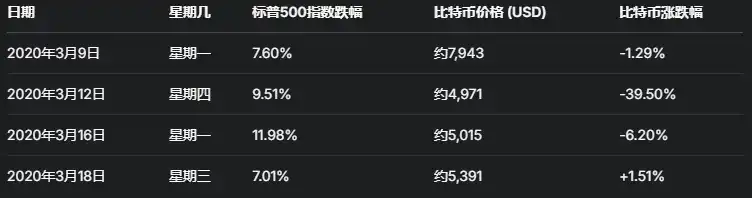
In this crisis, the S&P 500 index dropped from 3393 points at the end of February to 2237 points on March 23, a drop of over 34%. Bitcoin's performance was particularly brutal, plummeting by 39.5% on March 12, marking a rare single-day drop in the crypto market. Notably, Bitcoin failed to break away with an independent trend but instead became highly correlated with the Nasdaq, amplifying the tech stock performance. CNBC commentator Jim Cramer pointed out: "The lesson of 2020 is that Bitcoin is no longer a safe haven asset but rather a 'large-cap Nasdaq,' with a risk exposure far exceeding the traditional stock market." Today, the same pattern is repeating: Bitcoin's correlation with the Nasdaq 100 has recently risen to 0.85, much higher than gold's 0.12, indicating its vulnerability in a panic environment.
History also reveals a turning point. After each circuit breaker in 2020, the market's short-term panic intensified, but the Federal Reserve promptly cut interest rates to zero and launched unlimited QE, ultimately stabilizing the situation. While the turmoil caused by Trump's tariffs was policy-driven, the panic eruption on Monday followed a similar pattern. Cramer added: "The commonality between 1987 and 2020 is that fear brewing over the weekend spiraled out of control on Monday. Today, the opacity of the trade war leaves investors nowhere to hide."
Global Impact and the Comeback of Safe-Haven Assets
The ripple effects of this storm have swept across the globe. China's Ministry of Commerce stated on Sunday: "Resolute measures will be taken to counteract." The EU's trade commissioner warned of possible tariffs on U.S. cars and agricultural products. India and Brazil are also evaluating retaliatory measures. A 7.2 magnitude earthquake in Myanmar last week further disrupted the rare earth and semiconductor supply chain, driving up tech manufacturing costs. Morgan Stanley estimates that if the supply chain crisis persists, global economic growth could be revised down by 0.5 percentage points by 2025.
Hedge assets have become a rare bright spot. The 10-year U.S. Treasury yield fell by 10 basis points to 3.89%, while the 2-year yield fell by 19 basis points to 3.46%. Bloomberg data shows that the global negative-yield bond market has grown to $16.5 trillion, reaching a high not seen since 2023. The Japanese yen rose to 148.50 against the U.S. dollar, and the Swiss franc increased by 0.8%. Although gold has experienced a short-term pullback, it remains attractive in the long run, with UBS predicting it may return to $3100 per ounce by year-end.
The Fed's Turning Point: The Alarm of the MOVE Index
The Federal Reserve is facing unprecedented pressure. Tariffs may raise import costs, and inflation concerns have emerged—Goldman Sachs estimates that if a 34% tariff is implemented, the U.S. CPI could rise by 1.2 percentage points in 12 months. However, a market crash and bond volatility are forcing accommodation. Hayes's MOVE Index theory has become a focal point: "As the MOVE Index rises, the financing cost of bond trading surges, and selling pressure will transmit to the financial system. The Fed has no choice but to act. 140 is the critical point." The current index has reached 125.71, and if panic intensifies on Monday, it may quickly surpass this level.
There is disagreement within the Fed. Hawkish officials advocate waiting for inflation data, while doves warn that delays could trigger systemic risks. Chicago Fed President Evans stated, "When markets are in disarray, monetary policy must be decisive." The market expects the May FOMC meeting to potentially initiate a rate cut, with a magnitude of up to 50 basis points.
Where is the Turning Point: Dawn After the Earthquake
Hedge fund manager Bill Ackman has proposed another possibility: "If Trump announces a tariff delay on Monday to seek negotiation space, the market may catch its breath." However, he also warns that if the policy remains tough, the S&P 500 could fall another 10%, and the risk of an economic recession could increase from the current 35% to 60%. Ackman concludes, "In any case, this Monday will determine the direction of the next few months."
Although this earthquake is chilling, it may herald a turning point. After the 2020 circuit breaker, the Fed's decisive intervention reversed the decline. Now, with the MOVE Index sounding the alarm, the pressure for rate cuts is mounting. If the Fed gives in, accommodative policies could inject vitality into the market and reignite investor confidence. History tells us that the deepest darkness often comes before the dawn. The tug-of-war between Trump's tough stance and the market's fragility makes the Fed's decision a decisive variable.
The calls for rate cuts are growing louder—perhaps this is the first ray of sunshine after the storm. For investors, the gold pullback may be a buying opportunity, and the tech stock slump is a litmus test of patience. As Ackman said, this Monday will go down in history, and the Fed's actions may unexpectedly bring this crisis to a close.
You may also like

Will MicroStrategy fall into a death spiral? What will the macro trend be in the second half of the year?

Blockchain Capital Partner: The Core Secret of Arbitrage

STRC unanchored by 11%, can the perpetual motion machine of Strategy still operate?

Bitcoin Market Analysis 2026: Can BTC Reach $150K by Year-End?

Bitcoin ETF Outflows Hit a Record $4.4 Billion: What Are Traders Doing With Their Cash?

WEEX App Just Got Smarter – New Tabs for Faster Trades & Easy Asset Management

WEEX All-New Search Features: Find, Trade & Earn Faster Than Ever

Morning Report | Illinois signs the strictest digital asset tax law in the U.S.; RWA tokenization market size surpasses $43 billion, institutions accelerate the migration of on-chain assets

Full version of the debut Q&A! Federal Reserve Chairman Waller: Sticking to the 2% inflation target, establishing five special working groups, individual did not submit the dot plot

From Disruptor to Shadow Market: The Crypto Market is Becoming a Colony of Traditional Finance
Dalio's important long article: How to position in the current market environment?
OKX Star analyzes Binance's competitive advantages: when regulation levels the playing field, competition has just begun

New gameplay for participating in initial offerings on cryptocurrency exchanges
Why Is Bitcoin Down Today? What the Hawkish FOMC Means for SpaceX, Gold and Nasdaq

DeepSeek Financing Story

Morning Report | DeepSeek completes over $7 billion in financing, with a valuation exceeding $50 billion; Musk's personal wealth has surpassed the total market value of Bitcoin

Cursor, why did you get on Musk's spaceship?
In the name of charity, for the benefit of the family: How the Trump family turned charity into profit?
Will MicroStrategy fall into a death spiral? What will the macro trend be in the second half of the year?
Blockchain Capital Partner: The Core Secret of Arbitrage
STRC unanchored by 11%, can the perpetual motion machine of Strategy still operate?
Bitcoin Market Analysis 2026: Can BTC Reach $150K by Year-End?
Bitcoin ETF Outflows Hit a Record $4.4 Billion: What Are Traders Doing With Their Cash?
WEEX App Just Got Smarter – New Tabs for Faster Trades & Easy Asset Management


