
Market Predictions 2.0 Preview: 5 New Product Forms Beyond "Pure Speculation"




Original Title: Beyond the Basic Bet: Newer Expressions of Prediction Markets
Original Author: neel daftary
Original Translation: Golem, Odaily Planet Daily
The future of prediction markets may currently be dominated by Polymarket/Kalshi, capturing all attention and market share. Nevertheless, even so, we might eventually use entirely reimagined prediction markets in the future, markets that cater to everyone's needs and align with their preferences and interests.
Reflect on how the trading of Meme coins has evolved. From simply buying a token featuring a dog on its face back in 2015, to needing to utilize tools (Axiom), track wallets (Cielo, Nansen, Arkham), and join a community by 2025, engaging with others to hunt for tokens on platforms like Solana, BNB, and Base.
Every opportunity emerging in the crypto space started from a simple pattern. Over time, these simple patterns either fade away (e.g., NFTs) or grow more complex as more participants join, eroding early advantages (e.g., Meme coins). Naturally, users also desire to engage in more intricate games, as evident in the evolution of most video games (God of War, Assassin's Creed, FIFA, etc.). To maintain appeal and relevance to the core user base, gaming and gaming-like platforms need to introduce features and complexity, enabling top players to stand out from the 99% of players.
When this pattern repeats and aligns with the prediction market category, it will no longer be a singular, monolithic platform but a comprehensive ecosystem consisting of numerous prediction-related applications.
These standalone products can leverage the core mechanisms of prediction markets (incentivized forecasting and vested interests) to create entirely new experiences. Here are five highly anticipated categories:
Trading Expected Impact: Illustrated by Lightcone
This is perhaps the newest and most intricate original concept, transcending the realm of probability, allowing users to trade on the impact of events.
You can understand it as follows: a prediction market informs you of the probability (P) of an event occurring, while a spot market informs you of the spot price (S) of an event occurring. However, the new category defined by Lightcone, an "Impact Market," aims to separate and price impact (I).
Its operation is based on cloning assets to a "parallel universe" based on future events. For example, a user can deposit 1 BTC before the U.S. presidential election and receive two new tradable tokens, Trump-BTC and Kamala-BTC.
These tokens trade in separate "parallel universes." When the event occurs (e.g., Trump's victory), all Trump-BTC can be redeemed for real Bitcoin, while all Kamala-BTC will be reset to zero (and vice versa).
This model's advantage is that it has spawned two new applications:
· New Information Machine: It provides us with a sandbox to predict financial impacts. By comparing the prices of Trump-BTC (e.g., $130,000) and Kamala-BTC (e.g., $91,000) to the current spot price of Bitcoin ($102,000), the market explicitly tells us the expected financial impact of each outcome, completely independent of the probability of the outcome occurring.
· Event-Based Hedging: Traders can hedge specific risks without paying a premium unless that risk materializes. For example, traders concerned about a specific credit event (such as a Saylor default) can hold strSolvent-BTC while selling their strDefault-BTC for strDefault-USDC.
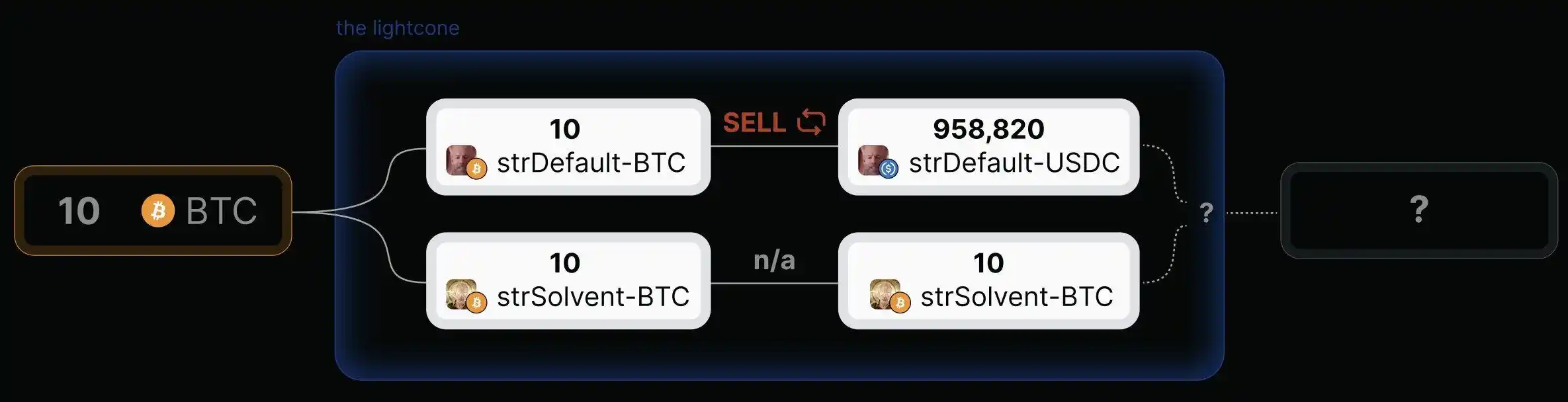
If a default occurs, their strDefault-USDC will convert to real USDC. They have successfully hedged and sold their Bitcoin before the event occurred; if no default occurs, their strSolvent-BTC can be redeemed for their original Bitcoin. They still hold a long position, and the hedging operation incurred no costs.
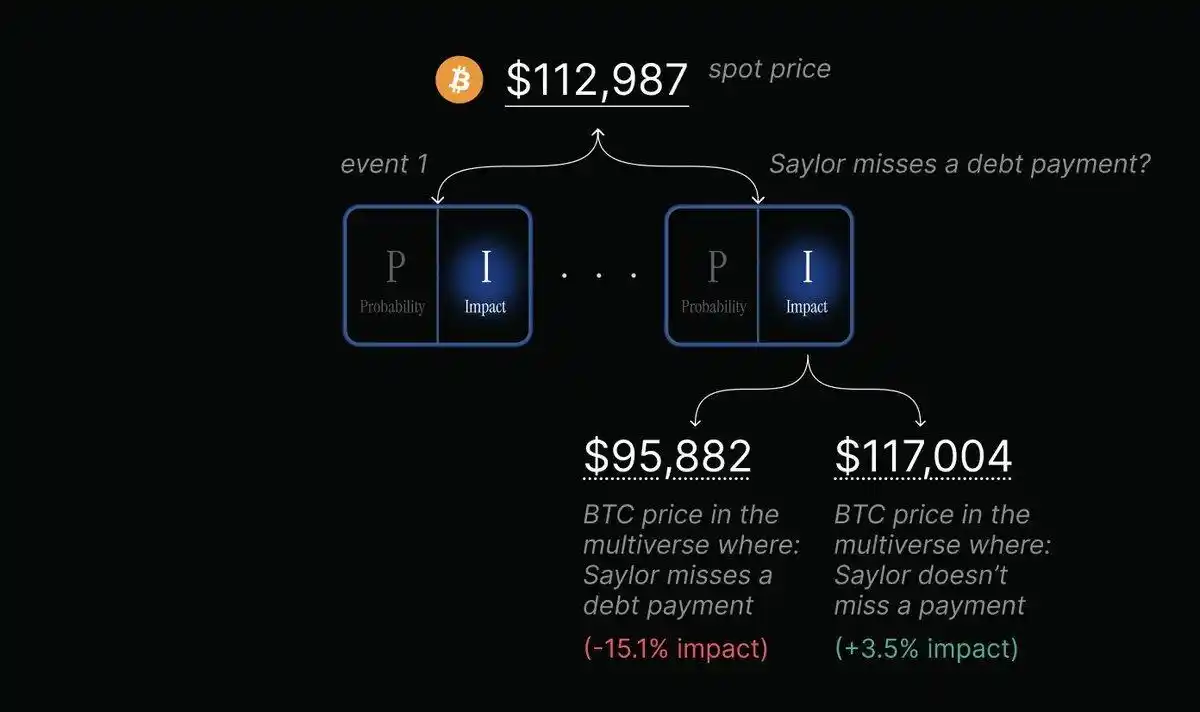
This is a complex tool. It removes the "probability" variable from trading, allowing institutions and traders to trade solely based on impact factors, truly creating a new financial foundation.
Opinion Market: Betting on Belief
This is a captivating concept where participants no longer bet on objective facts (e.g., "Can Ethereum reach $5,000?") but on what people will believe.
For example: "Will over 70% of participants bet 'Yes' in this market?"
This model has two main advantages:
· Fast Settlement: The market can settle based on its own internal dynamics daily or even every few hours. It does not rely on slow external oracles.
· Social Capital Monetization: It rewards players who can accurately predict collective psychology rather than facts. This is a direct way to monetize cultural influence and understanding.
Currently, platforms such as Melee, vPOP, opinions.fun, among others, are attempting to build this model to allow people to convert social capital into profits.
Virtual Sports: High-Frequency Prediction Market
Virtual sports is a $250 billion industry centered around a cyclical prediction market.
On the Football.Fun platform, users don't place just one bet but engage in combination predictions. Building a team is essentially a bet on the overall performance of the players, with all players being subject to a budget constraint.
The strength of this model lies in:
· Generating continuous, cyclical betting volume (e.g., weekly NFL/NBA/PL tournaments).
· Allowing users to monetize the expertise they have accumulated through watching over 10 hours of matches weekly.
The native advantage of cryptocurrency lies in its tradable assets. Digital player cards themselves are a prediction of a player's in-game value. Native cryptocurrency virtual sports enable players to profit through participating in pure player card trading (similar to gacha boxes, physical collectibles) and regular cyclic prediction market games.
Opportunity Market: Private Information Discovery
This is the second innovative mechanism proposed by the Paradigm team, enabling prediction markets to address the problem enterprises face: finding valuable early information.
The model is as follows:
· Initiator (VC): Provides all liquidity for the private market (e.g., "Will we invest in Startup Y this year?").
· Scout (Expert): Utilizes their own information and expertise to purchase shares of "Yes."
· Signal: Price increases become a proprietary aggregate signal for VCs/institutions, signaling the market should investigate/reinvestigate this project.
This is actually a decentralized reconnaissance program. It can also address the "free-rider problem" in some way (signals are private and only the initiator can access) and the liquidity problem (the initiator is a permanent liquidity provider).
Wisdom of Stake Market Governance
This is a governance model that delegates policy decision-making to market wisdom. The core idea is: "People will vote based on values but will stake based on beliefs."
It operates as follows:
· A DAO achieves consensus on a certain value or goal (e.g., "maximize monthly active users").
· Propose a proposal ("Proposal 123: Spend 50,000 tokens to launch a new incentive program").
· Create two conditional prediction markets: Market A, "If Proposal 123 passes, what will be the number of monthly active users on December 31st?"; Market B, "If Proposal 123 fails, what will be the number of monthly active users on December 31st?"
· If the price (prediction) in Market A is higher than in Market B, the proposal automatically passes.
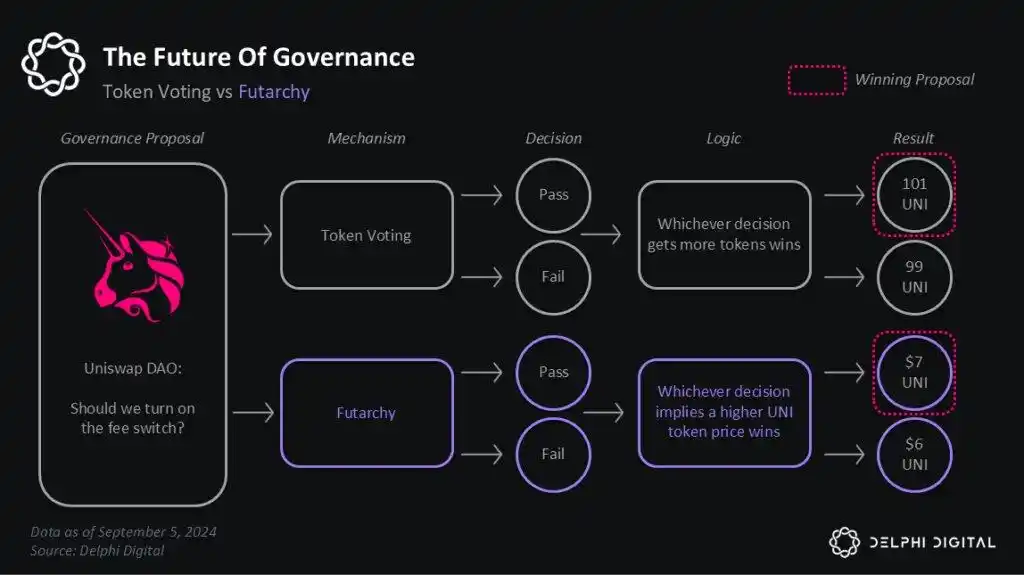
It forces participants to stake funds for their beliefs, shifting governance from a subjective popularity contest to an information-driven practice.
But honestly, the innovation in the application layer of prediction markets goes far beyond this. In addition to the applications listed above, we also see concepts such as the prediction market-based news platform Boring News and the dedicated prediction market fund PolyFund under construction.
The design space for the application layer of prediction markets is just beginning to be explored, and we are not optimistic enough.
You may also like

Morning Report | BitMine increased its holdings by 126,971 ETH last week; trader Eugene announced his exit from the crypto market

Wang Chuan: How can one not feel anxious after the neighbor Old Wang made thirty times profit by investing in storage stocks? (Seven) - A quarter-century cycle

Cryptocurrency CEXs are flocking to sell US stocks, and traditional brokerages are facing an "uninvited guest."

$75 billion in foreign capital has fled, and South Korean retail investors have absorbed it all using leverage

Japan’s Three Megabanks Plan Joint Stablecoin Issuance in Fiscal 2026
MUFG, SMBC, and Mizuho reportedly plan to jointly issue fiat-pegged stablecoins in fiscal 2026, signaling Japan’s growing push into bank-led digital payment infrastructure.

Humanity Discloses H Token Dual-Chain Attack Details, With Losses on Ethereum and BSC Exceeding $36 Million
Humanity said the H token attack across Ethereum and BSC caused more than $36 million in losses after leaked ProxyAdmin keys enabled malicious contract upgrades and token minting.
White House Discusses CLARITY Act With Law Enforcement Ahead of Senate Vote
The White House discussed the CLARITY Act with law enforcement ahead of a Senate vote, focusing on illicit finance risks and developer protections.

Bitcoin Trading Guide 2026: Strategies for Experienced Traders

What Is XAUT and PAXG? Why Tokenized Gold Is Booming in 2026

Will the SpaceX IPO Hurt Bitcoin? Here's What Traders Are Watching

Foreign selling in the South Korean stock market accelerates, with cumulative net sales reportedly reaching $75 billion this year
On June 9, The Kobeissi Letter, citing Goldman Sachs data, reported that global investors are selling South Korean stocks at an unusually rapid pace. In the latest trading session, foreign investors sold about $801 million worth of Kospi constituent stocks again; total foreign outflows last week reached about $10 billion, and the market has been in net foreign selling on nearly every trading day over the past month. According to the data cited in the report, foreign investors have sold about $75 billion worth of South Korean stocks so far this year. Meanwhile, South Korean retail and institutional investors together recorded roughly $69 billion in net buying over the same period, suggesting that the market’s main buying support has come from domestic capital rather than returning overseas funds. The information currently disclosed still mainly comes from The Kobeissi Letter’s retelling and Goldman Sachs data summaries, while public details on the statistical period and the specific definition of “selling” remain relatively limited.

Fortune Warns of Strategy’s Financing Structure Risks as Bitcoin Premium Narrows
Fortune warned that Strategy’s Bitcoin treasury model faces growing financing risks as MSTR’s net asset premium narrows and preferred stock dividend pressure increases.

Ferrari Challenge Le Mans: Carl Moon to Dominate in WEEX Livery

Sahara AI Responds to SAHARA’s Sharp Drop: No Contract or Product Security Issues Found, Internal Investigation Underway
Sahara AI responded to SAHARA’s 60% price drop, saying no token contract or product security issues have been found and an internal investigation is underway.

WEEX Deposit/Withdrawal Dynamic Island: Your Asset Status, Always in Sight
Scaling Crypto Derivatives: The Digital Asset Infrastructure Behind High-Volume Trading
In the fast-moving digital asset ecosystem, derivatives platforms face an extreme architectural test. High-leverage futures markets demand more than just standard security—they require absolute operational precision, zero-latency matching engines, and ironclad structural scalability, all while navigating intense market volatility.
As global platforms scale to meet these demands, the industry is shifting away from rigid, monolithic setups toward a more agile, "decoupled" infrastructure philosophy.
The Blueprint for High-Volume Copy TradingFor elite global exchanges like WEEX (founded in 2018), this architectural choice becomes critical when scaling high-volume retail features like social copy trading. When thousands of users automatically mirror the real-time strategies of elite traders simultaneously, it triggers sudden, monumental spikes in concurrent transactional volume.
To prevent execution latency or settlement bottlenecks during these peak volatility events, a platform's primary engine must remain entirely dedicated to risk management, copy-trade synchronization, and order matching.
The Architectural Rule: New-generation platforms must separate front-end user execution engines from heavy backend infrastructural overhead to eliminate operational friction.
By separating these layers, platforms can maintain complete sovereignty over their trading environments and user experiences while strategically aligning with institutional-grade infrastructure ecosystems. This strategic framework allows modern exchanges to leverage advanced Digital Asset Custody infrastructure such as Cobo’s behind the scenes, ensuring that backend wallet management scales elastically alongside trading spikes.
Capitalizing on Market Momentum and 400× LeverageIn a derivatives arena where platforms offer up to 400× leverage on perpetual contracts, capital efficiency and market agility are core business metrics. To capture market momentum, an exchange needs the ability to rapidly expand its asset offerings, supporting everything from legacy crypto assets to sudden, trending altcoins across a massive library of trading pairs.
Adopting a flexible, scalable Wallet-as-a-Service (WaaS) solution such as Cobo’s could completely rewrite the development timeline for high-growth exchanges. Instead of spending months of engineering capital building out custom backend wallet architectures for every new blockchain network, platforms can deploy localized infrastructure in days.
This agility allows platforms to instantly scale their listings to over a thousand trading pairs without compromising security or delaying time-to-market. It mirrors the exact operational advantages seen during high-velocity market events, similar to how advanced wallet infrastructure empowers platforms during sudden asset surges; allowing exchanges to pass that speed and liquidity directly to their global user base.
A Mature Foundation for GrowthThe synergy between trusted infrastructure ecosystems and global trading platforms represents the natural evolution of a maturing crypto market. As WEEX continues to scale its global spot and derivatives offerings for over 6 million users, adopting robust backend paradigms proves that platforms no longer have to compromise between cutting-edge trading velocity and uncompromised structural security.

Get Paid to Onboard? Try WEEX’s New Homepage with Rewards for Registration, Deposit & Trade
WEEX Custom Layout: Build Your Perfect Trading Workspace in Seconds
Morning Report | BitMine increased its holdings by 126,971 ETH last week; trader Eugene announced his exit from the crypto market
Wang Chuan: How can one not feel anxious after the neighbor Old Wang made thirty times profit by investing in storage stocks? (Seven) - A quarter-century cycle
Cryptocurrency CEXs are flocking to sell US stocks, and traditional brokerages are facing an "uninvited guest."
$75 billion in foreign capital has fled, and South Korean retail investors have absorbed it all using leverage
Japan’s Three Megabanks Plan Joint Stablecoin Issuance in Fiscal 2026
MUFG, SMBC, and Mizuho reportedly plan to jointly issue fiat-pegged stablecoins in fiscal 2026, signaling Japan’s growing push into bank-led digital payment infrastructure.
Humanity Discloses H Token Dual-Chain Attack Details, With Losses on Ethereum and BSC Exceeding $36 Million
Humanity said the H token attack across Ethereum and BSC caused more than $36 million in losses after leaked ProxyAdmin keys enabled malicious contract upgrades and token minting.


