
LP-free, insider-free meme lottery site, can Super.exchange save the bear market?




The market has long been plagued by insider trading. This is perhaps the sigh that every degen who has been rugged by a meme coin or a wife rug pulls out. Just when they finally survived the rug pull, yesterday's waterfall event once again washed the market's face, causing FUD in the community.
At this moment, "No LP, No Insider Trading." "We will save the bear market!" — a project named Super.exchange, like a Superhero rescuing the market, hit the pain point directly, quickly gaining attention in the community. What magic does this Solana-based new asset issuance platform possess?
An Upgraded Version of Pump.fun
Why are meme insider trading, sniper attacks, and rug pulling so common? According to Super.exchange, a significant part of the problem lies in the fact that "Bonding Curves have been played out" — this is one of the core reasons why tokens cannot achieve price discovery, leading to extreme price fluctuations.
To address the early whale control problem, Super.exchange upgraded the traditional bonding curve to the Infinite Bonding Curve AKA Super Curve, making price increases more gradual. The principle of the Super Curve is not complicated; it can be seen as a Bonding Curve composed of 7 different curves. These seven curves are like the gears of a manual transmission car; the car needs to shift gears to accelerate. Similarly, to make the token price "accelerate," its underlying liquidity must also "shift gears." The seven "gears" of the Super Curve, while maintaining stable market depth, facilitate rapid and sustained price growth.
So, what does the Super Curve solve? The traditional bonding curve, due to slow early growth, allows some buyers to accumulate a large proportion of the token supply. In the later stages, the rapid curve growth can lead to a liquidity gap, and without liquidity provider support, continuing trading becomes challenging. However, by utilizing the Super Curve, all price ranges have permanently locked liquidity, mitigating rug pull risks and ensuring sustainable price growth.
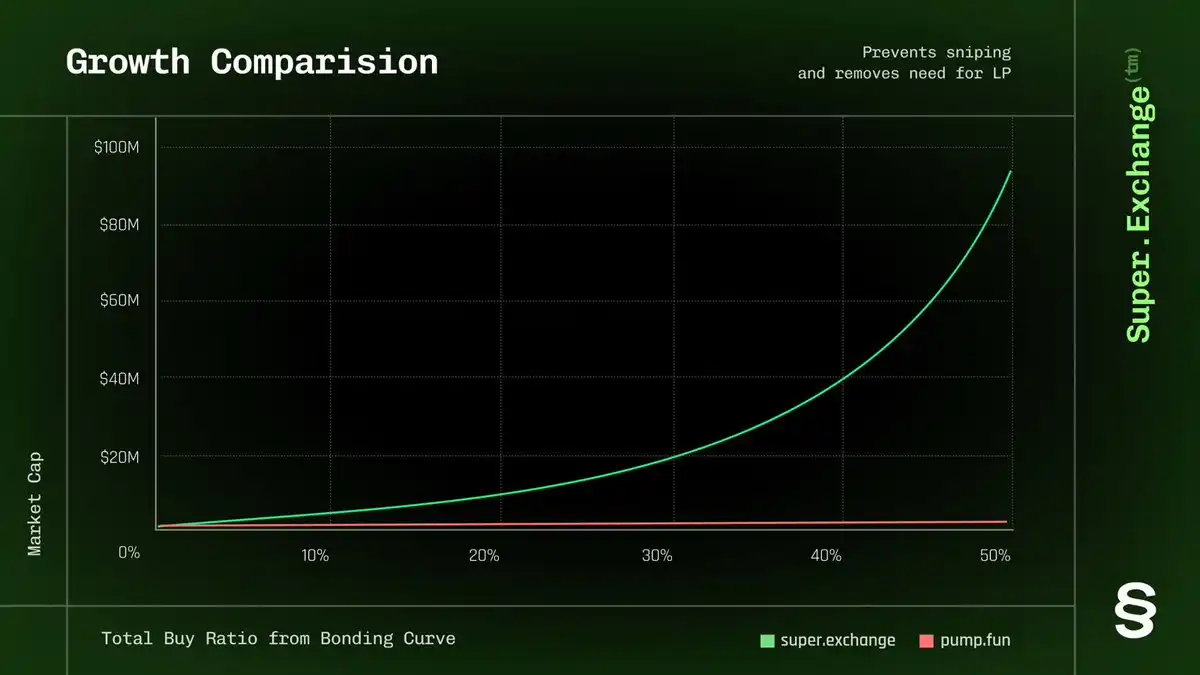
Comparison of token growth using Super Curve versus traditional Bonding Curve, image from @_superexchange official account
More specifically, by controlling 80% of the token supply through a traditional Bonding Curve on Pump.fun, it only takes less than $20,000, and the price increases by only 15 times. However, on Super, to buy 80% of the tokens, the price would increase by 40,269 times. As a result, it is difficult to accumulate a large amount of chips at a low price in the early stages of the token.
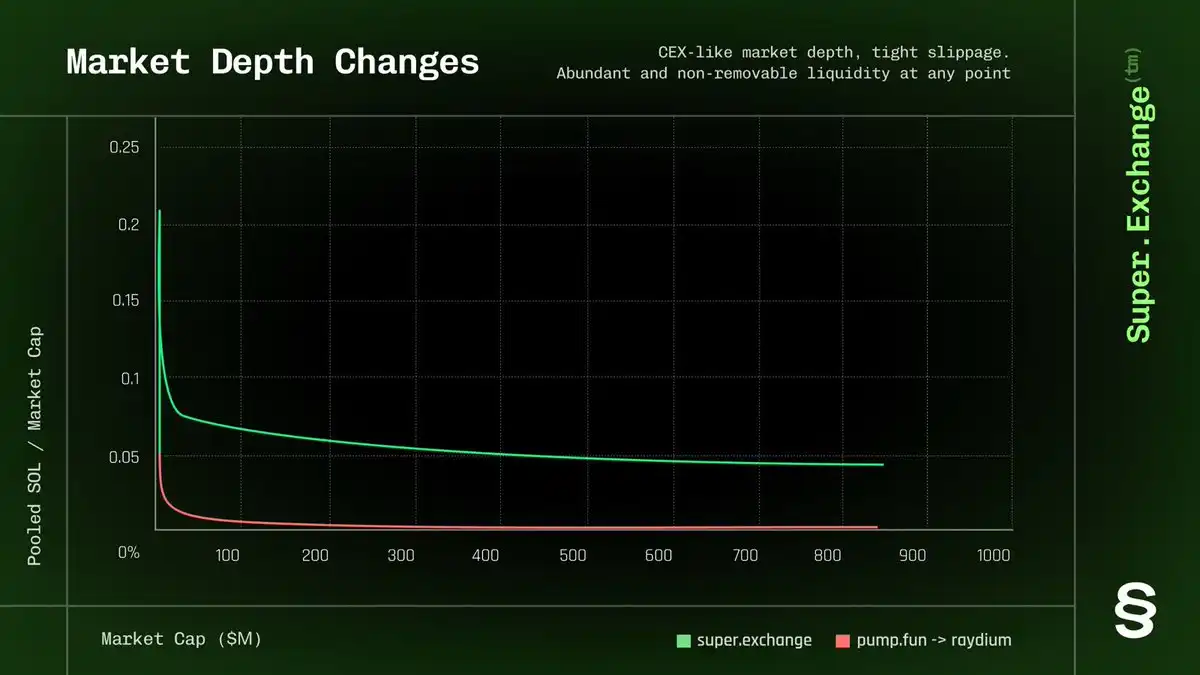
Super Curve versus the market depth characteristics of the traditional model, image from @_superexchange official account
On Pump.fun, as the market cap increases, the pool's depth rapidly decreases. Super.exchange eliminates reliance on liquidity providers, prevents pool draining, ensures sustainable liquidity, and creates a secure and growth-friendly trading environment.
Not only is the Super Curve innovative, but Super.exchange also astutely addressed another pain point that made everyone from a small player to a grandmaster suffer during the meme rush—ticker uniqueness.
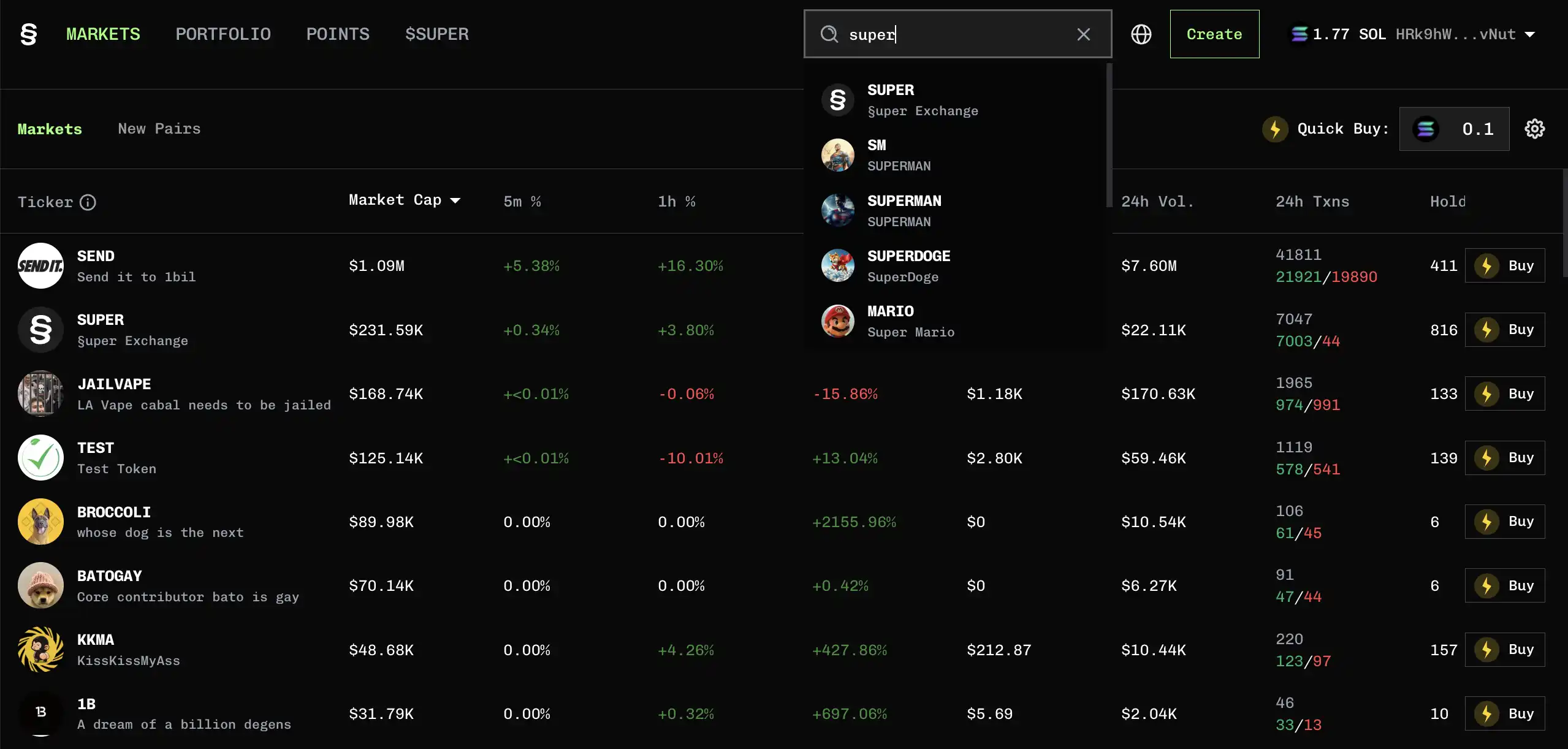
Remember the Broccoli Wars on the BNB Chain half a month ago? A large number of homogenized tokens were simultaneously released, flooding the new coin billboard with the same image and name, igniting an intense PvP showdown. But try searching for $SUPER on Super.exchange, and the results will refresh you. No need to painstakingly check the authenticity of each one; each ticker is a unique identity marker for the token, all in uppercase letters, putting an end to the case of capitalization.
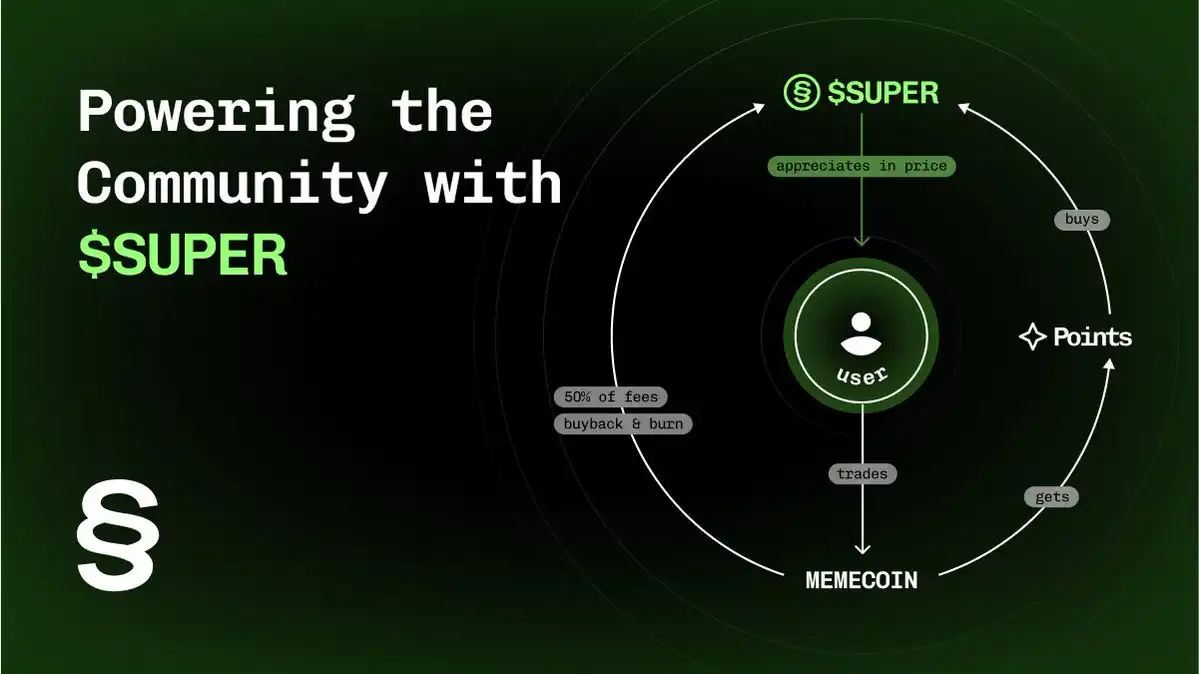
Finally, Super.exchange has also created its platform token $SUPER. $SUPER is 100% community-owned, with a deflationary mechanism and a transparent buyback and burn policy. $SUPER has a total supply of 10 billion tokens launched fairly, with no reserves, no front-running, and no VC quotas. Of this, 50% of the platform fee income is used to repurchase $SUPER and burn it, executed by a smart contract in 5-minute intervals, and the entire process is transparently recorded on the blockchain. As the platform develops, the repurchase scale expands, driving long-term coin price growth and establishing a community growth flywheel.
How to Play Super.exchange
How to Get Started with Super.exchange? Once users access the homepage and connect their wallets, they can mainly interact with the following three functions:
How to Create a Token
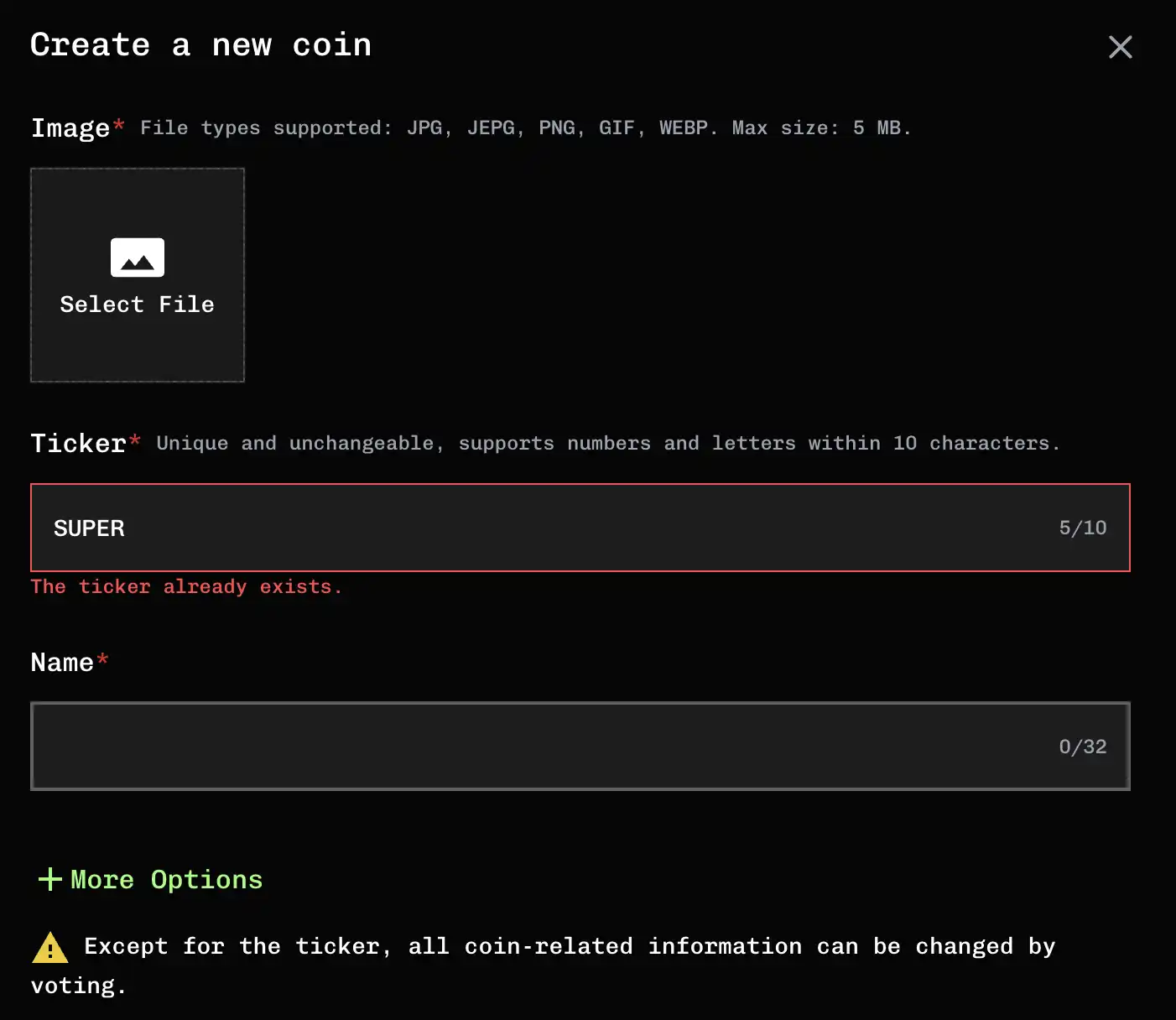
In the top right corner of the homepage, you can see the 'create' option. Clicking on it allows you to enter the token icon, ticker, and name to complete the creation process. If the chosen ticker is already in use, you won't be able to create a token with the same name. The ticker supports combinations of up to 10 alphanumeric characters. While the ticker cannot be changed after creation, other options can be modified through community voting. Based on practical experience, creating a token costs approximately 2.5%, slightly more expensive than Pump.fun.
How to Buy a Token
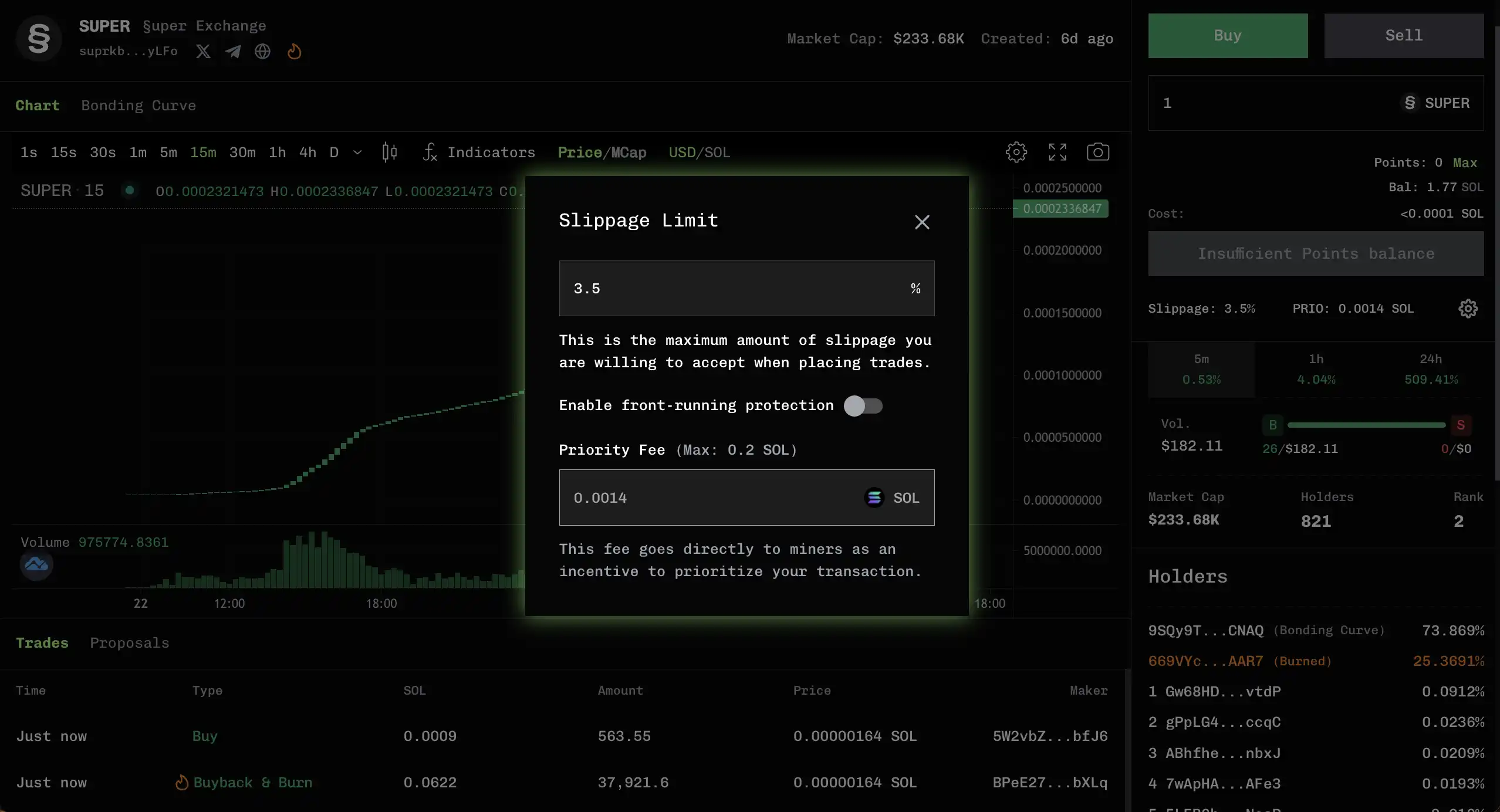
Super.exchange also distinguishes between internal and external markets. By clicking on 'MARKETS' on the homepage, you can see the token board, with 'Markets' representing the external market and 'New Pairs' equivalent to the internal market. The market value of each token is calculated using the Super Curve. Clicking on a token icon to enter the purchase page allows you to set the amount and slippage tolerance. After purchase, you can view your acquired assets in 'PORTFOLIO'.
How to Earn $SUPER
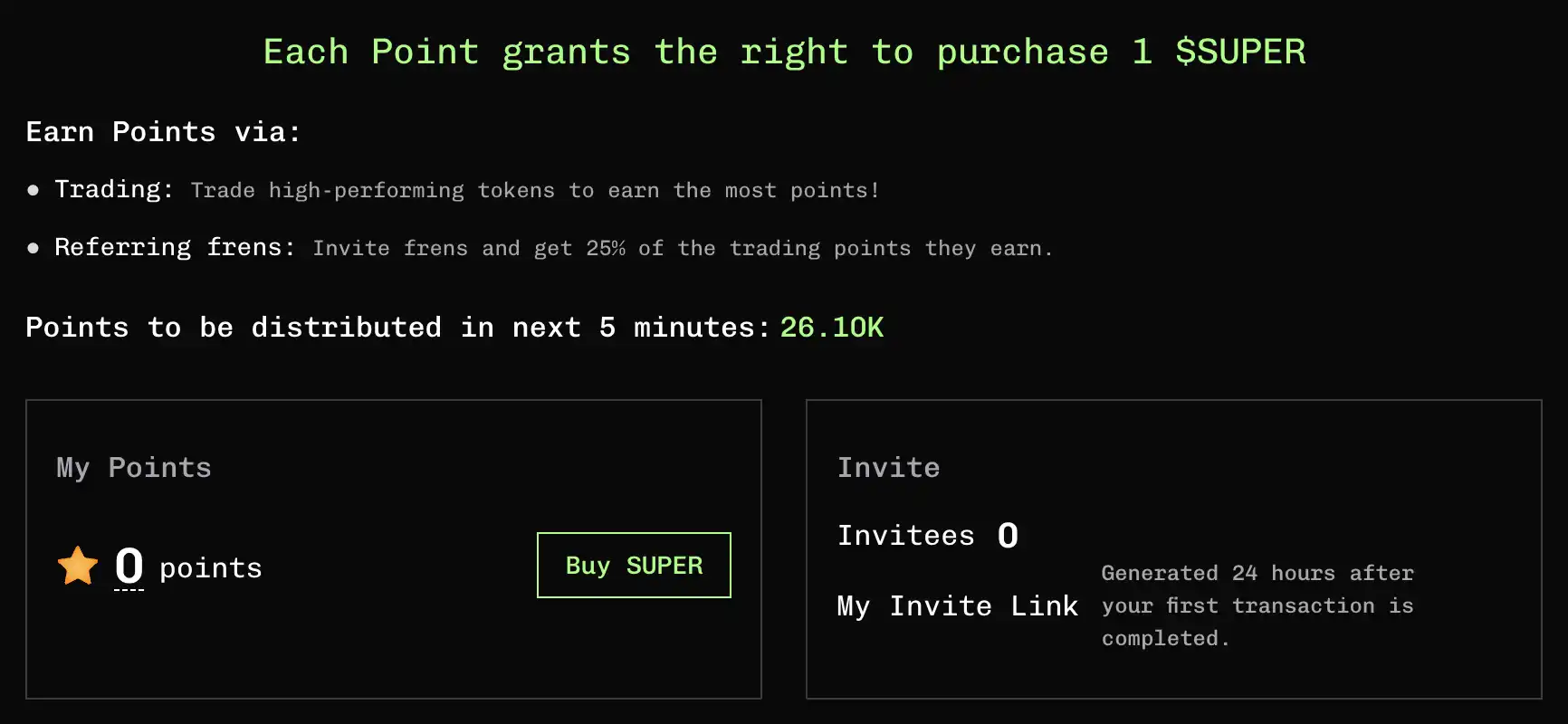
Currently, the official website only provides two ways to earn $SUPER: trading and referrals. The higher the performance of the traded token, the more points you earn; inviting friends allows you to receive 25% of their trading points. 1 point equals the right to purchase 1 SUPER, meaning that only active traders on the platform have the privilege to buy $SUPER. This benefits early users who genuinely use the platform for trading, rather than allowing whales to lock up millions in liquidity in a new DeFi protocol.
Will Super.exchange Become a Memeworthy Superhero?
As of now, Super.exchange seems to have to some extent addressed the pain points of the increasingly criticized meme market: insider trading, low-price chip accumulation, indistinguishable tickers, and rug pulls after pumping. These issues turned the meme market into a complete gamble, leading to a market filled with uncertainty and a crisis of trust. In this regard, Super.exchange, through its unique design and mechanism, appears to offer a solution to these chaotic situations, at least outwardly making the trading environment seem more transparent and fair.
However, looking back at the entire meme coin cycle, the essence of its rise is more of a community-driven cultural phenomenon, rather than something that can be fully encompassed by just technology or tokenomics. While Super.exchange has optimized the trading mechanism, it's hard to deny that the most attractive aspect of memes, to a large extent, comes from the lottery stations tailored for them by Pump.fun and the myth of hundredfold and thousandfold wealth creation.
Related Reading: "Neiro Resurrection: Trading Platforms are Becoming the "Referees" of the Meme Market|100x Retrospective"
The current improvements may perhaps curb some speculative behavior, but they also find it hard to answer the following questions: How can a strong and enduring community consensus be quickly formed without the short-term stimulus of price pumping? If the meme's lottery odds are no longer attractive, will it still attract as many people to sit idly by and bring in new liquidity? Especially in the current bear market, will memes be liquidated as oversupply by the market or will they continue to span cycles based on their emotional and ideological value? This may be the true key to the future development of memes.
As for Super.exchange, can it, after the market's vulnerabilities, filter out memes that truly have consensus and value through a more rational price discovery mechanism? Under the dual driving forces of innovative mechanisms and community flywheels, can it become the superhero that saves memes? Perhaps only time will tell.
You may also like

Claude enforces "facial recognition for household registration," starting in July, no ID card means no access?

After 18 years, blockchain has finally started to head towards the main channel

SpaceX IPO, Nvidia, and Bitcoin: Why Traders Are Watching More Than Just Crypto in 2026

Paul Graham: How to Make a Billion Dollars

If the AI bubble has already burst, who will truly remain?

Morning Report | Prediction market platforms like Kalshi and Polymarket jointly sue Kentucky over 14.25% trading tax; Bridgewater founder discusses decision-making in the AI era: principled thinking should run parallel to AI, human insight remains irre...

What is the connection between Huang Zheng of Pinduoduo and blockchain?

The other side of Musk's trillion-dollar fortune: 85% cannot be sold
The U.S. government prohibits foreigners from using Fable 5, Anthropic issues a rebuttal

Citibank releases "2030 Asset Tokenization Market Outlook": 6 major trends may create a $8.2 trillion market
The trillion-dollar valuation test: Are the three major super IPOs a celebration for tech stocks or a nightmare for the crypto market?
Morning Report | Digital Asset completes $355 million financing led by a16z Crypto; Meta completes operational separation from Manus

a16z Crypto Partner: Cash flow is the moat

Cryptocurrency market makers collectively seek change as it becomes increasingly difficult to make money

How TradeXYZ, xStocks, and Alpaca break down the SpaceX IPO into three different strategies
$75 billion in risk asset redistribution: How will SpaceX's IPO affect U.S. stocks and Bitcoin?
Why Is BlackRock Investing $5 Billion in the SpaceX IPO?
Morning News | CME Group launches Nasdaq Cryptocurrency Index futures; Asset management giant Janus Henderson strategically invests in Ethena
Claude enforces "facial recognition for household registration," starting in July, no ID card means no access?
After 18 years, blockchain has finally started to head towards the main channel
SpaceX IPO, Nvidia, and Bitcoin: Why Traders Are Watching More Than Just Crypto in 2026
Paul Graham: How to Make a Billion Dollars
If the AI bubble has already burst, who will truly remain?
Morning Report | Prediction market platforms like Kalshi and Polymarket jointly sue Kentucky over 14.25% trading tax; Bridgewater founder discusses decision-making in the AI era: principled thinking should run parallel to AI, human insight remains irre...


