
In the Crypto+AI Leapfrogging Wave, How to Seize the Hundredfold Narrative?


Original Article Title: Crypto X AI Thesis (Part 1) -- We're at a "Step Function" Moment
Original Article Author: karsenthil, Lattice Fund Venture Partner
Original Article Translation: zhouzhou, BlockBeats
Editor's Note: This article discusses the evolution of blockchain from the consensus layer (Bitcoin) to the execution layer (smart contracts), and now towards the application layer transition. AI is seen as the key to unlocking the future, with four major innovation directions over the next 25 years: Super Apps, SaaS-like Smart Agents, AI-native Infrastructure, and Intelligent Assets. It is predicted that these areas will drive a new wave of industry growth, including all-encompassing financial applications, dynamic intelligent assets, and AI-specific on-chain platforms, all showing tremendous potential.
The following is the original content (slightly reorganized for readability):
AI represents the next inflection point in blockchain evolution, with each era of blockchain development typically following a familiar trajectory.
1. A "step function" leap forward triggers a wave of innovation;
2. Progress gradually stabilizes, and imitators begin to flood in;
3. The next leap forward follows.
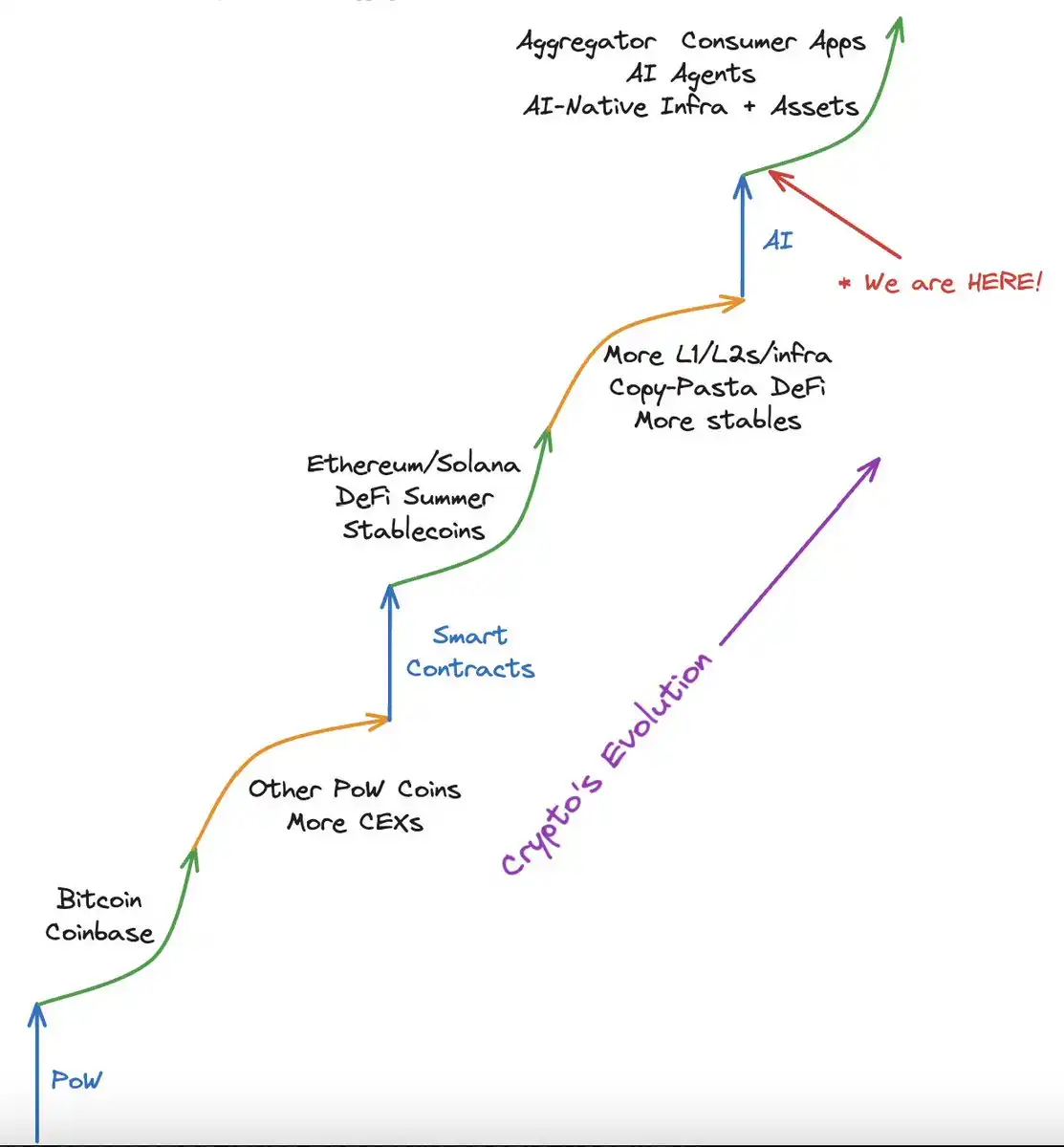
The first leap forward in the crypto space began with the innovation at the consensus layer: the invention of Bitcoin and Proof of Work (PoW). This wave of innovation (roughly from 2009 to 2014) propelled the total crypto market capitalization to grow over 10,000 times, surging from about $750,000 to around $7.5 billion.
The second leap forward occurred at the execution layer, with the emergence of smart contracts enabling blockchain programmability. Today, most infrastructure (L1, L2, etc.) and applications (tokens, stablecoins, DeFi, etc.) are built on this core primitive. This wave of innovation (roughly from 2014 to present) expanded the total crypto market capitalization by about 500 times, reaching around $3.5 trillion, with projects born in this wave holding a staggering 43% (about $1.5 trillion) of the total market cap.
However, progress has once again stabilized. Why? Here are my (potentially controversial) views:
Everything that can be built on smart contracts may have already been built. Even the recent trend of meme coins is just a "mash-up" of existing building blocks (such as tokens, bond curves, NFT mania), rather than a completely new invention.
Smart contracts have become the core bottleneck of user experience (UX). Cryptographic applications must interact directly with smart contracts, shifting complexity to the user. Users need to understand the contract's location, function, interaction method, and also sign transactions, pay gas fees, etc.
Fortunately, the next transformative improvement is already here—bringing innovation at the application layer through enhanced usability.
AI Will Become Cryptography's Frontend
Every new technology requires a suitable "frontend" (or user experience layer) to abstract complexity in a localized manner and integrate functionality. For example:
· Personal computers have GUI and operating systems;
· The Internet has web browsers and FAANG;
· Mobile devices have native apps and app stores.
AI will become this user experience layer in the cryptographic field, providing an order-of-magnitude better user experience for cryptographic infrastructure to promote broader adoption. The reason I hold this view is that AI can abstract the biggest user experience challenge in cryptography:
· Onboarding: Lowering the threshold for users to interact with cryptography;
· Execution: Simplifying operations that typically require multiple discrete steps, with LLM having an advantage in this aspect;
· Discovery: Helping users find suitable applications and features.
By 2030, I anticipate that 40% of the global population will have completed on-chain transactions, with over 95% of on-chain transactions being completed through AI. By then, users will be using applications based on cryptographic technology without consciously realizing that it is cryptography that drives them.
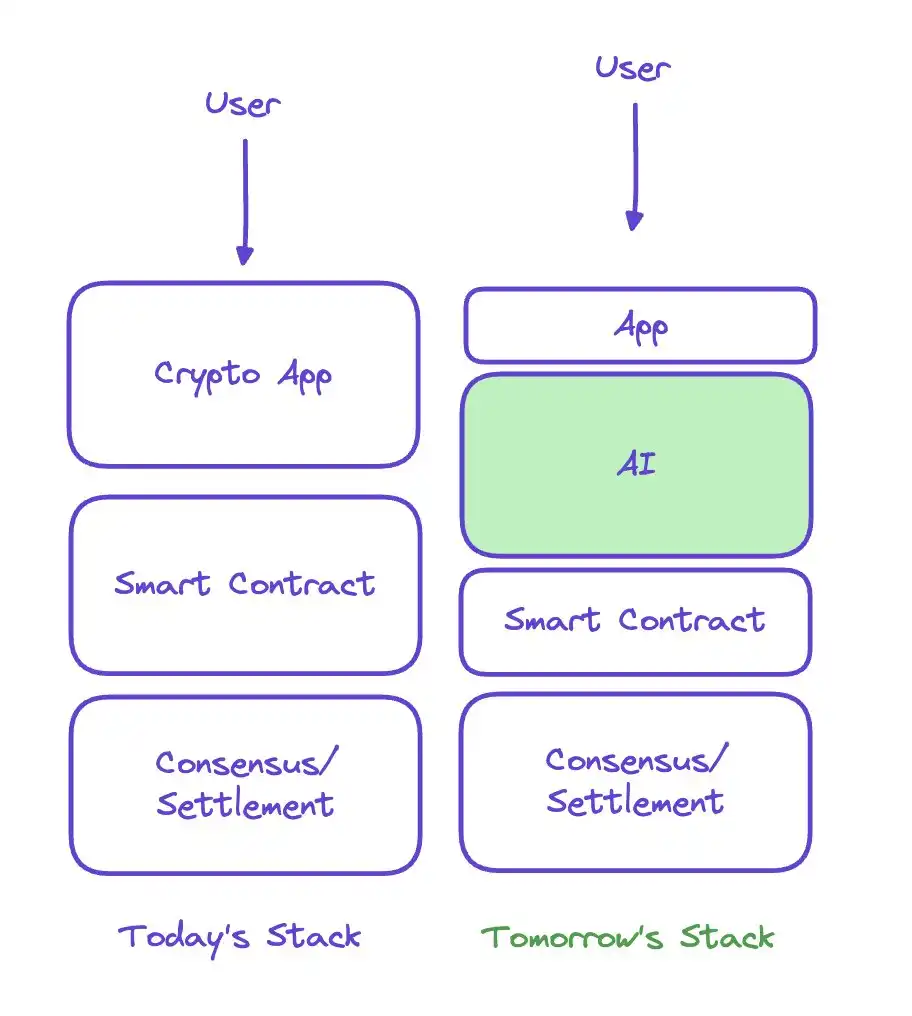
To achieve this, AI will become the "connecting organization" between the application layer and the cryptographic infrastructure, working together upward and downward in the tech stack. In the future, applications will interact directly with multiple AI agents and models, and these AI agents will aggregate on behalf of users and execute on-chain operations. Smart contracts will also evolve into forms integrated natively with AI, such as "smart tokens," providing a generative and customized experience rather than the uniform and deterministic patterns we see today.
When you look at cryptographic applications from the perspective of AI, everything becomes clear. For example, the next generation of super financial applications may leverage AI to aggregate information, make proactive recommendations, and execute DeFi operations based on the user's intent, preferences (such as security, yield, etc.), and real-time market predictions. Users won't need to understand what L1/L2 is, won't need to remember the names of protocols or assets, and won't need to know how cross-chain bridges work and other complex details.
Even more exciting, this future is just beginning to take shape.
So, who will emerge as the biggest winner?
As AI unleashes its innovative power at the application layer, the answer seems quite clear: it's all about the applications, applications, applications! (Of course, with some infrastructure play as well.) As David points out below, we're already starting to see a shift from the infrastructure cycle to the application cycle, and AI will only further accelerate this transition.
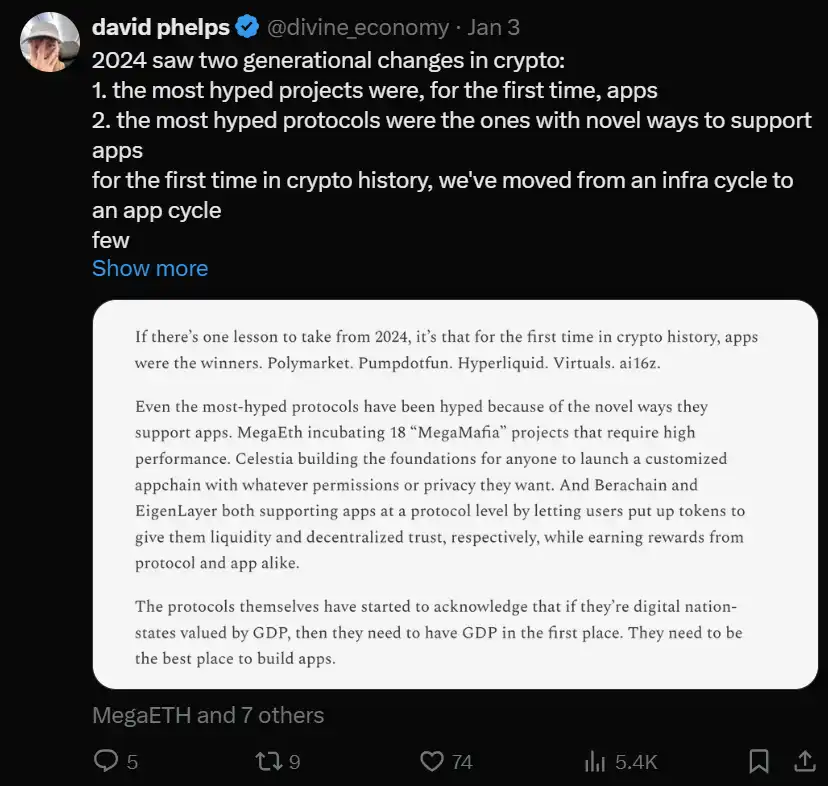
In the crypto space, there are four types of products that particularly excite me, each of which has significant asymmetric potential in its early stages:
1. Aggregators, a.k.a. Super Apps
I predict that the "FAANG of the Crypto Space" will emerge: Super apps that simplify the on-chain user experience through proxies, directly engage with users, and vertically integrate infrastructure, making applications more robust. By becoming infrastructure providers (similar to Amazon or Google), they attract developers, while demonstrating monopolistic advantages in their respective domains (e.g., search and advertising, finance, commerce, social, etc.).
Just as today's FAANG drives about 20% of the S&P 500's value, I also expect this category to follow a power-law distribution, capturing a similar proportion of the crypto market's total market cap by 2030: a conservative estimate of hundreds of billions, with an optimistic prediction reaching trillions in market opportunity.
In this field, I am particularly bullish on DeFi (or as the younger generation calls it, DeFAI) as a killer app scenario: imagine a next-generation financial super app where users can seamlessly access all on-chain financial assets, receive investment advice or insights, perform real-time sentiment analysis, and directly execute user intent. Additionally, the "Google of the Crypto Space" is equally anticipated, tackling the discovery problem of crypto applications and assets through a design similar to the "PageRank" algorithm, monetizing through advertising or innovative value flows.
The winners in this category will create unprecedented outcomes because they possess a key factor that Web2 super apps have never had: tokens. Tokens in the crypto space have proven to be an undeniable product-market fit (PMF), capable of attracting broad attention from users, investors, and believers, and occupying mindshare.
2. Agents as a Service (Agents as SaaS)
I am excited about AI agents that excel in a specific field, which can be combined through aggregators or other agents, similar to today's SaaS or financial products.
For example, a fully autonomous agent could accept liquidity and invest it in the crypto market (acting both as a top-tier high-liquidity trader and participating in the best-performing projects on Echo), all while charging lower fees than an ETF or fund. Alternatively, an agent could achieve excess returns in prediction markets or sports betting markets. Another example is a tool like aixbt that provides high-value market and investment research.
These agents will democratize market access through on-chain assets (such as dollars, real-world assets, etc.) and strategies (quantitative, venture capital, etc.), making previously inaccessible markets more reachable.
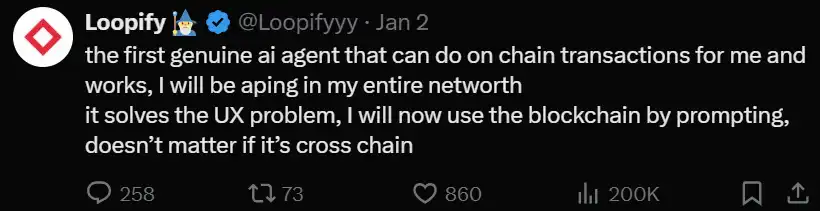
This is not limited to the financial sector alone. Imagine a world where an AI doctor, trained specifically for a patient's profile, can directly interface with insurance companies through a crypto payment system and issue low-risk prescriptions. Or, an insurance agent could find the cheapest insurance for your home. Of course, there is still a long way to go to achieve these scenarios (after all, most agents currently can't even handle basic on-chain interactions).
However, with innovations from these agents in user acquisition, value capture, and pricing mechanisms (e.g., users needing to hold 100 AIXBT to access premium services), the opportunities will be endless. As these developments unfold, I also anticipate significant opportunities in the agent market, akin to "the eBay or OpenSea of this world."
3. AI-native Infrastructure
The next-generation critical infrastructure opportunity (e.g., L1) will no longer focus on speed or cost but will instead provide an order-of-magnitude improvement in user experience. By leveraging AI agents and AI-powered smart contracts at its core, the new infrastructure will natively support efficient on-chain reasoning, verifiable off-chain reasoning (leveraging trusted execution environments [TEEs]), semi-autonomous AI agents supporting smart accounts (with built-in security limits), computation/training access, and bidirectional agent-value flow capabilities, empowering collaborative group efforts and the development of agentomics.
Similar to the current era of dApps, many agents from the aforementioned category 2 (especially long-tail agents) will deploy on these new L1s instead of managing their own infrastructure, thereby benefiting from the proximity and composability network effects. I am also excited about reimagining value capture mechanisms, MEV, and consensus mechanisms for this new generation of L1s (e.g., can agents become validators?).
This does not mean I am bearish on Ethereum, Solana, or other leading L1/L2 ecosystems. These ecosystems can and will introduce many of these features into their tech stacks over the next few years. However, I believe that L1s born in this era, more aligned with the needs of a new generation of developers, will have tremendous growth opportunities. Projects like ai16z and Virtuals have already served as early harbingers in this space, showcasing possible future forms and their potential market size.
The story of L1 may still have some excitement to come.
4. Smart Assets
Some of the most popular applications in the crypto space today (such as stablecoins, NFTs, ERC-20/SPL tokens) are essentially deterministic, static assets. They perform well for their designed purposes, but what if users could have smart assets that strive dynamically towards specific goals (such as more holders, higher value, etc.)?
Imagine a scenario where smart contracts could invoke a reasoning model on-chain to allow assets to dynamically adjust token supply, issuance schedules, burning or staking mechanisms, or other parameters that are currently hard-coded (or require social consensus for modification). Each token could even be customized based on the holder and their preferences, providing a whole new dimension of personalization.
I speculate that the earliest experiments with these assets will emerge in the NFT and DAO space. For example, an NFT that is 100% generated in every aspect (not just its media content); or a governance token that could, based on protocol history and holder preferences, represent users in drafting proposals or voting.
As the technology matures, the big winners in this category may still be focused on financial use cases. For instance, someday in the future, Ethena's USDE stablecoin may be able to dynamically adjust its synthetic dollar strategy based on macroeconomic conditions.
You may also like

Morning Report | OpenAI has submitted an S-1 registration statement draft to the U.S. SEC; Morpho completes $175 million financing

Galaxy Deep Research Report: How Hyperliquid's HIP-4 Upgrade Changes the Landscape of Prediction Markets?

Latest research from 13 top universities including Cornell University: The current state, challenges, and misconceptions of the fusion of Crypto and AI

Deconstructing Anthropic: The Best AI Company, Possibly Also a Type of Organizational Invention

Every exchange is a "Universal Exchange."

The counterattack of traditional finance: Alliance chains are quietly reviving
Pantera Capital Partner: How Tokenization is Restructuring the Private Equity and Early Investment Ecosystem?

Mastercard Launches Agent Pay for AI, Plans to Record AI Agent Payment Authorizations on Polygon
Mastercard launched Agent Pay for AI, a new payment protocol designed to help AI agents make small payments such as pay-per-use access to data and APIs. The system plans to record human-granted AI agent permissions on Polygon, focusing on verifiable authorization, identity, and payment controls.

Curve Deploys Llamalend v2 on Optimism With 250,000 OP Incentives
Curve launched Llamalend v2 on Optimism with 250,000 OP incentives from the Optimism Foundation. The upgrade expands Llamalend beyond its earlier crvUSD-focused model, adding broader collateral support, LlamaRisk market reviews, and the ability to use Curve LP tokens as collateral.

Raydium Old Liquidity Pool Reportedly Exploited, With $1.34 Million Moved to Ethereum and Tornado Cash
An old Raydium liquidity pool was reportedly exploited for around $1.34 million in USDC, RAY, and wSOL, with the stolen funds bridged to Ethereum and deposited into Tornado Cash. The incident highlights the tail risks of legacy DeFi pools, old contracts, and cross-chain fund laundering paths.
Kalshi Executive Challenges “SBF Backed AI Unicorns” Narrative, Says Leopold Aschenbrenner Was Key Figure
Kalshi executive John Wang questioned the “SBF backed AI unicorns” narrative, saying Leopold Aschenbrenner was the key figure behind major AI investment decisions.

New York Proposes Stricter Stablecoin Issuer Rules Aligned With Federal GENIUS Act
NYDFS proposed stricter stablecoin issuer rules aligned with the GENIUS Act, covering reserves, custody, redemption timelines, audits, and capital buffers.

CryptoQuant Says Bitcoin Profitable Supply Is Near 45% Pressure Zone as On-Chain Data Points to Market Repricing
CryptoQuant said Bitcoin’s profitable supply is nearing the 45% pressure zone, signaling rising market stress, unrealized losses, and a possible on-chain repricing phase.

Bitcoin Falls Below 200-Week Moving Average as On-Chain Data Shows Over Half of Supply in Loss
Bitcoin dropped below its 200-week moving average as on-chain data showed over 50% of circulating supply is now in loss, signaling rising market stress.

CFTC Reportedly Plans New Prediction Market Rules Focused on Manipulation Risk and Public Interest Review
The CFTC is reportedly preparing new prediction market rules focused on manipulation risk, public interest review, and retail trader protections.

Meet the new WEEX trial fund—your gateway to greater profits

WEEX Labs Lands at Dutch Blockchain Week: A Disruptive Crypto × AI Conversation Sets Sail in Amsterdam
SK Hynix Reportedly Plans U.S. ADR Listing as Early as August, With SEC Approval Possible in Late June
SK Hynix may pursue a U.S. ADR listing as early as August, with SEC approval reportedly possible in late June amid strong AI chip supply chain demand.
Morning Report | OpenAI has submitted an S-1 registration statement draft to the U.S. SEC; Morpho completes $175 million financing
Galaxy Deep Research Report: How Hyperliquid's HIP-4 Upgrade Changes the Landscape of Prediction Markets?
Latest research from 13 top universities including Cornell University: The current state, challenges, and misconceptions of the fusion of Crypto and AI
Deconstructing Anthropic: The Best AI Company, Possibly Also a Type of Organizational Invention
Every exchange is a "Universal Exchange."
The counterattack of traditional finance: Alliance chains are quietly reviving


