
 Buy Crypto
- Markets
 Futures
- Spot
- Copy Trade
- Earn
- More
If the Bitcoin Reserve Bill is passed, it may bring an end to the cryptocurrency's four-year boom-bust cycle.

Original Title: A Bitcoin Reserve Act may end crypto's 4-year boom-bust cycle
Original Author: DANIEL RAMIREZ-ESCUDERO, Cointelegraph
Original Translation: Lawrence, MarsBit
The "Bitcoin Reserve Act" may break the halving cycle. Will this four-year cycle unfold in a different way? Are we entering a mythical supercycle?
Speculation is growing that the incoming President Donald Trump may sign an executive order on his first day in office to announce the establishment of a Bitcoin reserve, or establish a reserve through legislation during his term, leaving many wondering whether this move could lead to a cryptocurrency supercycle.
Since Wyoming Senator Cynthia Lummis introduced the "Bitcoin Reserve Act" earlier this year, states like Texas and Pennsylvania have also introduced similar proposals. Reports indicate that Russia, Thailand, and Germany are also considering their own proposals, further intensifying the pressure.
If governments around the world are all rushing to secure their own Bitcoin reserves, will we bid farewell to what many believe is the cryptocurrency price's four-year boom-bust cycle caused by Bitcoin halving?
Analyst Iliya Kalchev from cryptocurrency lending institution Nexo believes that the "Bitcoin Reserve Act" could be a milestone moment for Bitcoin, indicating its "recognition as a legitimate global financial instrument."
"Every Bitcoin cycle has had this kind of narrative, attempting to push the idea of 'this time it's different.' The conditions have never been more ideal. Cryptocurrency has never had a pro-crypto U.S. President with control of the Senate and Congress."
Lummis' proposed 2024 Bitcoin bill would allow the U.S. government to introduce Bitcoin by purchasing 200,000 BTC per year over five years to deposit it as a reserve asset in its treasury, accumulating 1 million BTC, and holding it for at least 20 years.
Jack Mallers, the founder and CEO of Strike, believes that Trump "could potentially utilize an executive order to purchase Bitcoin," but he warns that this does not equate to purchasing 1 million Bitcoin.
The co-founder of the Satoshi Act Fund, a non-profit organization supporting US policy bills favorable to Bitcoin, Dennis Porter, also believes that Trump is exploring establishing a strategic Bitcoin reserve through an executive order.
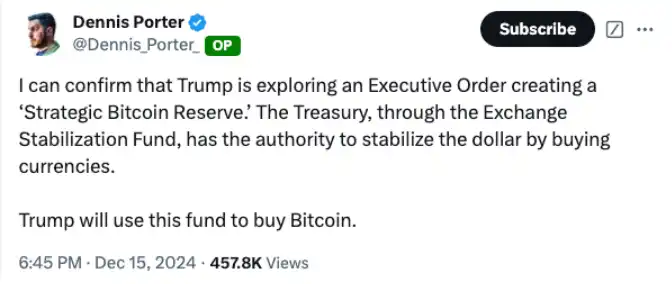
Dennis Porter announced that Trump is looking into an executive order regarding a strategic Bitcoin reserve. Source: Dennis Porter
So far, Trump's team has not directly confirmed the rumor about the executive order. However, when asked on CNBC whether the US would create a BTC reserve similar to its oil reserve (which could imply legislation), Trump replied, "Yes, I think so."
However, executive orders lack stability as subsequent presidents often overturn such orders. The only way to ensure a strategic Bitcoin reserve for the long term future is through legislation supported by a majority.
With the Republican Party in control of Congress, holding a slim majority in the Senate, Bitcoin proponents in Trump's team have ample reason to advocate for the Lummis bill. However, as long as a few Republican defectors are swayed by progressive voices, they may block the bill, believing it hands over government wealth to Bitcoin holders.
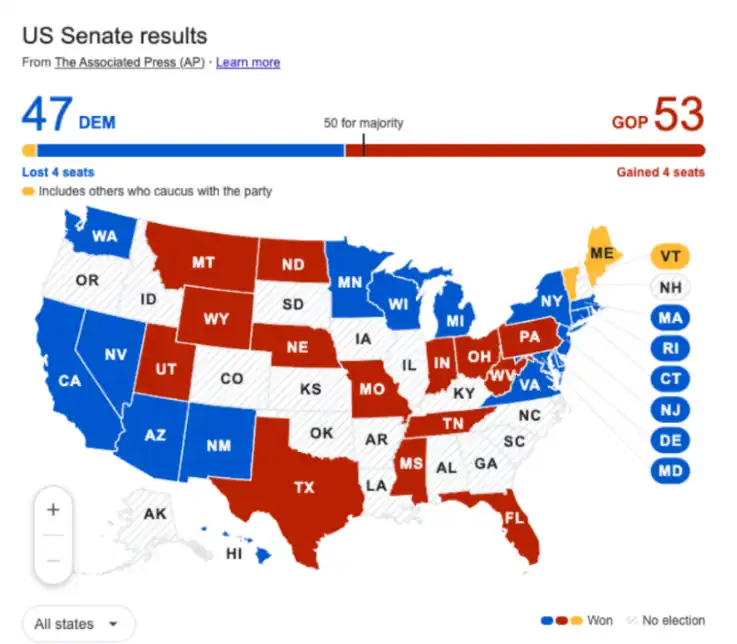
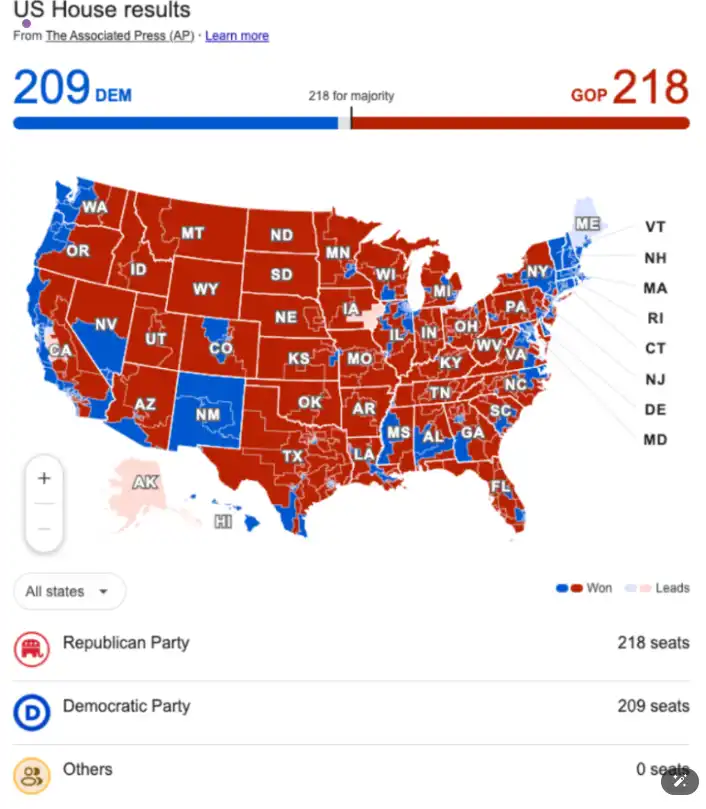
Election results for the US Senate and House of Representatives after the 2024 elections. Source: Associated Press
Avoid Comparing This Cycle to Previous Ones
At the beginning of this month, Alex Krüger, founder of macro digital asset consulting firm Asgard Markets and an economist, stated that the election results made him believe "Bitcoin is very likely entering a super-cycle."
He believes that Bitcoin's unique situation can be compared to that of gold. Following former US President Richard Nixon's announcement of abandoning the gold standard, ending the Bretton Woods system, Bitcoin's price surged from $35 per ounce in 1971 to $850 in 1981.
Krüger does not rule out the possibility of Bitcoin going through a bear market as it has in the past. However, he urges cryptocurrency investors "not to compare this cycle to previous cycles," as this time may be different.
Trump's actions so far undeniably indicate that government policy will move in a favorable direction. After Gary stepped down, he nominated Paul Atkins, a supporter of cryptocurrency and deregulation, as the chairman of the U.S. Securities and Exchange Commission.
He also nominated cryptocurrency supporter Scott Bessent as Treasury Secretary and appointed former PayPal COO David Sacks as the AI and cryptocurrency czar, tasked with developing a clear legal framework for the cryptocurrency industry.
Super Cycle Theory Has Never Seen Super Success
However, the concept of "this time is different" has emerged in every past Bitcoin bull market, with narratives around mainstream and institutional adoption as support each time.
During the 2013-2014 bull market, the Super Cycle Theory gained support as a theory that Bitcoin would become an internationally prominent alternative asset to fiat currency.
During the 2017-2018 cycle, the rapid price increase was seen as a sign of mainstream financial adoption and the beginning of Bitcoin's mainstream acceptance, with institutional interest expected to flourish.
During the 2020-2021 cycle, as tech companies like MicroStrategy, Square, and Tesla entered the Bitcoin market, they believed many tech-related companies would follow suit.
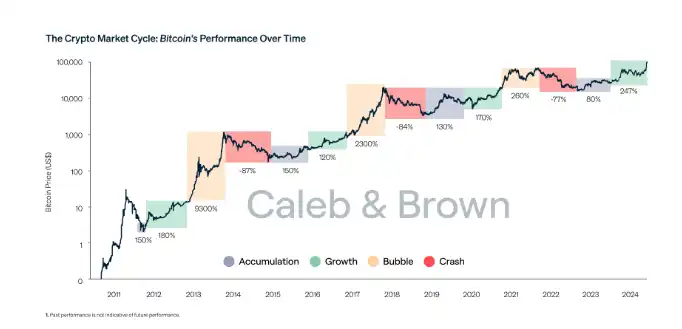
Bitcoin's price performance reached peaks and valleys in the previous cycles. Data Source: Caleb & Brown
However, in each cycle, the narrative of the super cycle has failed to materialize, ultimately leading to price crashes, with supporters going bust and entering a long bear market. Su Zhu, co-founder of Three Arrows Capital, is the most famous proponent of the 2021 super cycle theory, believing that even without a sustained bear market, the cryptocurrency market will remain in a bull market, with Bitcoin eventually reaching a peak of $5 million.
3AC did indeed borrow money, as if the super cycle theory were true, and when it was eventually liquidated, the cryptocurrency market cap plummeted by nearly 50% on that news, causing a collapse that led to lenders such as Voyager Digital, Genesis Trading, and BlockFi declaring bankruptcy and facing financial difficulties.
Therefore, the supercycle is a dangerous theory and should not be the basis for gambling your life savings.
For Chris Brunsike, a partner at the venture capital firm Placeholder and former Blockchain Product Lead at ARK Invest, the Bitcoin supercycle is nothing but a myth.
The supercycle is undoubtedly a mass delusion. Nevertheless, considering the support from the U.S. President, the U.S. election results have provided unprecedented and extremely bullish conditions for Bitcoin, with the U.S. President seemingly fulfilling his commitment to supporting cryptocurrencies, including a pledge to never sell the Bitcoin held in the U.S. reserves.
Potential Global Domino Effect
If the "Bitcoin Reserves Bill" is passed, it could trigger a global race to hold Bitcoin, with other countries following suit to avoid falling behind.
George S. Georgiades, a lawyer who switched from providing financing advice to Wall Street companies in 2016 to serving the cryptocurrency industry, told Cointelegraph that enacting the "Bitcoin Reserves Bill" would "mark a turning point in global Bitcoin adoption" and could potentially "trigger other countries and private institutions to follow suit, driving broader adoption and enhancing market liquidity."
Basel Ismail, CEO of the crypto investment analysis platform Blockcircle, agreed and stated that approval would be "one of the most exciting events in crypto history" as "it will catalyze a race to acquire as much Bitcoin as possible."
Other countries will have no say; they will be forced to act. Either pivot, compete, or perish. He believes that "most countries in the G20, the world's most powerful and economically advanced countries, will also mimic and build their reserves."
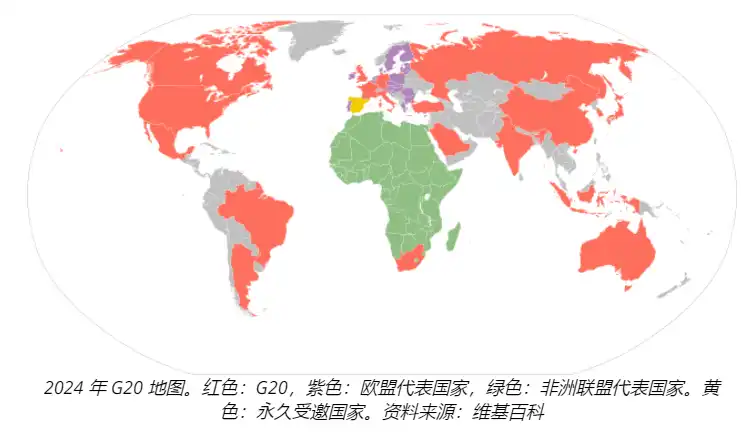
Seasoned cryptocurrency investor and Bitcoin educator Chris Dunn told Cointelegraph that this FOMO-driven frenzy of countries racing to buy in may completely alter the current cryptocurrency market cycle.
If the U.S. or other major economic powers start accumulating, Bitcoin could set off FOMO, potentially creating a market cycle and supply-demand dynamic unlike anything we have seen before.
OKX Exchange CEO Hong Fang told Cointelegraph that other countries may already be prepared for such a race.
Game theory is likely already at play.
However, Ismail noted that most Bitcoin purchases will be conducted through over-the-counter brokers and settled in large trades, so "it may not have a direct impact on Bitcoin's price," but it will create a persistent demand force that will ultimately drive up Bitcoin's price.
A New Wave of Cryptocurrency Investors Could Change the Dynamics of the Cryptocurrency Market
If countries become market buyers, the Bitcoin market could undergo a fundamental transformation. A new wave of investors from global financial centers will enter the cryptocurrency market, altering market dynamics, psychology, and reactions to certain events.
Nexo analyst Kalchev stated that while this legislation may disrupt Bitcoin's well-known four-year halving cycle, it is speculative, but several dynamic changes may occur.
Bitcoin is a unique market, driven so far by retail trading, with prices strongly reacting to market psychology. The emergence of new types of investors could change market dynamics, altering historical cycles.
Ismail believes that "investor behavior in the stock market will be different from" the overreacting retail investors. Institutional investors have substantial funds and advanced risk management strategies, enabling them to treat Bitcoin differently from retail investors.
Over time, Wall Street's participation will help create a more stable, less reactive market environment. Stability is another way of saying reduced volatility, which logically means that bear markets will not be as intense as in past cycles.
Georgeades believes that "the price cycle will continue," but "sustained demand from large-scale buyers like the United States can reduce volatility and the fluctuations we have seen in past cycles."
Meanwhile, Ismail pointed out that Bitcoin's market performance has already been different from previous four-year cycles. Bitcoin's price in the current cycle fell below the previous cycle's all-time high (ATH), "everyone thought this was impossible," and then, prior to the official halving, Bitcoin set a new all-time high.
The Four-Year Cycle Has Been Exposed and Broken Several Times
So far, Bitcoin has only undergone four halvings, with nearly thirty halving events yet to occur. "It's hard to imagine all these halvings following the same predictable four-year pattern," Kalchev said, especially as broader macroeconomic and political factors (such as central bank policies and regulatory developments) have a greater impact on Bitcoin's market trends.
Kalchev believes that the price of Bitcoin will no longer be as influenced by internal mechanisms such as halving, but more by external factors such as institutional adoption and geopolitical events.
You may also like

Why can this institution still grow by 150% when the scale of leading crypto VCs has shrunk significantly?

Anthropic's $1 trillion, compared to DeepSeek's $100 billion

Geopolitical Risk Persists, Is Bitcoin Becoming a Key Barometer?

Annualized 11.5%, Wall Street Buzzing: Is MicroStrategy's STRC Bitcoin's Savior or Destroyer?

An Obscure Open Source AI Tool Alerted on Kelp DAO's $292 million Bug 12 Days Ago

Mixin has launched USTD-margined perpetual contracts, bringing derivative trading into the chat scene.
The privacy-focused crypto wallet Mixin announced today the launch of its U-based perpetual contract (a derivative priced in USDT). Unlike traditional exchanges, Mixin has taken a new approach by "liberating" derivative trading from isolated matching engines and embedding it into the instant messaging environment.
Users can directly open positions within the app with leverage of up to 200x, while sharing positions, discussing strategies, and copy trading within private communities. Trading, social interaction, and asset management are integrated into the same interface.
Based on its non-custodial architecture, Mixin has eliminated friction from the traditional onboarding process, allowing users to participate in perpetual contract trading without identity verification.
The trading process has been streamlined into five steps:
· Choose the trading asset
· Select long or short
· Input position size and leverage
· Confirm order details
· Confirm and open the position
The interface provides real-time visualization of price, position, and profit and loss (PnL), allowing users to complete trades without switching between multiple modules.
Mixin has directly integrated social features into the derivative trading environment. Users can create private trading communities and interact around real-time positions:
· End-to-end encrypted private groups supporting up to 1024 members
· End-to-end encrypted voice communication
· One-click position sharing
· One-click trade copying
On the execution side, Mixin aggregates liquidity from multiple sources and accesses decentralized protocol and external market liquidity through a unified trading interface.
By combining social interaction with trade execution, Mixin enables users to collaborate, share, and execute trading strategies instantly within the same environment.
Mixin has also introduced a referral incentive system based on trading behavior:
· Users can join with an invite code
· Up to 60% of trading fees as referral rewards
· Incentive mechanism designed for long-term, sustainable earnings
This model aims to drive user-driven network expansion and organic growth.
Mixin's derivative transactions are built on top of its existing self-custody wallet infrastructure, with core features including:
· Separation of transaction account and asset storage
· User full control over assets
· Platform does not custody user funds
· Built-in privacy mechanisms to reduce data exposure
The system aims to strike a balance between transaction efficiency, asset security, and privacy protection.
Against the background of perpetual contracts becoming a mainstream trading tool, Mixin is exploring a different development direction by lowering barriers, enhancing social and privacy attributes.
The platform does not only view transactions as execution actions but positions them as a networked activity: transactions have social attributes, strategies can be shared, and relationships between individuals also become part of the financial system.
Mixin's design is based on a user-initiated, user-controlled model. The platform neither custodies assets nor executes transactions on behalf of users.
This model aligns with a statement issued by the U.S. Securities and Exchange Commission (SEC) on April 13, 2026, titled "Staff Statement on Whether Partial User Interface Used in Preparing Cryptocurrency Securities Transactions May Require Broker-Dealer Registration."
The statement indicates that, under the premise where transactions are entirely initiated and controlled by users, non-custodial service providers that offer neutral interfaces may not need to register as broker-dealers or exchanges.
Mixin is a decentralized, self-custodial privacy wallet designed to provide secure and efficient digital asset management services.
Its core capabilities include:
· Aggregation: integrating multi-chain assets and routing between different transaction paths to simplify user operations
· High liquidity access: connecting to various liquidity sources, including decentralized protocols and external markets
· Decentralization: achieving full user control over assets without relying on custodial intermediaries
· Privacy protection: safeguarding assets and data through MPC, CryptoNote, and end-to-end encrypted communication
Mixin has been in operation for over 8 years, supporting over 40 blockchains and more than 10,000 assets, with a global user base exceeding 10 million and an on-chain self-custodied asset scale of over $1 billion.

$600 million stolen in 20 days, ushering in the era of AI hackers in the crypto world
Vitalik's 2026 Hong Kong Web3 Summit Speech: Ethereum's Ultimate Vision as the "World Computer" and Future Roadmap
On the same day Aave introduced rsETH, why did Spark decide to exit?
Full Post-Mortem of the KelpDAO Incident: Why Did Aave, Which Was Not Compromised, End Up in Crisis Situation?

After a $290 million DeFi liquidation, is the security promise still there?
ZachXBT's post ignites RAVE nearing zero, what is the truth behind the insider control?

Vitalik 2026 Hong Kong Web3 Carnival Speech Transcript: We do not compete on speed; security and decentralization are the core
In-depth Analysis of RAVE Events: Short Squeeze, Crash, and Quantitative Financial Models of Liquidity Manipulation

Eve of Ceasefire, US Military Fires on Iranian Vessel | Rewire News Morning Brief

Figma's stock price drops over 7%, will Claude Design be the terminator?

Plunge by 10% Followed by Rebound, Weekend Oil Market Watch

SpaceX Mascot ASTEROID Fast Track $170 million, Stemming from an Unfinished Space Dream
Why can this institution still grow by 150% when the scale of leading crypto VCs has shrunk significantly?
Anthropic's $1 trillion, compared to DeepSeek's $100 billion
Geopolitical Risk Persists, Is Bitcoin Becoming a Key Barometer?
Annualized 11.5%, Wall Street Buzzing: Is MicroStrategy's STRC Bitcoin's Savior or Destroyer?
An Obscure Open Source AI Tool Alerted on Kelp DAO's $292 million Bug 12 Days Ago
Mixin has launched USTD-margined perpetual contracts, bringing derivative trading into the chat scene.
The privacy-focused crypto wallet Mixin announced today the launch of its U-based perpetual contract (a derivative priced in USDT). Unlike traditional exchanges, Mixin has taken a new approach by "liberating" derivative trading from isolated matching engines and embedding it into the instant messaging environment.
Users can directly open positions within the app with leverage of up to 200x, while sharing positions, discussing strategies, and copy trading within private communities. Trading, social interaction, and asset management are integrated into the same interface.
Based on its non-custodial architecture, Mixin has eliminated friction from the traditional onboarding process, allowing users to participate in perpetual contract trading without identity verification.
The trading process has been streamlined into five steps:
· Choose the trading asset
· Select long or short
· Input position size and leverage
· Confirm order details
· Confirm and open the position
The interface provides real-time visualization of price, position, and profit and loss (PnL), allowing users to complete trades without switching between multiple modules.
Mixin has directly integrated social features into the derivative trading environment. Users can create private trading communities and interact around real-time positions:
· End-to-end encrypted private groups supporting up to 1024 members
· End-to-end encrypted voice communication
· One-click position sharing
· One-click trade copying
On the execution side, Mixin aggregates liquidity from multiple sources and accesses decentralized protocol and external market liquidity through a unified trading interface.
By combining social interaction with trade execution, Mixin enables users to collaborate, share, and execute trading strategies instantly within the same environment.
Mixin has also introduced a referral incentive system based on trading behavior:
· Users can join with an invite code
· Up to 60% of trading fees as referral rewards
· Incentive mechanism designed for long-term, sustainable earnings
This model aims to drive user-driven network expansion and organic growth.
Mixin's derivative transactions are built on top of its existing self-custody wallet infrastructure, with core features including:
· Separation of transaction account and asset storage
· User full control over assets
· Platform does not custody user funds
· Built-in privacy mechanisms to reduce data exposure
The system aims to strike a balance between transaction efficiency, asset security, and privacy protection.
Against the background of perpetual contracts becoming a mainstream trading tool, Mixin is exploring a different development direction by lowering barriers, enhancing social and privacy attributes.
The platform does not only view transactions as execution actions but positions them as a networked activity: transactions have social attributes, strategies can be shared, and relationships between individuals also become part of the financial system.
Mixin's design is based on a user-initiated, user-controlled model. The platform neither custodies assets nor executes transactions on behalf of users.
This model aligns with a statement issued by the U.S. Securities and Exchange Commission (SEC) on April 13, 2026, titled "Staff Statement on Whether Partial User Interface Used in Preparing Cryptocurrency Securities Transactions May Require Broker-Dealer Registration."
The statement indicates that, under the premise where transactions are entirely initiated and controlled by users, non-custodial service providers that offer neutral interfaces may not need to register as broker-dealers or exchanges.
Mixin is a decentralized, self-custodial privacy wallet designed to provide secure and efficient digital asset management services.
Its core capabilities include:
· Aggregation: integrating multi-chain assets and routing between different transaction paths to simplify user operations
· High liquidity access: connecting to various liquidity sources, including decentralized protocols and external markets
· Decentralization: achieving full user control over assets without relying on custodial intermediaries
· Privacy protection: safeguarding assets and data through MPC, CryptoNote, and end-to-end encrypted communication
Mixin has been in operation for over 8 years, supporting over 40 blockchains and more than 10,000 assets, with a global user base exceeding 10 million and an on-chain self-custodied asset scale of over $1 billion.



 App
App