
 Buy Crypto
- Markets
 Futures
- Spot
- Copy Trade
- Earn
- More
Historical Perspective: The 12 Months Post-Election Are Typically the Golden Period of a Crypto Bull Market

Original Article Title: Republican Victory Ushers in a New Era for Crypto
Original Article Author: Kelvin Koh, Spartan Group
Original Article Translation: Fu Ruhe, Odaily Planet Daily
The 2024 U.S. presidential election has become one of the most watched elections in recent years. Despite widespread expectations of a fiercely contested election, the election results still took many by surprise. Not only did Trump convincingly win the presidential election, but the Republican Party also secured a majority in both the Senate and the House. Such a sweeping victory will give the Republican Party enough political leverage to drive multiple reforms in the coming years. The cryptocurrency field is expected to undergo significant changes, and we believe the next 12 months will be a bullish period for crypto assets.
One key difference in the 2024 election compared to the past is the emergence of a "crypto agenda," with the winning president and his core advisory team holding a crypto-friendly stance. Crypto companies strongly supported Trump and key Republican candidates through donations. Therefore, it is not surprising that the crypto industry has become one of the major beneficiaries of the Republican Party's resounding victory.
There has been much discussion about the significance of this election for the crypto industry, but here are some of the key impacts:
· Changes in SEC Policy. Under Gary Gensler's leadership, the SEC and other appointed officials of the Biden administration have implemented aggressive regulation on the crypto industry. Despite industry calls for regulatory guidance, the SEC has continued to pursue enforcement actions. During Gensler's tenure, over 2,700 enforcement actions were initiated, resulting in total fines of up to $210 billion. This has made it difficult for many projects to operate in the U.S. Trump clearly stated during his campaign that if elected, he would replace Gensler. As expected, last week Gensler announced that he would step down as SEC chairman on January 20, 2025. Several nominees have already been named to succeed him, and they are generally seen as more supportive of the crypto industry. This means that existing enforcement actions may be reversed, and the SEC will adopt a more cooperative regulatory approach.
· Improvement in Congressional Environment. In the past, a major challenge facing the crypto industry was the difficulty of passing any favorable bills in the U.S. Congress, as most lawmakers lacked an understanding of cryptocurrency. However, after this election, about two-thirds of Congress members are considered crypto-friendly. This could lead to a regulatory framework that supports innovation, making it easier for projects to raise funds and clearing obstacles for institutional capital to enter the crypto space.
· Proposal for a Strategic Bitcoin Reserve. During his campaign, Trump mentioned to his crypto supporters that if elected, he would push for the establishment of a Strategic Bitcoin Reserve instead of having the U.S. government continue to dispose of previously seized bitcoins. This proposal quickly gained attention after the election. If this proposal were to be implemented, the market would start speculating whether this means the U.S. government would become a net buyer rather than a seller of Bitcoin. If MicroStrategy alone can influence the price of Bitcoin, imagine the impact of the U.S. government establishing a Strategic Bitcoin Reserve. More importantly, how would other countries react to this? Would they also come up with similar plans?
· Support for DeFi. Even before the election, a team supported by Trump had launched World Liberty Financial in September 2024, aiming to provide decentralized lending services and governance through the native token WLF. The project has raised over $50 million to date, with the latest investment coming from crypto entrepreneur Justin Sun, who invested $30 million this week. WLF plans to raise a total of $300 million. Whether it reaches $300 million or $50 million, the significance of this project goes far beyond the amount raised—it has provided a huge boost to DeFi developers and innovators. Importantly, a DeFi project supported by the incoming U.S. president will have a profound impact on the entire industry.
Each of the above events alone is enough to have a significant driving force on the crypto market, and the combined impact of these events on the crypto industry is profound. The market has not yet fully reflected the potential impact of these changes, which is why the U.S. media refers to this period as the "golden age of crypto."
In addition to all of the above, Trump has also expressed his desire for the U.S. to become the "global capital of crypto." To some extent, the U.S. is already the de facto leading crypto nation. Many major infrastructure projects, some of the largest blockchain infrastructure companies, and decentralized applications originated in the U.S. The U.S. also has the world's largest licensed cryptocurrency exchanges, the largest crypto investment banks, and the largest Web3 venture capital pool. Furthermore, the U.S. controls around 40% of the global Bitcoin mining hash rate (compared to 17% in 2021), making it the largest center for Bitcoin mining, partly due to policy changes in China. Most of the world's crypto trading is also denominated in dollars, and major stablecoins are pegged to the dollar. Therefore, the U.S. is already a global crypto hub in many ways. However, if the U.S. government plans to consolidate or further expand its dominance, what does this mean for other governments, especially major financial centers like London, Tokyo, Dubai, and Hong Kong? More importantly, can Europe afford to miss out on the Web3 innovation era and once again lag behind after the Web2 era?
Some people may question whether Trump will actually fulfill these promises, but I believe the likelihood of fulfillment is high. Trump does not follow traditional rules, and the political leverage brought by this election victory is very strong. Additionally, Trump has two native cryptocurrency advisors—Elon Musk and JD Vance. The new Secretary of Commerce, Howard Lutnick, also serves as the Chairman and CEO of Cantor Fitzgerald, which has just acquired a 5% stake in Tether (the issuer of the world's largest stablecoin USDT). With a more crypto-friendly Congress, pushing forward these measures should not be difficult.
Historical Data: Strong Cryptocurrency Price Performance in the 12 Months Following the U.S. Election, Altcoins Outperform Bitcoin
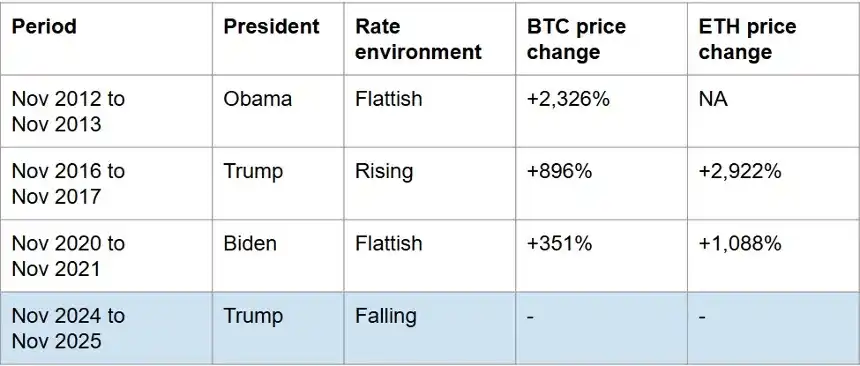
Against this background, discussing the impact of all this on cryptocurrency asset prices becomes particularly important. As seen in the table below, historically, the 12 months following a U.S. election have typically been a period of strong cryptocurrency price performance.
There are two main observations here:
· Regardless of who wins the presidential election and the interest rate environment, cryptocurrency assets have performed very well in the 12 months following the U.S. election. We attribute this to two factors:
a) Clarity brought by the election results and optimism about the new government;
b) The continued momentum of the Bitcoin halving cycle/cryptocurrency cycle.
· In the 12 months following the last two elections, altcoins (represented by ETH) have returned about three times as much as Bitcoin.
30 days after the 2024 election, Bitcoin rose by 46%, and Ethereum rose by 58%. We believe there is still significant upside potential in the next 11 months.
To better understand the opportunity with altcoins, let's look at the chart below, which shows the performance of altcoins relative to Bitcoin. It can be seen that there are stages within the cycle where altcoins significantly outperform Bitcoin. We refer to these stages as "altcoin cycles" or "altcoin seasons." The most recent major altcoin cycle occurred in January 2021 and peaked in November 2021. The previous cycle started in February 2017 and peaked in January 2018.

It is worth noting that these altcoin cycles roughly overlap with the 12-month period following the election. We believe the main reason is the strong price performance in the initial weeks after the election and the shift in investor sentiment towards risk appetite. Additionally, this trend has also attracted retail funds into the cryptocurrency asset class, with retail funds often preferring smaller and mid-sized tokens with higher risk due to the lack of liquidity constraints from institutional investors. Furthermore, at this point in the cycle, altcoins tend to underperform, making their risk-return profile more attractive compared to large-cap tokens. This is also the case in this cycle.
If this historical relationship holds, then we should expect the altcoin season to be imminent.
You may also like

Anthropic's $1 trillion, compared to DeepSeek's $100 billion

Geopolitical Risk Persists, Is Bitcoin Becoming a Key Barometer?

Annualized 11.5%, Wall Street Buzzing: Is MicroStrategy's STRC Bitcoin's Savior or Destroyer?

An Obscure Open Source AI Tool Alerted on Kelp DAO's $292 million Bug 12 Days Ago

Mixin has launched USTD-margined perpetual contracts, bringing derivative trading into the chat scene.
The privacy-focused crypto wallet Mixin announced today the launch of its U-based perpetual contract (a derivative priced in USDT). Unlike traditional exchanges, Mixin has taken a new approach by "liberating" derivative trading from isolated matching engines and embedding it into the instant messaging environment.
Users can directly open positions within the app with leverage of up to 200x, while sharing positions, discussing strategies, and copy trading within private communities. Trading, social interaction, and asset management are integrated into the same interface.
Based on its non-custodial architecture, Mixin has eliminated friction from the traditional onboarding process, allowing users to participate in perpetual contract trading without identity verification.
The trading process has been streamlined into five steps:
· Choose the trading asset
· Select long or short
· Input position size and leverage
· Confirm order details
· Confirm and open the position
The interface provides real-time visualization of price, position, and profit and loss (PnL), allowing users to complete trades without switching between multiple modules.
Mixin has directly integrated social features into the derivative trading environment. Users can create private trading communities and interact around real-time positions:
· End-to-end encrypted private groups supporting up to 1024 members
· End-to-end encrypted voice communication
· One-click position sharing
· One-click trade copying
On the execution side, Mixin aggregates liquidity from multiple sources and accesses decentralized protocol and external market liquidity through a unified trading interface.
By combining social interaction with trade execution, Mixin enables users to collaborate, share, and execute trading strategies instantly within the same environment.
Mixin has also introduced a referral incentive system based on trading behavior:
· Users can join with an invite code
· Up to 60% of trading fees as referral rewards
· Incentive mechanism designed for long-term, sustainable earnings
This model aims to drive user-driven network expansion and organic growth.
Mixin's derivative transactions are built on top of its existing self-custody wallet infrastructure, with core features including:
· Separation of transaction account and asset storage
· User full control over assets
· Platform does not custody user funds
· Built-in privacy mechanisms to reduce data exposure
The system aims to strike a balance between transaction efficiency, asset security, and privacy protection.
Against the background of perpetual contracts becoming a mainstream trading tool, Mixin is exploring a different development direction by lowering barriers, enhancing social and privacy attributes.
The platform does not only view transactions as execution actions but positions them as a networked activity: transactions have social attributes, strategies can be shared, and relationships between individuals also become part of the financial system.
Mixin's design is based on a user-initiated, user-controlled model. The platform neither custodies assets nor executes transactions on behalf of users.
This model aligns with a statement issued by the U.S. Securities and Exchange Commission (SEC) on April 13, 2026, titled "Staff Statement on Whether Partial User Interface Used in Preparing Cryptocurrency Securities Transactions May Require Broker-Dealer Registration."
The statement indicates that, under the premise where transactions are entirely initiated and controlled by users, non-custodial service providers that offer neutral interfaces may not need to register as broker-dealers or exchanges.
Mixin is a decentralized, self-custodial privacy wallet designed to provide secure and efficient digital asset management services.
Its core capabilities include:
· Aggregation: integrating multi-chain assets and routing between different transaction paths to simplify user operations
· High liquidity access: connecting to various liquidity sources, including decentralized protocols and external markets
· Decentralization: achieving full user control over assets without relying on custodial intermediaries
· Privacy protection: safeguarding assets and data through MPC, CryptoNote, and end-to-end encrypted communication
Mixin has been in operation for over 8 years, supporting over 40 blockchains and more than 10,000 assets, with a global user base exceeding 10 million and an on-chain self-custodied asset scale of over $1 billion.

$600 million stolen in 20 days, ushering in the era of AI hackers in the crypto world
Vitalik's 2026 Hong Kong Web3 Summit Speech: Ethereum's Ultimate Vision as the "World Computer" and Future Roadmap
On the same day Aave introduced rsETH, why did Spark decide to exit?
Full Post-Mortem of the KelpDAO Incident: Why Did Aave, Which Was Not Compromised, End Up in Crisis Situation?

After a $290 million DeFi liquidation, is the security promise still there?
ZachXBT's post ignites RAVE nearing zero, what is the truth behind the insider control?

Vitalik 2026 Hong Kong Web3 Carnival Speech Transcript: We do not compete on speed; security and decentralization are the core
In-depth Analysis of RAVE Events: Short Squeeze, Crash, and Quantitative Financial Models of Liquidity Manipulation

Eve of Ceasefire, US Military Fires on Iranian Vessel | Rewire News Morning Brief

Figma's stock price drops over 7%, will Claude Design be the terminator?

Plunge by 10% Followed by Rebound, Weekend Oil Market Watch

SpaceX Mascot ASTEROID Fast Track $170 million, Stemming from an Unfinished Space Dream

L1 is dead, Appchain should rise
Anthropic's $1 trillion, compared to DeepSeek's $100 billion
Geopolitical Risk Persists, Is Bitcoin Becoming a Key Barometer?
Annualized 11.5%, Wall Street Buzzing: Is MicroStrategy's STRC Bitcoin's Savior or Destroyer?
An Obscure Open Source AI Tool Alerted on Kelp DAO's $292 million Bug 12 Days Ago
Mixin has launched USTD-margined perpetual contracts, bringing derivative trading into the chat scene.
The privacy-focused crypto wallet Mixin announced today the launch of its U-based perpetual contract (a derivative priced in USDT). Unlike traditional exchanges, Mixin has taken a new approach by "liberating" derivative trading from isolated matching engines and embedding it into the instant messaging environment.
Users can directly open positions within the app with leverage of up to 200x, while sharing positions, discussing strategies, and copy trading within private communities. Trading, social interaction, and asset management are integrated into the same interface.
Based on its non-custodial architecture, Mixin has eliminated friction from the traditional onboarding process, allowing users to participate in perpetual contract trading without identity verification.
The trading process has been streamlined into five steps:
· Choose the trading asset
· Select long or short
· Input position size and leverage
· Confirm order details
· Confirm and open the position
The interface provides real-time visualization of price, position, and profit and loss (PnL), allowing users to complete trades without switching between multiple modules.
Mixin has directly integrated social features into the derivative trading environment. Users can create private trading communities and interact around real-time positions:
· End-to-end encrypted private groups supporting up to 1024 members
· End-to-end encrypted voice communication
· One-click position sharing
· One-click trade copying
On the execution side, Mixin aggregates liquidity from multiple sources and accesses decentralized protocol and external market liquidity through a unified trading interface.
By combining social interaction with trade execution, Mixin enables users to collaborate, share, and execute trading strategies instantly within the same environment.
Mixin has also introduced a referral incentive system based on trading behavior:
· Users can join with an invite code
· Up to 60% of trading fees as referral rewards
· Incentive mechanism designed for long-term, sustainable earnings
This model aims to drive user-driven network expansion and organic growth.
Mixin's derivative transactions are built on top of its existing self-custody wallet infrastructure, with core features including:
· Separation of transaction account and asset storage
· User full control over assets
· Platform does not custody user funds
· Built-in privacy mechanisms to reduce data exposure
The system aims to strike a balance between transaction efficiency, asset security, and privacy protection.
Against the background of perpetual contracts becoming a mainstream trading tool, Mixin is exploring a different development direction by lowering barriers, enhancing social and privacy attributes.
The platform does not only view transactions as execution actions but positions them as a networked activity: transactions have social attributes, strategies can be shared, and relationships between individuals also become part of the financial system.
Mixin's design is based on a user-initiated, user-controlled model. The platform neither custodies assets nor executes transactions on behalf of users.
This model aligns with a statement issued by the U.S. Securities and Exchange Commission (SEC) on April 13, 2026, titled "Staff Statement on Whether Partial User Interface Used in Preparing Cryptocurrency Securities Transactions May Require Broker-Dealer Registration."
The statement indicates that, under the premise where transactions are entirely initiated and controlled by users, non-custodial service providers that offer neutral interfaces may not need to register as broker-dealers or exchanges.
Mixin is a decentralized, self-custodial privacy wallet designed to provide secure and efficient digital asset management services.
Its core capabilities include:
· Aggregation: integrating multi-chain assets and routing between different transaction paths to simplify user operations
· High liquidity access: connecting to various liquidity sources, including decentralized protocols and external markets
· Decentralization: achieving full user control over assets without relying on custodial intermediaries
· Privacy protection: safeguarding assets and data through MPC, CryptoNote, and end-to-end encrypted communication
Mixin has been in operation for over 8 years, supporting over 40 blockchains and more than 10,000 assets, with a global user base exceeding 10 million and an on-chain self-custodied asset scale of over $1 billion.



 App
App