
Google's quantum chip Willow has been released. Will it pose a threat to Bitcoin?



Original title: "Google's quantum chip Willow is launched. Under the threat of super computing power, will it freeze the 1 million bitcoins held by Satoshi Nakamoto to ensure safety?"
Original author: Weilin, PANews
On December 10, Google introduced its latest quantum chip Willow in its official blog, which triggered another heated discussion in the crypto community on the topic of quantum computing attacks. Will quantum computing undermine the existing encryption security mechanism, especially posing a threat to mainstream cryptocurrencies such as Bitcoin?
Partly affected by the news, as of 14:20 on December 10, according to Coinglass data, a sharp crypto market pullback triggered a liquidation of $1.758 billion within 24 hours.
Google launches the latest quantum chip "Willow"
Google announced in a blog post that the "Willow" quantum chip has achieved two major achievements. First, as the number of quantum bits (qubits, the unit of measurement for quantum information) increases, Willow is able to achieve an exponential reduction in error rates, overcoming the key challenges that have been struggling to solve in the field of quantum error correction for nearly 30 years. Second, Willow completed a standard benchmark calculation in less than five minutes, while the same computing task would take even today's fastest supercomputer 10^25 years to complete, a figure far exceeding the age of the universe.
"This provides credible support for the view that quantum computing is carried out in multiple parallel universes, which is consistent with the theory that we live in a multiverse, a prediction first proposed by David Deutsch," said Hartmut Neven, founder and head of Google Quantum AI, in a blog post.
A quantum bit (qubit) is the basic unit of information and the core of quantum computing; the more qubits there are, the stronger the computing power. However, increasing the number of qubits also brings a higher risk of error. If the error rate is too high, the calculation will become unreliable and produce erroneous results, which will make it difficult for quantum technology to achieve practical large-scale applications.
On December 9, Google CEO Sundar Pichai said in an X post that Willow is an important step for Google on the road to building a "practical quantum computer" and that the technology has practical application potential in areas such as drug development, nuclear fusion energy, and battery design.
In response to Pichai's tweet, SpaceX CEO Elon Musk expressed his admiration for Google's invention. Pichai replied that they would cooperate on Starship's quantum cluster in the future.
Challenges in cryptocurrency security? Opinions vary
Does Willow pose a threat to cryptocurrency? Advances in quantum computing have been seen as a potential turning point for the crypto industry. If quantum computers can crack current encryption algorithms, they could quickly expose user funds and pose a huge risk of theft. However, opinions vary.
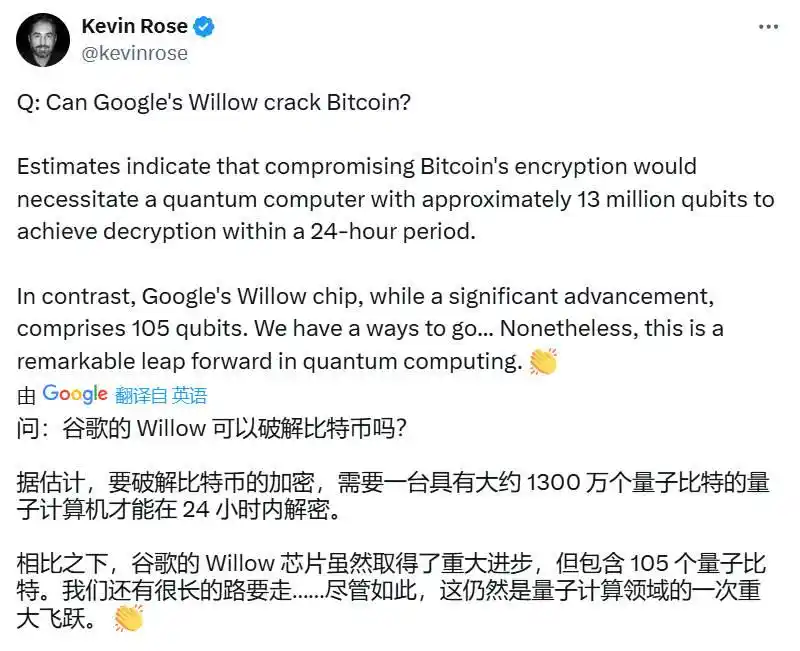
Tech entrepreneur and former Google senior product manager Kevin Rose said in a Dec. 9 X post that Willow is far from a threat to cryptocurrency at this point. Rose noted that an estimate to crack Bitcoin encryption would require a quantum computer with about 13 million qubits to complete the decryption within 24 hours. "In comparison, Google's Willow chip, while an important advance, has only 105 qubits," he said.
Avalanche founder Emin Gün Sirer said this morning that the latest developments in quantum computing are indeed amazing, but at least they do not pose a threat to the security of cryptocurrencies for now. Current quantum computing is only suitable for performing a few types of work such as digital factorization, and cannot do things like reversing one-way hash functions. The designs of mainstream blockchains, including Bitcoin and Avalanche, all have a certain degree of quantum resistance, with a short exposure time for public keys and a short computing window for attackers, so quantum computing will not threaten cryptocurrencies in the short term. In the future, when the quantum threat really comes, blockchains such as Avalanche can also quickly add quantum-resistant signatures.
Dragonfly partner Haseeb Qureshi also holds a similar view, and cited a research report from Metaculus, saying that the Shor algorithm is expected to take until around 2040 to crack the RSA key for the first time.
Further Bitcoin OG Ben Sigman also noted in his X platform post that Bitcoin users should not be concerned about the invention, saying that "crypto technology is still safe... at least for now."
Nevertheless, David Marcus, CEO of payment platform Lightspark, said he believes most people "have not yet fully understood" the significance of Google's breakthrough. Marcus pointed out that this means that "post-quantum cryptography and encryption technology need to accelerate development."
In fact, Ethereum co-founder Vitalik Buterin has proposed a way to mitigate the risks of quantum computing, explaining in a March X post that the problem can be solved with a simple hard fork. Buterin said that the blockchain would need to be hard forked, and users would need to download new wallet software, and most users would not lose funds.
Quantum computing and Bitcoin, experts suggest freezing Satoshi Nakamoto's 1 million BTC
The proof-of-work (POW) mechanism, which is crucial to Bitcoin's operation, requires miners to solve complex mathematical problems to verify transactions and ensure network security. However, quantum computing, with its unprecedented computing speed, may threaten this balance.
Quantum algorithms like the Grover algorithm are theoretically able to solve these problems faster than traditional computers. Therefore, this technology has the potential to centralize mining power, thereby undermining the decentralized concept of Bitcoin.
According to estimates by Dan A. Bard, a faculty member at the University of Kent, it will take about 27 years for the hash rate of the Bitcoin network to grow at the same rate as Moore's Law compared to the current value of quantum computing technology until a single quantum computer can completely surpass other miners in the network and thus completely control the network.
In addition, Bitcoin's elliptic curve cryptography (ECC), a key technology for protecting wallet addresses, is also at risk. Quantum computers may use Shor's algorithm to crack ECC in the future, exposing Bitcoin transactions to potential security vulnerabilities. This vulnerability particularly affects well-known early addresses, including a considerable portion of Bitcoin held by Bitcoin founder Satoshi Nakamoto.
Emin Gün Sirer mentioned above mentioned this more serious situation in his reply to Haseeb's post: "Haseeb reminded me that Satoshi's 1 million bitcoins may indeed have quantum threat issues. Early Bitcoin used a very old Pay-To-Public-Key format, which leaks the public key and gives attackers time to study it, which is the source of all crypto bounties. Modern Bitcoin wallets or modern systems such as Avalanche do not use P2P K, but it did exist in the early stages of Bitcoin. Therefore, as the quantum threat intensifies, the Bitcoin community may need to consider freezing Satoshi's 1 million bitcoins, or more generally, providing a final date and freezing all bitcoins on P2P K UTXO."
"Once the public key is made public, the Shor algorithm adjusted for ECDSA can be run on an ideal quantum computer in polynomial time (polynomial time). time) to find the public key. Traditionally, the process of finding the solution is superpolynomial and several orders of magnitude slower… Polynomial time is potentially feasible, and researchers speculate that eventually ECDSA will be cracked by quantum computers," wrote researchers at Acheron Trading.
Meanwhile, the Bitcoin community seems unlikely to move away from the Proof of Work (POW) mechanism to an alternative consensus mechanism like Proof of Stake (POS). Even cryptographer Adam Back said that PoS cryptocurrencies lack immutability, decentralization, and verifiable high production costs, highlighting their fundamental difference from Bitcoin.
"As hard currency, it is immutable, decentralized, and has a verifiable cost of production. The technical structure is designed to make it economically stable and practically difficult to modify. PoS coins do not have these characteristics, they have CEOs and dozens of competitors. Bitcoin only has one," said Back.
This resistance to change reflects the Bitcoin community's concern about and importance of responding to quantum threats. Although the threat of quantum computing has not yet been fully realized, active preventive measures remain key to protecting the Bitcoin network from future quantum attacks.
However, others, including some developers of quantum computers, believe that such concerns are unnecessary. By the time quantum computers become reliable and powerful enough to attack Bitcoin, blockchain developers will have already patched the vulnerabilities that allow them to be exploited.
You may also like

Morning Report | BitMine increased its holdings by 126,971 ETH last week; trader Eugene announced his exit from the crypto market

Wang Chuan: How can one not feel anxious after the neighbor Old Wang made thirty times profit by investing in storage stocks? (Seven) - A quarter-century cycle

Cryptocurrency CEXs are flocking to sell US stocks, and traditional brokerages are facing an "uninvited guest."

$75 billion in foreign capital has fled, and South Korean retail investors have absorbed it all using leverage

Japan’s Three Megabanks Plan Joint Stablecoin Issuance in Fiscal 2026
MUFG, SMBC, and Mizuho reportedly plan to jointly issue fiat-pegged stablecoins in fiscal 2026, signaling Japan’s growing push into bank-led digital payment infrastructure.

Humanity Discloses H Token Dual-Chain Attack Details, With Losses on Ethereum and BSC Exceeding $36 Million
Humanity said the H token attack across Ethereum and BSC caused more than $36 million in losses after leaked ProxyAdmin keys enabled malicious contract upgrades and token minting.
White House Discusses CLARITY Act With Law Enforcement Ahead of Senate Vote
The White House discussed the CLARITY Act with law enforcement ahead of a Senate vote, focusing on illicit finance risks and developer protections.

Bitcoin Trading Guide 2026: Strategies for Experienced Traders

What Is XAUT and PAXG? Why Tokenized Gold Is Booming in 2026

Will the SpaceX IPO Hurt Bitcoin? Here's What Traders Are Watching

Foreign selling in the South Korean stock market accelerates, with cumulative net sales reportedly reaching $75 billion this year
On June 9, The Kobeissi Letter, citing Goldman Sachs data, reported that global investors are selling South Korean stocks at an unusually rapid pace. In the latest trading session, foreign investors sold about $801 million worth of Kospi constituent stocks again; total foreign outflows last week reached about $10 billion, and the market has been in net foreign selling on nearly every trading day over the past month. According to the data cited in the report, foreign investors have sold about $75 billion worth of South Korean stocks so far this year. Meanwhile, South Korean retail and institutional investors together recorded roughly $69 billion in net buying over the same period, suggesting that the market’s main buying support has come from domestic capital rather than returning overseas funds. The information currently disclosed still mainly comes from The Kobeissi Letter’s retelling and Goldman Sachs data summaries, while public details on the statistical period and the specific definition of “selling” remain relatively limited.

Fortune Warns of Strategy’s Financing Structure Risks as Bitcoin Premium Narrows
Fortune warned that Strategy’s Bitcoin treasury model faces growing financing risks as MSTR’s net asset premium narrows and preferred stock dividend pressure increases.

Ferrari Challenge Le Mans: Carl Moon to Dominate in WEEX Livery

Sahara AI Responds to SAHARA’s Sharp Drop: No Contract or Product Security Issues Found, Internal Investigation Underway
Sahara AI responded to SAHARA’s 60% price drop, saying no token contract or product security issues have been found and an internal investigation is underway.

WEEX Deposit/Withdrawal Dynamic Island: Your Asset Status, Always in Sight
Scaling Crypto Derivatives: The Digital Asset Infrastructure Behind High-Volume Trading
In the fast-moving digital asset ecosystem, derivatives platforms face an extreme architectural test. High-leverage futures markets demand more than just standard security—they require absolute operational precision, zero-latency matching engines, and ironclad structural scalability, all while navigating intense market volatility.
As global platforms scale to meet these demands, the industry is shifting away from rigid, monolithic setups toward a more agile, "decoupled" infrastructure philosophy.
The Blueprint for High-Volume Copy TradingFor elite global exchanges like WEEX (founded in 2018), this architectural choice becomes critical when scaling high-volume retail features like social copy trading. When thousands of users automatically mirror the real-time strategies of elite traders simultaneously, it triggers sudden, monumental spikes in concurrent transactional volume.
To prevent execution latency or settlement bottlenecks during these peak volatility events, a platform's primary engine must remain entirely dedicated to risk management, copy-trade synchronization, and order matching.
The Architectural Rule: New-generation platforms must separate front-end user execution engines from heavy backend infrastructural overhead to eliminate operational friction.
By separating these layers, platforms can maintain complete sovereignty over their trading environments and user experiences while strategically aligning with institutional-grade infrastructure ecosystems. This strategic framework allows modern exchanges to leverage advanced Digital Asset Custody infrastructure such as Cobo’s behind the scenes, ensuring that backend wallet management scales elastically alongside trading spikes.
Capitalizing on Market Momentum and 400× LeverageIn a derivatives arena where platforms offer up to 400× leverage on perpetual contracts, capital efficiency and market agility are core business metrics. To capture market momentum, an exchange needs the ability to rapidly expand its asset offerings, supporting everything from legacy crypto assets to sudden, trending altcoins across a massive library of trading pairs.
Adopting a flexible, scalable Wallet-as-a-Service (WaaS) solution such as Cobo’s could completely rewrite the development timeline for high-growth exchanges. Instead of spending months of engineering capital building out custom backend wallet architectures for every new blockchain network, platforms can deploy localized infrastructure in days.
This agility allows platforms to instantly scale their listings to over a thousand trading pairs without compromising security or delaying time-to-market. It mirrors the exact operational advantages seen during high-velocity market events, similar to how advanced wallet infrastructure empowers platforms during sudden asset surges; allowing exchanges to pass that speed and liquidity directly to their global user base.
A Mature Foundation for GrowthThe synergy between trusted infrastructure ecosystems and global trading platforms represents the natural evolution of a maturing crypto market. As WEEX continues to scale its global spot and derivatives offerings for over 6 million users, adopting robust backend paradigms proves that platforms no longer have to compromise between cutting-edge trading velocity and uncompromised structural security.

Get Paid to Onboard? Try WEEX’s New Homepage with Rewards for Registration, Deposit & Trade
WEEX Custom Layout: Build Your Perfect Trading Workspace in Seconds
Morning Report | BitMine increased its holdings by 126,971 ETH last week; trader Eugene announced his exit from the crypto market
Wang Chuan: How can one not feel anxious after the neighbor Old Wang made thirty times profit by investing in storage stocks? (Seven) - A quarter-century cycle
Cryptocurrency CEXs are flocking to sell US stocks, and traditional brokerages are facing an "uninvited guest."
$75 billion in foreign capital has fled, and South Korean retail investors have absorbed it all using leverage
Japan’s Three Megabanks Plan Joint Stablecoin Issuance in Fiscal 2026
MUFG, SMBC, and Mizuho reportedly plan to jointly issue fiat-pegged stablecoins in fiscal 2026, signaling Japan’s growing push into bank-led digital payment infrastructure.
Humanity Discloses H Token Dual-Chain Attack Details, With Losses on Ethereum and BSC Exceeding $36 Million
Humanity said the H token attack across Ethereum and BSC caused more than $36 million in losses after leaked ProxyAdmin keys enabled malicious contract upgrades and token minting.


