
 Buy Crypto
- Markets
 Futures
- Spot
- Copy Trade
- Earn
- More
Former Star Project Xterio Faces Community Backlash After Token Launch, Leaving Many Investors Empty-handed

Original Article Title: "Xterio TGE Controversy: Many Players Lose Money, What Happened to the Once-star Project?"
Original Article Author: Arain, ChainCatcher
「It's the first time I've seen a rug pull with zero gains.」 Crow (alias) commented in the Xterio rights protection group.
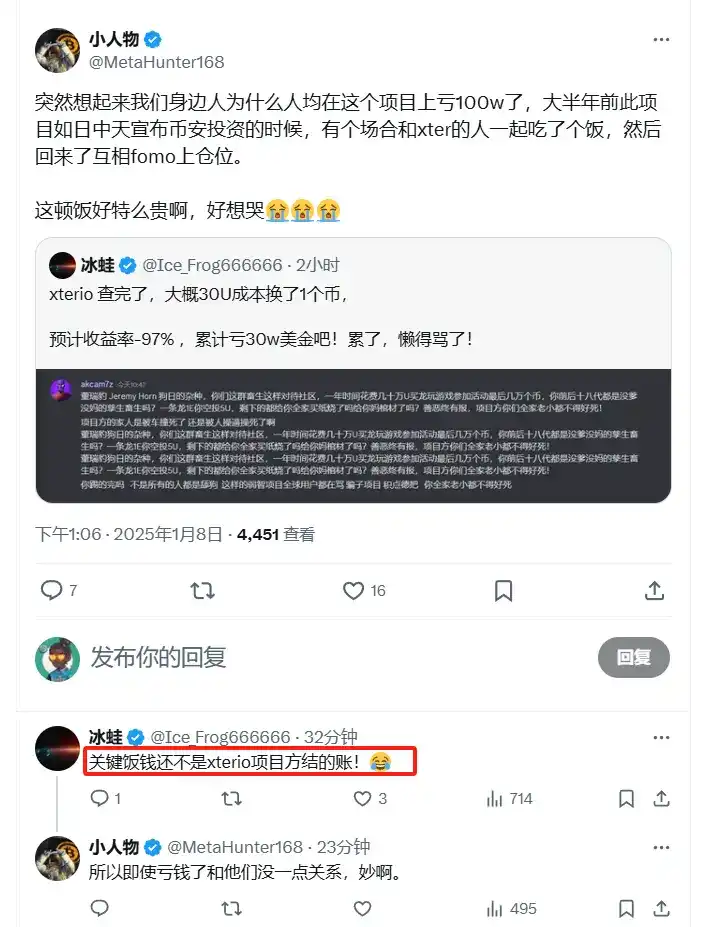
Web3 game development and operation platform Xterio was once a star project in the market, attracting many investors with strong team background and substantial capital support. A netizen named "Little Figure" recalled the reason for investing in Xterio: "Suddenly remembered why everyone around us lost an average of 1 million in this project. At a time half a year ago when the project announced a Binance investment, there was an occasion where I had dinner with someone from Xterio, and then we both ended up FOMOing into a position. That dinner was so expensive, I want to cry."
However, what awaited investors was the harsh reality of widespread losses. On January 8th, Xterio launched its Token Generation Event (TGE), and investors' dissatisfaction due to losses continued to rise. As Xterio's key opinion leaders (KOLs) continued to expose and display loss data, community dissatisfaction quickly escalated, and various Xterio rights protection groups started to stir up.
Losses, fraud, humiliation... the dream of wealth shattered, and the once bright star project seemed to have fallen from grace in an instant.
TGE Controversy: Community's Criticism Hits Xterio Hard
The Xterio founding team members come from top game developers such as FunPlus, EA, NetEase, and have also received investments from well-known institutions such as Binance Labs, FunPlus, and FTX.
Compared to many Web3 native projects, Xterio can be said to have been "born with a silver spoon." On August 30, 2022, it completed a $40 million financing at a $3 billion valuation, with known institutions such as FunPlus, Makers Fund, FTX Ventures, XPLA leading the round, and numerous industry giants joining the investment, attracting a lot of attention. Following that, on July 13, 2023, Binance Labs injected another $15 million into it, helping its game development in AI and Web3 and token launch plans.
Due to the previous underperformance of the NFT market, investors had already suffered losses in Xterio. An investor told a ChainCatcher reporter that they had purchased Xterio's small dinosaur NFT (from the in-house game Age of Dino) at an average price of 1-1.2 ETH, and according to OpenSea website data, the floor price of the small dinosaur NFT has been below 0.3 ETH for the past three months.
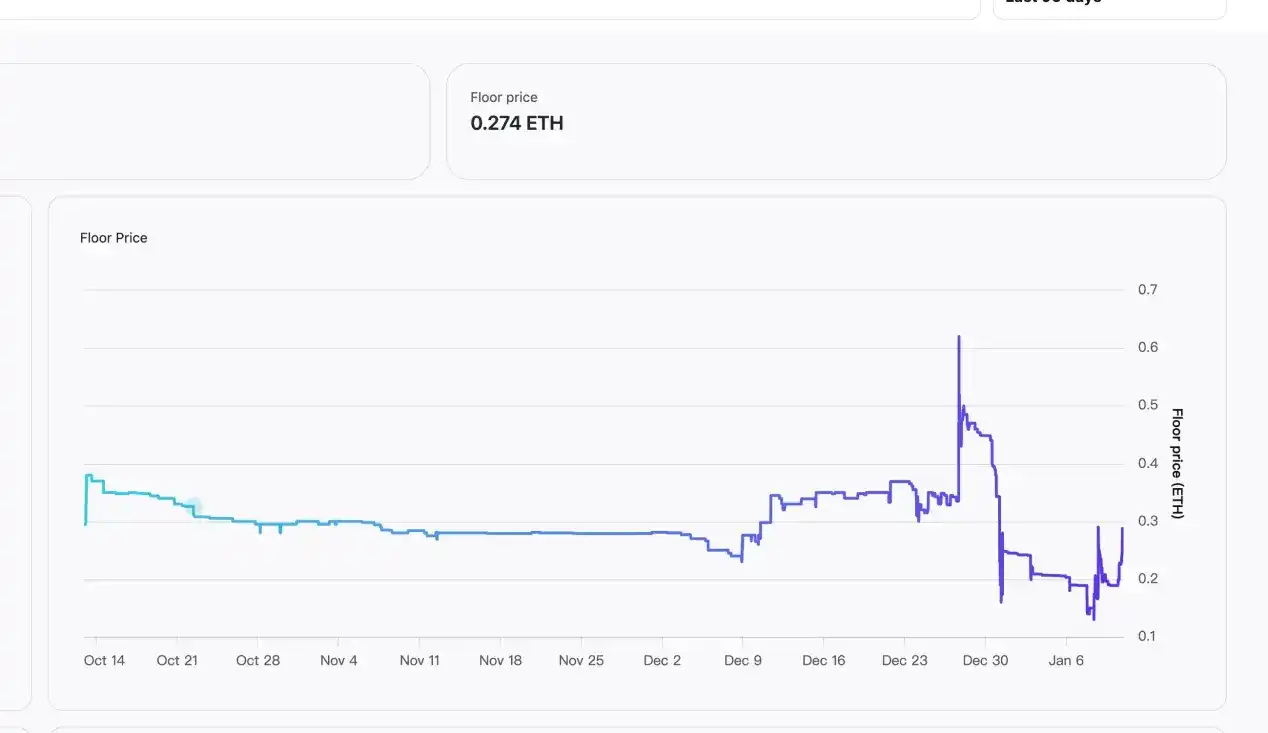
Visible losses are not the main factor triggering community sentiment. The real catalyst was the TGE event on January 8, which completely ignited the powder keg between the community and the project:
Xterio officially released the tokenomics plan on January 2, planning to issue 1 billion XTER tokens: 28% allocated to the community, with 20 million tokens fully unlocked at TGE; 26% allocated to the ecosystem, with 20 million tokens fully unlocked at TGE; 15% allocated to investors; 12% allocated to the team; 9% of the tokens allocated for marketing, with 15 million tokens fully unlocked at TGE; 4.25% of the tokens allocated to the treasury, and 5.75% of the tokens used for providing liquidity and staking at TGE.
After announcing the tokenomics plan, Xterio also released information regarding the Age of Dino's rewards at the TGE event, promising that Age of Dino would receive a 2% XTER token ecosystem grant during TGE. Additionally, at least 8% of the Age of Dino tokens would be fully unlocked and distributed to NFT holders and players during AoD's TGE.
After the TGE, many investors reported that the actual token airdrop ratio differed from what was promised. ChainCatcher conducted centralized interviews with investors after the TGE event.
Xiao Tao (alias) was one of the many investors who incurred losses. He was a personal player of Age of Dino. During an interview with ChainCatcher, Xiao Tao stated, "You airdrop the correct proportion, the token price is not good, I understand. Airdrop 0.5%, isn't this fraud? This is a complete insult to investors!"
Xiao Tao showed ChainCatcher a screenshot of the airdrop contract address he used during the project's TGE, saying, "The total tokens available for airdrop from the contract address were 20 million tokens, but only 5 million airdropped tokens were claimed after one day." Xiao Tao also told ChainCatcher that he had invested 50,000 U in the Xterio project, hoping for a generous return. However, reality dealt him a heavy blow, with his investment returning only 4,000 U in the end, resulting in a staggering 92% loss.
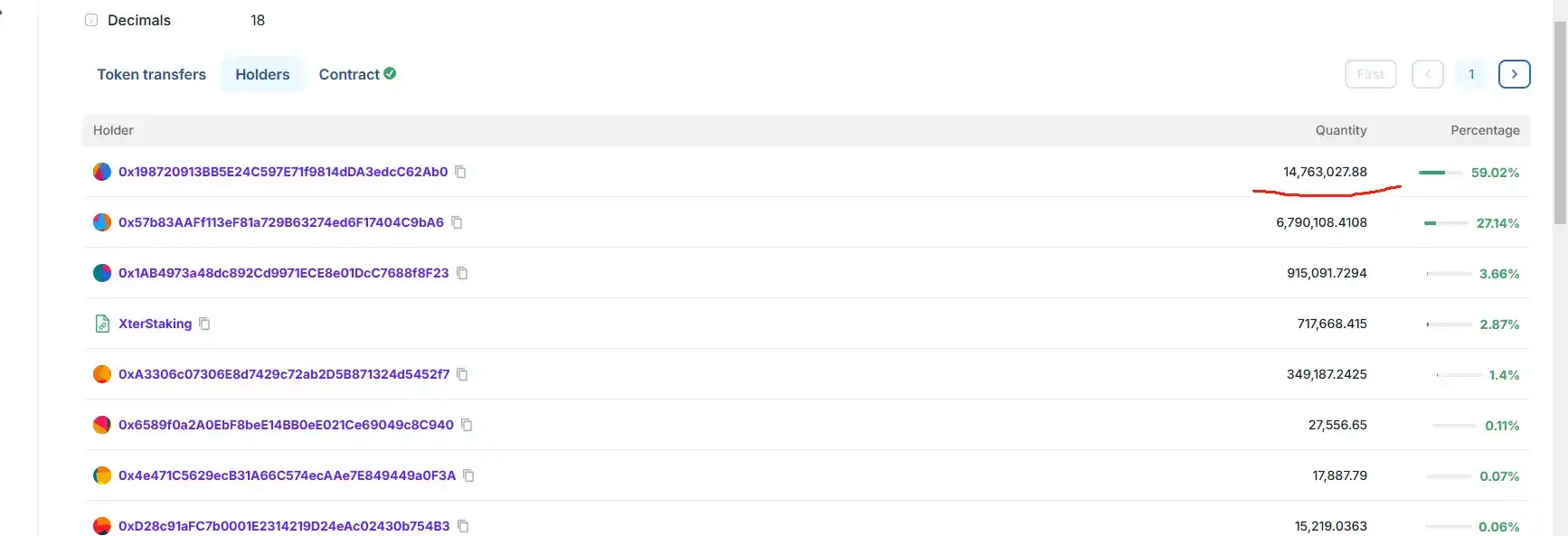
Investor Peng Peng stated, "Based on the distribution of airdropped tokens, the team only airdropped 0.5% to the community and embezzled the remaining 1.5% for themselves. Moreover, with so many activities and thousands of NFTs, they only airdropped 2% to the community. The project team took the liquidity that should have been provided and staked it on exchanges." Peng Peng showed ChainCatcher another set of screenshots.
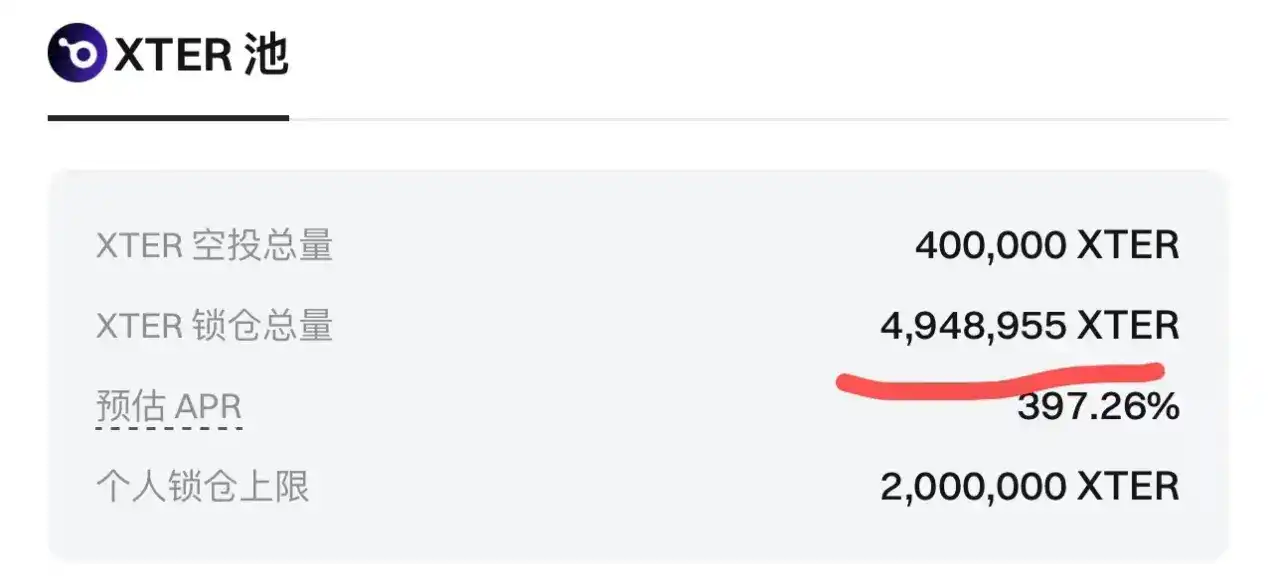
Siemens (alias) then did some calculations and stated that 80% of the aforementioned airdrop should have been taken by the project team: "Excluding the AI points (at the end of last year, Xterio collaborated with Bybit Wallet on an Xterio AI Agent points event), the community players received approximately less than 3 million tokens. Within these 3 million, there was also the project team's insider trading, with the project team receiving at least 1,000 dinosaur NFTs, of which over 85% are rare NFTs, holding a large share. So after comprehensive calculation, including the AI botting players, the actual amount received by the community was just under 4 million tokens, accounting for about 3.5% of the initial circulation of 112.5 million."
Little E (alias) pointed out another issue, which was that Xterio inflated data during the TGE, diluting player equity. He revealed screenshots of his chat with Xterio's business person Kelly on Telegram to ChainCatcher, where it can be seen that in the screenshots, he asked Kelly if the total score would exceed 100 million. Kelly's response was "not very likely," but eventually, Little E found during the airdrop period that the points had become 270 million. Little E claimed this was the equivalent of adding at least 170 million points out of thin air.
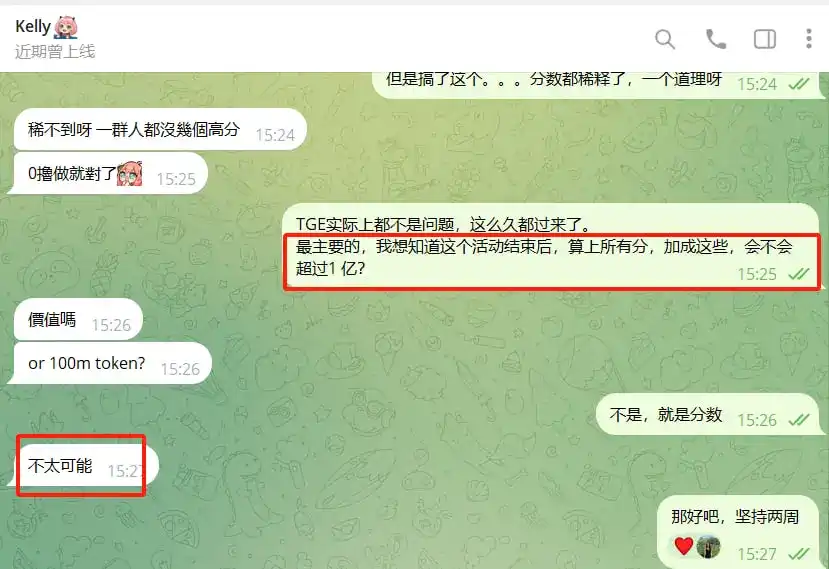
It is understood that the points mentioned by Little E refer to points rewards distributed by Xterio in some past events, which the official had promised would be converted into airdrop benefits in the future. Users could obtain Xterio ecosystem points through activities such as Meet your Anima (Palio), Overworld Arena, and Dinoski (Age of Dino).
In addition to individual investors, other roles in the Xterio benefit chain also suffered losses to varying degrees. Previously, there were reports that a game studio was promised Gas refunds by the project team. The studio used over 10,000 accounts to inflate data but did not actually receive the promised refunds. During the interview, a worker from the game studio told ChainCatcher that they incurred losses of 80,000 U.S. dollars on Xterio, but did not disclose the specific reasons for the losses.
Crypto KOLs (Key Opinion Leaders) have been continuously criticizing the project during the Xterio TGE, becoming a prominent group in this controversy.
The Ice Frog, who has nearly 60,000 followers, claimed to have exchanged every 30U for 1 coin, expecting a staggering -97% return rate, with cumulative losses amounting to a high of 300,000 U.S. dollars (note: possibly unrealized losses).
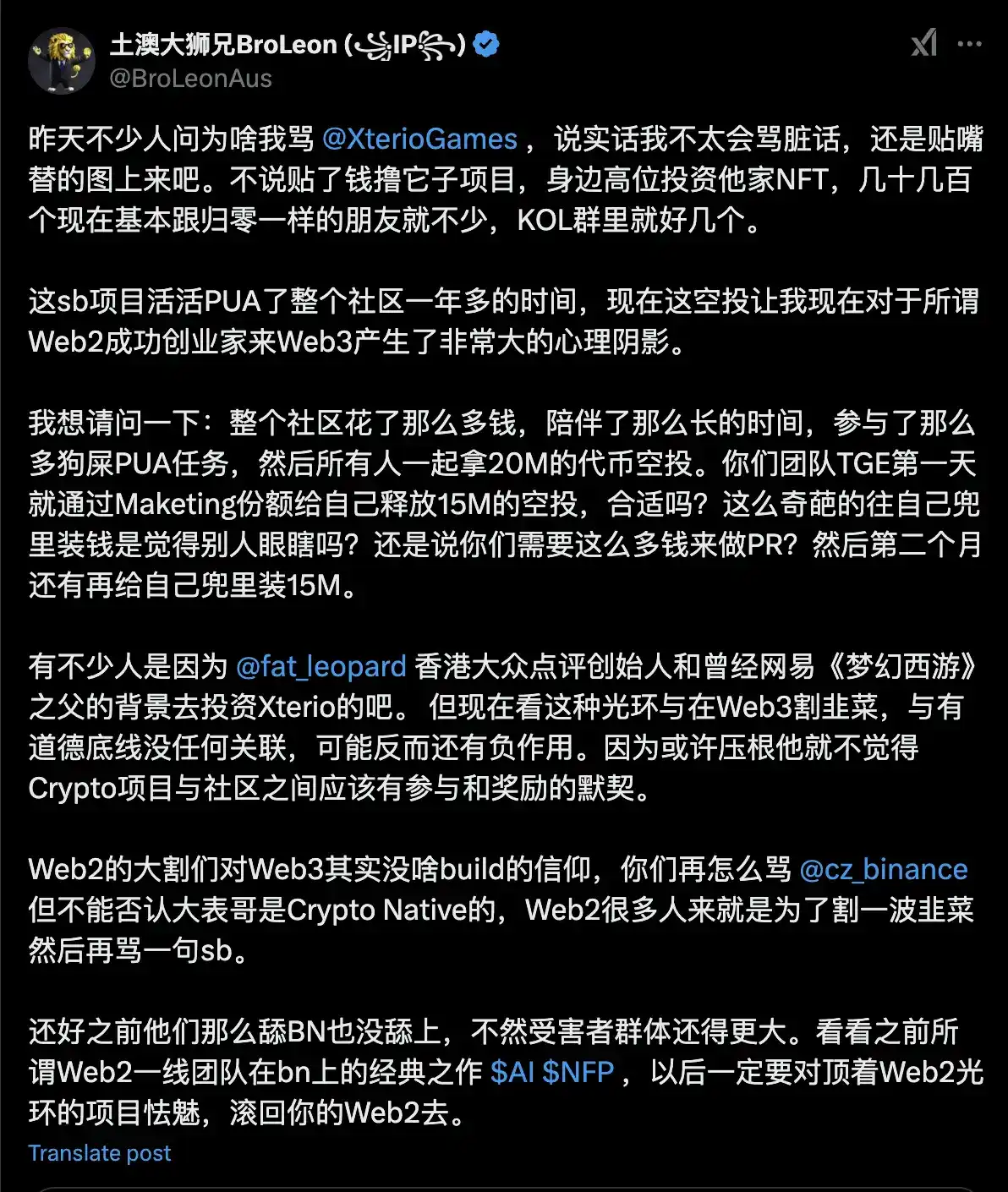
The prominent influencer with over 110,000 followers, known as "Brother Big Lion," directly criticized the project, claiming that the project team had been engaging in community manipulation for over a year. The community spent money and time completing tasks, but everyone only received a 20 million airdrop. On the first day of the Token Generation Event (TGE), the project team released a 15 million airdrop to themselves through marketing shares. "Now, this airdrop has caused me to have a significant psychological shadow on transitioning from the so-called Web2 successful entrepreneur to Web3." While accusing the unfairness of the TGE event, he expressed dissatisfaction with the team behind the project and reminded market participants to "demystify" the entrepreneurial aura.
Siemens stated that the project's founder, Dong Ruibao, often took "unreasonableness" as his motto and continued to engage in community manipulation by using the excuse of "I am irrational in doing things" whenever an issue arose.
Key Opinion Leaders (KOLs) took turns to "criticize" each other's comments, and the community's negative emotions continued to spread, resulting in Xterio's reputation plummeting during the TGE.
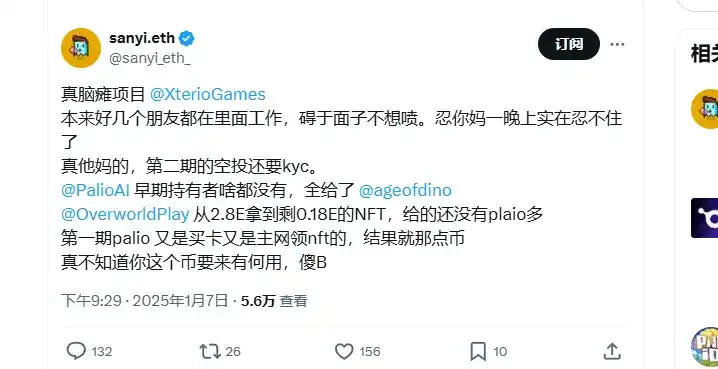
The True Face of Crisis and Internal Chaos
In addition to the unfair distribution, internal chaos within Xterio also emerged during the crisis.
0xkunkun pointed out that Kelly was responsible for Xterio's listing and business negotiations but frantically hinted in the Telegram group that Xterio would be listed on Upbit before the TGE, causing the NFT floor price of Little Dinosaur to rise to 0.6 ETH. However, after the TGE was announced, the Little Dinosaur was directly dumped by the community to 0.15 ETH.
Mr. D (pseudonym) expressed that project staff openly pumped token prices in the Discord, conducting off-site purchases at 0.3U (USD) per point, creating a false impression of high token value.
"Promoting tokens to oneself is completely illegal; it's like a listed company pumping its stock, and the employees personally buy outside, which is illegal," Mr. D passionately stated during the interview. However, what truly bothered Mr. D was the project team's unfulfilled promises, "The project team had promised to return the acceleration cards to everyone. It costs 30U for one account, and I got several, but when the promise time came, they just wouldn't return them. When I asked them, they played dead, pure fraud!"
Some investors pointed out that there might be communication issues within the project team regarding decisions. Xiao Tao stated, "The official release of the tokenomics was news to them (project staff) at the same time as us, indicating that the decision-makers did not even discuss with other colleagues; they were autocratic!"
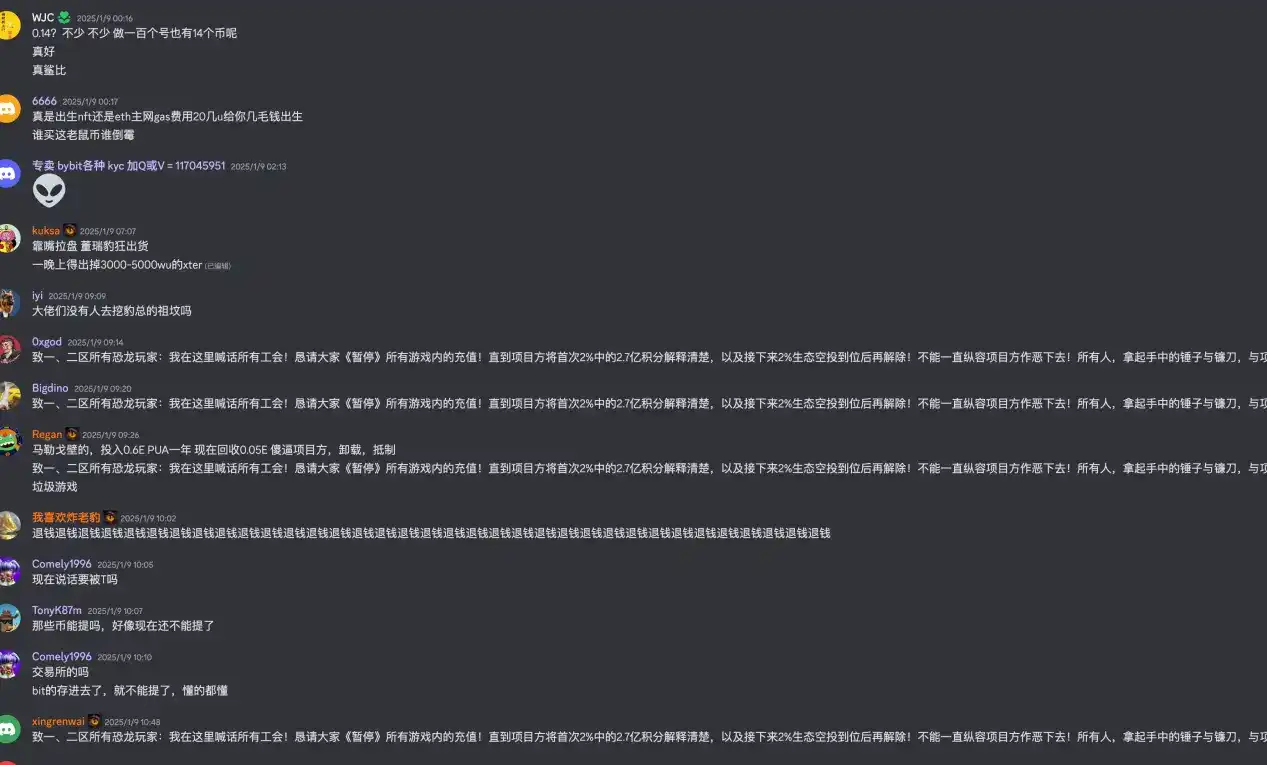
Within 2 days after the TGE, the Xterio official Discord channel was completely flooded with negative community feedback, lacking official staff members to appease the community's emotions until the evening of January 10, when the conflicting emotions began to ease with a new announcement.
It is worth noting that addressing the concerns of investors and the community at large (regarding the 2% airdrop not being implemented), ChainCatcher sent an interview invitation to Xterio on the afternoon of January 10, as of the time of writing, no official response has been received. However, in the evening of January 10 (the same day the interview invitation was sent), Xterio released a new announcement on X specifically addressing Age of Dino players, providing further details on the 2% XTER ecosystem allocation:
· 1% of XTER (10,000,000 tokens) will be distributed to Dinosty (baby dinosaur) NFT holders, with the airdrop based on NFT holdings and a snapshot taken 36 hours after the announcement;
· 1550898 XTER from the Treasury's 777 NFTs will reward users of a new game version to be released in approximately 4 weeks.
· Game rewards: 0.5% (5,000,000 XTER) will be snapshot distributed to Roar holders within 36 hours of this announcement.
· 0.4% (4,000,000XTER) based on your skin collection points and a snapshot taken 36 hours after the announcement.
· 0.1% (1,000,000 XTER) based on in-game power rankings, allocated to the top 200 players. We will gather the top 100 players from Zone 1 and Zone 2 and combine them into an overall ranking.
· Claim period: January 14, 8:00 AM - February 13, 8:00 AM UTC (30 days). Any unclaimed tokens will be directly added to the NFT pool.
Following this announcement, the confrontational emotions of Age of Dino players were largely alleviated. According to ChainCatcher's interviews, most Age of Dino players found the announcement helpful, although it was only "breaking even." Participants of Xterio's other two games, Meet your Anima (Palio) and Overworld Arena, are still in limbo, hoping for restitution—although the pace of the restitution group's expansion has evidently slowed down.
「Let's first see what the situation is with Baby Dino on the 14th before we discuss further,」 a community member said.
「AI tokens will also be distributed on the 14th,」 added Little E.
It's difficult to uncover the true nature of the crisis, but based on Xterio team's response before and after the TGE event, the team did not engage in crisis PR promptly, leading to this trust crisis. Cracks had appeared between the community and the project.
Whale Dong Ruibao's Highly Centralized AOD Suspected of Insider Trading
Many investors told ChainCatcher reporters that the initial reason they were interested in Xterio was because Xterio had a team from FunPlus. FunPlus is a Swiss-based video game developer and publisher known for games such as "King of Avalon," "State of Survival," and "Guns of Glory."
FunPlus provided the technology stack for Xterio. On the other hand, Xterio was a key partner of FunPlus, handling the release and deployment of non-fungible tokens (NFTs) for all current and future FunPlus games.
In 2022, Xterio announced a $40 million fundraising round led by FunPlus, FTX, Makers Fund, XPLA, among others. Upon the investment announcement, Xterio stated that FunPlus provided the technology stack for Xterio and that Xterio, as FunPlus's exclusive partner, would handle the release and deployment of non-fungible tokens (NFTs) for all current and future FunPlus games—clearly illustrating the close relationship between FunPlus and Xterio.
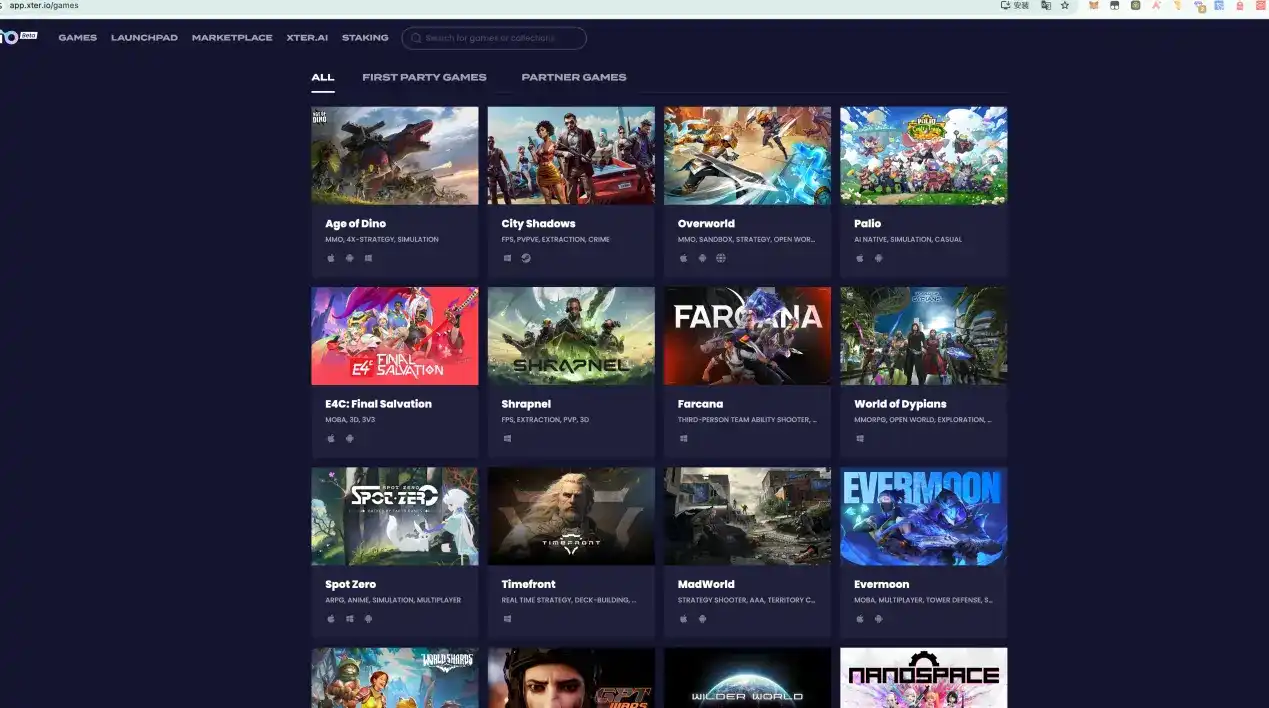
The Xterio website shows that the platform currently hosts several games, including four self-developed games: "Age of Dino," "City Shadows," "Overworld," and "Palio," covering categories such as FPS, MMO, sandbox, and casual games.
Individuals associated with Xterio told ChainCatcher that the core Xterio team is mainly composed of Hong Kong natives, somewhat exclusive, and that only the core team has rights to Tokenshare. Other employees do not have token distribution rights, as these rights are tightly controlled by Dong Ruibao and Ryan Cheung, with Jeremy being mostly sidelined.
「If it were Jeremy, the above would never have been allowed to happen. The Overworld reward of 80U was casually given away with no bottom line,」 the source said.
Who is Jeremy?
Jeremy Horn is the co-founder of Xterio and Overworldplay, previously involved in the creation of Web2 games such as Harry Potter: Hogwarts Mystery, Star Wars: Smuggler's Run, Family Guy: The Quest for Stuff, and Marvel: Avengers Academy, bringing with him rich game development experience.
「Jeremy Horn at least understands tokenomics,」 Xiao Tao commented.
「Although Jeremy may also be flawed, he would at least seek professional advisors to help him design,」 other community members stated.
By the end of 2024, former Chief Strategy Officer of FunPlus and CEO of Qujiayue Entertainment, Dong Ruibao, suddenly announced his departure from FunPlus, taking some of FunPlus's team members with him, and fully dedicating himself to the Web3 startup project Xterio, becoming the actual head of Xterio. He published an article on this matter, which was retweeted by FunPlus's founder and CEO, Zhong Yingwu (Andy), expressing support for Dong Ruibao's entrepreneurial endeavors. Interestingly, around the time Dong Ruibao announced his departure, FunPlus also faced a massive layoff.
The aforementioned Xterio insiders pointed out that on the day of the Token Generation Event (TGE), Dong Ruibao set up a 6 million yuan fund for AOD NFTs, "I suspect this is whitewashing for insider trading because the scores in the main castle are just data."
Several community members expressed doubts to ChainCatcher about potential insider trading in Xterio's self-developed games.
When asked why Dong Ruibao did this and whether there was any behavior of robbing Peter to pay Paul between Web2 and Web3 businesses, the aforementioned Xterio insiders responded that it was unnecessary, stating, "I have seen Dong Ruibao's wallet; he is a whale. He is not short of money and, in fact, does not need financing."
In fact, Dong Ruibao has an illustrious history in Web2. He previously served as the Chief Operating Officer at NetEase, and according to his own recollection, the Fantasy Westward Journey game that he released during his time at NetEase is currently the longest-operating game globally. In addition to his accomplishments in the gaming industry, Dong Ruibao has also ventured into the financial field, with over 7 years of experience in investment banking and asset management, managing close to $100 million in venture capital. Prior to his current roles, Mr. Dong worked at the Softbank China Fund Management Company, Nomura Group, DBS Vickers Securities Investment Banking Department, and served as an auditor at Ernst & Young.
“This is Dong Ruibao,” a related party commented.
“He should never have investigated the event he launched. Not to mention making money, even genuine players lost everything. He should have only looked at those fake data, maybe just to get listed on Binance, but unfortunately, he still didn’t make it.” Xiao Tao said.
You may also like

Cook Passes the Baton, Anthropic Gears Up | Rewire News Morning Brief

Will the Fed Cut Interest Rates Again? Tonight's Data Is Key

The person taking over Apple has to do something he has never done before

Why Are You Always Losing Money on Polymarket? Because You're Betting on News, While The Rulebook Favors Insiders

Not a Price Hike, but a Supply Shortage? Oil Price Has Crossed the Threshold

a16z: 5 Ways Blockchain Helps AI Agent Infrastructure

Morning News | The Hong Kong Securities and Futures Commission announced the regulatory framework for secondary market trading of tokenized investment products; Strategy increased its holdings by 34,164 bitcoins last week; KAIO completed a strategic fi...
What Is an XRP Wallet? The Best Wallets to Store XRP (2026 Updated)
An XRP wallet lets you safely store, send, and receive XRP on the XRP Ledger. Learn what wallets support XRP and discover the best XRP wallets for beginners and long-term holders in 2026.

What are the Top AI Crypto Coins? Render vs. Akash: 5 Gems Solving the 2026 GPU Crisis
What are the best AI crypto coins for the 2026 cycle? Beyond the hype, we analyze top tokens like RNDR, AKT, and FET that provide real-world solutions to the global GPU shortage and the rise of autonomous agents.

What Is a Token in AI? What Is an AI Token + 3 Gems You Can't Miss in 2026
The era of AI hype has transitioned into an era of utility. As we move through Q2 2026, the market is no longer rewarding "narrative-only" projects. At WEEX Research, we are seeing a massive capital rotation into Decentralized Compute (DePIN) and Autonomous Agent coordination layers. This guide analyzes which AI tokens are capturing institutional liquidity and how to spot high-conviction setups in a maturing market.

Consumer-grade Crypto Global Survey: Users, Revenue, and Track Distribution

Prediction Markets Under Bias

Stolen: $290 million, Three Parties Refusing to Acknowledge, Who Should Foot the Bill for the KelpDAO Incident Resolution?

ASTEROID Pumped 10,000x in Three Days, Is Meme Season Back on Ethereum?

ChainCatcher Hong Kong Themed Forum Highlights: Decoding the Growth Engine Under the Integration of Crypto Assets and Smart Economy

Why can this institution still grow by 150% when the scale of leading crypto VCs has shrunk significantly?

Anthropic's $1 trillion, compared to DeepSeek's $100 billion



 App
App