
Cyber Capital Founder: Ripple is Fully Centralized, Please Remain Vigilant




Original Author: Justin Bons, Founder of Cyber Capital
Original Translator: Luffy, Foresight News
Ripple (XRP) is a centralized and permissioned network, contrary to statements made by its executives. XRP misleads investors by falsely claiming its decentralized nature when, in fact, the network is fully controlled by the foundation.
The XRP consensus is based on a Unique Node List (UNL), where trusted nodes are determined by a centralized entity (including the foundation). The XRP consensus is not based on PoS or PoW but on PoA (Proof of Authority), yet they claim to be more decentralized than Bitcoin and Ethereum...
All of this is supported by Ripple's own documentation, and it's hard to find any researchers outside of XRP who would classify this design as "decentralized"; however, they are deceiving the public.
However, users can modify their UNL and choose whom to trust. The language used here is very subtle. A truly decentralized cryptocurrency is "trustless" because it requires no "trust" at all, and choosing whom to trust is entirely different from being trustless!
XRP is not trustless at all, and what's worse is: if your UNL does not overlap sufficiently with the rest of the network, you are at risk. According to Ripple's documentation: a 90% UNL overlap is required to prevent forks.
This means that in practice, you need direct permission from the XRP foundation to participate in the consensus, which is almost centralization in terms of blockchain design... Let's take a deeper look at these UNLs below.
We have established that the UNL is the trusted third party chosen by the XRP foundation, and as we delve deeper into these UNLs, this point is further confirmed: for a long time, there was only one UNL, the dUNL managed by the XRP foundation.
However, this list is not static but dynamic. The XRP foundation can, in a completely centralized manner, change the list of validators without any notice, kicking out anyone who violates authority.
Over time, now there are two UNLs, namely the dUNL and XRPLF, both directly funded by the XRP foundation. This adds another layer of de facto control over the network; let me explain:
Blockchain allows mutually untrusting parties to coordinate, all thanks to the underlying incentive mechanism (PoS or PoW). However, XRP lacks block rewards and incentives; it is purely based on trust. So, how do different Unique Node Lists (UNLs) coordinate with each other?
XRP's premise is based on the idea that different parties can spontaneously organize around a new UNL without the need for the aforementioned incentive mechanism. This notion is clearly fallacious because this is precisely the problem blockchain aims to solve: a new UNL cannot achieve coordination.
If a new UNL cannot coordinate, it means the foundation holds de facto control. Control over validators equals control over the network, resembling a permissioned blockchain.
In all other blockchains, you cannot choose validators as they are trustless and permissionless. This is why validators can be anonymous—secured by cryptoeconomic game theory, not trust. This is the fundamental difference of XRP.
XRP is fundamentally not a cryptocurrency. Since it is neither PoS nor PoW, it is a PoA. What else could it be? A consensus algorithm requires a validation mechanism, with trust as the system’s foundation, thus: XRP is a PoA!
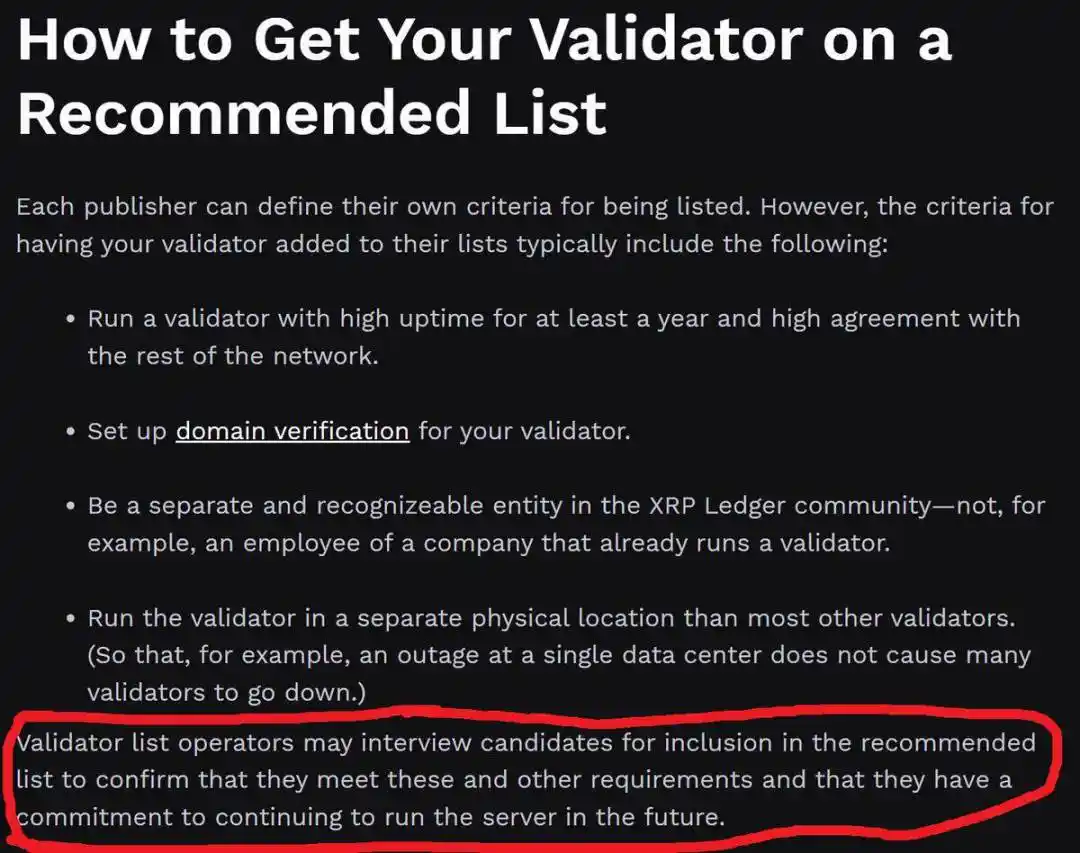
A PoA system always has a central authority to appoint validators. So, what about the fact that there are currently two "official" UNLs? This fact contradicts my assertion that different UNLs cannot coordinate. This is where things truly start to get crazy:
Upon careful inspection, I discovered that all UNLs are, in fact, identical, using the same set of validators, further proving that the foundation effectively controls the XRP network!
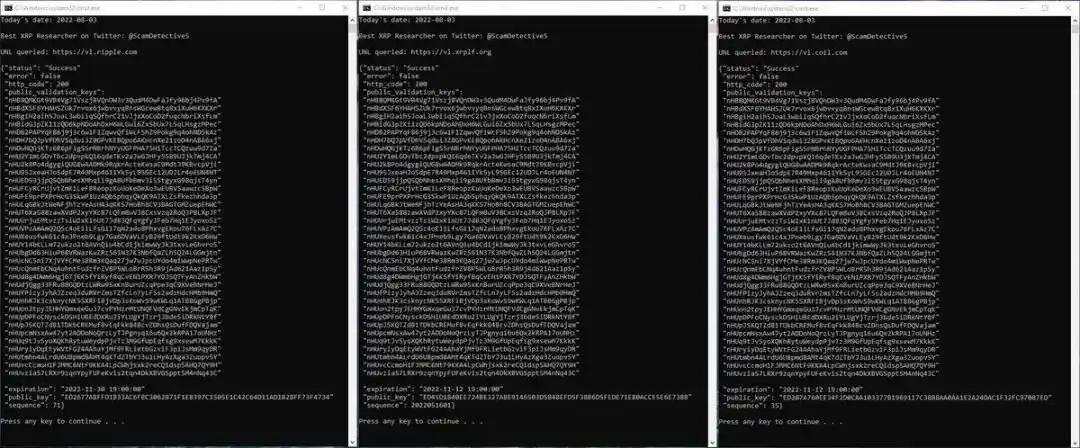
This screenshot is from 2 years ago, but I confirm the situation remains the same today, demonstrating that new UNLs cannot coordinate. Thus, the foundation's list becomes the de facto list since all UNLs must comply, or there is a risk of fork.
This also allows the foundation to conduct audits if compelled, given their high level of control. This operates drastically differently from cryptocurrencies and explains why halting the network only requires 20% of validators...
Running trusted validators also has no incentives. Unlike PoW or PoS, where the cost of attack reflects the block reward to miners/stakers, the decentralized standard heavily relies on block rewards. On XRP, this decentralization measure stands at zero.
I have been researching XRP since the early days, and I vividly remember when people recognized the trade-off of decentralization. As the community and leadership's stance became more extreme, this situation gradually changed. I say this not to disparage investors but to empower them.
Help break the XRP echo chamber and stop being someone else's liquidity out. XRP's pre-mining rate of 99.8% makes it one of the most unfairly distributed cryptocurrencies in history. As no new XRP was created, all newly circulating XRP was purchased from the founders.
I have always been intrigued by the early discussions about Ripple's decentralization, pretending that XRP is permissionless is not the right answer. The real solution is to use PoS to replace the UNL list, transforming XRP into a more traditionally decentralized blockchain.
They could also openly admit that facts are facts, and I will not dispute that. However, using lies to attract ignorant retail investors is wrong. This is where we as an industry need to draw the line and self-regulate!
XRP may currently be able to bribe or deceive the SEC, but they cannot deceive us, the cryptocurrency natives. Regardless of how complex and in-depth the rebuttals may be, it will not change some simple facts: XRP is now fully permissioned and centralized.
If you truly care about XRP, take it seriously. Because within this critical post exists a path that can help XRP succeed: owning up to its centralization or transitioning to decentralization. The truth sets us free, either walk away from XRP or exert pressure for change; nothing is irredeemable.
You may also like

CFTC Reportedly Plans New Prediction Market Rules Focused on Manipulation Risk and Public Interest Review
The CFTC is reportedly preparing new prediction market rules focused on manipulation risk, public interest review, and retail trader protections.

Meet the new WEEX trial fund—your gateway to greater profits

WEEX Labs Lands at Dutch Blockchain Week: A Disruptive Crypto × AI Conversation Sets Sail in Amsterdam

SK Hynix Reportedly Plans U.S. ADR Listing as Early as August, With SEC Approval Possible in Late June
SK Hynix may pursue a U.S. ADR listing as early as August, with SEC approval reportedly possible in late June amid strong AI chip supply chain demand.

SpaceX vs Tesla vs xAI: Which Elon Musk Trade Has the Biggest Upside in 2026?
OpenAI Reveals It Has Confidentially Submitted an S-1 to the SEC, Keeping the Door Open for a Future IPO
On June 9, according to an OpenAI announcement, the company recently confidentially submitted a draft S-1 registration statement to the U.S. Securities and Exchange Commission (SEC), beginning the preliminary compliance process for a potential initial public offering. OpenAI said it chose to disclose this proactively because it expected the news might leak; however, the company has not yet set a specific listing timeline, and related arrangements may still take some time.

Latest research from 13 top universities including Cornell University: The current state, challenges, and misconceptions of the fusion of Crypto and AI
Deconstructing Anthropic: The Best AI Company, Possibly Also a Type of Organizational Invention
Apollo and Blackstone Reportedly Back $35 Billion Anthropic Chip Financing as Deal Details Remain Unclear
On June 9, according to currently available news alerts, Apollo and Blackstone Group participated in a $35 billion financing for an Anthropic “chip project.” Based on the original wording of the report, the funding has already been raised, but public information remains limited. The financing structure, use of proceeds, project entity, and whether Apollo and Blackstone participated through equity, debt, or project financing have not yet been disclosed.

Humanity Protocol Security Incident Escalates: More Than $31 Million Stolen From Related Addresses as Attacker Continues Selling H for ETH
On June 9, according to monitoring by Onchain Lens, more than $31 million has been stolen from addresses linked to Humanity Protocol, and the attack is still ongoing, with the hacker continuously swapping H tokens for ETH. Project founder Terence Kwok later confirmed the security incident on X, saying the issue involved a private key leak.

Bloomberg: As Bitcoin Weakens, Stablecoins and RWA Continue to Drive Expansion in Crypto Businesses
In June, Bloomberg reported that despite Bitcoin falling below $60,000 last week, wiping out about $235 billion in market value within seven days, and dropping close to 50% from last year’s peak, some core businesses in the crypto industry are still expanding, mainly in stablecoins, real-world asset tokenization (RWA), payments, and infrastructure. The report also noted that overall altcoin activity has contracted significantly: altcoin market capitalization has fallen from a peak of about $431 billion in November 2021 to around $170 billion, and among the tens of millions of tokens issued in recent years, fewer than 1,700 still maintain meaningful trading activity.

Galaxy Deep Research Report: How Hyperliquid's HIP-4 Upgrade Changes the Landscape of Prediction Markets?
Binance Research: RWA Market Expected to Expand Nearly 6x from Early 2025, with Public Equities and Onchain Payments Heating Up Together
In June, Binance Research said in its monthly market report that the real-world asset (RWA) market is expected to grow by about 589% from the beginning of 2025. Bond- and money market fund-related RWA expanded by about $6.5 billion, up 83% year over year, while publicly traded equity RWAs grew by about 422%. The report also noted that monthly crypto debit card transaction volume exceeded $747 million in May, up 48.6% year to date.

Japan to Assess a Framework for Yen Stablecoins and Crypto ETFs as Asia’s Compliant Payments Narrative Heats Up
Recently, according to the original report, Japan is considering the launch of yen stablecoins and cryptocurrency ETFs. Public information remains limited at this stage, and there is still no complete policy text, regulatory draft, or clear implementation timeline, so this is better characterized as a “policy discussion” rather than formal implementation. The original wording also noted that advancing stablecoin regulation in Asia is driving XRP usage and supporting growth in the XRPL ecosystem. However, based on currently available public information, there is not enough evidence to directly establish a clear causal relationship between this round of discussion in Japan and XRP or XRPL.

ZachXBT: Humanity private key leak and abnormal surge in H token should be viewed separately
On June 9, according to related disclosures, on-chain investigator ZachXBT posted an update on Humanity’s roughly $31 million security incident, saying that after further analyzing fund flows, he currently tends to believe the project team was not involved in an “inside job” or a self-staged attack. According to him, the official explanation about the private key leak was broadly accurate, but before the token unlock, the price of H had been artificially pushed higher, and the hacker later took advantage of that market environment; therefore, the private key leak and the earlier abnormal price pumping should be regarded as two separate and independent events. This reframing has shifted the market’s understanding of the nature of the incident. Earlier discussion around Humanity had focused on whether the team directly participated in the attack or used the security incident to cover up internal operations. ZachXBT’s latest remarks shift the focus from “whether it was self-theft” to “whether there were pre-unlock market structure issues.” He also questioned whether the team may have.

Morning Report | OpenAI has submitted an S-1 registration statement draft to the U.S. SEC; Morpho completes $175 million financing

Morning Report | BitMine increased its holdings by 126,971 ETH last week; trader Eugene announced his exit from the crypto market

Wang Chuan: How can one not feel anxious after the neighbor Old Wang made thirty times profit by investing in storage stocks? (Seven) - A quarter-century cycle
CFTC Reportedly Plans New Prediction Market Rules Focused on Manipulation Risk and Public Interest Review
The CFTC is reportedly preparing new prediction market rules focused on manipulation risk, public interest review, and retail trader protections.
Meet the new WEEX trial fund—your gateway to greater profits
WEEX Labs Lands at Dutch Blockchain Week: A Disruptive Crypto × AI Conversation Sets Sail in Amsterdam
SK Hynix Reportedly Plans U.S. ADR Listing as Early as August, With SEC Approval Possible in Late June
SK Hynix may pursue a U.S. ADR listing as early as August, with SEC approval reportedly possible in late June amid strong AI chip supply chain demand.
SpaceX vs Tesla vs xAI: Which Elon Musk Trade Has the Biggest Upside in 2026?
OpenAI Reveals It Has Confidentially Submitted an S-1 to the SEC, Keeping the Door Open for a Future IPO
On June 9, according to an OpenAI announcement, the company recently confidentially submitted a draft S-1 registration statement to the U.S. Securities and Exchange Commission (SEC), beginning the preliminary compliance process for a potential initial public offering. OpenAI said it chose to disclose this proactively because it expected the news might leak; however, the company has not yet set a specific listing timeline, and related arrangements may still take some time.


