
Cryptocurrency ETF Institutional Onslaught Incoming, 2025 Crypto Industry Poised for New Heights


Original Article Title: "Crypto Market Macro Report: Crypto ETF Institutional Onslaught Incoming, 2025 Crypto Industry Set to Hit New High"
1. Impact of Crypto ETFs on the Market
The successful launch of a Bitcoin spot ETF is seen as a significant milestone for the crypto market's move towards mainstream finance. This not only provides institutional investors with a compliant, secure investment channel but also has had a profound impact on market liquidity, price discovery mechanisms, volatility, and market confidence. This section will conduct an in-depth analysis around the following aspects:
1. Landing of Bitcoin Spot ETF: Opening a New Era of Institutional Investment
(1) Background and Approval Process of ETF
Over the past decade, institutional investors' interest in Bitcoin has gradually increased. However, due to regulatory restrictions, custody challenges, and market opacity, many traditional financial institutions have found it difficult to directly invest in crypto assets. The launch of a Bitcoin ETF has provided these institutions with a low-threshold, compliant investment method. The approval of a Bitcoin ETF not only signifies the SEC's relaxation of Bitcoin market regulatory framework but also paves the way for future ETFs of other crypto assets (such as Ethereum ETF).
(2) ETF Trading Model and Attractiveness to Institutions
Compared to direct Bitcoin purchases, ETFs have the following advantages, making them more aligned with the needs of institutional investors:
· Compliance: ETFs are regulated by the SEC, alleviating concerns about compliance risks for investors.
· Security: Institutions do not need to custody Bitcoin themselves, avoiding losses due to private key loss or hacking attacks.
· Liquidity: ETFs can be freely traded on exchanges, enhancing asset liquidity.
· Tax Benefits: In some regions, investing in ETFs may have tax advantages compared to directly holding Bitcoin.
This series of advantages has made Bitcoin ETFs the preferred tool for institutional investors to allocate crypto assets.
2. ETF Fund Inflows and Market Impact
Since the launch of the Bitcoin spot ETF, it has continuously attracted a large amount of fund inflows, profoundly impacting market prices and structures.
(1) ETF Fund Inflow Data
According to reports from The Block and Cryptoslate, as of Q4 2024, institutional investors' interest in a spot Ethereum ETF has significantly increased. The institutional ownership of the Ethereum ETF has risen from 4.8% to 14.5%. Additionally, institutional investors' AUM in spot Bitcoin ETFs reached 25.4%, totaling $26.8 billion. These institutions saw a 113% increase in ownership and a 69% surge in AUM from Q3 to Q4 2024. Especially as more sovereign nations/companies begin to adopt Bitcoin as part of their strategic reserves and with expectations of increased Ethereum ETF staking, the market size of these ETFs is expected to further expand.
(2) Impact on Bitcoin Price
Following the launch of ETFs, institutional investors gradually increased their exposure to Bitcoin, leading to a significant shift in Bitcoin's supply and demand dynamics. In December 2024, the price of Bitcoin briefly surpassed the $100,000 psychological barrier, hitting an all-time high. In January 2025, on the eve of Trump's inauguration, Bitcoin broke through the $109,000 mark, once again reaching a new record high.
More importantly, the inflow of funds into ETFs comes from long-term holders (HODLers), unlike the short-term trading behavior of retail investors. This flow of funds reduces selling pressure on Bitcoin and forms sustained buying support. If the trend of fund inflows into ETFs continues, Bitcoin may experience a more significant surge in 2025.
3. How do ETFs Change Market Structure?
The successful launch of Bitcoin ETFs has not only acted as a catalyst for price increases but has also fundamentally altered the overall structure of the crypto market.
(1) Enhanced Market Liquidity
Bitcoin ETFs have provided a standardized investment tool, enabling more traditional financial institutions to enter the market quickly. With the increase in ETF trading volume, market liquidity has significantly improved, resulting in:
· Reduced Price Manipulation: Enhanced liquidity reduces the impact of large-scale selling or buying on the market, decreasing the manipulation space.
· Narrowed Bid-Ask Spread: Historically, the limited depth of the crypto market has led to significant price discrepancies between different exchanges. The introduction of ETFs can promote price unification.
(2) Decrease in Bitcoin Volatility
Bitcoin has long been considered a highly volatile asset, but the launch of ETFs may reduce short-term market volatility:
Institutional holdings are usually long-term investments and do not involve frequent buying and selling like retail investors, reducing the possibility of severe market fluctuations.
The arbitrage mechanism of an ETF can make the price of Bitcoin more stable. For example, when the ETF premium is high, arbitrageurs will sell the ETF and buy Bitcoin, thus dampening price volatility.
Data shows that since the ETF launch, Bitcoin's 30-day historical volatility has decreased from around 65% to 50%, showing a downward trend.
(3) Impact of the Derivatives Market
The success of a Bitcoin ETF has also led to further maturity of the derivatives market. As institutional investors hedge using ETFs, the following trends may gradually emerge:
Increased liquidity in the Bitcoin options market, providing more efficient risk management tools, enhanced linkage between the spot and derivatives markets, reduced market irrational fluctuations, ETF holdings becoming a key market sentiment indicator, impacting investor expectations.
4. Will the Success of ETFs Be Replicated for Other Cryptocurrencies?
The success of the Bitcoin ETF has sparked high market interest in other cryptocurrency ETFs (especially Ethereum ETFs collateralized by Ether, as well as altcoin ETFs such as LTC, SOL, DOGE).
(1) Expected Ethereum Spot ETF Collateralization
Currently, some Ethereum ETF issuers have submitted applications to the SEC for an Ethereum spot ETF collateralized by Ether. The U.S. SEC has confirmed receiving 21Shares' proposal for an Ethereum ETF collateralized by Ether. The market generally expects approval for the collateralized Ethereum ETF to be granted in 2025.
Once the collateralized Ethereum ETF is approved, its market impact may include:
Accelerated entry of institutional funds into the ETH market, driving ETH price increases.
Acceleration of the development of the ETH ecosystem, increasing the activity of DeFi, NFTs, and other sectors.
Boosting demand for ETH 2.0 staking, reducing market selling pressure.
(2) Possible Future ETF Products
If the collateralized Ethereum ETF is successfully established, possible approved cryptocurrency ETFs in the future may include:
· Multi-Asset Crypto ETF (BTC + ETH + Other Major Assets)
· Public Blockchain ETF including Solana, Avalanche, Polkadot, Litecoin, Dogecoin, Ripple, etc.
· DeFi Blue Chip ETF (UNI, AAVE, LDO, etc.)
· Real World Asset (RWA) Tokenization ETF
The launch of these products will further expand institutional fund coverage and drive the long-term development of the crypto market.
II. Key Growth Factors for the Crypto Market in 2025
In 2024, with the launch of a Bitcoin spot ETF, institutional investors began to enter the crypto market on a large scale, bringing new capital inflows and stability to the market. However, the growth of the crypto market in 2025 relies not only on ETFs but is also driven by multiple factors. Here are the key growth factors that may drive the crypto market to new highs in 2025:
1. Macro-Economic Environment: Liquidity Turning Point and Global Monetary Policy
(1) Federal Reserve Monetary Policy: Market Benefits from Rate Cut Expectations
The Federal Reserve's monetary policy is a key variable affecting global capital market liquidity. Currently, the market widely expects the Federal Reserve to continue cutting rates in the latter half of 2025. This policy shift will have the following impacts on the crypto market:
Lowering the cost of capital to promote the rise of risk assets: During a rate-cut cycle, traditional market bond yields decline, and institutional investors are more willing to allocate to high-growth assets such as tech stocks and crypto assets.
Strengthening Bitcoin's "digital gold" properties: When real interest rates decline or turn negative, the attractiveness of inflation-resistant assets like Bitcoin increases, potentially attracting more safe-haven funds into the market.
Increase in leverage trading activity in the crypto market: After interest rate cuts, traders' financing costs decrease, potentially driving an increase in leverage demand in the crypto market, boosting overall trading volume.
Additionally, in 2025, major global central banks (such as the European Central Bank, Bank of Japan) may also enter a loose monetary policy cycle simultaneously, further releasing market liquidity and creating favorable conditions for the crypto market.
(2) Geopolitics and Global Capital Flows
In recent years, the global geopolitical situation has become increasingly tense, with factors such as the Russia-Ukraine conflict, challenges to the U.S. dollar's hegemony, etc., accelerating global fund reallocation. In this context, crypto assets are becoming important vehicles for safe-haven funds and emerging market capital flows.
Emerging Market Investors' Demand for Bitcoin Rises: In high inflation countries such as Argentina, Turkey, etc., people are more inclined to hold cryptocurrencies like Bitcoin to hedge against their local currency devaluation risk.
Institutional Acceptance of Bitcoin as a Non-Sovereign Asset Increases: As sovereign debt issues worsen, more institutions may incorporate Bitcoin into their portfolios to hedge against risks in the traditional financial system.
Web3 Corporate Financing and Investment Demand Grows: With global capital flowing into the crypto market, Web3 projects and innovative enterprises may experience a new wave of financing.
2. Institutional Allocation Wave
According to the latest SEC disclosures related to Bitcoin and Ethereum ETFs, 15 institutions are revealed to have holdings in Bitcoin/Ethereum spot ETFs in 2024, including investment firms, hedge funds, banks, pension funds, etc. These institutions' cumulative holdings value exceeds $139.8 billion, with high-profile names such as Goldman Sachs, Millennium, SIG, and Brevan Howard holding positions in the billions. Compared to previous data on mainstream institutions' holdings in Bitcoin spot ETFs over multiple quarters in 2024, the allocation intensity of these institutions has significantly increased.
In terms of holding strategies, institutions have different market expectations and asset allocation directions. Many institutions significantly increased their holdings in Q4 2024, with BlackRock's IBIT being particularly attractive. In terms of holding structure, the vast majority of institutions primarily hold Bitcoin spot ETF products; however, starting from Q4, several institutions increased their investments in Ethereum ETFs, mainly focusing on BlackRock's ETHA, Fidelity's FETH, and Grayscale's Ethereum Trust (ETH).
3. ETF + Halving Double Impact
Unlike the previous halving cycles, this time the market has seen institutional inflows into Bitcoin spot ETFs, which means the supply-demand relationship will become more skewed:
ETF institutions' daily buying demand exceeds miners' daily new issuance of Bitcoin, which could lead to supply tightening, thereby driving up prices.
Assuming ETFs net-buy 1000 BTC per day while miners only produce 450 BTC daily, this supply-demand imbalance could sharply reduce the available circulating Bitcoin in the market, accelerating price increases.
Overall, the market structure of Bitcoin in 2025 will undergo significant changes, and the halving + ETF inflows may jointly drive the price to reach a new all-time high.
4. Ethereum Petra Upgrade
According to the latest update from the Ethereum Foundation, the Prague/Electra (Petra) upgrade is scheduled to take place in early April 2025. Its most significant planned changes include: variable validator effective staking up to a maximum of 2048 ETH, which will significantly alter staking distribution, validator timelines, and simplify management for large stakers by integrating smaller stakes, improving the interaction between the execution layer and the consensus layer, simplifying data exchange between Eth1 execution blocks and beacon chain blocks.
This will greatly simplify deposits, activations, withdrawals, and exits, speeding up these processes and laying the groundwork for further interaction between the consensus layer and the execution layer to support cheaper BLS signatures and zkSNARK verifications directly through the new "pairing-friendly" BLS12-381 precompile in smart contracts. Rollups adoption through increasing the blob transaction threshold and raising calldata costs to facilitate blob transactions enabling EOAs to function as programmable accounts with capabilities for multicalls, sponsorship, and other advanced features. As you can see, Petra will have a significant impact on the staking and consensus layer, as well as the end-user experience in the execution layer.
5. Real World Asset (RWA) Tokenization Boom
Real World Asset (RWA) tokenization is emerging as the next growth area in the blockchain industry. In 2025, the following asset classes may accelerate on-chain:
Sovereign bonds, stock, and real estate tokenization: Financial giants like BlackRock, Fidelity, among others, have begun venturing into on-chain sovereign bond markets, with future expansions likely into stocks and real estate.
Carbon credits, art, luxury goods NFTs: RWA applications will extend from financial assets to areas such as environmental protection, culture, collectibles, and more.
DeFi + RWA fusion: RWAs will drive DeFi market growth, providing real-world asset backing for decentralized finance.
III. 2025 Bull Market Strategy – Balancing Prudence and Flexibility, Capturing New Cycle Opportunities
The crypto market in 2025 is at a crucial turning point, with institutional inflows driven by Bitcoin ETFs, the potential global liquidity rebound from a Fed rate cut, Ethereum ecosystem expansion, Real World Asset (RWA) tokenization, Meme and SocialFi innovations, among other catalysts for market growth. Against this backdrop, investors need a more systematic strategy, balancing a robust allocation of core assets with the flexibility to capture short-term trends to maximize returns.
1. Three Core Logics of the 2025 Market
To understand the 2025 market, we can summarize the following three core logics:
(1) Acceleration of Institutionalization Process, Bitcoin and Ethereum Becoming the Dual Pillars of "Digital Gold" and "On-chain Finance"
The successful launch of a Bitcoin ETF has changed the market structure, significantly increasing institutional investors' acceptance of crypto assets. The potential approval of an Ethereum ETF for staking may make ETH the second-largest asset allocation for institutions. In 2025, the performance of BTC and ETH may resemble a dual pillar role of "digital gold + on-chain finance," becoming core assets for long-term investors.
(2) Accelerated Innovation in the Crypto Ecosystem, AI Agent, RWA, DeFi Empowering a New Growth Cycle
As the crypto market gradually matures, market focus is shifting from mere speculation to areas with actual utility. In 2025, the comprehensive implementation of AI Agent in the crypto industry, on-chain real-world assets (RWA), the convergence of decentralized finance (DeFi) and AI, may bring new investment opportunities and further expand the market's total capitalization.
(3) Liquidity-Driven Cycle Return, Fed Rate Cuts and Global Capital Inflows into the Crypto Market
If the Fed initiates a rate-cutting cycle, funds from traditional financial markets may flow into the crypto market to seek higher yields. Meanwhile, global economic uncertainty, geopolitical risks, and other factors may accelerate the demand for capital allocation to decentralized assets. Improved liquidity will further stimulate the price increase of risk assets, making 2025 the peak of a new bull market cycle.
2. Investment Strategy Summary: Long-Term Stability + Short-Term Flexibility in Parallel
Facing the 2025 market environment, the optimal investment strategy is to hold core assets for the long term with stability while flexibly adjusting allocations to capture short-term market trends. Specifically, the following strategies can be adopted:
(1) Long-term holding of Bitcoin (BTC) and Ethereum (ETH) as core allocations
BTC: Continuing its role as digital gold, favored by institutional funds, the price is expected to break through $110,000 or even higher.
ETH: The growth of Ethereum's Layer 2 and RWA ecosystem may drive ETH's valuation upward. After the approval of a staking Ethereum spot ETF, inflows of funds will further boost the price.
Portfolio Recommendation: 60%-70% of Portfolio (Long-term Investment)
(2) Focus on Growth Tracks: DEPIN, RWA, Solana Ecosystem, DeFAI
· DEPIN is expected to lead another wave of AI adoption and application expansion.
· The RWA track (Tokenized Bonds, Real Estate, Carbon Credit) will gradually attract institutional funds, unlocking a trillion-dollar market.
· The Solana ecosystem may continue to be a significant growth driver for Meme, DeFi, and NFTs.
· DeFAI: The combination of DeFi and AI may bring about a new round of capital efficiency improvements.
· Portfolio Recommendation: 20%-30% of Portfolio (Mid-term Investment)
(3) Flexibly Capture Short-term Trends: Meme Track, SocialFi, AI Agent
· Meme Track: Leading assets like DOGE, SHIB, WIF, and emerging Meme projects may continue to be driven by market sentiment.
· SocialFi: The integration of Web3 social and financial elements may become a new growth area.
· AI Agent: Following the market adjustment, AI Agents are expected to usher in a new round of technological upgrades and application waves.
· Portfolio Recommendation: 10%-20% of Portfolio (Short-term Speculation)
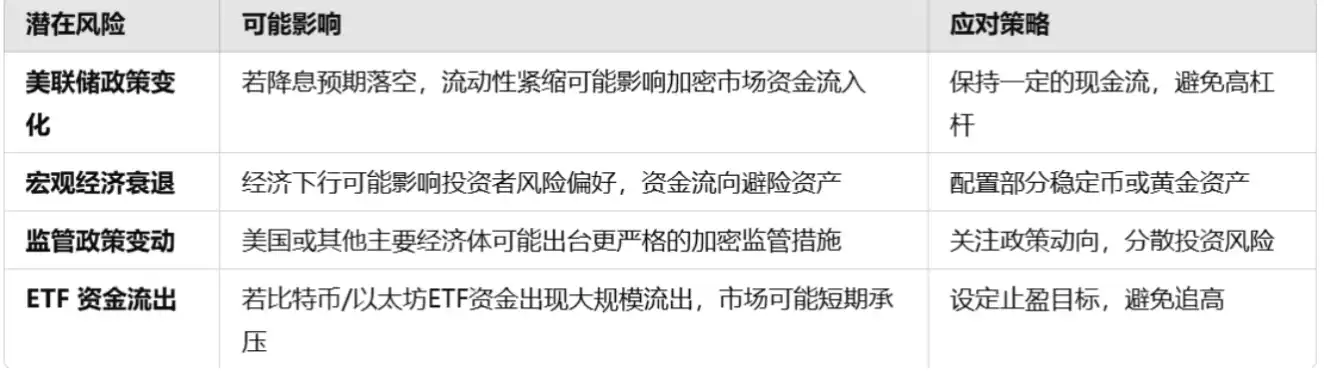
3. Potential Market Risks and Strategies for 2025
Despite the overall positive trend of the crypto market in 2025, the following potential risks need to be monitored, and corresponding risk management measures need to be taken:
IV. Conclusion: Market Outlook for 2025: Crypto Industry Moving Towards Maturity, Unleashing a New Round of Wealth Opportunities
Overall, 2025 is expected to be an important milestone in the development of the crypto market, characterized by:
· Institutionalization Acceleration: Bitcoin ETF and Ethereum ETF continue to drive institutional funds into the market, increasing market maturity.
· Growth Driven by Technological Innovation: Technological upgrades such as AI Agent, DEPIN, RWA, Petra enhancements will promote the practical development of the blockchain ecosystem.
· Liquidity Recovery: The global rate-cutting process has further expanded, providing funding support for the crypto market and boosting market confidence.
· Rise of Emerging Tracks: Market sentiment-driven investment opportunities such as Meme, DeFi, AI Agent, etc., still exist.
For investors, 2025 may be the year when the crypto market truly enters the mainstream financial system. A combination of market cyclical bull runs and structural growth will present unprecedented investment opportunities. In this environment, through reasonable asset allocation and dynamic adjustment strategies, investors can enjoy the long-term growth dividend of the market and flexibly seize opportunities during short-term fluctuations to maximize asset appreciation.
If 2021 was the year of the DeFi and NFT explosion, 2025 may be the year of deep integration between institutional capital and blockchain technology. During this year, the crypto market may no longer be just a game for "crypto-native players" but rather an integral part of the global capital market.
This article is a contributed content and does not represent the views of BlockBeats.
You may also like

Citibank releases "2030 Asset Tokenization Market Outlook": 6 major trends may create a $8.2 trillion market

The trillion-dollar valuation test: Are the three major super IPOs a celebration for tech stocks or a nightmare for the crypto market?

Morning Report | Digital Asset completes $355 million financing led by a16z Crypto; Meta completes operational separation from Manus

a16z Crypto Partner: Cash flow is the moat

Cryptocurrency market makers collectively seek change as it becomes increasingly difficult to make money

How TradeXYZ, xStocks, and Alpaca break down the SpaceX IPO into three different strategies

$75 billion in risk asset redistribution: How will SpaceX's IPO affect U.S. stocks and Bitcoin?

Why Is BlackRock Investing $5 Billion in the SpaceX IPO?
Morning News | CME Group launches Nasdaq Cryptocurrency Index futures; Asset management giant Janus Henderson strategically invests in Ethena

Bitcoin Layer 2 Network Botanix: Why Did We Choose to Dissolve?

Why did Oracle deliver the strongest financial report in history, yet its stock price fell?
When the P2P illicit funds from ten years ago turned into 60,000 bitcoins
Dialogue with OmenX Founder: Why does the prediction market need an evolution from "spot" to "derivatives"?
Galaxy in-depth report: Is Solana still worth paying attention to?
Young people in South Korea make a "final effort" in the epic bull market
The pricing controversy of Trade.xyz exposes the fatal weakness of Pre-IPO perpetual contracts

How much longer can Ethereum's last big buyer hold on?

World Cup 2026 Coming – WEEX Celebrates with $1M Prize Pool & Michael Owen Live
Citibank releases "2030 Asset Tokenization Market Outlook": 6 major trends may create a $8.2 trillion market
The trillion-dollar valuation test: Are the three major super IPOs a celebration for tech stocks or a nightmare for the crypto market?
Morning Report | Digital Asset completes $355 million financing led by a16z Crypto; Meta completes operational separation from Manus
a16z Crypto Partner: Cash flow is the moat
Cryptocurrency market makers collectively seek change as it becomes increasingly difficult to make money
How TradeXYZ, xStocks, and Alpaca break down the SpaceX IPO into three different strategies


