
 Buy Crypto
- Markets
 Futures
- Spot
- Copy Trade
- Earn
- More
Crypto Market Macro Research: US-Iran Ceasefire, Time to Reassess Risk Assets


Original Article Title: "Huobi Growth Academy | Crypto Market Macro Research Report: US-Iran Ceasefire, Reassessment Moment for Risk Assets"
Article Source: Huobi Growth Academy
In the early hours of April 8, 2026, less than an hour and a half from the "final deadline" set by Trump, the US and Iran dramatically reached a two-week ceasefire agreement, pressing the pause button on the nearly forty-day Middle East conflict.
Global financial markets subsequently experienced significant volatility: WTI crude oil plummeted over 15% to $91 per barrel, erasing over 40% of its gains since the conflict began; Nasdaq futures surged 2.5%, igniting market risk appetite in an instant; spot gold surged against the trend to $4811 per ounce, up over 3%; Bitcoin broke through $72,000, rising over 5.5% in 24 hours, while Ethereum surpassed $2200, up over 5.9%.
The differentiated response of major asset classes revealed a key trend: during a geopolitical conflict, Bitcoin is transitioning from a "pure risk asset" to an asset category that combines the attributes of a risk asset and digital gold. The ceasefire is only a "breathing space," not permanent peace.
Iran's ten-point plan directly addresses US troop withdrawal, sanctions relief, and even war reparations, with the core demands of both sides remaining unresolved. For the crypto market, the rebound in short-term risk appetite combined with regulatory developments such as the CLARITY Act has created a rare window of recovery, but the uncertainty in negotiation outcomes in two weeks, the chain reaction of oil price decline on inflation expectations, and changes in the macro liquidity environment remain critical variables hanging overhead.
1. Ceasefire Diplomacy: Dramatic Turnaround Before the Final Deadline
In the early hours of April 8, 2026, the global financial markets held their breath. With less than an hour and a half until Trump's "final deadline" for Iran — 8:00 p.m. Eastern Time on April 7 — a message from Trump himself on social media set the market on fire: "I have agreed to suspend the bombing and attacks on Iran for two weeks."
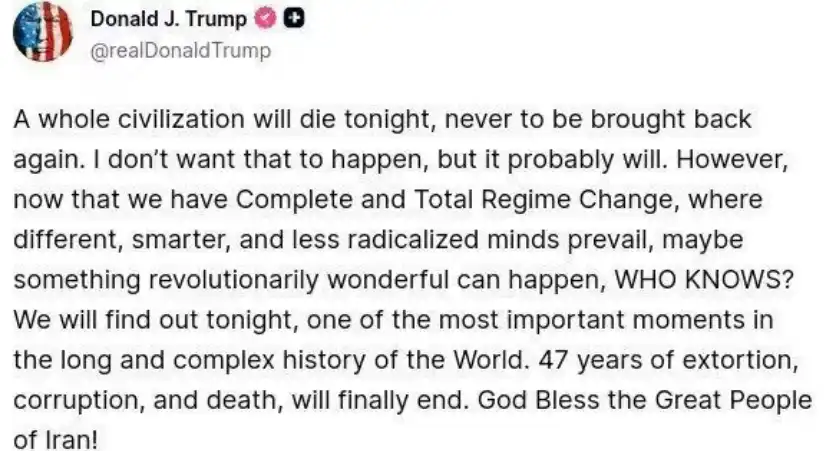
This ceasefire was the result of intensive diplomatic mediation.
The day before, Pakistani Prime Minister Shahbaz had called both Trump and Iran's Supreme Leader Khamenei, requesting a two-week extension of the "final deadline" and asking Iran to open the Strait of Hormuz for two weeks as a gesture of goodwill. Trump's condition was for Iran to "comprehensively, immediately, and safely" open the Strait of Hormuz in exchange for the ceasefire.
The Iranian side has accepted the ceasefire proposal but has made it clear that they have "complete mistrust" towards the US. According to the agreement, the ceasefire officially took effect at 3:30 a.m. Iran time on April 8 (8 a.m. Beijing time), and Israel has also agreed to suspend bombing operations during the negotiations.
The ceasefire will last for two weeks, and talks will begin on April 10 in Islamabad, Pakistan, with the possibility of extension upon mutual agreement. Currently, US military airstrikes in Iran have been paused, and the Iranian armed forces have ceased defensive operations. However, it is important to note that the ceasefire is a "two-way pause" and not a permanent peace agreement.
The Iranian side has simultaneously released a ten-point plan submitted to the US through Pakistan, with key demands including: the withdrawal of US combat troops from all bases in the region, lifting all sanctions against Iran, acceptance of Iran's uranium enrichment activities, payment of war reparations to Iran, and ultimately the approval of all terms through a binding UN Security Council resolution.
The Iranian statement claims that "Pakistan has informed Iran that the US has accepted the above principles as a basis for negotiations," but the US has never responded positively to this. The significant gap in core demands between the two sides has created a high level of uncertainty about the outlook two weeks from now. The negotiations are a continuation of the battlefield rather than the end of it.
II. Market Overview: Extreme Differentiation of Four Asset Classes
After the ceasefire announcement, global asset classes exhibited a rare and sharp differentiation, reflecting the market's complexity in pricing the "peace expectations" logic.
Cryptocurrency Market: Risk appetite has surged across the board, with Bitcoin leading the way. Bitcoin briefly surpassed $72,000, reaching as high as $72,760, with a 24-hour gain of over 5%; Ethereum surpassed $2,200, hitting $2,273 at one point, with a 24-hour gain of over 7%; other mainstream coins like SOL also saw varying degrees of increase. Over the past 24 hours, there was a total of $595 million in liquidations, with short liquidations accounting for $429 million, representing 72%, primarily Bitcoin short liquidations totaling $244 million.
The core drivers of Bitcoin's strong rebound: First, the ceasefire news directly triggered the liquidation of concentrated short positions accumulated earlier; second, the US-listed Bitcoin spot ETF recorded a net inflow of $471.3 million on Monday, continuing the inflow trend from last week, with institutional funds returning providing fundamental support for the rebound.
Crude Oil: A complete reversal of the war premium. As the absolute epicenter of this conflict, the crude oil market experienced the most intense volatility.
During the conflict, the risk of a blockade in the Strait of Hormuz pushed WTI crude oil prices from around $65 to nearly $118 per barrel, representing a nearly 70% increase.
Upon the ceasefire announcement, WTI crude oil futures experienced a single-day plummet of over 15%, dropping to as low as $91.3 per barrel, with the decline extending to 19%. Approximately one-fifth of the global oil supply chain relies on the Strait of Hormuz, and once the ceasefire agreement can be maintained, the oil price faces further downward pressure.
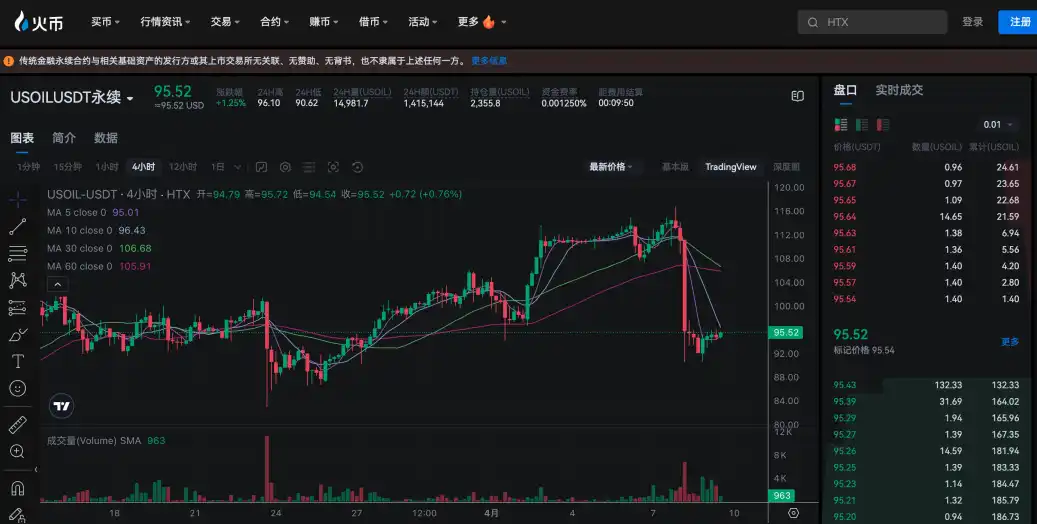
Gold: Resurgence of safe-haven demand. Gold's performance is the most noteworthy signal in this event. Following the traditional logic of "buy the rumor, sell the news," a de-escalation of geopolitical tensions should weaken gold's safe-haven demand, leading to a price retreat.
However, spot gold instead surged against the trend to $4811 per ounce after the ceasefire news, a gain of over 3%, with the main New York gold futures contract rising back above $4840. This abnormal phenomenon of "safe-haven assets surging after geopolitical easing" reveals a deeper logic: long-term funds are not betting on a short-term ceasefire but rather on a long-term distrust of the U.S. dollar credit system and global U.S. leadership.
The rise in gold essentially reflects deep skepticism about fiat currency credit and long-term geopolitical stability. During the US-Iran conflict, the US Dollar Index appreciated over 2%; following the ceasefire news, the US Dollar Index intraday fell by nearly 0.7%, retreating to 98.9, further strengthening this assessment.
U.S. Stocks: Rebound but underlying concerns remain. Nasdaq futures extended gains to 2.5%, S&P 500 futures rose over 2%, and Dow futures increased by 1.8%. The Asia-Pacific markets responded in sync, with the Nikkei 225 Index's gain expanding to 4.7% and the MSCI Asia Pacific Index rising 2.1%.
However, the three major U.S. stock indices actually showed lackluster performance during regular Tuesday trading hours: the S&P 500 rose by 0.08%, Nasdaq rose by 0.1%, and the Dow fell by 0.18%, indicating a cautious stance from investors toward the economic fundamentals.
The differential pricing of major asset classes indicates that the ceasefire news triggered varying dynamics in different asset categories: oil directly unwound the war premium, U.S. stocks repaired risk appetite, gold priced in long-term uncertainty, and the crypto market simultaneously absorbed the sentiment recovery of risk assets and the narrative of digital asset safe-haven.
3. The New Geopolitical Logic of Cryptographic Assets: The Dual Role of Risk and Hedging
During the recent US-Iran conflict, Bitcoin's performance pattern provided an important analytical framework: it is no longer simply equated with being a "risky asset" or a "safe haven asset," but instead demonstrates a unique "dual attribute."
During the conflict escalation phase (late February to early April), Bitcoin's performance clearly differentiated from traditional risk assets. While geopolitical tension led to a surge in oil prices, an increase in inflation expectations, a setback in the market's expectation of a Fed rate cut, and significant pressure on traditional tech stocks, Bitcoin did not experience a synchronous significant decline.
The reason for this was that Bitcoin had already experienced a significant pullback early in the conflict, limiting potential passive selling pressure in the market. At the same time, continued net inflows into US-listed Bitcoin spot ETFs provided liquidity support to the market.
During the rebound phase following the ceasefire announcement, Bitcoin's performance contained logic from two aspects: on one hand, it rebounded in sync with US stocks and the Asia-Pacific stock market, reflecting its risk attribute as a globally liquid-sensitive asset; on the other hand, its rebound magnitude and sustainability exceeded that of traditional risk assets, reflecting the market's pricing of its "digital gold" narrative.
Some market analyses have pointed out that Bitcoin's performance after major global crises is often better than that of traditional safe-haven assets. Research from Mercado Bitcoin shows that in the 60-day market performance following events such as the early stages of the pandemic and the escalation of US trade tariffs, Bitcoin's returns significantly outperformed gold and the S&P 500 in most time frames.
Bitcoin's "dual attribute" is the core feature that sets it apart from other assets. It is a risk asset, highly sensitive to global liquidity and macro policies; it is also a scarce asset, gaining a hedging premium in the background of questioned sovereign credit.
These two attributes are not mutually exclusive but take turns dominating under different macro conditions. In times of heightened geopolitical conflict, its hedging narrative takes the lead; in times of liquidity contraction, its risk attribute becomes more prominent.
However, the establishment of this framework depends on one premise: the continued increase in institutional participation. On April 7, the US Bitcoin spot ETF recorded a net inflow of $471.3 million, indicating that institutional funds are strategically positioning themselves in response to market volatility.
The pricing power of institutional funds over Bitcoin has significantly strengthened, shifting Bitcoin's response pattern to geopolitical events from "retail-driven emotion" to "institutionally driven macro pricing." This shift implies that in the future, Bitcoin's correlation with macro variables (interest rates, the US dollar index, global liquidity) may further strengthen, while the impact of mere geopolitical news on prices may gradually weaken.
IV. Future Outlook: Two-Week Window and Three Key Macroeconomic Variables
The ceasefire agreement only lasts for two weeks, meaning the current market pricing is based on an extremely fragile premise—that progress can be made in the Islamabad negotiations on April 10 and the ceasefire can hold for two weeks. If the negotiations deadlock, geopolitical risk premium will quickly return to the market. Here are the three key variables that need to be closely monitored in the future:
Variable One: Direction of Islamabad Negotiations (Key Dates: April 10 - April 24). The Iranian negotiation team is expected to adhere to the core demands of the ten-point plan, including terms such as U.S. troop withdrawal and sanctions relief, while the Trump administration's bottom line is "Iran completely abandoning nuclear [activity], dismantling nuclear facilities."
There is a significant gap in the core demands of both sides, and the uncertainty remains high as to whether a substantive agreement can be reached within two weeks. Goldman Sachs maintained its forecast of an average Brent crude oil price of $85 in 2026 in its latest report, far exceeding the $61 at the beginning of the year, reflecting that the market's pricing of long-term geopolitical risk remains relatively high.
Several analysts have pointed out that a two-week time window is insufficient to reach a structural agreement to resolve the deep-rooted Middle East conflicts. The sharp decline in energy assets such as crude oil is more of a long position profit-taking and a technical squeeze, rather than a complete elimination of fundamental supply risks.
Variable Two: Inflation Expectations and the Fed Policy Path. Over the past month, due to the U.S.-Iran conflict causing a more than 40% surge in oil prices, global inflation expectations have significantly heated up, and the market briefly started pricing in a scenario where the Fed would postpone rate cuts or even raise rates. With the sharp fall in oil prices, the pressure on inflation expectations has eased, and the market is recalibrating its expectations for the Fed's rate-cutting path.
If oil prices remain below $100 during the ceasefire, it will provide the Fed with greater policy flexibility, which is a macroeconomic positive for global risk assets, including Bitcoin. However, if the negotiations collapse in two weeks and oil prices surge again, inflation expectations will quickly revert, at which point the Fed's rate-cutting path will once again face uncertainty.
Variable Three: Legislative Progress of the CLARITY Act. Rachel Lucas, an analyst at BTC Markets, pointed out: "The bull market scenario depends on two catalysts: one is a confirmed and sustained U.S.-Iran ceasefire, bringing oil prices below $100; the other is the U.S. CLARITY Act expected to pass in late April, institutional market participants are closely watching this act, seeing it as a regulatory 'unsealing'."
If the CLARITY Act is passed in late April, it will provide a clearer legal framework for stablecoins and digital asset regulation, further lowering institutional entry barriers, and becoming a significant mid-term catalyst for the crypto market.
Additionally, attention needs to be paid to on-chain derivatives market trends. In the US-Iran ceasefire prediction market, the probability of the April 15th contract jumped from 67% to 90% within minutes of the news being released, then rose to 99.6% "YES," demonstrating the market's high confidence in a short-term ceasefire.
However, research from institutions like Chainalysis indicates that when prediction market probabilities become overly concentrated on a single outcome, it often means the market has underpriced tail risks—when everyone believes the ceasefire will continue, it is actually the moment most susceptible to an unexpected reversal.
Five, Risk Warning and Strategic Advice
The current market rebound is built on an extremely fragile premise—a two-week ceasefire. If this foundation is shaken, various assets currently priced in the market will face significant revaluation.
The return of geopolitical risks is the most direct risk. If the April 10th Islamabad talks fail to make substantial progress or if the ceasefire agreement is not extended after two weeks, the market will swiftly reprice geopolitical risk premiums. At that time, oil prices may surge again, global inflation expectations may rise, the Fed's interest rate cut path may once again face uncertainty, and risk assets (including Bitcoin) will face renewed pressure.
Uncertainty in regulatory policies is also worth noting. If the CLARITY Act is smoothly passed in late April, it will be a mid-term positive for the crypto market; however, if it encounters resistance during deliberation, the market may reprice regulatory risks.
The third variable is the risk of macro liquidity tightening. If oil prices continue to decline due to the ceasefire, alleviating inflationary pressures and giving the Fed more room to cut interest rates, this will benefit risk assets like Bitcoin. Conversely, if oil prices surge again due to a ceasefire breakdown, expectations of a Fed rate cut will be suppressed, posing a macro-level headwind to Bitcoin.
From a strategic perspective, the current rebound in the crypto market provides a rare opportunity for position reduction or adjustment. Key data on the 14th and 15th (such as US CPI, PPI, retail sales data) and the start of negotiations on April 10th will provide more macro judgment bases.
It is recommended that investors maintain flexible positions, closely monitor Islamabad negotiation progress, oil price changes, and Fed officials' statements, stay rational when the market overprices "peace," and remain clear-headed when the market panics about "war." In the dual game of macro and geopolitical factors, maintaining strategic flexibility and sensitivity to key variables is more important than betting on a single direction.
This article is a contributed piece and does not represent the views of BlockBeats.
You may also like

Anthropic's $1 trillion, compared to DeepSeek's $100 billion

Geopolitical Risk Persists, Is Bitcoin Becoming a Key Barometer?

Annualized 11.5%, Wall Street Buzzing: Is MicroStrategy's STRC Bitcoin's Savior or Destroyer?

An Obscure Open Source AI Tool Alerted on Kelp DAO's $292 million Bug 12 Days Ago

Mixin has launched USTD-margined perpetual contracts, bringing derivative trading into the chat scene.
The privacy-focused crypto wallet Mixin announced today the launch of its U-based perpetual contract (a derivative priced in USDT). Unlike traditional exchanges, Mixin has taken a new approach by "liberating" derivative trading from isolated matching engines and embedding it into the instant messaging environment.
Users can directly open positions within the app with leverage of up to 200x, while sharing positions, discussing strategies, and copy trading within private communities. Trading, social interaction, and asset management are integrated into the same interface.
Based on its non-custodial architecture, Mixin has eliminated friction from the traditional onboarding process, allowing users to participate in perpetual contract trading without identity verification.
The trading process has been streamlined into five steps:
· Choose the trading asset
· Select long or short
· Input position size and leverage
· Confirm order details
· Confirm and open the position
The interface provides real-time visualization of price, position, and profit and loss (PnL), allowing users to complete trades without switching between multiple modules.
Mixin has directly integrated social features into the derivative trading environment. Users can create private trading communities and interact around real-time positions:
· End-to-end encrypted private groups supporting up to 1024 members
· End-to-end encrypted voice communication
· One-click position sharing
· One-click trade copying
On the execution side, Mixin aggregates liquidity from multiple sources and accesses decentralized protocol and external market liquidity through a unified trading interface.
By combining social interaction with trade execution, Mixin enables users to collaborate, share, and execute trading strategies instantly within the same environment.
Mixin has also introduced a referral incentive system based on trading behavior:
· Users can join with an invite code
· Up to 60% of trading fees as referral rewards
· Incentive mechanism designed for long-term, sustainable earnings
This model aims to drive user-driven network expansion and organic growth.
Mixin's derivative transactions are built on top of its existing self-custody wallet infrastructure, with core features including:
· Separation of transaction account and asset storage
· User full control over assets
· Platform does not custody user funds
· Built-in privacy mechanisms to reduce data exposure
The system aims to strike a balance between transaction efficiency, asset security, and privacy protection.
Against the background of perpetual contracts becoming a mainstream trading tool, Mixin is exploring a different development direction by lowering barriers, enhancing social and privacy attributes.
The platform does not only view transactions as execution actions but positions them as a networked activity: transactions have social attributes, strategies can be shared, and relationships between individuals also become part of the financial system.
Mixin's design is based on a user-initiated, user-controlled model. The platform neither custodies assets nor executes transactions on behalf of users.
This model aligns with a statement issued by the U.S. Securities and Exchange Commission (SEC) on April 13, 2026, titled "Staff Statement on Whether Partial User Interface Used in Preparing Cryptocurrency Securities Transactions May Require Broker-Dealer Registration."
The statement indicates that, under the premise where transactions are entirely initiated and controlled by users, non-custodial service providers that offer neutral interfaces may not need to register as broker-dealers or exchanges.
Mixin is a decentralized, self-custodial privacy wallet designed to provide secure and efficient digital asset management services.
Its core capabilities include:
· Aggregation: integrating multi-chain assets and routing between different transaction paths to simplify user operations
· High liquidity access: connecting to various liquidity sources, including decentralized protocols and external markets
· Decentralization: achieving full user control over assets without relying on custodial intermediaries
· Privacy protection: safeguarding assets and data through MPC, CryptoNote, and end-to-end encrypted communication
Mixin has been in operation for over 8 years, supporting over 40 blockchains and more than 10,000 assets, with a global user base exceeding 10 million and an on-chain self-custodied asset scale of over $1 billion.

$600 million stolen in 20 days, ushering in the era of AI hackers in the crypto world
Vitalik's 2026 Hong Kong Web3 Summit Speech: Ethereum's Ultimate Vision as the "World Computer" and Future Roadmap
On the same day Aave introduced rsETH, why did Spark decide to exit?
Full Post-Mortem of the KelpDAO Incident: Why Did Aave, Which Was Not Compromised, End Up in Crisis Situation?

After a $290 million DeFi liquidation, is the security promise still there?
ZachXBT's post ignites RAVE nearing zero, what is the truth behind the insider control?

Vitalik 2026 Hong Kong Web3 Carnival Speech Transcript: We do not compete on speed; security and decentralization are the core
In-depth Analysis of RAVE Events: Short Squeeze, Crash, and Quantitative Financial Models of Liquidity Manipulation

Eve of Ceasefire, US Military Fires on Iranian Vessel | Rewire News Morning Brief

Figma's stock price drops over 7%, will Claude Design be the terminator?

Plunge by 10% Followed by Rebound, Weekend Oil Market Watch

SpaceX Mascot ASTEROID Fast Track $170 million, Stemming from an Unfinished Space Dream

L1 is dead, Appchain should rise
Anthropic's $1 trillion, compared to DeepSeek's $100 billion
Geopolitical Risk Persists, Is Bitcoin Becoming a Key Barometer?
Annualized 11.5%, Wall Street Buzzing: Is MicroStrategy's STRC Bitcoin's Savior or Destroyer?
An Obscure Open Source AI Tool Alerted on Kelp DAO's $292 million Bug 12 Days Ago
Mixin has launched USTD-margined perpetual contracts, bringing derivative trading into the chat scene.
The privacy-focused crypto wallet Mixin announced today the launch of its U-based perpetual contract (a derivative priced in USDT). Unlike traditional exchanges, Mixin has taken a new approach by "liberating" derivative trading from isolated matching engines and embedding it into the instant messaging environment.
Users can directly open positions within the app with leverage of up to 200x, while sharing positions, discussing strategies, and copy trading within private communities. Trading, social interaction, and asset management are integrated into the same interface.
Based on its non-custodial architecture, Mixin has eliminated friction from the traditional onboarding process, allowing users to participate in perpetual contract trading without identity verification.
The trading process has been streamlined into five steps:
· Choose the trading asset
· Select long or short
· Input position size and leverage
· Confirm order details
· Confirm and open the position
The interface provides real-time visualization of price, position, and profit and loss (PnL), allowing users to complete trades without switching between multiple modules.
Mixin has directly integrated social features into the derivative trading environment. Users can create private trading communities and interact around real-time positions:
· End-to-end encrypted private groups supporting up to 1024 members
· End-to-end encrypted voice communication
· One-click position sharing
· One-click trade copying
On the execution side, Mixin aggregates liquidity from multiple sources and accesses decentralized protocol and external market liquidity through a unified trading interface.
By combining social interaction with trade execution, Mixin enables users to collaborate, share, and execute trading strategies instantly within the same environment.
Mixin has also introduced a referral incentive system based on trading behavior:
· Users can join with an invite code
· Up to 60% of trading fees as referral rewards
· Incentive mechanism designed for long-term, sustainable earnings
This model aims to drive user-driven network expansion and organic growth.
Mixin's derivative transactions are built on top of its existing self-custody wallet infrastructure, with core features including:
· Separation of transaction account and asset storage
· User full control over assets
· Platform does not custody user funds
· Built-in privacy mechanisms to reduce data exposure
The system aims to strike a balance between transaction efficiency, asset security, and privacy protection.
Against the background of perpetual contracts becoming a mainstream trading tool, Mixin is exploring a different development direction by lowering barriers, enhancing social and privacy attributes.
The platform does not only view transactions as execution actions but positions them as a networked activity: transactions have social attributes, strategies can be shared, and relationships between individuals also become part of the financial system.
Mixin's design is based on a user-initiated, user-controlled model. The platform neither custodies assets nor executes transactions on behalf of users.
This model aligns with a statement issued by the U.S. Securities and Exchange Commission (SEC) on April 13, 2026, titled "Staff Statement on Whether Partial User Interface Used in Preparing Cryptocurrency Securities Transactions May Require Broker-Dealer Registration."
The statement indicates that, under the premise where transactions are entirely initiated and controlled by users, non-custodial service providers that offer neutral interfaces may not need to register as broker-dealers or exchanges.
Mixin is a decentralized, self-custodial privacy wallet designed to provide secure and efficient digital asset management services.
Its core capabilities include:
· Aggregation: integrating multi-chain assets and routing between different transaction paths to simplify user operations
· High liquidity access: connecting to various liquidity sources, including decentralized protocols and external markets
· Decentralization: achieving full user control over assets without relying on custodial intermediaries
· Privacy protection: safeguarding assets and data through MPC, CryptoNote, and end-to-end encrypted communication
Mixin has been in operation for over 8 years, supporting over 40 blockchains and more than 10,000 assets, with a global user base exceeding 10 million and an on-chain self-custodied asset scale of over $1 billion.




 App
App