
- Buy Crypto
- Markets
- Futures
- Spot
- Copy Trade
 Earn
Earn- More
Confiscated Bitcoin Quietly Sold? US Law Enforcement Accused of Ignoring Trump Executive Order

Original Article Title: Did DOJ Prosecutors Violate Trump's Executive Order by Selling the Forfeited Samourai Wallet Bitcoin?
Original Article Author: Frank Corva, Bitcoin Magazine
Original Article Translation: Chopper, Foresight News
The United States Marshals Service (USMS) appears to have liquidated the Bitcoin paid by Samourai Wallet developer Keonne Rodriguez and William Lonergan Hill, totaling $6.3 million, as part of their plea agreement.
This action is suspected to violate Executive Order 14233, which stipulates that Bitcoin obtained through criminal or civil asset forfeiture proceedings by the government should be held in the United States Strategic Bitcoin Reserve and not liquidated.
If the New York Southern District Federal Court, responsible for overseeing the Samourai case, indeed violated Executive Order 14233, this would not be the first time court personnel have defied federal government directives.
Where Did This Bitcoin Go?
Bitcoin Magazine has obtained a previously undisclosed Asset Liquidation Agreement document. The document reveals that the Bitcoin seized from Rodriguez and Hill has either been or is about to be sold.
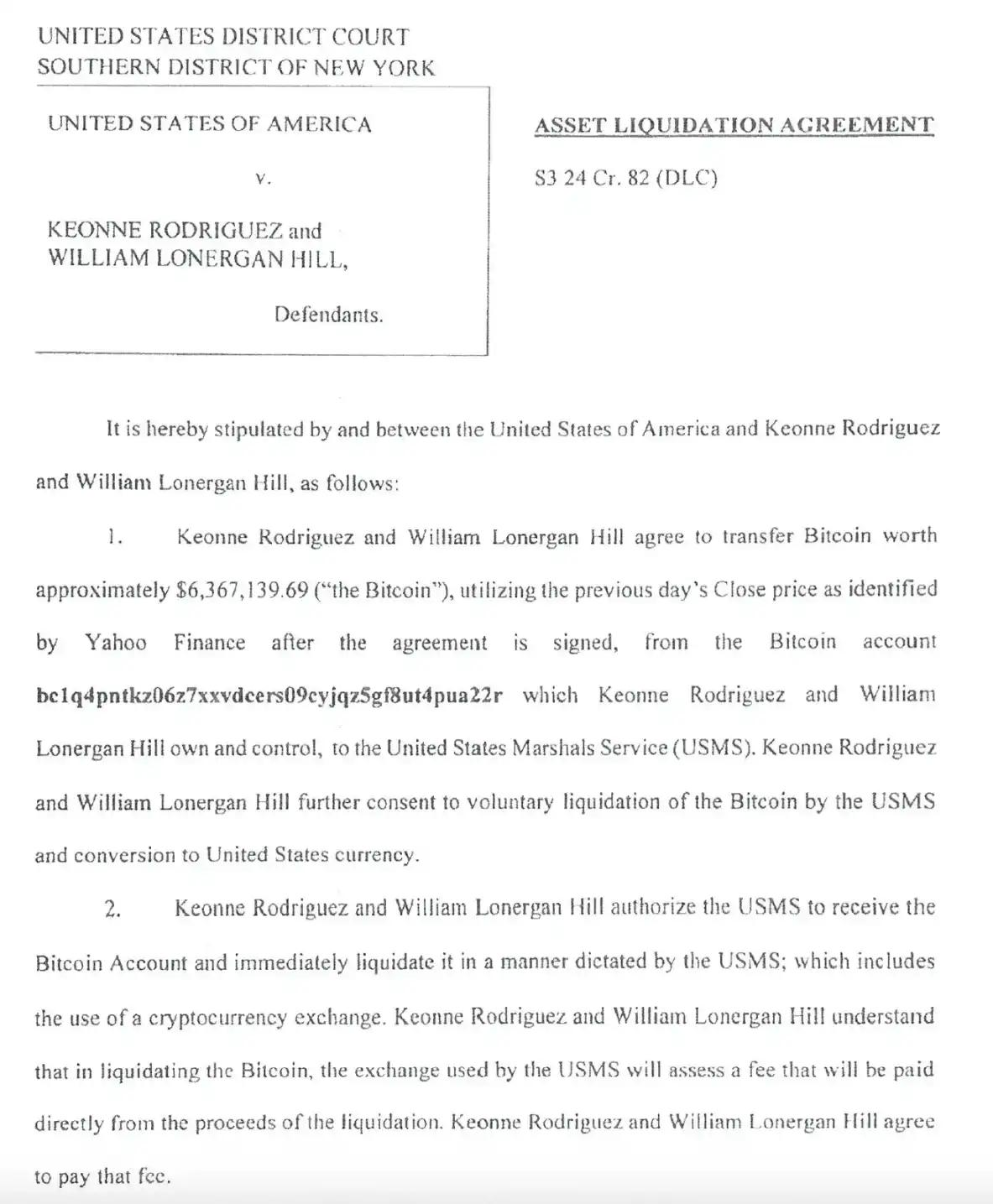
According to the agreement, the two defendants agreed to transfer 57.5 Bitcoins to the USMS, valued at approximately $6.36 million on the agreement's final signing date of November 3, 2025.
On November 3, 2025, this Bitcoin was sent from address bc1q4pntkz06z7xxvdcers09cyjqz5gf8ut4pua22r, but it did not appear to go directly into the USMS's custody account; instead, it was directly transferred to Coinbase Prime's wallet address 3Lz5ULL7nG7vv6nwc8kNnbjDmSnawKS3n8, presumably for liquidation.
Currently, the balance of this Coinbase Prime address has been depleted, indicating that this Bitcoin has most likely been sold.
Violation of Executive Order 14233
Once the US Marshals confirm the sale of this seized Bitcoin, it will constitute a violation of Executive Order 14233. The order expressly mandates that Bitcoin obtained through criminal forfeiture proceedings "shall not be sold" and must be added to the US Strategic Bitcoin Reserve.
The US Marshals' decision to sell the Bitcoin is based on its own discretion rather than a legal requirement. This phenomenon suggests that some members of the Department of Justice may still consider Bitcoin a "taboo asset," eager to offload it for liquidity, rather than as a strategic asset to be held as per President Trump's directive to government agencies.
It is worth noting that the investigation and prosecution against Samourai began during the previous administration. At that time, the government harbored strong animosity towards non-custodial cryptocurrency tools and their developers. Therefore, the Department of Justice's decision to disregard Executive Order 14233 and proceed with the Bitcoin sale continues the consistent approach of past administrations in treating Bitcoin as an asset to be quickly cleared from the government's balance sheet.
Legal Details Related to Seizure and Liquidation
According to a knowledgeable legal source, the Bitcoin belonging to Samourai developers was seized under Title 18, Section 982(a)(1) of the US Code. This provision stipulates that any property involved in the crime of operating an unlicensed money transmitting business in violation of Title 18, Section 1960 of the US Code shall be subject to forfeiture and turned over to the US government.
Combining Title 18, Section 982 of the US Code with a reference to Title 21, Section 853(c) of the US Code (a criminal forfeiture statute allowing for the forfeiture of property transferred to persons other than the defendant through a special forfeiture order, followed by delivery to the US government), the Bitcoin seized from Rodriguez and Hill entirely fits the definition of "government Bitcoin" in Executive Order 14233.
Neither Title 18, Section 982 of the US Code nor its reference to Title 21, Section 853 mandates the liquidation of criminally seized property. Furthermore, the two asset forfeiture statutes cited in Section 3 of Executive Order 14233, Title 31, Section 9705 of the US Code and Title 28, Section 524(c) of the US Code, only regulate the handling and use of forfeited funds, without requiring the conversion of seized Bitcoin into fiat currency.
The order specifically states that "government Bitcoin" falls under the category of "government digital assets" and mandates that "agency heads shall not sell or otherwise dispose of any government digital asset" except in specific circumstances. The Rodriguez and Hill case does not meet any of the exceptions, and in all exception cases, the US Attorney General must be involved in the decision-making process regarding the disposition of seized digital assets.
The "One's Own Faction" New York Southern District Federal Court
Considering Executive Order 14233 and various regulations cited in this article, the actions of the New York Southern District Federal Court clearly violated the core requirement in the executive order to "transfer criminally seized bitcoins to the U.S. Strategic Bitcoin Reserve."
And this is not the first time this court has shown such disobedience.
This judicial district, often jokingly referred to as the "New York Sovereign Zone Court," has always been known for its independent and arbitrary behavior, often operating outside of control even though it is within the federal judiciary system.
The court's persistent advancement of the lawsuits against Rodriguez, Hill, and Tornado Cash developer Roman Storm is another testament to its stubbornness.
On April 7, 2025, U.S. Deputy Attorney General Todd Blanche issued a memorandum entitled "Ending the Fine-in-Lieu-of-Custody Model," clearly stating that "the Department of Justice will no longer charge virtual currency exchange platforms, mixer services, and offline wallet developers based on end-user actions..."
However, the New York Southern District Federal Court disregarded this core spirit in the memorandum and continued to forcefully pursue the cases involving Samourai Wallet and Tornado Cash.
Of particular note, Hill and Rodriguez's defense teams had applied for Brady requests (requiring the prosecution to disclose exculpatory evidence to the defense), and the finally obtained documents revealed that two senior officials from the U.S. Department of the Treasury's Financial Crimes Enforcement Network had explicitly stated that, given Samourai Wallet's non-custodial nature, it did not constitute a money transmission business. Nevertheless, the prosecution still insisted on filing charges.
In criminal cases tried in the U.S. federal court system, over 90% of defendants are ultimately convicted, with acquittal rates in some years dropping as low as 0.4%. The prosecution team of the New York Southern District Federal Court is particularly known for its significantly higher-than-average federal conviction rate.
Rodriguez is well aware of these statistics, and he also knows that Judge Denise Cote, who presides over his and Hill's cases, is known for her harsh sentencing.
On the morning before he admitted to the charge of "conspiring to operate an unlicensed money transmission business," Rodriguez confessed all of this to me.
Has the Cryptocurrency War Really Ended?
In the 2024 election, many Bitcoin and cryptocurrency supporters cast their votes for President Trump, and the cryptocurrency industry had also thrown its weight behind his re-election campaign. Now, these supporters and industry insiders are questioning whether President Trump truly intends to end the war on cryptocurrency.
To achieve this goal, the Department of Justice under the Trump administration must strictly adhere to the requirements of Executive Order 14233, while following Deputy Attorney General Blanche's guidance to cease prosecution of non-custodial cryptocurrency developers. Regarding the latter, President Trump recently stated that he is considering pardoning Rodriguez.
Pardoning Rodriguez and directing the Department of Justice to investigate the sale of the confiscated bitcoins from the Samourai developer would send a strong signal, indicating that the President's stance in support of Bitcoin and cryptocurrency is serious and steadfast.
You may also like

Alibaba Backed Latin America Stablecoin Company, Why VelaFi?

AI Crypto Trading in 2026: How AI Agents Use Stablecoins for Capital Management and Settlement
Learn how AI agents use stablecoins for crypto trading in 2026 — managing capital, settling transactions, and operating across exchanges and DeFi protocols.

Key Market Information Discrepancy on January 14th – A Must-See! | Alpha Early Report
Key Takeaways Bitcoin reached a new milestone, hitting $96,000, while Ethereum surpassed $3,300. Privacy coins such as ORDI…

Tether Freezes $182 Million in Assets in a Day: Is USDT Still a Neutral Coin?
Key Takeaways Tether recently froze $182 million in USDT across five wallets on the Tron blockchain, raising questions…

Analyst: MSTR is the “Mullet” of this Bitcoin Bull Cycle, Acting as a Bitcoin Pressure Relief
MSTR absorbed significant volatility in this Bitcoin cycle, easing potential pressure on Bitcoin itself. Michael Saylor’s strategic issuance…
The New Era in Bitcoin Core Development: The Rise of Core Maintainer TheCharlatan
Key Takeaways Integration of a New Maintainer: For the first time in three years, a new Bitcoin Core…

Bitwise CIO Predicts Parabolic Bitcoin Surge with Sustained ETF Demand
Key Takeaways Prolonged demand for Bitcoin ETFs may lead to a parabolic rise in Bitcoin’s price, drawing parallels…

Final Federal Reserve Chair Candidate Rick Rieder, How He Views Cryptocurrency
Key Takeaways Rick Rieder stands out among the Federal Reserve Chair candidates due to his strong pro-crypto stance,…
ASTER’s Largest Long Position on Hyperliquid Faces Significant Challenges
Key Takeaways A significant long position on ASTER is experiencing notable floating losses, revealing the volatility of crypto…

XRP Price Analysis and Outlook: Unpacking the Gravestone Doji
Key Takeaways The gravestone doji, a rare chart pattern, has recently appeared on XRP’s weekly chart, indicating potential…

Crypto Price Forecast Today 12 January—XRP, Solana, Maxi Doge
Key Takeaways: XRP illustrates strong potential in 2026 with ecosystem growth and stablecoin expansion despite recent challenges. Solana…

Solana Price Forecast: The Impact of its Integration into Elon’s X (Twitter)
Key Takeaways: Solana’s speculated integration into X (formerly Twitter) could amplify its recognition across X’s extensive user base…

Kaspa Price Prediction – KAS Price Estimated to Drop to $ 0.038116 By Jan 17, 2026
Key Takeaways Kaspa is trading at $0.048316, showing a 3.06% decrease over the past 24 hours and a…

Story is Trading 33.03% Above Our Price Prediction for Jan 17, 2026
Key Takeaways Current Market Positioning: Story is trading at $2.58, significantly above the predicted price of $1.94 for…

Sky Price Prediction – SKY Price Estimated to Decline to $ 0.042476 By Jan 17, 2026
Key Takeaways Short-term Decline Expected: The price of SKY is currently predicted to decrease by 23.14% within the…
Pepe Coin Price Prediction – Anticipated Drop to $ 0.000005 by Mid-January 2026
Key Takeaways: Pepe Coin is currently valued at $0.000006, with an expected decline to $0.000005 by January 15,…
Dogecoin Price Analysis: Why $0.14 May Be a Barrier Difficult to Overcome
Key Takeaways Dogecoin has faced a significant challenge as a strong resistance has emerged at the $0.14 level,…
Wintermute's 28-Page Report Unveils the Inner Workings of Off-Chain Liquidity
Alibaba Backed Latin America Stablecoin Company, Why VelaFi?
AI Crypto Trading in 2026: How AI Agents Use Stablecoins for Capital Management and Settlement
Learn how AI agents use stablecoins for crypto trading in 2026 — managing capital, settling transactions, and operating across exchanges and DeFi protocols.
Key Market Information Discrepancy on January 14th – A Must-See! | Alpha Early Report
Key Takeaways Bitcoin reached a new milestone, hitting $96,000, while Ethereum surpassed $3,300. Privacy coins such as ORDI…
Tether Freezes $182 Million in Assets in a Day: Is USDT Still a Neutral Coin?
Key Takeaways Tether recently froze $182 million in USDT across five wallets on the Tron blockchain, raising questions…
Analyst: MSTR is the “Mullet” of this Bitcoin Bull Cycle, Acting as a Bitcoin Pressure Relief
MSTR absorbed significant volatility in this Bitcoin cycle, easing potential pressure on Bitcoin itself. Michael Saylor’s strategic issuance…
The New Era in Bitcoin Core Development: The Rise of Core Maintainer TheCharlatan
Key Takeaways Integration of a New Maintainer: For the first time in three years, a new Bitcoin Core…


 App
App