
Coin Metrics: Analyzing Circle's IPO Filing and $USDC's On-Chain Footprint


Original Article Title: New State of the Network: Unpacking Circle's IPO Filing and $USDC's On-Chain Footprint
Original Article Author: Tanay Ved, Coin Metrics
Original Article Translation: Shan Ou Ba, Golden Finance
Key Points:
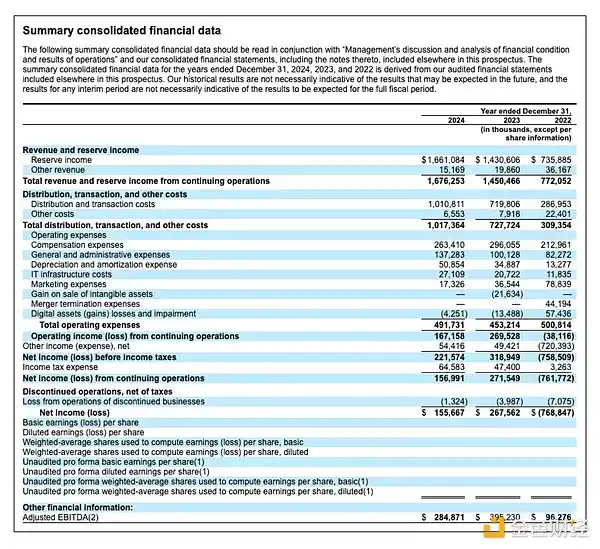
· Circle generated $1.7 billion in revenue in 2024, with 99% coming from interest income on USDC reserves. Distribution costs paid to partners such as Coinbase and Binance totaled $1.01 billion, reflecting the crucial role of exchanges in expanding USDC coverage.
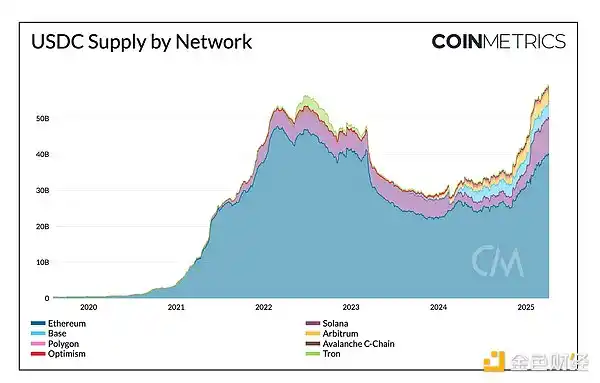
· USDC's total supply has rebounded to $60 billion, with a 30-day average transfer volume of $40 billion, indicating market confidence and cross-chain adoption recovery. However, USDC remains highly sensitive to interest rate fluctuations, competitive pressures, and regulatory developments.
· The use of USDC on major exchanges continues to grow, currently representing 29% of Binance's spot trading volume, thanks to Circle's strategic partner relationships.
· Looking ahead, the next phase for Circle may depend on diversifying revenue sources from passive interest income to active sources related to tokenized assets, payment infrastructure, and capital market integration.
Introduction
Circle is the largest stablecoin issuer in the United States and the company behind the $60 billion USDC, recently filed for an IPO, providing a window into the financial health and strategic outlook of this foundational company in the cryptocurrency space. As the only direct exposure to the fastest-growing vertical in the cryptocurrency space in the public markets, Circle's filing comes at a crucial moment. While the IPO may still face delays due to market conditions, it coincides with stablecoin legislation taking shape and increasing competition between issuers and blockchain.
In this article, we dissect key points from Circle's IPO filing and combine them with on-chain data for USDC to understand how Circle generates revenue, how factors like interest rates impact its business, and the role of platforms like Coinbase and Binance in shaping USDC distribution. We also explore USDC's on-chain footprint to assess Circle's positioning in an increasingly competitive landscape.
Circle Financial Overview
From its origins as a Bitcoin payment app to becoming a leading stablecoin issuer and crypto infrastructure provider, Circle has gone through a series of challenges in its 12-year evolution. After experiencing explosive revenue growth in 2021 (450%) and 2022 (808%), the growth rate slowed in 2023, when USDC was impacted by the collapse of a Silicon Valley bank, resulting in an 88% revenue increase. By the end of 2024, Circle reported revenue of $1.7 billion, a 15% year-over-year growth, indicating its shift towards a more sustainable expansion.
Source: Circle S-1 Filing
However, profitability saw a decline, with net income and adjusted EBITDA decreasing by 42% and 28%, to $157 million and $285 million, respectively. Notably, Circle's financial data shows that its revenue is highly concentrated on interest income from reserves, while distribution costs to partners like Coinbase and Binance amounted to around $1.01 billion. Nevertheless, these factors contributed to the resurgence of USDC's supply, which grew by 80% over the year, reaching $440 billion.
USDC On-Chain Growth
USDC is at the core of Circle's business, launched in 2018 through a joint venture with Coinbase. USDC is a tokenized representation of the US dollar, allowing end-users to store value in digital form and transact on blockchain networks, enabling near-instant, low-cost settlements. It operates on a fully reserved basis, backed by highly liquid assets (such as short-term US Treasuries, overnight repurchase agreements, and cash held with regulated financial institutions) in a 1:1 ratio.
Source: Coin Metrics Network Data Pro & Coin Metrics Labs
The total supply of USDC has grown to around $600 billion, making it the second-largest stablecoin, behind only Tether's USDT. Although its market share came under pressure in 2023, it has since rebounded to 26%, reflecting a recovery in market confidence. Approximately $400 billion (65%) is issued on Ethereum, around $95 billion on Solana (15%), about $37.5 billion on Base Layer-2 (6%), with the rest issued on blockchains like Arbitrum, Optimism, Polygon, Avalanche, among others.
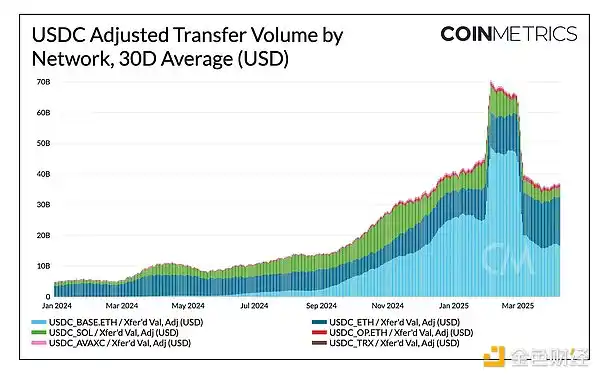
The circulation speed and transfer volume of USDC have also shown remarkable growth, with a 30-day average reaching around $400 billion. In 2025, most of the USDC transfer volume occurs on Base and Ethereum, sometimes accounting for up to 90% of the adjusted total transfer volume.
Source: Coin Metrics Network Data Pro
These metrics indicate that as stablecoins serve as an emerging market dollar substitute and with the proliferation of payment and financial technology infrastructure, the usage of USDC is increasing. They also reflect Circle's cross-chain strategy, with USDC widely present on major blockchains and supported by interoperability tools like Cross-Chain Transfer Protocol (CCTP).
Reserve Composition and Sensitivity to Interest Rates
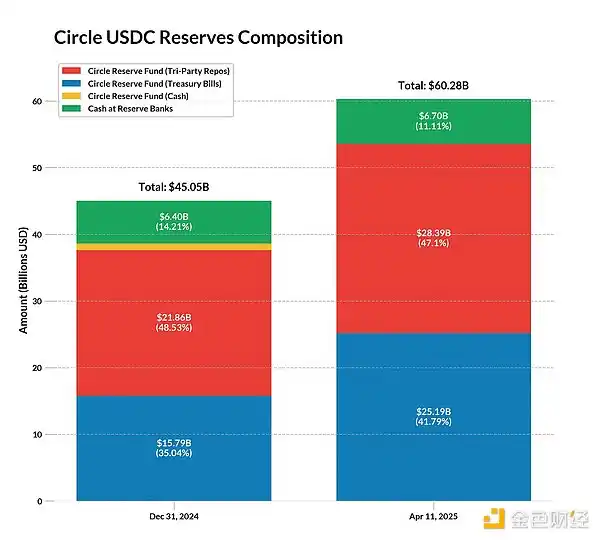
For every USDC dollar issued, Circle invests the backing reserve in a range of highly liquid, low-risk assets, such as short-term U.S. Treasuries and cash deposits. This structure enables Circle to earn revenue from the reserve while ensuring liquidity for USDC holders and stability for redemptions. In its filing, Circle revealed that it earned $1.6 billion in reserve income in 2024, representing 99% of its total revenue and highlighting a high concentration of its revenue structure in interest rates.
Most of USDC's reserves are held in the Circle Reserve Fund, which is a U.S. Securities and Exchange Commission-registered government money market fund managed by BlackRock. Based on Circle's monthly attestation, financial statements, and the aforementioned BlackRock Circle Reserve Fund, as of April 11th, approximately $535 billion (about 88%) of the USDC reserves consist of U.S. Treasuries and overnight repurchase agreements with multiple financial institutions, all with maturities of less than 2 months. Additionally, 11% of its reserves include cash held in regulated banks.
Source: Circle Transparency & BlackRock Circle Reserve Fund
Based on the $1.6 billion reserve income generated from Circle's approximately $440 billion reserve assets in 2024, the implied annualized yield is around 3.6%. If interest rates remain near current levels, assuming the USDC supply remains stable or grows, Circle's reserve income may remain stable.
Our previous article focusing on the decrease in USDC supply during a rising interest rate environment revealed the high correlation between Circle's reserve revenue and prevailing interest rates, indicating that its revenue model is highly sensitive to interest rate changes. While the effective federal funds rate in 2024 is expected to be between 4.58% and 5.33%, what does this mean for Circle in a declining rate environment? In its S-1 filing, Circle estimates that a mere 1% interest rate decrease could result in a $441 million reduction in stablecoin reserve revenue, a key risk outlined in the filing.
Given that Circle retains all revenue — unlike issuers such as Ethena and Maker, which distribute interest to holders — its business model remains highly sensitive to future interest rate fluctuations, competitive pressures, and regulatory evolution.
Distribution, Distribution, Distribution
The Role of Coinbase and Binance
Circle's IPO application also revealed the importance of partners like Coinbase and Binance in driving the adoption of USDC. In 2024, their distribution costs amounted to $1.01 billion, a significant 40% increase from 2023 and a 150% increase from 2022.
While Coinbase's relationship with Circle is well known, the filing shed light on the financial closeness between the two. In 2024, Coinbase earned $908 million from USDC-related activities, accounting for approximately 13.8% of its total revenue. Under the revenue-sharing agreement with Circle, Coinbase earns 100% of the interest on USDC held on its platform and 50% of the interest held elsewhere.
The USDC supply held on the Coinbase platform is currently at 20%, up from 5% in 2022, suggesting that most of the economic benefits accrue to Coinbase. The filing also disclosed a one-time payment of $60.25 million to Binance, aimed at promoting distribution in a similar manner.
Source: Coin Metrics Market Data Feed
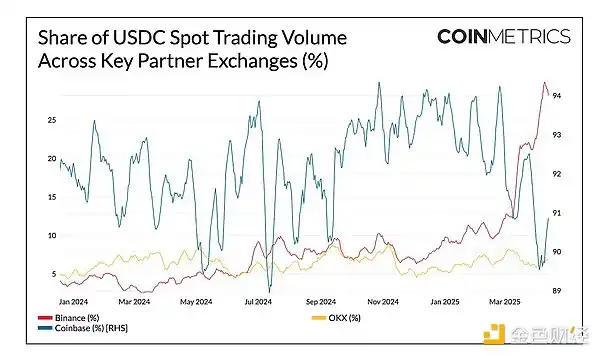
Looking at trading activity on major partner platforms, USDC currently represents over 29% of Binance's spot trading volume (approximately $6.2 billion), surpassing FDUSD after its recent unpegging. It trails only behind USDT, which accounts for about 50% of Binance's trading volume. On Coinbase, USDC drives around 90% of the merged USD and USDC market's spot trading.
Despite the high cost, Circle's distribution efforts have translated into significant exchange-level adoption—driving USDC liquidity and trusted on-chain trading volumes of over $100 billion.
Beyond Exchanges: Empowering DeFi and Commerce
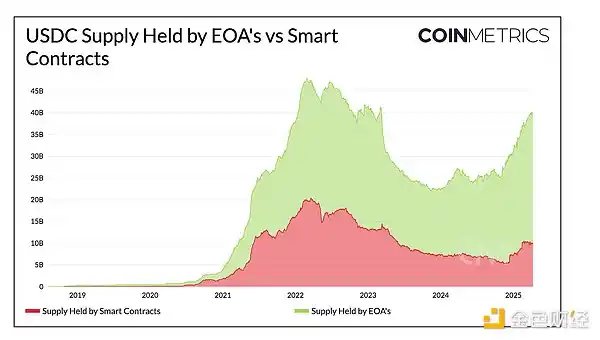
Viewing the supply held in smart contracts versus externally owned accounts (EOA) separately reveals the distribution of USDC across Ethereum wallets and applications. Currently, about $30 billion is held by EOA, a 66% increase, while about $10 billion is in smart contracts, a 42% increase from a year ago. The growth in EOA balances may reflect the increase in exchange custodianship and individual user holdings, while the growth in smart contracts indicates USDC's utility as collateral in the DeFi lending market and a liquidity source for decentralized exchanges (DEX).
Source: Coin Metrics Network Data Pro
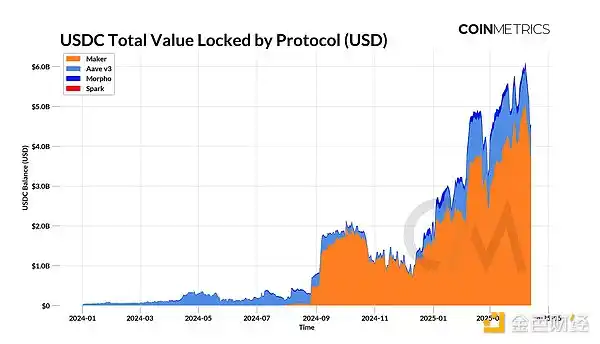
USDC continues to play a foundational role in the DeFi lending market, with over $5 billion locked in protocols like Aave, Spark, and Morpho (representing supplied but not borrowed USDC). For collateralized debt protocols like Maker (now Sky), about $4 billion in USDC also backs the issuance of Dai/USDS through its price stability module.
Source: Coin Metrics ATLAS & Reference Rates
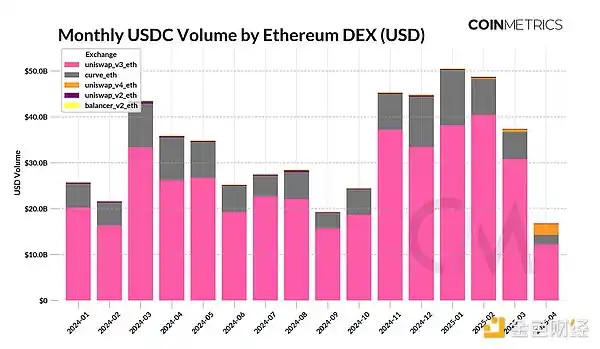
Likewise, USDC is a key liquidity source for various DEX pools facilitating trading of stable value assets. It is also increasingly underpinning on-chain FX markets, especially as other fiat-pegged stablecoins like Circle's compliant-to-MiCA-regulation EURC make strides.
Source: Coin Metrics DEX Data
Conclusion
The on-chain growth of USDC reflects the recovery of market confidence, but Circle's prospectus also highlights key challenges, particularly high distribution costs and heavy reliance on interest income. To maintain its growth momentum in a low-interest-rate environment, Circle is committed to diversifying its revenue through proactive product lines such as Circle Mint and expanding into the tokenized asset infrastructure space through the acquisition of the largest issuer of tokenized money market funds, Hashnote.
With the increasing regulatory clarity, especially with the U.S. Securities and Exchange Commission (SEC) stating its position that stablecoins are not securities, Circle is well-positioned. However, it now faces intensifying competition from offshore issuers like Tether and a new wave of U.S.-based challengers hoping to capitalize on the policy shift momentum. While Circle's valuation is still to be determined, its IPO will mark the first time the public markets can directly invest in stablecoin infrastructure growth.
You may also like

The AI gamble of mining companies: Valuations enter a phase of differentiation, and it's hard to turn the tide

A letter from Alliance to entrepreneurs: Written on the occasion of Cursor selling for 60 billion dollars

Stablecoins Finally Find Real Returns: On-Chain Reinsurance Re Explained | Interview with Re Founder Karan Saroya

The impossible triangle is simply a pseudo problem

Will MicroStrategy fall into a death spiral? What will the macro trend be in the second half of the year?

Blockchain Capital Partner: The Core Secret of Arbitrage
STRC unanchored by 11%, can the perpetual motion machine of Strategy still operate?

Bitcoin Market Analysis 2026: Can BTC Reach $150K by Year-End?
Bitcoin ETF Outflows Hit a Record $4.4 Billion: What Are Traders Doing With Their Cash?
WEEX App Just Got Smarter – New Tabs for Faster Trades & Easy Asset Management

WEEX All-New Search Features: Find, Trade & Earn Faster Than Ever

Morning Report | Illinois signs the strictest digital asset tax law in the U.S.; RWA tokenization market size surpasses $43 billion, institutions accelerate the migration of on-chain assets
Full version of the debut Q&A! Federal Reserve Chairman Waller: Sticking to the 2% inflation target, establishing five special working groups, individual did not submit the dot plot

From Disruptor to Shadow Market: The Crypto Market is Becoming a Colony of Traditional Finance
Dalio's important long article: How to position in the current market environment?
OKX Star analyzes Binance's competitive advantages: when regulation levels the playing field, competition has just begun

New gameplay for participating in initial offerings on cryptocurrency exchanges
Why Is Bitcoin Down Today? What the Hawkish FOMC Means for SpaceX, Gold and Nasdaq
The AI gamble of mining companies: Valuations enter a phase of differentiation, and it's hard to turn the tide
A letter from Alliance to entrepreneurs: Written on the occasion of Cursor selling for 60 billion dollars
Stablecoins Finally Find Real Returns: On-Chain Reinsurance Re Explained | Interview with Re Founder Karan Saroya
The impossible triangle is simply a pseudo problem
Will MicroStrategy fall into a death spiral? What will the macro trend be in the second half of the year?
Blockchain Capital Partner: The Core Secret of Arbitrage


