
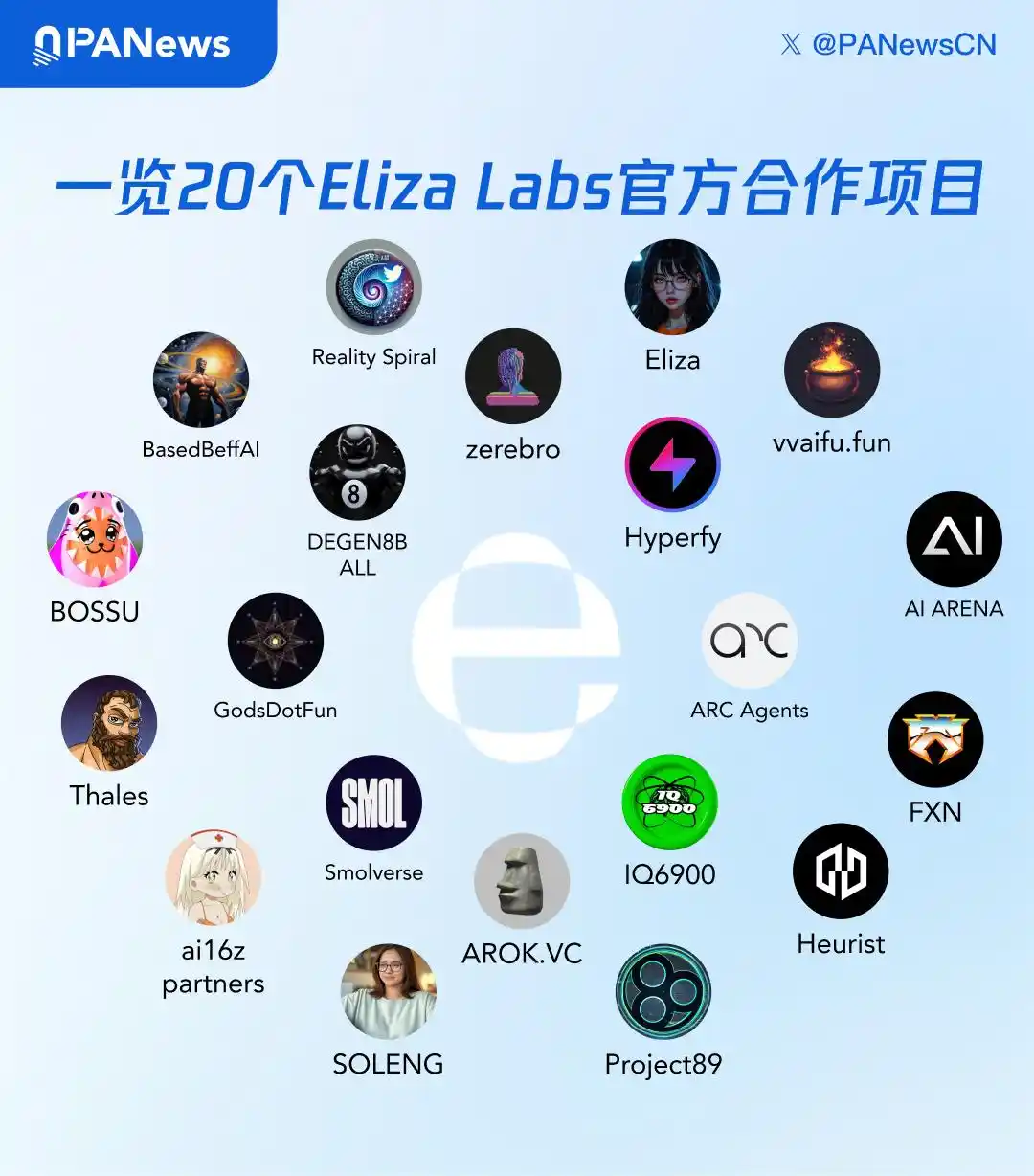
Check out the list of 20 Eliza Labs official partner projects: Low Market Cap Boost Effect More Pronounced




Original Article Title: "Overview of 20 Eliza Labs Official Partner Projects: Hyperfy Surges to Billions in Short Time, Low Market Cap Boost Effect More Prominent"
Original Article Author: Nancy, PANews
Recently, due to a retweet by Shaw, founder of ai16z and Eliza, the market value of the Metaverse+AIAgent project Hyperfy surged to billions of dollars in just a few hours, demonstrating an astonishing market response. This phenomenon once again confirms Shaw's significant influence. As a key figure in this round of AIAgent hype, he has a strong ability to drive project value and market attention.

On January 7, Shaw tweeted that Eliza Labs has established an official website to announce official partners and recognized projects. Among these partner projects, besides established projects in infrastructure, public chains, DEX, and other tracks such as Arbitrum, Berachain, EigenLayer, io.net, and Jupiter Exchange, most are emerging projects, and many of the token projects showed a significant price boost after the partnership news was announced.
This article by PANews lists 20 Eliza Labs official partner projects, mainly focusing on high market cap projects, most of which are valued between tens of millions and even billions of dollars. From a market performance perspective, many low-cap projects have shown significant gains, while among the high-market cap projects, in addition to Hyperfy's significant surge effect, the rest of the projects have relatively limited gains, perhaps due to these high-market cap projects having experienced high increases before.
zerebro (ZEREBRO)
ZEREBRO is a self-owned artificial intelligence system designed to create, distribute, and analyze content across various decentralized and social platforms. According to DEX Screener data as of January 7, ZEREBRO's market cap exceeds $460 million, with a more than 10.8% decrease in the past 24 hours.
Hyperfy (HYPER)
Hyperfy is a Metaverse platform that allows anyone to easily create a rich, immersive virtual world by integrating Eliza to introduce an AI Agent into the 3D world. According to DEX Screener data, as of January 7, HYPER's market cap reached a peak of $280 million shortly after its launch on January 6, now falling to nearly $160 million, with a 34.4% decrease in the past 24 hours.
Eliza (ELIZA)
Eliza is an open-source multi-agent simulation framework developed by ai16z, aimed at creating, deploying, and managing autonomous AI agents. According to DEX Screener data, as of January 7th, Eliza has a market capitalization of nearly $1.03 billion, with a price increase of over 1.1% in the past 24 hours.
vvaifu.fun (vvaifu)
vvaifu.fun is a platform focused on the creation and issuance of AIAgent projects on the Solana blockchain. According to DEX Screener data, as of January 7th, vvaifu has a market capitalization exceeding $1.02 billion, with a price increase of approximately 8.5% in the past 24 hours.
AI ARENA/ARC Agents (NRN)
ARC Agents is a decentralized network aimed at supporting AI Agent integration in innovative gaming experiences, combining data aggregation, model training, and model verification functionalities, covering both imitation learning and reinforcement learning. AI Arena is an AI-driven Web3 competitive game, with ARC Agents providing AI agent support. According to DEX Screener data, as of January 7th, NRN has a market capitalization of $99.309 million, with a price increase of 38.4% in the past 24 hours.
FXN (fxn)
FXN is a decentralized Agent resource-sharing network designed to break down traditional resource silos and open up valuable digital resources to any AI agent. Through FXN's peer-to-peer protocol, agents can securely share their capabilities while controlling the shared content and access rights. According to DEX Screener data, as of January 7th, fxn has a market capitalization of approximately $60.5 million, with a price increase of over 4.1% in the past 24 hours.
IQ6900 (IQ)
IQ6900 is developing on-chain code technology aimed at ensuring all AI- and meme-related content is permanently stored on-chain. According to DEX Screener data, as of January 7th, IQ has a market capitalization of $32.5 million, with a price increase of 85.9% in the past 24 hours.
Heurist (HEU)
Heurist is a decentralized AI infrastructure project that provides developers with a one-stop AI Agents deployment and hosting solution. DEX Screener data shows that as of January 7th, HEU has a market capitalization of $28.5 million, with a growth of over 24.8% in the past 24 hours.
Project89 (Project89)
Project89 is a revolutionary ecosystem aimed at creating an AI-driven collective intelligence platform, redefining the way reality is constructed. DEX Screener data shows that as of January 7th, Project89 has a market capitalization of $27.4 million, with a growth of over 17.9% in the past 24 hours.
AROK.VC (AROK)
AROK is the first AI Agent to generate alpha through autonomous trading, sentiment analysis, and narrative construction, currently managing funds exceeding $1.7 million. DEX Screener data shows that as of January 7th, AROK has a market capitalization of $26.5 million, with a growth of 24.7% in the past 24 hours.
SOLENG (SOLENG)
SOLENG is the world's first Web3 solution engineering and developer relations agent, aiming to become EigenLayer developer nader dabit's spouse. DEX Screener data shows that as of January 7th, SOLENG has a market capitalization of nearly $24.9 million, with a decrease of approximately 17.1% in the past 24 hours.
Smolverse (SMOL)
Smolverse is a Web3 game on Treasure DAO, collaborating with ai16z to introduce an AI agent. DEX Screener data shows that as of January 7th, SMOL has a market capitalization of approximately $17.3 million, with a decrease of over 14.4% in the past 24 hours.
ai16z partners
ai16z partners is a PFP NFT project created by ai16z community member @SOLsesame, with Shaw mentioning support in several tweets. Magic Eden data shows that as of January 7th, the floor price of ai16z partners is 8.36 SOL, with a growth of 46.5% in the past 24 hours, a market capitalization of $9.7 million, and approximately 2610 holding addresses.
Thales
Thales is an AI Agent of the first quant analyst and the initial version of the multi-agent simulation framework Eliza, taken over by the community through Redacted Research's on-chain transition (CTO). According to DEX Screener data, as of January 7th, Thales has a market capitalization of approximately $7.8 million, with a nearly 1.2% increase in the past 24 hours.
GodsDotFun
GodsDotFun aims to create and nurture AI agents with independent identities and missions that will eventually ascend to "deities," supported by Eliza. According to DEX Screener data, as of January 7th, GODS has a market capitalization of approximately $3.6 million, with a surge of over 110% in the past 24 hours.
BOSSU
BOSSU is an original IP and autonomous character agent developed using the Eliza AI framework, depicted as an egg wearing a shark suit, set to launch NFTs and gaming products this year. According to DEX Screener data, as of January 7th, BOSSU has a market capitalization of approximately $3 million, with a 66.4% surge in the past 24 hours.
DEGEN8BALL
DEGEN8BALL is an AI Agent developed by Tenji, a contributor to the Eliza architecture, and the first agent to transact NFTs. According to DEX Screener data, as of January 7th, 8BALL has reached a market capitalization of $2.4 million, with a nearly 58.3% increase in the past 24 hours.
Reality Spiral
Reality Spiral harnesses the power of a large language model AI agent to provide dynamically interactive insights tailored to demand. According to DEX Screener data, as of January 7th, RSP has a market capitalization of $2 million, with a decrease of approximately 1.6% in the past 24 hours.
BasedBeffAI
BasedBeffAI, developed by Lucid, a partner at ai16z, aims to achieve maximum e/acc (effective accelerationism) accuracy and has garnered attention from e/acc founder Guillaume Verdon. According to DEX Screener data, as of January 7th, BeffAI has a market capitalization of approximately $1.9 million, with a 167% surge in the past 24 hours.
You may also like

Mastercard Launches Agent Pay for AI, Plans to Record AI Agent Payment Authorizations on Polygon
Mastercard launched Agent Pay for AI, a new payment protocol designed to help AI agents make small payments such as pay-per-use access to data and APIs. The system plans to record human-granted AI agent permissions on Polygon, focusing on verifiable authorization, identity, and payment controls.

Curve Deploys Llamalend v2 on Optimism With 250,000 OP Incentives
Curve launched Llamalend v2 on Optimism with 250,000 OP incentives from the Optimism Foundation. The upgrade expands Llamalend beyond its earlier crvUSD-focused model, adding broader collateral support, LlamaRisk market reviews, and the ability to use Curve LP tokens as collateral.

Raydium Old Liquidity Pool Reportedly Exploited, With $1.34 Million Moved to Ethereum and Tornado Cash
An old Raydium liquidity pool was reportedly exploited for around $1.34 million in USDC, RAY, and wSOL, with the stolen funds bridged to Ethereum and deposited into Tornado Cash. The incident highlights the tail risks of legacy DeFi pools, old contracts, and cross-chain fund laundering paths.

Kalshi Executive Challenges “SBF Backed AI Unicorns” Narrative, Says Leopold Aschenbrenner Was Key Figure
Kalshi executive John Wang questioned the “SBF backed AI unicorns” narrative, saying Leopold Aschenbrenner was the key figure behind major AI investment decisions.

Pantera Capital Partner: How Tokenization is Restructuring the Private Equity and Early Investment Ecosystem?

New York Proposes Stricter Stablecoin Issuer Rules Aligned With Federal GENIUS Act
NYDFS proposed stricter stablecoin issuer rules aligned with the GENIUS Act, covering reserves, custody, redemption timelines, audits, and capital buffers.
Every exchange is a "Universal Exchange."

The counterattack of traditional finance: Alliance chains are quietly reviving

CryptoQuant Says Bitcoin Profitable Supply Is Near 45% Pressure Zone as On-Chain Data Points to Market Repricing
CryptoQuant said Bitcoin’s profitable supply is nearing the 45% pressure zone, signaling rising market stress, unrealized losses, and a possible on-chain repricing phase.

Bitcoin Falls Below 200-Week Moving Average as On-Chain Data Shows Over Half of Supply in Loss
Bitcoin dropped below its 200-week moving average as on-chain data showed over 50% of circulating supply is now in loss, signaling rising market stress.

CFTC Reportedly Plans New Prediction Market Rules Focused on Manipulation Risk and Public Interest Review
The CFTC is reportedly preparing new prediction market rules focused on manipulation risk, public interest review, and retail trader protections.

Meet the new WEEX trial fund—your gateway to greater profits

WEEX Labs Lands at Dutch Blockchain Week: A Disruptive Crypto × AI Conversation Sets Sail in Amsterdam
SK Hynix Reportedly Plans U.S. ADR Listing as Early as August, With SEC Approval Possible in Late June
SK Hynix may pursue a U.S. ADR listing as early as August, with SEC approval reportedly possible in late June amid strong AI chip supply chain demand.

SpaceX vs Tesla vs xAI: Which Elon Musk Trade Has the Biggest Upside in 2026?
OpenAI Reveals It Has Confidentially Submitted an S-1 to the SEC, Keeping the Door Open for a Future IPO
On June 9, according to an OpenAI announcement, the company recently confidentially submitted a draft S-1 registration statement to the U.S. Securities and Exchange Commission (SEC), beginning the preliminary compliance process for a potential initial public offering. OpenAI said it chose to disclose this proactively because it expected the news might leak; however, the company has not yet set a specific listing timeline, and related arrangements may still take some time.
Latest research from 13 top universities including Cornell University: The current state, challenges, and misconceptions of the fusion of Crypto and AI
Deconstructing Anthropic: The Best AI Company, Possibly Also a Type of Organizational Invention
Mastercard Launches Agent Pay for AI, Plans to Record AI Agent Payment Authorizations on Polygon
Mastercard launched Agent Pay for AI, a new payment protocol designed to help AI agents make small payments such as pay-per-use access to data and APIs. The system plans to record human-granted AI agent permissions on Polygon, focusing on verifiable authorization, identity, and payment controls.
Curve Deploys Llamalend v2 on Optimism With 250,000 OP Incentives
Curve launched Llamalend v2 on Optimism with 250,000 OP incentives from the Optimism Foundation. The upgrade expands Llamalend beyond its earlier crvUSD-focused model, adding broader collateral support, LlamaRisk market reviews, and the ability to use Curve LP tokens as collateral.
Raydium Old Liquidity Pool Reportedly Exploited, With $1.34 Million Moved to Ethereum and Tornado Cash
An old Raydium liquidity pool was reportedly exploited for around $1.34 million in USDC, RAY, and wSOL, with the stolen funds bridged to Ethereum and deposited into Tornado Cash. The incident highlights the tail risks of legacy DeFi pools, old contracts, and cross-chain fund laundering paths.
Kalshi Executive Challenges “SBF Backed AI Unicorns” Narrative, Says Leopold Aschenbrenner Was Key Figure
Kalshi executive John Wang questioned the “SBF backed AI unicorns” narrative, saying Leopold Aschenbrenner was the key figure behind major AI investment decisions.
Pantera Capital Partner: How Tokenization is Restructuring the Private Equity and Early Investment Ecosystem?
New York Proposes Stricter Stablecoin Issuer Rules Aligned With Federal GENIUS Act
NYDFS proposed stricter stablecoin issuer rules aligned with the GENIUS Act, covering reserves, custody, redemption timelines, audits, and capital buffers.


