
Bittensor vs. Virtuals: Two Distinct AI Flywheel Mechanisms





Original Title: Bittensor Subnets vs Virtual Agents
Original Author: 0xJeff, AI Investor
Original Translation: AididiaoJP, Foresight News
This article aims to provide a brief comparison of Bittensor Subnets and Virtual Agents, to help understand their respective flywheels, differences, and similarities.
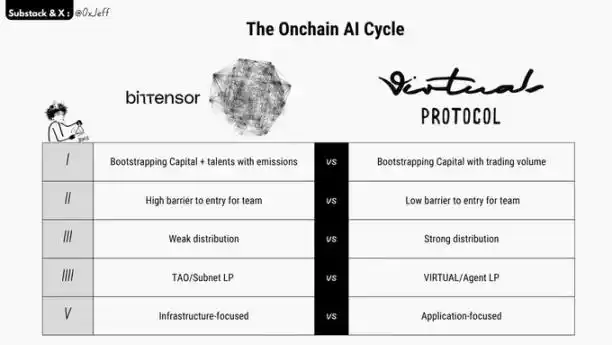
1. Guiding Funds and Talent through an Emission Mechanism vs Guiding Funds through Transaction Volume
Bittensor guides subnet development through the TAO emission mechanism. Subnets are responsible for introducing the most innovative projects (or revenue-generating businesses) and compete for a share of 3,600 TAO daily.
The subnet also guides contributors (including miners performing tasks and validators working on mining validation) through its alpha token emission mechanism. The emission mechanism and stakeholder incentive coordination mechanism have been embedded since the project's inception.
Virtuals adopt a pump.fun-like model, guiding development through transaction volume. High transaction activity converts into accumulated capital for the smart agent project. Smart agent teams can use their emission mechanism to incentivize user participation.
In market cycles with high speculative token demand, this model has a significant advantage—teams can rapidly accumulate capital, gain product visibility and market interest, thereby driving project launch and development.
2. High Barrier to Entry vs Low Barrier to Entry (for Teams)
Launching a subnet on Bittensor requires a significant investment. Currently, acquiring a subnet seat requires 871 TAO (approximately $300,000), with the price fluctuating based on demand and auction mechanisms. This means subnet teams usually need a mature concept, clear planning, and solid execution capability.
To successfully operate a subnet, the owner must ensure that the set tasks or goals contribute to the development of their artificial intelligence product/solution, prevent miner misconduct, ensure validators fulfill their validation duties, achieve revenue through business expansion and customer partnerships, and maintain investor confidence through a buyback mechanism.
The Subnet Token price needs to maintain an upward trend to attract more TAO inflow, increase the subnet emission ratio, thereby attracting a higher level of contributors to participate in mining.
In contrast, launching an Artificial Intelligence Agent token on Virtuals has a lower barrier to entry, requiring no initial cost to launch, making it easy to experiment with new ideas with lower capital.
Virtuals also has a "60-day plan" that allows founders to test new ideas and issue tokens during this period. If a product-market fit is not found within 60 days, the related funds will be withdrawn, and investors can retrieve some of their invested capital.
Three, Weak Distribution Capability vs Strong Distribution Capability
Bittensor operates independently on a blockchain built on the Polkadot Substrate framework, making cross-chain bridging difficult, lacking decentralized finance foundational components, and not equipped with common infrastructures such as the Ethereum Virtual Machine or Solana.
This results in a higher barrier to entry for the Bittensor ecosystem. In addition, the related learning materials are filled with complex terms, increasing the learning curve and understanding difficulty for new users. Therefore, its community members are mostly professional technical individuals willing to dedicate time to in-depth research, with lower participation from retail investors.
In contrast, Virtuals have a lower barrier to understanding. Their team excels in marketing, brand communication, and distribution, making it easier for retail users to intuitively understand concepts related to AI agents, agent payments, and robots.
Since Virtuals are deployed on the Base chain, the purchase process for AI Agent tokens is straightforward. Users take a shorter time from learning about the project, forming a positive opinion, to making a purchase decision, which is also a key factor in its rapid adoption between late 2024 and 2025 (earlier than Bittensor in terms of time).
Currently, with the support from Jason, Chamath, Barry Silbert (DCG and Yuma), and the community, Bittensor is gradually gaining mainstream attention, increasing its visibility. However, the purchase process for its subnet token remains relatively complex, and the issue has not been fundamentally resolved.
Four, TAO/Subnet Liquidity Pool vs VIRTUAL/Agent Liquidity Pool
Bittensor and Virtuals have a key similarity in the liquidity pool flywheel mechanism.
Investors looking to purchase Subnet Alpha tokens need to hold TAO to transact. Therefore, the increase in demand for Alpha tokens will drive up the TAO price.
Likewise, in the Virtuals ecosystem, the rising demand for AI agent tokens will also drive up the VIRTUAL price.
If the core token (TAO or VIRTUAL) can circulate within the ecosystem without outflows (e.g., preserving value through trading goods and services among project parties), the advantages of this mechanism will be more pronounced.
5. Infrastructure-Oriented vs. Application-Oriented
The Bittensor subnet mainly focuses on infrastructure or capital-intensive businesses, such as decentralized computing, inference, training, drug discovery, and quantum experiments.
As Bittensor can provide over $10 million in annual funding to high-quality subnets and attract top talent to participate, its model is suitable for driving ambitious, high-investment projects.
The Virtuals' AI agent team focuses more on the application layer and consumer-facing AI agent products. Due to the lower initial price of AI agent tokens, if the team can release high-quality consumer products, they can quickly attract attention and drive project development through the token's market popularity.
Benefiting from Virtuals' distribution advantages, the flywheel effect of AI agent tokens shows faster growth and higher gains during periods of intense market activity (such as late 2024 to early 2025).
You may also like

How much longer can Ethereum's last big buyer hold on?

The pricing controversy of Trade.xyz exposes the fatal weakness of Pre-IPO perpetual contracts

World Cup 2026 Coming – WEEX Celebrates with $1M Prize Pool & Michael Owen Live

Galaxy in-depth report: Is Solana still worth paying attention to?
Young people in South Korea make a "final effort" in the epic bull market

Dialogue with OmenX Founder: Why does the prediction market need an evolution from "spot" to "derivatives"?
When the P2P illicit funds from ten years ago turned into 60,000 bitcoins

Morning News | CME Group launches Nasdaq Cryptocurrency Index futures; Asset management giant Janus Henderson strategically invests in Ethena
Why did Oracle deliver the strongest financial report in history, yet its stock price fell?

Bitcoin Layer 2 Network Botanix: Why Did We Choose to Dissolve?

Morning Report | OpenAI has submitted an S-1 registration statement draft to the U.S. SEC; Morpho completes $175 million financing

Galaxy Deep Research Report: How Hyperliquid's HIP-4 Upgrade Changes the Landscape of Prediction Markets?

Latest research from 13 top universities including Cornell University: The current state, challenges, and misconceptions of the fusion of Crypto and AI
Deconstructing Anthropic: The Best AI Company, Possibly Also a Type of Organizational Invention

Every exchange is a "Universal Exchange."

The counterattack of traditional finance: Alliance chains are quietly reviving
Pantera Capital Partner: How Tokenization is Restructuring the Private Equity and Early Investment Ecosystem?

Mastercard Launches Agent Pay for AI, Plans to Record AI Agent Payment Authorizations on Polygon
Mastercard launched Agent Pay for AI, a new payment protocol designed to help AI agents make small payments such as pay-per-use access to data and APIs. The system plans to record human-granted AI agent permissions on Polygon, focusing on verifiable authorization, identity, and payment controls.
How much longer can Ethereum's last big buyer hold on?
The pricing controversy of Trade.xyz exposes the fatal weakness of Pre-IPO perpetual contracts
World Cup 2026 Coming – WEEX Celebrates with $1M Prize Pool & Michael Owen Live
Galaxy in-depth report: Is Solana still worth paying attention to?
Young people in South Korea make a "final effort" in the epic bull market
Dialogue with OmenX Founder: Why does the prediction market need an evolution from "spot" to "derivatives"?


