
 Buy Crypto
- Markets
 Futures
- Spot
- Copy Trade
- Earn
- More
Anthropic's Earth's Most Powerful AI So Strong It Made Wall Street Hold Emergency Meeting, But JPMorgan Was Missing Its "Antidote"


On April 8, U.S. Treasury Secretary Benson and Federal Reserve Chair Powell urgently convened CEOs of six systemically important banks at the Treasury Department headquarters in Washington, D.C. to discuss the potential cybersecurity risks posed by Anthropic's new Mythos model. According to Bloomberg, CEOs from Citigroup (Fraser), Morgan Stanley (Gorman), Bank of America (Moynihan), Wells Fargo (Scharf), and Goldman Sachs (Solomon) all attended. JPMorgan Chase (Dimon) was unable to attend due to a "scheduling conflict."
This was not a typical financial regulatory meeting. The last time a Treasury Secretary and Fed Chair jointly summoned bank CEOs to the same room was on October 13, 2008. Paulson and Bernanke had announced a $250 billion TARP funding plan in an attempt to stem an unfolding financial system collapse. This time, the triggering factor was not the market but an AI model.
And this meeting was just the third wave of federal-level regulatory actions against Anthropic within 44 days.
People in the Lab and People in the Room, Virtually No Overlap
Mythos is not scattered uncontrollably around the world. On April 7, Anthropic officially released the Mythos Preview and announced a defensive cybersecurity initiative called Project Glasswing, restricting model access to 12 partner organizations. These 12 include Amazon, Apple, Microsoft, Google, Nvidia, CrowdStrike, Palo Alto Networks, and one financial institution, JPMorgan Chase.
The problem is, the people called to discuss risks and the people who received the defensive tool are almost two different groups.
The five bank CEOs present collectively oversee around $9 trillion in assets. None of their institutions are on the Glasswing list or have access to Mythos. They were called in, reportedly by Bloomberg, to "ensure that banks understand future risks posed by Mythos and similar models and are taking defensive measures." However, the core defensive tool, Mythos itself, is not available to them.
And the only entity that appears on both lists, JPMorgan Chase, had its CEO Dimon conveniently absent.
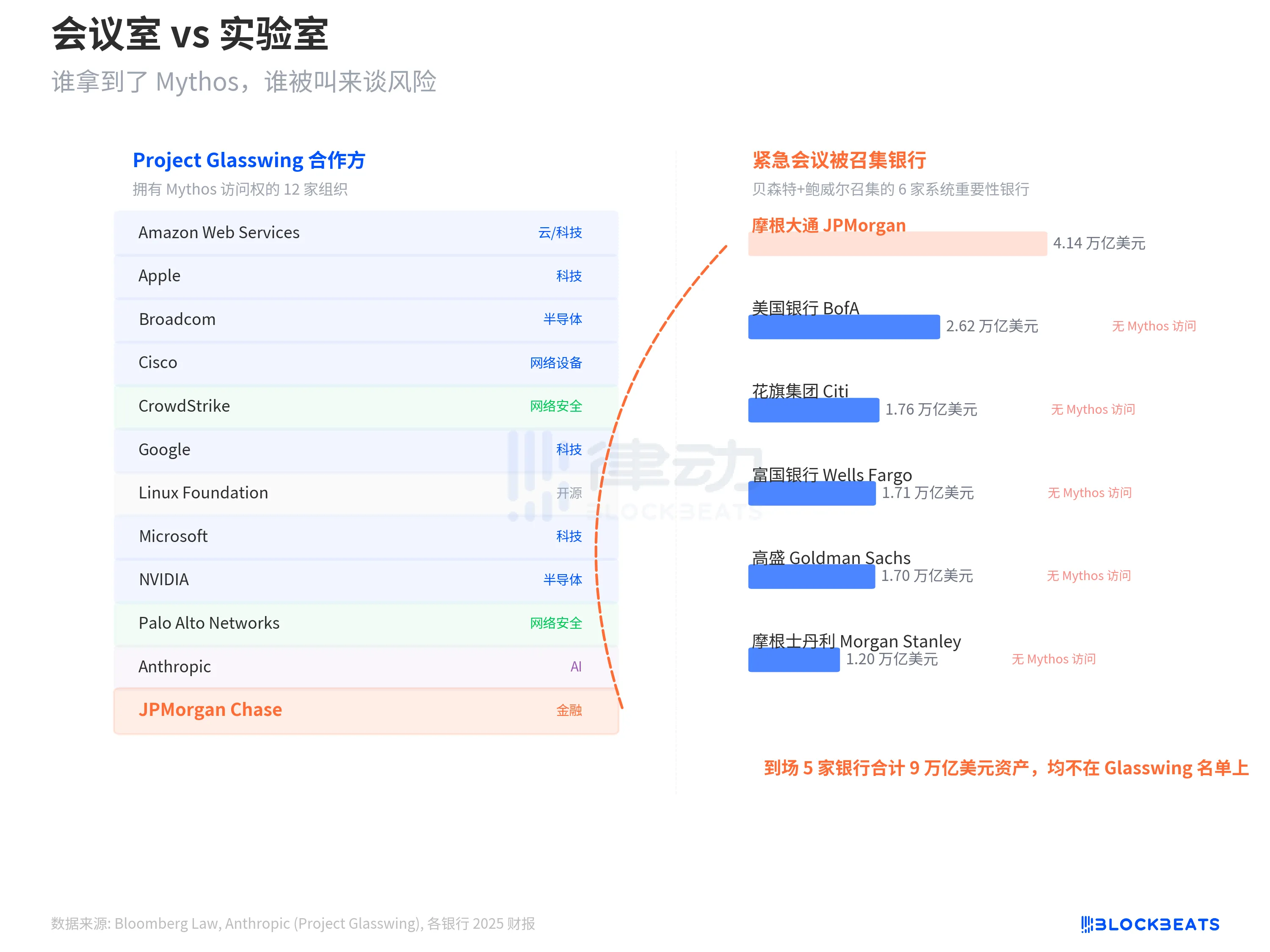
According to the Anthropic website, JPMorgan Chase is the only financial institution among Glasswing's 12 founding partners. The bank spends around $600 million annually on cybersecurity and reportedly has about 3,000 cybersecurity personnel. On the same day as the emergency meeting convened by Benson and Powell on April 8, analysts at JPMorgan Chase released a report recommending investment in CrowdStrike and Palo Alto Networks, citing the establishment of Glasswing as the reason.
On one side were the five banks called to discuss the threat, with no tools in hand. On the other side was the one bank that had the tool, with the CEO absent from the meeting, and the analyst still issuing buy ratings to partners. What Glasswing manufactured was not just a technological barrier but an information barrier.
What Happened in 44 Days
If you were to line up the federal regulatory actions Anthropic faced over the past six weeks, you would see an unprecedented chain reaction in both speed and direction.
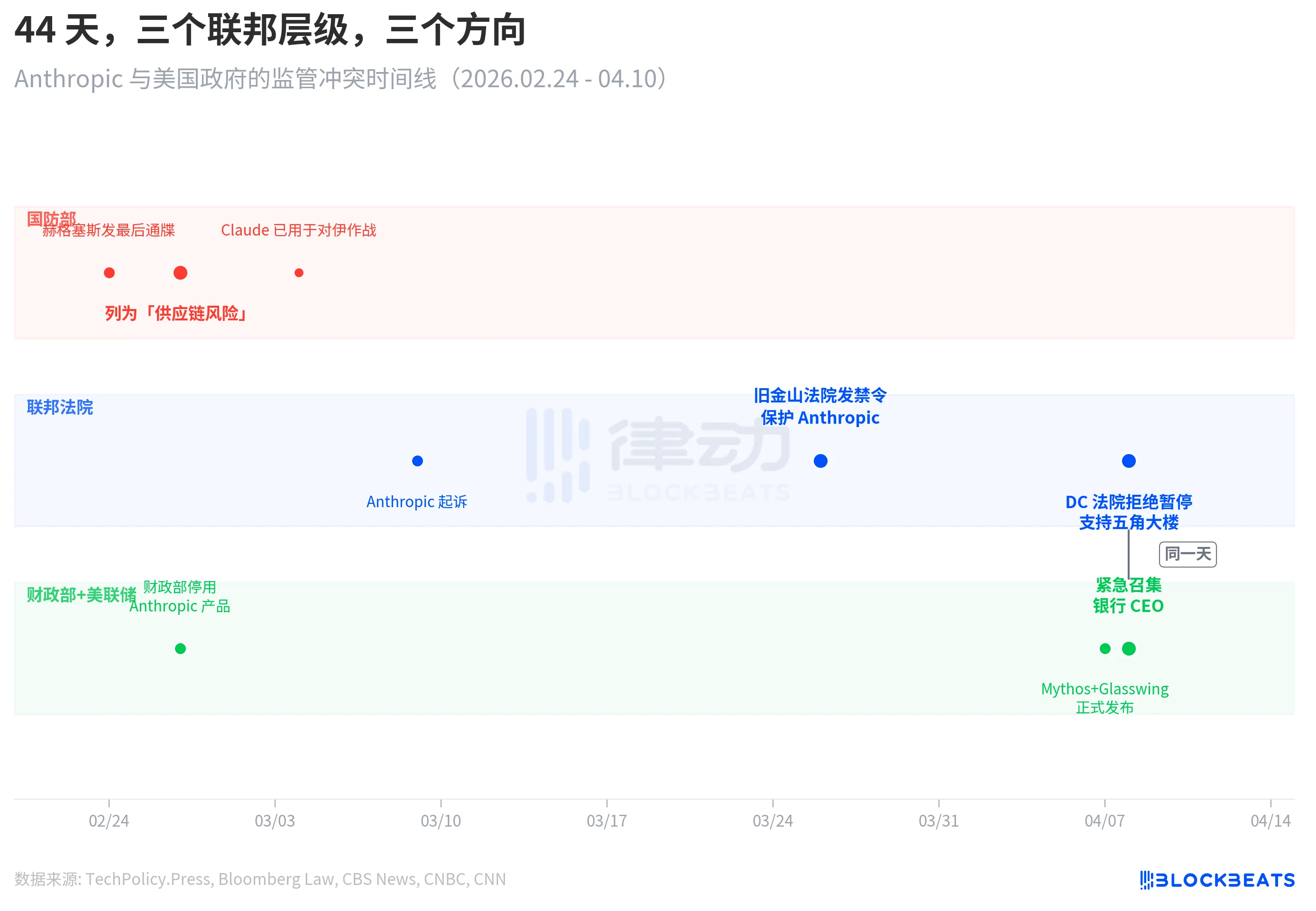
On February 24, Secretary of Defense Hegesius issued a final ultimatum to Anthropic CEO Amodei: accept the "any lawful use" clause by 5:01 p.m. on February 27 or face consequences. At the core of this clause was the dispute over two usage restrictions that Anthropic had retained in its contract with the Pentagon, prohibiting the use of Claude for large-scale surveillance and fully autonomous weapons systems. According to CBS News, Hegesius stated, "America's warriors should never be held hostage to Big Tech ideology." Pentagon's Chief Technology Officer Emil Michael added, "At some level, you have to trust that your military will do the right thing."
Anthropic refused. On February 27, Trump ordered federal agencies to cease using Anthropic products. That same day, Hegesius classified Anthropic as a "supply chain risk."
Over the next 44 days, three federal levels almost simultaneously took conflicting actions against Anthropic.
On March 26, San Francisco Federal Judge Lin issued a 43-page preliminary injunction, finding the Pentagon's actions "troubling" and potentially retaliatory against Anthropic, temporarily halting the enforcement of the supply chain risk designation. According to CNN, the judge wrote in the ruling that the government's actions "likely violated the law."
On April 8, the DC Federal Appeals Court denied the suspension of the Pentagon's designation, effectively overturning the protection granted by the San Francisco court. That same day, Bessent and Powell held that emergency meeting.
One court protecting the company, another court supporting sanctions against it, while the Treasury and the Fed discussed it as a systemic risk from a financial stability perspective. The same entity, within the same federal system, simultaneously seen as an innovator in need of protection and a threat to guard against.
Who Was the "Supply Chain Risk" Label Originally For?
The "supply chain risk" label is not just any administrative designation. It was originally a tool designed by the Federal Communications Commission (FCC) to address threats to the security of foreign communications equipment.
In 2019, Congress and the FCC initiated this designation process for Huawei and ZTE for the first time, citing their ties to the Chinese government, espionage obligations under Chinese law, and known security vulnerabilities in their equipment. In June 2020, the FCC issued a formal designation order. In 2021, Hikvision, Dahua, and Hytera were added to the list. In 2022, Russia's Kaspersky was also included.
According to FCC public records, prior to Anthropic, all entities listed under this designation were foreign companies, and all were foreign companies identified as having technical security risks.
On February 27, 2026, Anthropic became the first domestic U.S. company to be labeled a "supply chain risk." According to a report by TechPolicy.Press, the reason for the designation was not a technical security vulnerability but a breakdown in contract negotiation terms, as Anthropic refused to lift restrictions on AI use. According to an assessment by Northeastern University security policy researcher, this precedent could have a chilling effect on the entire AI industry, as refusing to cooperate with military use conditions could lead to the highest level of supply chain sanctions.
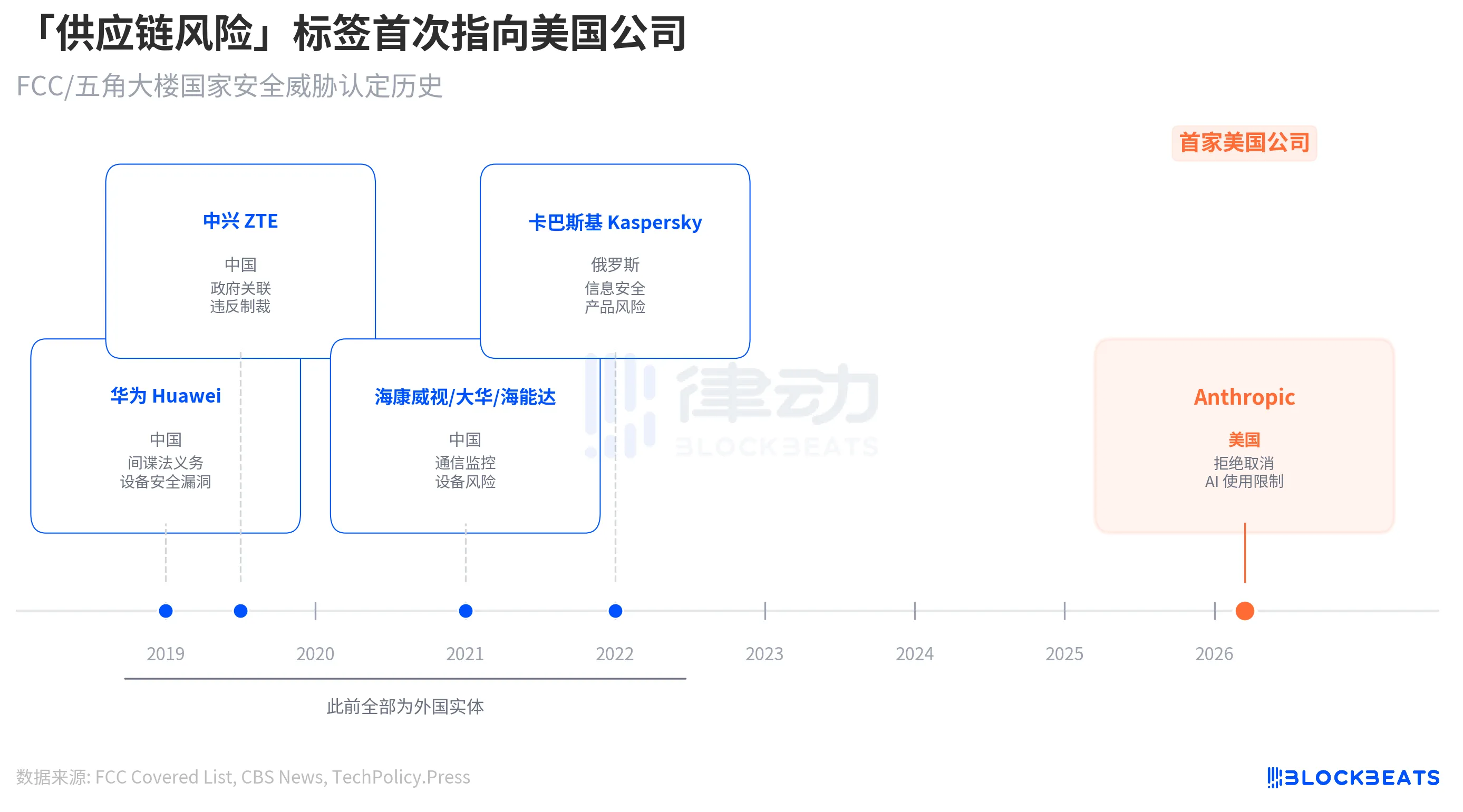
A sanctioning tool designed for Huawei was used for the first time to sanction a U.S. company that refused to allow its AI to be used for unrestricted military purposes. It's the same tool, but the logic of use has completely changed. On May 19, the DC Circuit Court of Appeals will hear oral arguments on this case.
When an AI model is both the best defense tool and the greatest systemic threat, existing regulatory frameworks have not been designed with any mechanism to address this duality of "capability as risk," and the process of filling this regulatory gap is happening in real time at a pace of a weekly federal-level event.
You may also like

Anthropic's $1 trillion, compared to DeepSeek's $100 billion

Geopolitical Risk Persists, Is Bitcoin Becoming a Key Barometer?

Annualized 11.5%, Wall Street Buzzing: Is MicroStrategy's STRC Bitcoin's Savior or Destroyer?

An Obscure Open Source AI Tool Alerted on Kelp DAO's $292 million Bug 12 Days Ago

Mixin has launched USTD-margined perpetual contracts, bringing derivative trading into the chat scene.
The privacy-focused crypto wallet Mixin announced today the launch of its U-based perpetual contract (a derivative priced in USDT). Unlike traditional exchanges, Mixin has taken a new approach by "liberating" derivative trading from isolated matching engines and embedding it into the instant messaging environment.
Users can directly open positions within the app with leverage of up to 200x, while sharing positions, discussing strategies, and copy trading within private communities. Trading, social interaction, and asset management are integrated into the same interface.
Based on its non-custodial architecture, Mixin has eliminated friction from the traditional onboarding process, allowing users to participate in perpetual contract trading without identity verification.
The trading process has been streamlined into five steps:
· Choose the trading asset
· Select long or short
· Input position size and leverage
· Confirm order details
· Confirm and open the position
The interface provides real-time visualization of price, position, and profit and loss (PnL), allowing users to complete trades without switching between multiple modules.
Mixin has directly integrated social features into the derivative trading environment. Users can create private trading communities and interact around real-time positions:
· End-to-end encrypted private groups supporting up to 1024 members
· End-to-end encrypted voice communication
· One-click position sharing
· One-click trade copying
On the execution side, Mixin aggregates liquidity from multiple sources and accesses decentralized protocol and external market liquidity through a unified trading interface.
By combining social interaction with trade execution, Mixin enables users to collaborate, share, and execute trading strategies instantly within the same environment.
Mixin has also introduced a referral incentive system based on trading behavior:
· Users can join with an invite code
· Up to 60% of trading fees as referral rewards
· Incentive mechanism designed for long-term, sustainable earnings
This model aims to drive user-driven network expansion and organic growth.
Mixin's derivative transactions are built on top of its existing self-custody wallet infrastructure, with core features including:
· Separation of transaction account and asset storage
· User full control over assets
· Platform does not custody user funds
· Built-in privacy mechanisms to reduce data exposure
The system aims to strike a balance between transaction efficiency, asset security, and privacy protection.
Against the background of perpetual contracts becoming a mainstream trading tool, Mixin is exploring a different development direction by lowering barriers, enhancing social and privacy attributes.
The platform does not only view transactions as execution actions but positions them as a networked activity: transactions have social attributes, strategies can be shared, and relationships between individuals also become part of the financial system.
Mixin's design is based on a user-initiated, user-controlled model. The platform neither custodies assets nor executes transactions on behalf of users.
This model aligns with a statement issued by the U.S. Securities and Exchange Commission (SEC) on April 13, 2026, titled "Staff Statement on Whether Partial User Interface Used in Preparing Cryptocurrency Securities Transactions May Require Broker-Dealer Registration."
The statement indicates that, under the premise where transactions are entirely initiated and controlled by users, non-custodial service providers that offer neutral interfaces may not need to register as broker-dealers or exchanges.
Mixin is a decentralized, self-custodial privacy wallet designed to provide secure and efficient digital asset management services.
Its core capabilities include:
· Aggregation: integrating multi-chain assets and routing between different transaction paths to simplify user operations
· High liquidity access: connecting to various liquidity sources, including decentralized protocols and external markets
· Decentralization: achieving full user control over assets without relying on custodial intermediaries
· Privacy protection: safeguarding assets and data through MPC, CryptoNote, and end-to-end encrypted communication
Mixin has been in operation for over 8 years, supporting over 40 blockchains and more than 10,000 assets, with a global user base exceeding 10 million and an on-chain self-custodied asset scale of over $1 billion.

$600 million stolen in 20 days, ushering in the era of AI hackers in the crypto world
Vitalik's 2026 Hong Kong Web3 Summit Speech: Ethereum's Ultimate Vision as the "World Computer" and Future Roadmap
On the same day Aave introduced rsETH, why did Spark decide to exit?
Full Post-Mortem of the KelpDAO Incident: Why Did Aave, Which Was Not Compromised, End Up in Crisis Situation?

After a $290 million DeFi liquidation, is the security promise still there?
ZachXBT's post ignites RAVE nearing zero, what is the truth behind the insider control?

Vitalik 2026 Hong Kong Web3 Carnival Speech Transcript: We do not compete on speed; security and decentralization are the core
In-depth Analysis of RAVE Events: Short Squeeze, Crash, and Quantitative Financial Models of Liquidity Manipulation

Eve of Ceasefire, US Military Fires on Iranian Vessel | Rewire News Morning Brief

Figma's stock price drops over 7%, will Claude Design be the terminator?

Plunge by 10% Followed by Rebound, Weekend Oil Market Watch

SpaceX Mascot ASTEROID Fast Track $170 million, Stemming from an Unfinished Space Dream

L1 is dead, Appchain should rise
Anthropic's $1 trillion, compared to DeepSeek's $100 billion
Geopolitical Risk Persists, Is Bitcoin Becoming a Key Barometer?
Annualized 11.5%, Wall Street Buzzing: Is MicroStrategy's STRC Bitcoin's Savior or Destroyer?
An Obscure Open Source AI Tool Alerted on Kelp DAO's $292 million Bug 12 Days Ago
Mixin has launched USTD-margined perpetual contracts, bringing derivative trading into the chat scene.
The privacy-focused crypto wallet Mixin announced today the launch of its U-based perpetual contract (a derivative priced in USDT). Unlike traditional exchanges, Mixin has taken a new approach by "liberating" derivative trading from isolated matching engines and embedding it into the instant messaging environment.
Users can directly open positions within the app with leverage of up to 200x, while sharing positions, discussing strategies, and copy trading within private communities. Trading, social interaction, and asset management are integrated into the same interface.
Based on its non-custodial architecture, Mixin has eliminated friction from the traditional onboarding process, allowing users to participate in perpetual contract trading without identity verification.
The trading process has been streamlined into five steps:
· Choose the trading asset
· Select long or short
· Input position size and leverage
· Confirm order details
· Confirm and open the position
The interface provides real-time visualization of price, position, and profit and loss (PnL), allowing users to complete trades without switching between multiple modules.
Mixin has directly integrated social features into the derivative trading environment. Users can create private trading communities and interact around real-time positions:
· End-to-end encrypted private groups supporting up to 1024 members
· End-to-end encrypted voice communication
· One-click position sharing
· One-click trade copying
On the execution side, Mixin aggregates liquidity from multiple sources and accesses decentralized protocol and external market liquidity through a unified trading interface.
By combining social interaction with trade execution, Mixin enables users to collaborate, share, and execute trading strategies instantly within the same environment.
Mixin has also introduced a referral incentive system based on trading behavior:
· Users can join with an invite code
· Up to 60% of trading fees as referral rewards
· Incentive mechanism designed for long-term, sustainable earnings
This model aims to drive user-driven network expansion and organic growth.
Mixin's derivative transactions are built on top of its existing self-custody wallet infrastructure, with core features including:
· Separation of transaction account and asset storage
· User full control over assets
· Platform does not custody user funds
· Built-in privacy mechanisms to reduce data exposure
The system aims to strike a balance between transaction efficiency, asset security, and privacy protection.
Against the background of perpetual contracts becoming a mainstream trading tool, Mixin is exploring a different development direction by lowering barriers, enhancing social and privacy attributes.
The platform does not only view transactions as execution actions but positions them as a networked activity: transactions have social attributes, strategies can be shared, and relationships between individuals also become part of the financial system.
Mixin's design is based on a user-initiated, user-controlled model. The platform neither custodies assets nor executes transactions on behalf of users.
This model aligns with a statement issued by the U.S. Securities and Exchange Commission (SEC) on April 13, 2026, titled "Staff Statement on Whether Partial User Interface Used in Preparing Cryptocurrency Securities Transactions May Require Broker-Dealer Registration."
The statement indicates that, under the premise where transactions are entirely initiated and controlled by users, non-custodial service providers that offer neutral interfaces may not need to register as broker-dealers or exchanges.
Mixin is a decentralized, self-custodial privacy wallet designed to provide secure and efficient digital asset management services.
Its core capabilities include:
· Aggregation: integrating multi-chain assets and routing between different transaction paths to simplify user operations
· High liquidity access: connecting to various liquidity sources, including decentralized protocols and external markets
· Decentralization: achieving full user control over assets without relying on custodial intermediaries
· Privacy protection: safeguarding assets and data through MPC, CryptoNote, and end-to-end encrypted communication
Mixin has been in operation for over 8 years, supporting over 40 blockchains and more than 10,000 assets, with a global user base exceeding 10 million and an on-chain self-custodied asset scale of over $1 billion.



 App
App