
AI&DeSci - Unveiling the Infrastructure Potential Behind the Bull and Bear Narrative





Original Author: Evan Lu, Waterdrip Capital, X: @Fisher256X
How Far Are We from Mass Adoption
One week after Trump won the U.S. election, despite BTC rising over 20%, the meme coin craze once again ushered in madness. During the past six months of a low period, the market seemed to be stuck in a narrative of "lack of real-world adoption in the crypto industry." At that time, while the DeFi industry was still under construction, with some subsectors like cloud computing, there is still a considerable distance to go before true mass adoption. However, in the speculative frenzy of memes, CZ and Vitalik personally joined the scene, causing the heat around the DeSci concept to unexpectedly reignite. It is undeniable that every new concept cannot escape the stage of speculation and hype at the beginning of its birth; DeSci naturally could not avoid it. But after years of development in the blockchain industry starting from Bitcoin, it is also time to consider how to build applications that benefit humanity and reach real-world adoption.
AI & Desci
At the beginning of last year, the AI revolution led by ChatGPT injected new narrative momentum into this bull market. "AI represents advanced productivity, and blockchain represents advanced production relations redistribution and integration." This new paradigm consensus quickly sparked heated discussions in the community and became one of the new narratives on the eve of the bull market. Driven by this trend, projects like Bittensor and fetch.ai quickly rose to prominence and became pioneers of this concept.
Not only that, in September of this year, as the crypto market gradually regained vitality, meme coins revolving around the AI concept also experienced a frenzy of launches thanks to $Goat. A small team or even an individual only needs to develop an AI agent with a specific function—whether it is AI trading or AI virtual companionship; then nurture their own community and fan base—achieving success in just one week; and finally "profit" through launching a meme coin of the same name.
The DeSci concept can actually be traced back to the previous bull market, but it was constrained by the long cycle of "Science" in Crypto+Science, which never gained much presence in the crypto industry. It truly began to gain attention on November 8 when Binance Labs announced an investment in BIO Protocol, marking Binance Labs' first foray into the decentralized science (DeSci) field. Shortly after this announcement, in less than a week, CZ attended Binance's DeSci Day event in Bangkok and discussed Desci insights with Vitalik. CZ even stated his hope to see 1000 DeSci projects next year. Subsequently, whether it was the Binance official account or CZ's posts, DeSci was mentioned multiple times. CZ and Vitalik's enthusiastic endorsements momentarily propelled the DeSci concept meme coins to the forefront; within a few days, multiple popular coins based on the Desci concept emerged, such as $uro, corresponding to a single drug released by BIO, $rif, and $SciHub for donations to the world's largest open-access scientific paper platform Sci-Hub, among others. The combined market value of related concepts has already exceeded 800 million USD.
However, good storytelling is not only reflected in short-term popularity but also requires long-term infrastructure construction to achieve real-world application scenarios. The most essential foundation of AI—computing power—is still in the early stages of development and not widely used on a large scale through Depin cloud computing for the scheduling of idle computing power, with the cost, computing environment stability, and corresponding speed not yet effectively market validated.
The core technology behind DeSci—decentralized storage, has evolved from the IPFS protocol to the present day, proving to be lower in cost and higher in security compared to traditional centralized storage solutions; and the current implementation of the solution is relatively mature. It can be said that DeSci's infrastructure has been fully established, and now it only needs more people to recognize and adopt the concept of decentralized storage.
Tracing the DeSci Concept, Is Speculation Still Greater Than Utility?
I remember at this year's April Hong Kong Web3 Carnival, I had conversations with several projects quietly working in the DeSci track, but without exception, they all told me that this is a project that requires a psychological preparedness for 'long-termism.' The current stage can only indicate that DeSci has just been introduced into the user's field of view, and that it is just in the stage of presenting solutions before the glorious Rome is built.
So, what is DeSci? DeSci stands for Decentralized Science. It promotes global open access to research data through distributed storage technology, reduces government or institutional singular control over data, avoids the possibility of data leakage, loss, and malicious tampering in centralized storage. This model not only makes scientific research activities open and transparent but also allows global researchers to freely share resources. In addition, DeSci uses smart contracts and DAOs to enhance the transparency and efficiency of research funding and help scientists raise funds for their research needs. This fundamentally changes the traditional source structure of research funding and greatly enhances the efficiency of fund utilization.
In summary, the DeSci model has innovated in two areas: 1. Fundraising is achieved through token launches, and the currently popular $rif and $uro have both raised funds for the development of the two drugs through the launch of meme coins. 2. Research data storage has been transferred from centralized servers to decentralized and permanently retained blockchains.
"Decentralized Science (DeSci) has successfully brought the liquidity of meme coins to universities and laboratories around the world, supporting real scientific research." The founder of BIO Protocol's reply to CZ on X also revealed the essence of DeSci: to leverage the speculative nature of the crypto market to drive and accelerate the value realization in the field of scientific research and more real-world applications.
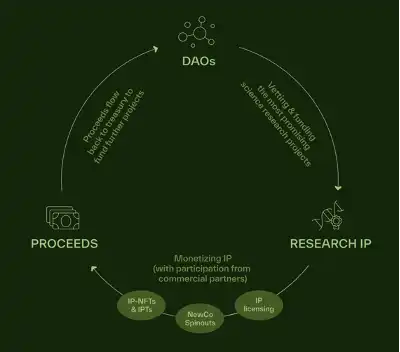
BIO Protocol Business Model, Source: https://docs.bio.xyz/bio
The current popularity of the DeSci concept is mainly supported by a wealth effect driven by memes, where the industry's development is engulfed by market sentiment due to brief yet massive exposure. However, the research field requires continuous and substantial financial investment while facing high risk and a high failure rate, which contradicts the DeFi's short-term speculative and rapidly exhausting liquidity nature.
Therefore, in the short term, this trend will lead to a significant number of speculators entering this arena, using it as a gimmick to launch fundraising projects with the purpose of "fundraising as profit" rather than genuinely investing in scientific research. Consequently, after a brief period of hype, DeSci will transition into a phase of separating the wheat from the chaff, gradually fostering user awareness of DeSci through the education market process, which might then truly achieve the goal of "leveraging crypto finance to monetize research outcomes."
Currently, behind DeSci, there is an immense demand for data storage and on-chain proof. If DeSci can leverage the hype of memes to break boundaries and effectively establish a mature business model, decentralized storage will become the infrastructure of the DeSci field. This stable and significant demand will greatly drive the development of the decentralized storage ecosystem.
Maturing of Decentralized Storage, Significant Infrastructure Behind DeSci
Decentralized storage has gone through various developmental stages from early projects like Storj to Filecoin, Arweave, and the underlying IPFS protocol. An analysis in May 2023 pointed out that decentralized storage is about 78% cheaper on average compared to centralized storage, and in enterprise data storage, this difference can be up to 121 times. Additionally, decentralized storage has clear advantages in terms of data security, privacy, and reliability. However, even though some Web2 clients have started to adopt decentralized storage solutions like Filecoin and Arweave, centralized storage with a more intuitive user experience and a mature product system still dominates the market. The limitations of Filecoin in programmability and restrictions in data permanent storage, along with the relatively high cost brought by Arweave's focus on "permanent storage," are still industry pain points that have not been fully resolved.
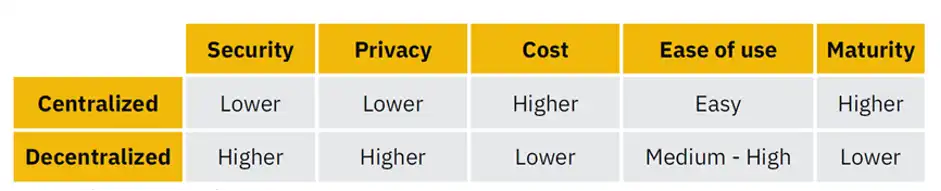
Centralized Storage vs. Decentralized Storage Comparison, Source: Binance Research
It was just last April when Binance announced the launch of BNB Greenfield, marking a new milestone for decentralized storage. The key feature of Greenfield is to provide decentralized storage infrastructure for the entire BNB Chain ecosystem, enabling users and decentralized applications (DApps) to create, store, and exchange fully owned data. Through a native cross-chain bridge with BSC, users can freely transfer BNB between BSC and Greenfield, facilitating seamless interaction with DApps built on Greenfield.
Compared to IPFS and Arweave, BNB Greenfield excels in deep integration with the BNB Chain, cross-chain support, the combination of decentralized storage and computational capabilities, as well as cost-effectiveness. This makes Greenfield more suitable for decentralized finance (DeFi), smart contracts, and Web3 application scenarios, with stronger scalability and ecosystem synergy. Looking ahead, Greenfield can be utilized in the following scenarios, including but not limited to:
· Website Hosting: Users can quickly deploy and host websites through an API, streamlining registration and payment processes.
· Personal Cloud Storage: Create secure personal cloud storage using a private key, making it easy to upload and download encrypted files.
· Blockchain Data Storage: Store BNB Smart Chain and other ecosystem data, reducing latency and increasing availability.
· Content Publishing: Creators can store their work and mirror it on the BNB Smart Chain, allowing buyers access after completing a transaction.
· Social Media: Social media influencers can fully control their content data, publish through decentralized platforms, and benefit from it.
· Personal Data Marketplace: Provide decentralized data storage and management solutions to ensure the security of personal data.
Meanwhile, the development of GreenField also relies on the support of its ecosystem projects. Just this year, the BNB Ecosystem officially launched the Community Favorite Project Vote, dividing the ecosystem into 5 categories. In the Infra category, 4EVERLAND and BAS, as part of GreenField's native infrastructure, are crucial components.
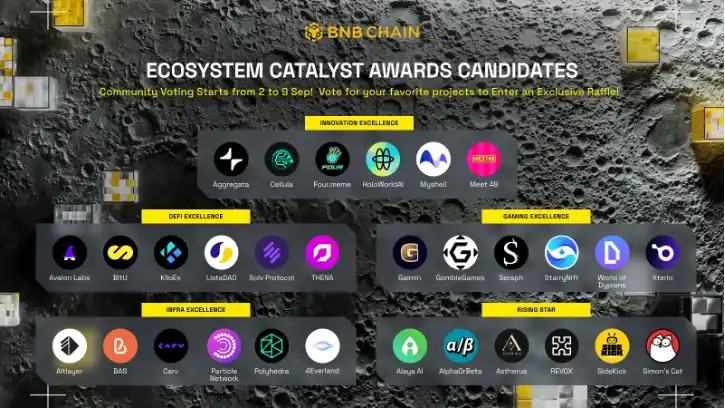
BNB Ecosystem Catalyst Awards Candidates, Source: Binance Square
4EVERLAND
4EVERLAND is the largest decentralized storage provider in the GreenField ecosystem. As an officially certified Storage Provider (SP) and validator, 4EVERLAND offers robust storage resources on GreenField while supporting the BNB Chain and opBNB network, aiming to construct an efficient decentralized storage network. Building upon GreenField by integrating the features and advantages of IPFS and Arweave, 4EVERLAND provides a superior integrated storage network solution, offering a more user-friendly experience and reducing the complexity of decentralized storage usage.
Its key advantages include:
· Storage and Validation Dual Role: As a Storage Provider (SP) and validator on GreenField, 4EVERLAND not only provides storage solutions to users but also participates in the Proof of Stake (PoS) mechanism to ensure blockchain security.
· Multi-Chain Support and Compatibility: In addition to GreenField, 4EVERLAND also supports the BNB Chain and opBNB.
· Integration of Decentralized Storage and Computational Resources: While providing storage services, 4EVERLAND combines its 4Ever Node to utilize idle hardware to offer users on-demand storage data access + computation, achieving more efficient data utilization scenarios.
· Flexible Storage Solution: 4EVERLAND provides a hybrid solution suitable for both hot and cold storage, combining the storage modes of IPFS + Arweave/Greenfield to meet different storage needs and be compatible with Web2.
· Decentralized AI Service: Through AI RPC (API standard), 4EVERLAND provides an aggregated solution of 100+ models to offer users efficient AI model invocation services.
· 4EVERLAND also provides DWeb hosting services, which play a significant role in the Greenfield ecosystem, providing developers with one-click deployment functionality, allowing dApp frontends to be quickly deployed to Greenfield storage, and in conjunction with BNB's ecosystem's future RAAS (Rollup as a service) initiative, achieving one-click chain-starting functionality.
Currently, 4EVERLAND has over 3 million registered users, 100,000+ daily active users, and stores 2000 TB on IPFS (third in the IPFS ecosystem), 20 TB on Arweave (third in the Arweave ecosystem), and has over 30,000 daily interactions on Greenfield (first in the Greenfield ecosystem). In terms of funding, it has received support from BNBChain, Polygon, Optimism, IPFS, Arweave, and ICP, as well as backing from multiple well-known investment institutions.
Recently, 4EVERLAND has collaborated with several projects of DeSci to jointly promote the decentralized storage of scientific research papers. DeSci's data includes some content that should not be altered and is suitable for permanent storage on Arweave, while data that is continuously updated is suitable for IPFS and GreenField. 4EVERLAND has established a decentralized storage solution tailored for DeSci by combining IPFS, Arweave, and Greenfield, where cold backup data is placed on Arweave and hot data access is hosted on GreenField.
BAS
BNB Attestation Service (BAS), as the underlying data protocol standard of BNB, aims to generate certification information for verification, to introduce tens of millions of trusted private data into the Web3 ecosystem, especially to provide data support for AI. The characteristics of BAS are:
· Decentralized Verification Service: By bringing Web2 and Web3 data on-chain, it provides cross-platform verification services, supporting exchange information from platforms such as Binance and Coinbase, as well as data from social platforms like X and TikTok. Moreover, services such as research data verification in DeSci can also directly use BAS for verification and post the results on-chain.
· User Sovereignty and Data Privacy: Users can actively upload data through the data sets created by BAS for dApp projects and defined data format standards, reducing the need for third parties to annotate and clarify data, achieving proactive data classification and standardization, and returning data control to users.
· AI Training and Data Set Service: Through decentralized data verification, BAS will directly provide the most reliable and available data for AI training and data set needs.
· Ecosystem Collaboration and Applications: BAS has connected with over 3000 independent attesters, 100+ data providers, and 100+ ecosystem partners, supporting over 30M attestations.
For Greenfield, the introduction of BAS provides data verification and management capabilities, further enhancing the platform's security, transparency, and user control, making Greenfield a more robust decentralized storage solution. By integrating with BAS, Greenfield can ensure data verification and compliance, while providing efficient data management and permission control.
Efforts Toward Sustainable Development in the Crypto Industry
GreenField is a strategic layout even personally instructed by Binance and CZ, marking a significant ecological innovation within the BNB ecosystem since its launch. Different from opBNB, a "front-line main force" facing end-users on the BNB chain, GreenField will more quietly cultivate behind the scenes. Its high performance and high interoperability will also be more conducive to the development of a new industry narrative.
If DeSci's business model is validated and supported by Binance's traffic, it will undoubtedly greatly promote the prosperity of the BNB ecosystem, and GreenField will also be widely adopted. Thus, this article only confirms the value investment potential of decentralized storage. From a broader perspective, what truly concerns us, the millions of cryptocurrency users and practitioners, is whether the cryptocurrency industry can remain youthful and achieve sustainable development.
CZ, Binance CEO, and Vitalik have recently emphasized the importance of DeSci. Vitalik has even invested a substantial amount of money to support this field. Even the official Binance account has published a research report specifically about DeSci to give it credibility. This is undoubtedly a significant innovative attempt rather than just a concept hype. Behind the industry dynamics, blockchain finance can truly serve the market, realize value, and advance the vision of blockchain technology making a real contribution to society.
Article References
· Does DeSci Need to Return to Value or Chase Memes? At the crossroads, should we go left or right?
This article is contributed content and does not represent the views of BlockBeats
You may also like

Morning Report | OpenAI has submitted an S-1 registration statement draft to the U.S. SEC; Morpho completes $175 million financing

Morning Report | BitMine increased its holdings by 126,971 ETH last week; trader Eugene announced his exit from the crypto market

Wang Chuan: How can one not feel anxious after the neighbor Old Wang made thirty times profit by investing in storage stocks? (Seven) - A quarter-century cycle

Cryptocurrency CEXs are flocking to sell US stocks, and traditional brokerages are facing an "uninvited guest."

$75 billion in foreign capital has fled, and South Korean retail investors have absorbed it all using leverage

Japan’s Three Megabanks Plan Joint Stablecoin Issuance in Fiscal 2026
MUFG, SMBC, and Mizuho reportedly plan to jointly issue fiat-pegged stablecoins in fiscal 2026, signaling Japan’s growing push into bank-led digital payment infrastructure.

Humanity Discloses H Token Dual-Chain Attack Details, With Losses on Ethereum and BSC Exceeding $36 Million
Humanity said the H token attack across Ethereum and BSC caused more than $36 million in losses after leaked ProxyAdmin keys enabled malicious contract upgrades and token minting.
White House Discusses CLARITY Act With Law Enforcement Ahead of Senate Vote
The White House discussed the CLARITY Act with law enforcement ahead of a Senate vote, focusing on illicit finance risks and developer protections.

Bitcoin Trading Guide 2026: Strategies for Experienced Traders

What Is XAUT and PAXG? Why Tokenized Gold Is Booming in 2026

Will the SpaceX IPO Hurt Bitcoin? Here's What Traders Are Watching

Foreign selling in the South Korean stock market accelerates, with cumulative net sales reportedly reaching $75 billion this year
On June 9, The Kobeissi Letter, citing Goldman Sachs data, reported that global investors are selling South Korean stocks at an unusually rapid pace. In the latest trading session, foreign investors sold about $801 million worth of Kospi constituent stocks again; total foreign outflows last week reached about $10 billion, and the market has been in net foreign selling on nearly every trading day over the past month. According to the data cited in the report, foreign investors have sold about $75 billion worth of South Korean stocks so far this year. Meanwhile, South Korean retail and institutional investors together recorded roughly $69 billion in net buying over the same period, suggesting that the market’s main buying support has come from domestic capital rather than returning overseas funds. The information currently disclosed still mainly comes from The Kobeissi Letter’s retelling and Goldman Sachs data summaries, while public details on the statistical period and the specific definition of “selling” remain relatively limited.

Fortune Warns of Strategy’s Financing Structure Risks as Bitcoin Premium Narrows
Fortune warned that Strategy’s Bitcoin treasury model faces growing financing risks as MSTR’s net asset premium narrows and preferred stock dividend pressure increases.

Ferrari Challenge Le Mans: Carl Moon to Dominate in WEEX Livery

Sahara AI Responds to SAHARA’s Sharp Drop: No Contract or Product Security Issues Found, Internal Investigation Underway
Sahara AI responded to SAHARA’s 60% price drop, saying no token contract or product security issues have been found and an internal investigation is underway.

WEEX Deposit/Withdrawal Dynamic Island: Your Asset Status, Always in Sight
Scaling Crypto Derivatives: The Digital Asset Infrastructure Behind High-Volume Trading
In the fast-moving digital asset ecosystem, derivatives platforms face an extreme architectural test. High-leverage futures markets demand more than just standard security—they require absolute operational precision, zero-latency matching engines, and ironclad structural scalability, all while navigating intense market volatility.
As global platforms scale to meet these demands, the industry is shifting away from rigid, monolithic setups toward a more agile, "decoupled" infrastructure philosophy.
The Blueprint for High-Volume Copy TradingFor elite global exchanges like WEEX (founded in 2018), this architectural choice becomes critical when scaling high-volume retail features like social copy trading. When thousands of users automatically mirror the real-time strategies of elite traders simultaneously, it triggers sudden, monumental spikes in concurrent transactional volume.
To prevent execution latency or settlement bottlenecks during these peak volatility events, a platform's primary engine must remain entirely dedicated to risk management, copy-trade synchronization, and order matching.
The Architectural Rule: New-generation platforms must separate front-end user execution engines from heavy backend infrastructural overhead to eliminate operational friction.
By separating these layers, platforms can maintain complete sovereignty over their trading environments and user experiences while strategically aligning with institutional-grade infrastructure ecosystems. This strategic framework allows modern exchanges to leverage advanced Digital Asset Custody infrastructure such as Cobo’s behind the scenes, ensuring that backend wallet management scales elastically alongside trading spikes.
Capitalizing on Market Momentum and 400× LeverageIn a derivatives arena where platforms offer up to 400× leverage on perpetual contracts, capital efficiency and market agility are core business metrics. To capture market momentum, an exchange needs the ability to rapidly expand its asset offerings, supporting everything from legacy crypto assets to sudden, trending altcoins across a massive library of trading pairs.
Adopting a flexible, scalable Wallet-as-a-Service (WaaS) solution such as Cobo’s could completely rewrite the development timeline for high-growth exchanges. Instead of spending months of engineering capital building out custom backend wallet architectures for every new blockchain network, platforms can deploy localized infrastructure in days.
This agility allows platforms to instantly scale their listings to over a thousand trading pairs without compromising security or delaying time-to-market. It mirrors the exact operational advantages seen during high-velocity market events, similar to how advanced wallet infrastructure empowers platforms during sudden asset surges; allowing exchanges to pass that speed and liquidity directly to their global user base.
A Mature Foundation for GrowthThe synergy between trusted infrastructure ecosystems and global trading platforms represents the natural evolution of a maturing crypto market. As WEEX continues to scale its global spot and derivatives offerings for over 6 million users, adopting robust backend paradigms proves that platforms no longer have to compromise between cutting-edge trading velocity and uncompromised structural security.

Get Paid to Onboard? Try WEEX’s New Homepage with Rewards for Registration, Deposit & Trade
Morning Report | OpenAI has submitted an S-1 registration statement draft to the U.S. SEC; Morpho completes $175 million financing
Morning Report | BitMine increased its holdings by 126,971 ETH last week; trader Eugene announced his exit from the crypto market
Wang Chuan: How can one not feel anxious after the neighbor Old Wang made thirty times profit by investing in storage stocks? (Seven) - A quarter-century cycle
Cryptocurrency CEXs are flocking to sell US stocks, and traditional brokerages are facing an "uninvited guest."
$75 billion in foreign capital has fled, and South Korean retail investors have absorbed it all using leverage
Japan’s Three Megabanks Plan Joint Stablecoin Issuance in Fiscal 2026
MUFG, SMBC, and Mizuho reportedly plan to jointly issue fiat-pegged stablecoins in fiscal 2026, signaling Japan’s growing push into bank-led digital payment infrastructure.


