
 Buy Crypto
- Markets
 Futures
- Spot
- Copy Trade
- Earn
- More
After Microsoft rejected Bitcoin, what will Amazon and other technology giants do?

Original title: Why tech giants like Amazon may hesitate to adopt Bitcoin
Original author: DANIEL RAMIREZ-ESCUDERO
Original translation: Lawrence, MarsBit
Big tech companies have a lot of cash on hand. Currency depreciation makes them lose purchasing power. Is Bitcoin a financial solution to fight inflation? Amazon is the next to decide.

Big tech companies such as Amazon have a lot of cash on hand ($87 billion last year), but the purchasing power of this cash is declining as the currency depreciates.
The National Center for Public Policy Research (NCPPR), a think tank in Washington, DC, has submitted a proposal to shareholders to adopt Bitcoin as a solution. However, it is not clear whether the tech giants will benefit from it.
NCPPR has been pursuing this strategy at Microsoft and Amazon. At both companies, the think tank argues that including Bitcoin in its treasury would protect cash assets and shareholder value from inflation.
The proposal argues that the Consumer Price Index (CPI) holds inflation at 4.95%, an “extremely poor indicator” of true monetary depreciation, and suggests that actual inflation could be twice that.
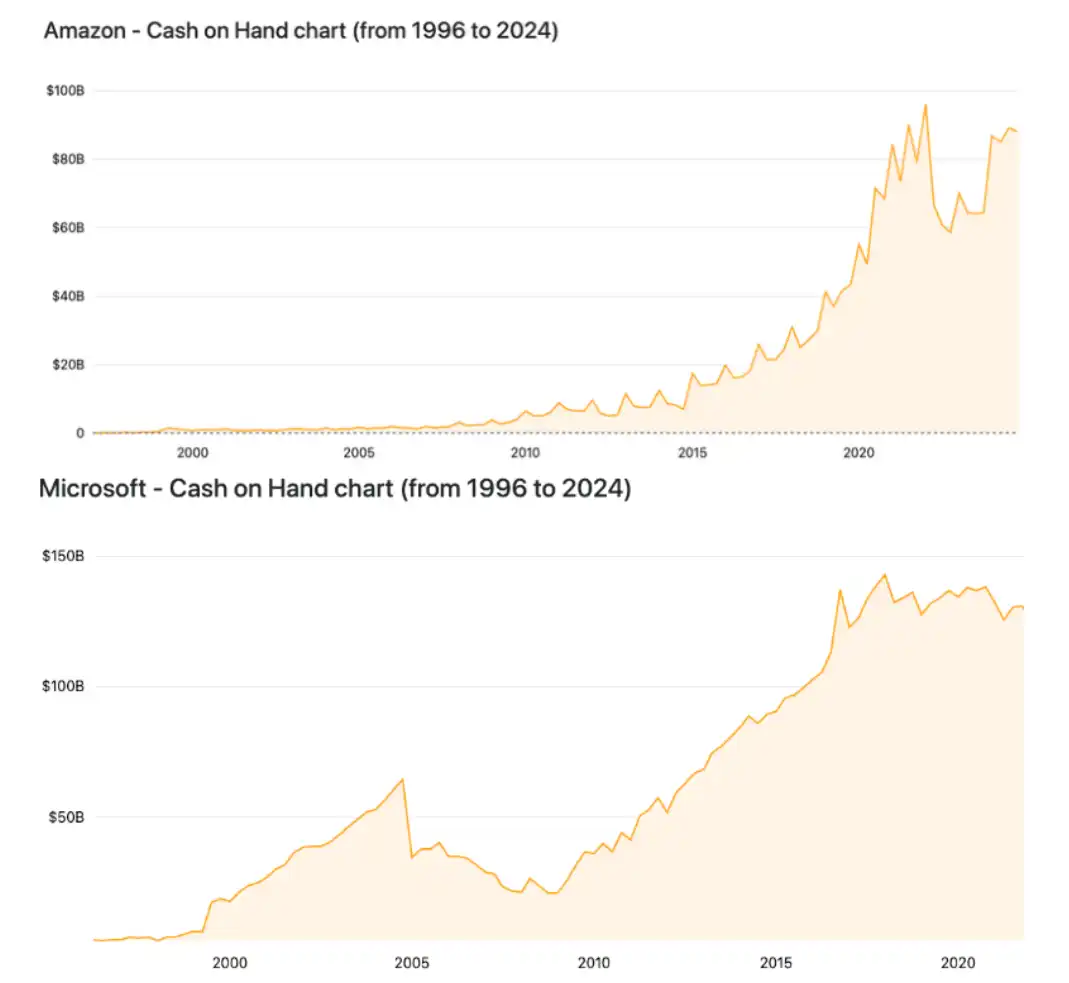
Microsoft and Amazon’s cash reserves from 1996 to 2024. Source: Companiesmarketcap
Microsoft has $78 billion in cash on hand, while Amazon has $87 billion. While Bitcoin could offer a potential hedge, does the risk outweigh the benefit?
Despite support from orange pill expert and business intelligence company MicroStrategy chairman Michael Saylor, Microsoft shareholders overwhelmingly voted down the NCPPR’s bitcoin reserve proposal, indicating that its alleged volatility was a negative factor.
Next up is Amazon. Will the vote be different this time?
Amazon isn’t as conservative a tech company as Microsoft
Nick Cowan, CEO of fintech firm Valereum, told Cointelegraph that Microsoft and Amazon may have similarities as tech giants, but their styles are very different.
“Amazon’s shareholder vote may indeed be different than Microsoft’s due to its reputation for innovation and risk tolerance.”
While Microsoft has historically been more conservative in its fiscal and strategic approach, Amazon has a track record of adopting emerging technologies and exploring new investments.
“Unlike Microsoft, Amazon’s higher propensity to innovate may align with Bitcoin’s diversification potential,” Cowan said.
Amazon will likely vote on the NCPPR proposal at its annual shareholder meeting in May 2025. The proposal urges the company to allocate more than the usual 1-2% of its portfolio to risky assets.
"Amazon should at least evaluate the benefits of holding a portion (even as little as 5%) of its Bitcoin assets."
Cowan believes this proportion is unlikely to be achieved. "A 5% Bitcoin allocation is ambitious and probably unrealistic for a company of Amazon's size," he said. "While Bitcoin provides diversification, its volatility and lack of tangible returns make it difficult to justify at such a level." He believes that "smaller experimental allocations similar to Tesla's approach may gain more shareholder support."
Tesla's purchase of Bitcoin in 2021 has brought significant profits to the company. Tesla initially purchased $1.5 billion worth of Bitcoin, but sold 70% of its initial holdings in 2021.
Nevertheless, Tesla still holds its Bitcoin reserves (9,720 BTC), which is valued at over $1.3 billion, according to BitcoinTreasuries.NET.
Amazon has billions of dollars in cash, so it could easily allocate a similar amount to Tesla.
While the NCPPR may sincerely want Amazon and Microsoft to adopt Bitcoin, Cowen believes the broader strategy is to amplify the message that Bitcoin can be considered an inflation hedge to "create potential momentum for institutional acceptance of Bitcoin."
NCPPR did not immediately respond to Cointelegraph’s request for comment.
Do tech giants need Bitcoin to enrich their wealth?
MicroStrategy has seen remarkable results in incorporating Bitcoin into its core financial strategy.
The company began buying Bitcoin on August 11, 2020, acquiring 21,454 BTC for $250 million. Since then, its share price has soared from $14 to $411, and its market capitalization has risen from $1.3 billion to nearly $100 billion.
Michael Saylor’s bet on Bitcoin as a hedge against inflation has far exceeded expectations, so why don’t tech giants follow Saylor’s financial model?
However, MicroStrategy’s approach is significantly different, using a lot of leverage, so its strategy is much riskier than Tesla’s buy-and-hold strategy.
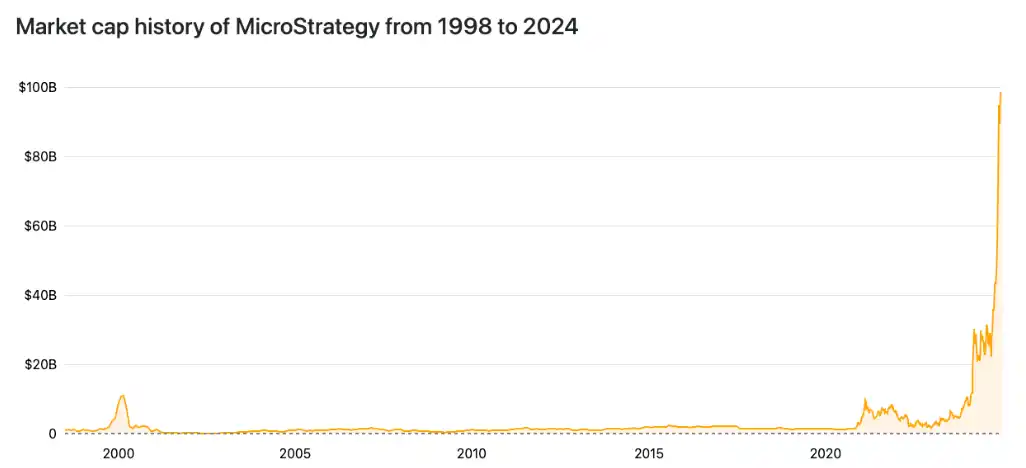
MicroStrategy’s market cap history from 1998 to 2024. Source: Companiesmarketcap
In addition, the ratio of Bitcoin to its total market cap turns its stock into a leveraged Bitcoin proxy.
According to the article, Amazon’s market cap is $2.4 trillion and Microsoft’s is $3.3 trillion, so its Bitcoin adoption effect would not be similar to MicroStrategy’s.
Cowen believes that Amazon is in no rush to adopt Bitcoin because its “core business is strong.” While reallocating some or all of its cash reserves into Bitcoin could provide a hedge against inflation, there are risks in deviating from its current financial strategy, which some shareholders may see as a potential burden on its profitable business model.
“The opportunity cost of holding a volatile asset like Bitcoin instead of investing in R&D or acquisitions would weigh heavily in a decision like this.”
“Putting a significant portion of funds in Bitcoin could impact Amazon’s ability to fund key growth areas like AWS, AI development, and logistics infrastructure,” he said. The shareholder vote will need to “strike a balance between speculative asset acquisitions and investments in key innovations that will determine Amazon’s competitive advantage.”
Bitcoin environmental issues could hold back shareholders
Big tech companies also have to consider public perception, as mainstream media has a big influence on their brands and stock prices. While Bitcoin's reputation has improved significantly, it is still associated with speculative trading assets, potential abuses and environmental issues.
"A negative PR narrative could obscure potential economic benefits, especially given Amazon's focus on ESG initiatives and its need to remain broadly appealing to stakeholders."
Amazon has revolutionized commerce by delivering goods quickly to your door. However, according to a 2022 report by environmental group Oceana, the impact of this model on the environment is alarming, generating more than 709 million pounds of plastic waste.
The company has pledged to achieve net zero carbon emissions by 2040, a decade ahead of the goals of the Paris Agreement.
The high energy consumption of Bitcoin mining has been heavily criticized by environmentalists. However, as mining infrastructure comes under more thorough scrutiny, that narrative is changing. Despite this shift, the risk of a PR backlash remains.
Amazon shareholders must decide whether the company can achieve positive results similar to Tesla or MicroStrategy by using Bitcoin to hedge against inflation, or whether it should avoid risk and focus on its core business model.
You may also like

a16z New Post: Predicting the Market, Entering the Fast Forward Phase

Arthur Hayes New Post: It's Now "No Trade" Time
a16z New Article: Predictive Markets Entering Fast-Forward Phase

a16z founder: In the age of Agents, what truly matters has changed

The President of Kyrgyzstan meets with Sun Yuchen, and TRON collaborates with Kyrgyzstan to build a new pattern of digital economy in Central Asia
46 minutes, $292 million stolen, DeFi faces development dilemma again

How to Earn Free USDT in 2026: No High Volume Required (WEEX Poker Party Guide)
Is Joker Crypto legit in 2026 or just another memecoin? Can You Really Earn Passive Income with Joker Crypto in 2026? Learn how Joker staking rewards work, how to earn NFT bonuses, expected APY ranges, gas-fee rebates, and how to avoid crypto scams before joining.

How to Get Free USDT Welcome Bonus in 2026: Earn Up to 700 USDT on WEEX
Legit Free Welcome Bonus 2026: Learn how to earn up to 700 USDT on WEEX with Auto Earn Boost Fest. Increase your balance, activate Auto Earn, and qualify automatically.

AI Agent Payments Just Got Real: Utexo × x402 Brings 50ms USDT Transactions to Internet Scale
Utexo integrates USDT into the x402 protocol, enabling 50ms instant payments embedded natively in HTTP requests. Explore how this breakthrough is rewriting the rules for AI agent payments, API monetization, and the machine-to-machine economy.

DWF Deep Report: AI in DeFi Outperforms Humans in Yield Optimization, but Complex Trades Still Lag Behind by 5 Times

What Separates Smart Money from the Crowd in Crypto? Insights from Freedom of Money
Most crypto traders lose money not because of bad luck, but because they misunderstand how the market really works. From Freedom of Money to the rise and fall of Sam Bankman-Fried, they highlight a key divide in crypto: those who build the market and those who chase it. This reading guide explores essential books that reveal how narrative, regulation, capital, and psychology shape long-term success in the crypto industry.

The Risk Management Core Team has just been ousted, and Aave is now facing a $200 million default.

The $293 million bug wasn't in the code; so, what's the deal with the "DVN Configuration Bug," which led to the largest hack of 2026?

a16z on Recruitment: How to Choose Between Crypto-Native and Traditional Talent?
The biggest DeFi heist of 2026, hackers easily took advantage of Aave

Will Robots Replace Humans? He Says No!
Binance Coin's Price Skyrockets 15x to All-Time High, Saved by Three Bull Market Lifelines




 App
App